Wilson’s Fourteen Points Set a New Vision for World Peace
Woodrow Wilson’s speech on January 8, 1918, changed the course of U.S. foreign policy and international diplomacy.
By experts and staff
- Published
 James M. LindsayCFR ExpertMary and David Boies Distinguished Senior Fellow in U.S. Foreign Policy
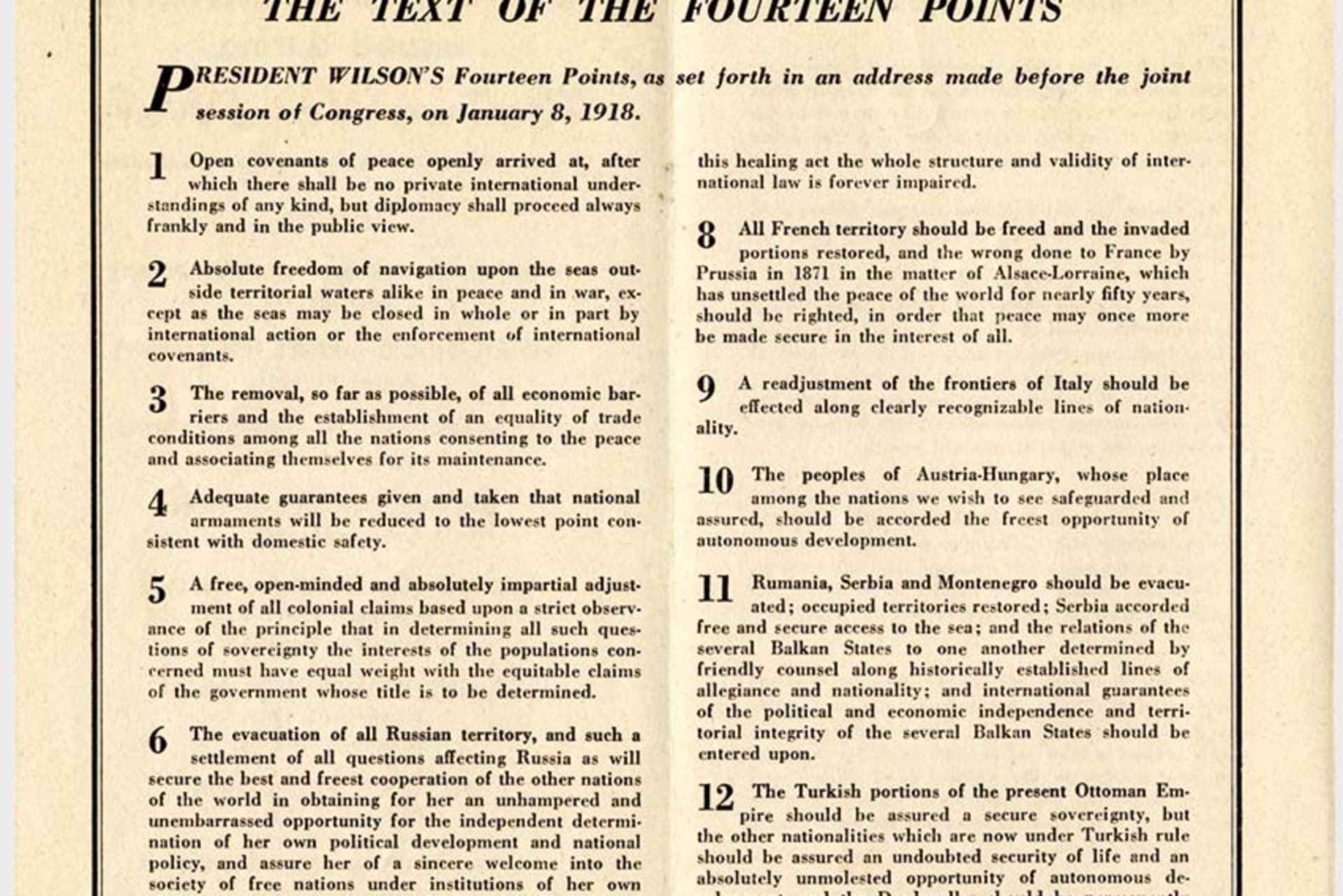
Every U.S. president has left his mark, for good or for ill, on U.S. foreign policy. But very few had an impact that equaled that of the twenty-eighth president of the United States—Woodrow Wilson. His legacy has shaped how many Americans have viewed the world for more than a century, and his principles have guided U.S. foreign policy since the end of World War II. On this date in 1918, Wilson gave his most consequential foreign policy speech, The Fourteen Points.
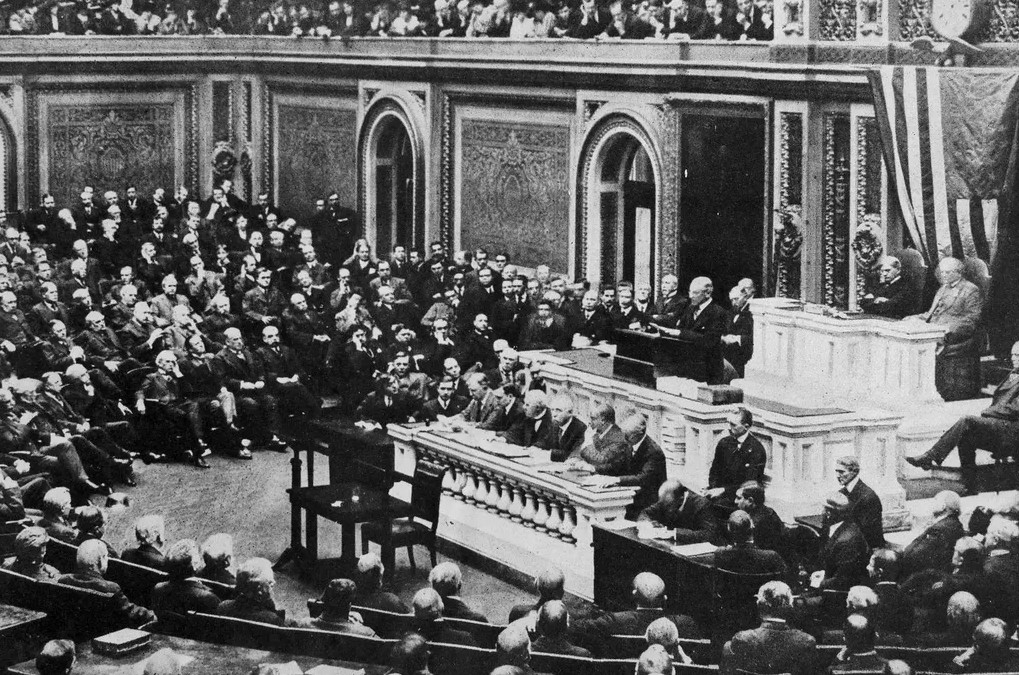
When Wilson arrived at the Capitol to address a joint session of Congress on January 8, 1918, the United States had been at war with the German-led Central Powers for nine months, though U.S. troops were only just then reaching Europe and few had yet gone into battle. It was a war that Wilson had long sought to avoid. He had declared the United States neutral when the war began in August 1914, famously urging Americans to be “impartial in thought as well as in action.” As late as January 1917, Wilson was calling for “peace without victory” by either the Central or Allied Powers. Even after Germany resumed unrestricted submarine warfare on U.S. merchant shipping ten days later, Wilson still balked at going to war. It was only in April 1917, after much of the country had turned against neutrality and Wilson’s cabinet was demanding that he act, that he asked Congress to declare war.
The dynamics of the war in Europe had changed in the weeks leading up to the Fourteen Points speech. Vladimir Lenin had seized power in Russia two months earlier and quickly signed an armistice agreement with the Central Powers, taking Russia out of the war and allowing Germany to concentrate its military might on the Western front. Lenin also revealed the contents of secret treaties that Tsarist Russia had negotiated with Britain and France to carve up Germany territories after the war. The news created an uproar over the imperialist designs of the Allied Powers.
Against this backdrop, Wilson’s goal in addressing Congress was, to borrow modern parlance, to reset the narrative. As he noted at the start of his remarks, Russia and the Central Powers had announced their war objectives. So, “there is no good reason why that challenge should not be responded to, and responded to with the utmost candor.” By laying out what the United States was fighting for, he hoped to solidify American public support for the war, undercut German public support for the war, and press Britain and France to accept his views on the fundamental pillars of a post-war settlement.
Wilson’s vision consisted of fourteen points, the first of which was “open covenants of peace, openly arrived at.” It was a direct rebuke of the secret agreements that Britain and France had negotiated and Lenin had exposed. The pledge would later be misinterpreted as a promise to negotiate all treaties publicly. Wilson, however, understood that negotiations needed to be confidential. His point was to end the practice of secret agreements and to have the results of negotiations public for all to see.
Points two through five promised freedom of navigation, the removal of trade barriers, reductions in national armaments, and giving equal weight to the interests of colonial populations and to colonial powers. Points six through thirteen called for revising borders in Europe to align with the nationalities of the people living within them—another sharp break from the U.S. practice of staying out of the affairs of Europe.
The fourteenth and final point was the most important proposal and Wilson’s personal passion. It called for creating a “general association of nations” to provide “mutual guarantees of political independence and territorial integrity to great and small states alike.” The idea of creating a multinational organization to prevent war, what today would be called “collective security,” had been gaining popularity in the United States for years. In 1910, a year after stepping down as president, Theodore Roosevelt called for creating “a League of Peace” to keep the peace and “prevent, by force if necessary, its being broken by others.” Five years later, a League to Enforce Peace was established with former President William Howard Taft as its head. And Wilson had called for a “League for Peace” in his “Peace Without Victory” speech a year earlier.
Wilson’s Fourteen Points speech accomplished his objective. By promising a world based on respect for national sovereignty, rule of law, and the rights of nationalities, he rejected the world of great power politics where the strong did as they wished and the weak suffered what they must. In its place, he offered an idealist view of what the world could be, and in doing so, galvanized both sides of the Atlantic. By fall 1918, Germany, Britain, and France had all agreed that the Fourteen Points would serve as the basis for negotiations for a final peace settlement. When Wilson arrived in Europe in December 1918 for the Paris Peace Conference, massive crowds greeted him everywhere he went with a hero’s welcome.
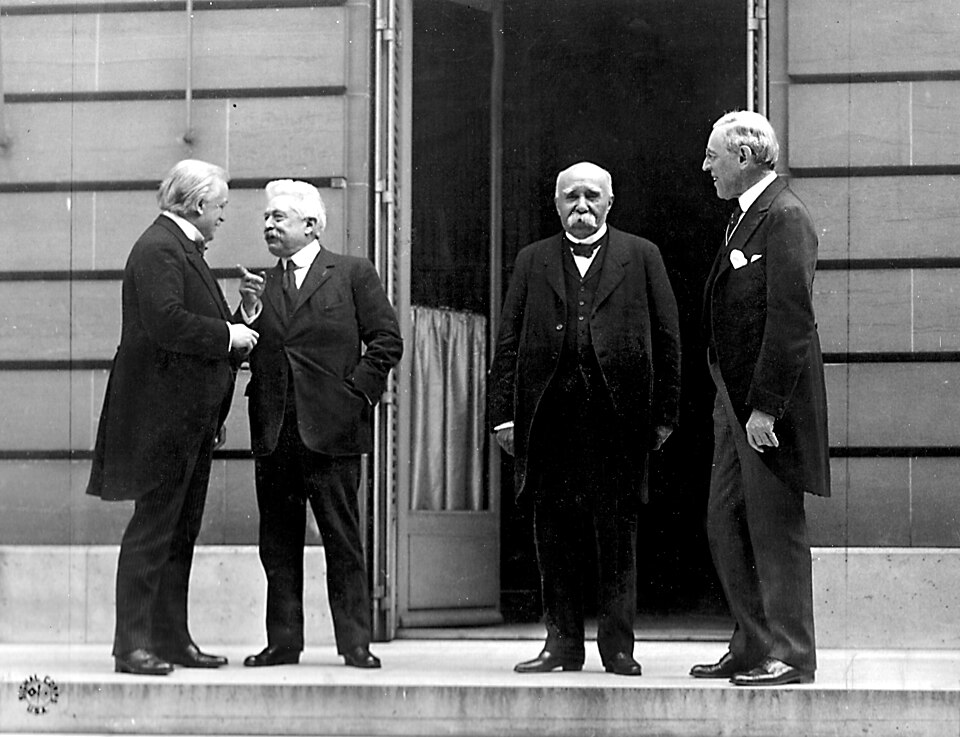
But Wilson soon discovered that it was far easier to sketch a vision of a peace settlement than to implement one. At the Paris Peace Conference, the leaders of the three victorious European powers—Britain, France, and Italy—fought bitterly to protect their interests and win compensation for their war losses. Territorial settlements that seemed simple in theory became complicated in practice. Wilson retreated from many of his Fourteen Points in his bid to salvage his overriding goal of creating an international organization dedicated to collective security. The compromises he made at the bargaining table disappointed people around the world who had embraced his revolutionary vision of how the world should operate. His retreats ultimately produced an agreement to create a League of Nations. Yet even here Wilson met disappointment. He returned to the United States to make the case for Treaty of Versailles, only to have the U.S. Senate reject his handiwork. The League of Nations came into operation without U.S. membership and never accomplished the goals he hoped for it.
Wilson died mourning the failure of his vision. But it lived on. A quarter-century later, the United States would emerge from another world war and lead the creation of a global order that reflected the principles he had sketched out. That order would deliver unprecedented peace and prosperity for eight decades. It is an order that has been fraying for years, and one that the United States now seems to be seeking to end.
Oscar Berry assisted in the preparation of this post.