Moldova’s Victory Over Russia
A majority of voters in Moldova reaffirmed the country’s desire to break free of Russian interference and continue its path to join the European Union. The victory for reformist leader Maia Sandu, who was reelected president last year, represents one of Europe’s signal successes as Moscow seeks to intimidate and divide the continent.
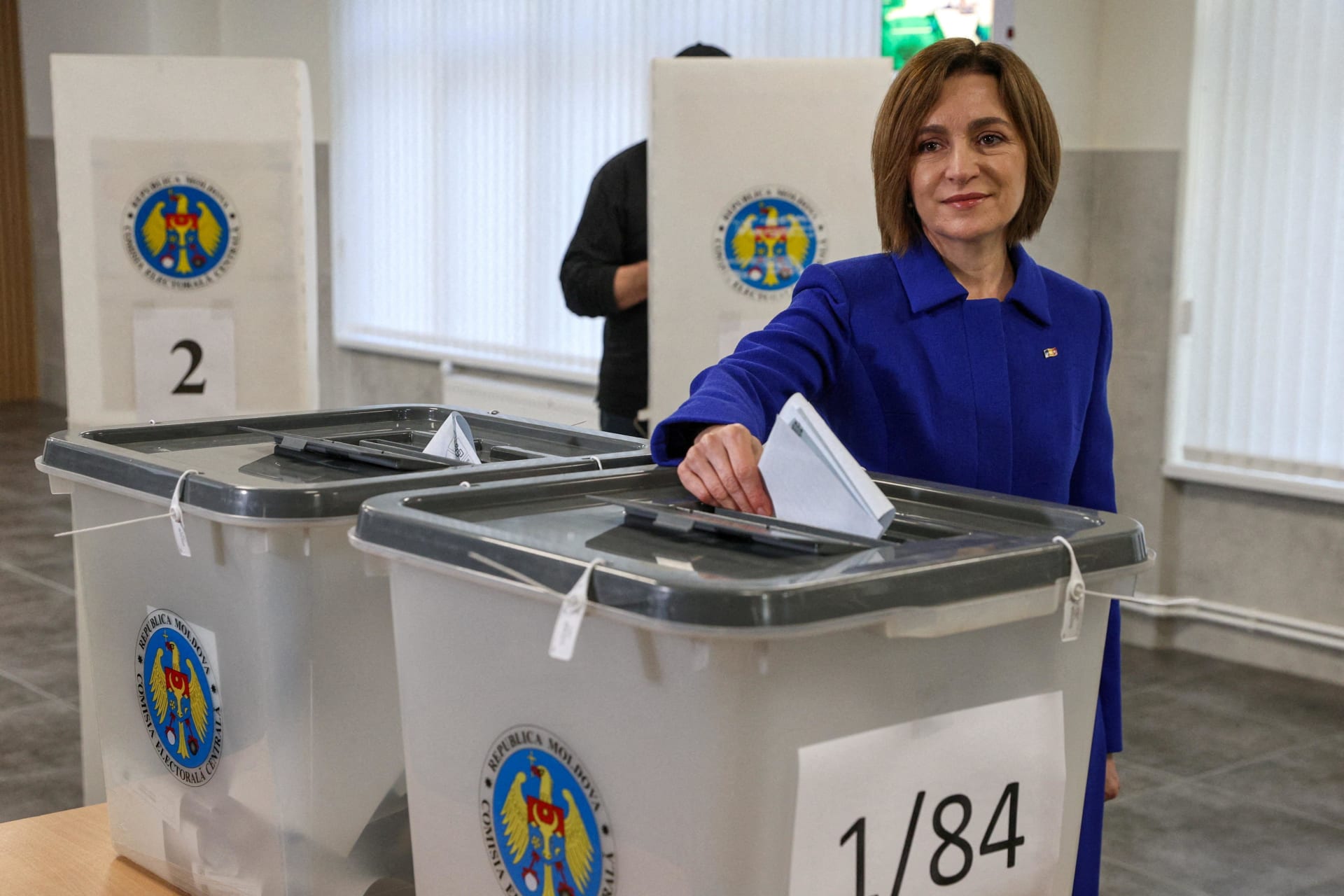

The victory of President Maia Sandu’s Party for Action and Solidarity in Moldova’s September 28 parliamentary elections is significant for three reasons. First, tiny Moldova, on the western edge of Ukraine, won a decisive victory over an unrelenting hybrid warfare campaign by Russia, which still parks 1,500 troops in a sliver of Moldovan territory that it would like to use to open a western front in Ukraine. That such a small country could stand up to Russia gives heart to others in Moscow’s sights.
Since Sandu first became president in 2021 at the head of a popular reform movement, she has sought to move the former Soviet republic out of Russia’s orbit by cleaning up corruption and joining the European Union (EU). She narrowly won reelection last year in the face of a sustained effort, financed and orchestrated from Moscow with the help of Federal Security Service (FSB) agents and a Moldovan billionaire living in Russia, to unseat her through disinformation, vote-buying, cyberattacks, and training armed agitators. Continued progress rested on her party retaining its majority in parliament in the September elections, so the Russian-backed machinery to distort the vote, much of it conducted through Telegram and fake social media accounts, geared up over the summer. Bomb threats and agitators were again employed to deter voters.
Sandu was projected to lose her majority in parliament, because of the external interference but also because voters in one of Europe’s poorest countries are struggling with the fallout from the war in next-door Ukraine and the slower-than-hoped benefits of her anti-corruption campaign. In the end, she won an outright majority over two rival blocs, the pro-Russian Patriotic Bloc and the Socialist-Communist bloc. She received a boost on the eve of the election when Greece extradited one of the billionaire fugitives (and former Moldovan politician) to Chișinău to stand trial for his alleged role in a massive bank fraud scandal that siphoned one billion dollars out of the country. The judiciary, purged of one-third of its judges, now have a marquee case to try in person. The country has also made significant progress in diversifying its gas and electricity supplies to prevent further energy blackmail from Russia, such as occurred last winter. A new power line will be in place by year’s end, and the country has greatly increased its production of renewable energy with the help of EU and U.S. aid. (Most U.S. aid was cut when Trump administration came into office, but U.S. funding for a critical third electricity line was restored just before the election.)
The second reason Sandu’s victory is significant, beyond delivering a clear rebuke to Russia’s campaign of destabilizing Europe, is that it clears the path for Moldova to join the European Union by 2030. EU membership will greatly strengthen the country’s hand against further meddling by Russia, and cement the progress made to date in developing new markets for Moldovan wine, cherries, and other products, and gaining investment to lift the country out of poverty. After Russia’s invasion of Ukraine, the EU fast-tracked its application and that of Moldova to grant both countries candidate status. Moldova has met the requirements to open accession talks, and Ukraine has been able to clear several hurdles despite the war, but Hungary continues to block the start of official negotiations.
The third reason Sandu’s reelection is significant is that she is one of just twenty-nine current heads of government or state who are women, as well as the first woman to be elected president in this conservative Orthodox country. In an interview, Sandu credited the open-mindedness of Moldovans to vote for her, but not because she was a woman. She was trained at Harvard University, worked at the World Bank, and as education minister had stamped out endemic cheating. “They voted for someone they thought was honest,” she said, “and prepared to run the country—not for a woman or a man.” Her successive electoral victories have had coattails for women, who now comprise 40 percent of the parliament and cabinet ministers and 215 of 518 mayors. The World Economic Forum ranks Moldova seventh in the world for progress in closing the gender gap. During my May visit, Sandu was greeted with cheers at a gathering of mayors where she was made a ceremonial mayor by Chișinău’s five-term female mayor.
Sandu’s reaffirmed mandate is due above all to Moldova’s voters, but international support was and remains vital given the David versus Goliath nature of the fight and the fact that Russia is unlikely to give up. Leaders of the EU, France, the United Kingdom, and Germany provide high-profile support, and European and U.S. sanctions on dozens of figures implicated in the destabilization and corruption of Moldova have also helped. But Sandu has led the way and proven that a woman can just as effectively stand up to a global authoritarian power by strengthening defenses, blunting cyber and information attacks, and reducing economic vulnerabilities. Under her leadership, Moldova has written a playbook for defeating hybrid warfare, and it is one that others can learn from.