Two Gladiators, One Ambition
There is the opposition to President Bola Tinubu, and then there is Atiku Abubakar.
By experts and staff
- Published
Experts
![]() By Ebenezer ObadareDouglas Dillon Senior Fellow for Africa Studies
By Ebenezer ObadareDouglas Dillon Senior Fellow for Africa Studies
This is the second installment in the series on the 2027 Nigerian general election. The inaugural installment can be found here.
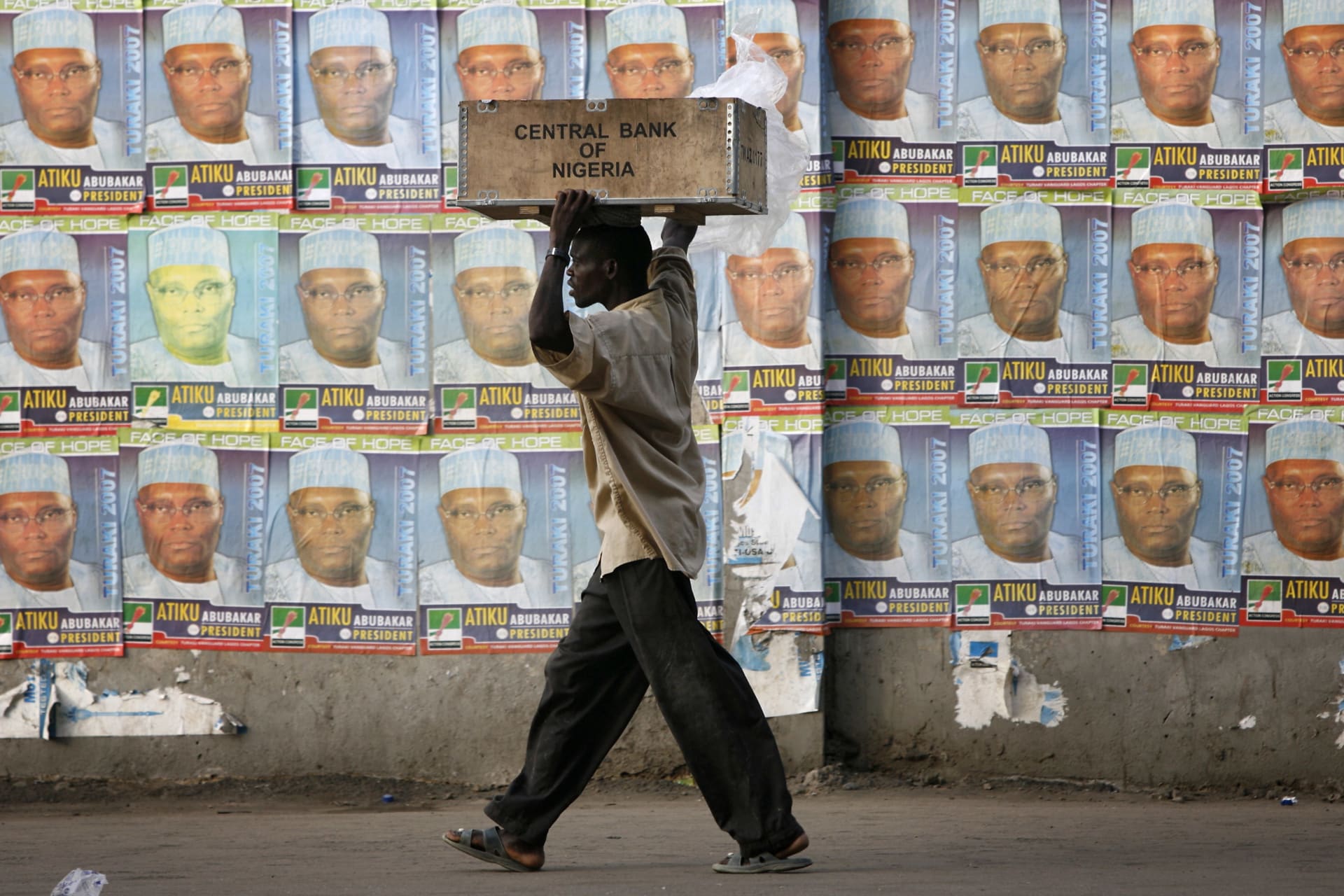
For Atiku Abubakar, perennial presidential candidate and unofficial leader of the opposition to President Bola Tinubu, being seen as a team player, someone who can be trusted to comply with a decision even when such goes against their personal interest, has never been more important. The politics of the race to be the standard-bearer of the African Democratic Congress (ADC), Nigeria’s de facto opposition party following the unraveling of the People’s Democratic Party, are proving to be one such test of solidarity. In recent weeks, there have been indications that his traditional backers within the old northern military establishment and a handful of southern political notables were applying pressure on Mr. Abubakar to give up his ambition and allow the party to field a different candidate, one that conceivably gives the party the best chance of dislodging Tinubu next January. For instance, a Peter Obi (former Anambra state governor)-Rabiu Kwankwaso (former Kano state governor) ticket has been canvassed.
Abubakar may have been alluding to such overtures when he announced on national television last week that he intended to run in the ADC’s shadow primary, though he would give whoever ultimately emerged as the party’s candidate his unstinting support. Still, Abubakar was quick to add that none of the other candidates currently jostling for the party’s ticket come close in terms of pedigree or political clout, and most important, “None of them has gotten more northern block (sic) votes as much as I have got.”
While pressure on Abubakar (eighty-years-old in November) to yield to a younger generation of candidates may be understandable—having run unsuccessfully on six previous occasions, he would appear to have come to the end of his political tether—no one who has followed his career from the start can be surprised that the one-time vice president (1999–2007) is backing himself to finally realize his lifetime ambition at the seventh time of asking. Ambition aside, the truth of the matter is that, for Abubakar, getting one over Tinubu, a former friend and business and political associate, is also deeply personal.
On the face of it, Abubakar and Tinubu could not be more different. The former likes to couch their current mutual antipathy as rooted in fundamental disagreement over values and social vision, while the latter’s campaign has sought to portray Abubakar as a relic from a past that the country is desperate to leave behind. Yet, in truth, both could not be more similar, standing apart from the competition in terms of their organizational savvy and single-minded pursuit of power. The fact that it is Tinubu who currently occupies Nigeria’s highest office is one of those historical quirks that no one could have seen coming, certainly not at the beginning of their respective political careers when Abubakar, as a protégé of the late Major-General Shehu Musa Yar’Adua, looked destined for political greatness.
Abubakar and Tinubu first became political associates (Tinubu once confided in a U.S. diplomat that it was Abubakar who “convinced him to join politics in the early 1990s”) under the umbrella of Yar’Adua’s People’s Front of Nigeria and would fall into the same progressive camp under the umbrella of the Social Democratic Party, one of the two government-created political parties—the National Republican Convention was the other one—after General Ibrahim Babangida determined that none of the parties created by the political elite at his own instigation was fit for purpose. Over time, Abubakar and Tinubu’s paths would continue to cross, and they would remain allies, more or less, even as the abrogation of the June 12, 1993 election, the struggle for whose validation the Yar’Adua camp was generally lukewarm about, put Tinubu on a fateful trajectory. In any case, they were still close enough (Tinubu took Abubakar’s side in the latter’s storied political fight with his boss, and created the political party Action Congress (AC), under which the latter ran for president in 2007) that they actually considered teaming up in 2003 when the understanding was that Obasanjo would step aside after one term of office. The reason they could not, when Atiku eventually ran to succeed Obasanjo in 2007 as the candidate of the AC, plumping for the Anambra-born Senator Ben Obi, a Christian, as his running mate, was because of Atiku’s doubts about the feasibility of a Muslim-Muslim ticket.
While Tinubu was disappointed that Abubakar went for an Igbo running mate, his (Tinubu’s) permutation that a Muslim-Muslim ticket would work as long as it was a North-Southwest or Southwest-North (Muslim-Muslim) ticket has proved to be astute. Now, there is no way to tell what would have happened if Abubakar had chosen Tinubu as his running mate in 2007, but the fact that he approached Tinubu again in 2015 for support (only to discover that the latter had reached an understanding with the late Muhammadu Buhari that became the basis of the formation of the All Progressives Congress) before ultimately settling for Peter Obi shows that Abubakar may have realized that Tinubu had been right all along about a Muslim-Muslim ticket.
Against this backdrop, the 2027 election looms as the opportunity that the former vice president has been waiting for to show the stuff he is made of against the only opponent whom he sees and respects as his real rival in terms of organizational capacity (hence the aforementioned remark about the quality of the opposition he faces within the ADC), and one who first saw a strategic opening that he was slow to recognize.
Not for the first time, Abubakar has indicated that this is his last campaign. Yet, if he falls short again, we shouldn’t be all too surprised if he reverses himself. Tinubu is a reminder to Abubakar of what might have been, and a standing rebuke for what some may see as a failure of political judgment. He will desire nothing more than the satisfaction of eliminating that reproach by vanquishing its symbol.
We may rightly expect that he will throw everything at it.