Where Are U.S. Military Forces Deployed in Europe?
Transatlantic tensions and the U.S.-Israeli war against Iran have prompted the United States to decrease its troop presence in Europe, signaling a shift in security on the continent.
By experts and staff
- Updated
- Program Coordinator, Center for Preventive Action
- Benjamin HarrisResearch Associate, Europe and U.S. Foreign Policy
- Global Conflict Analyst
- The Pentagon announced plans on May 1 to withdraw five thousand troops from Germany over the next six to twelve months, reducing the U.S. troop presence in Europe to pre-Ukraine war levels.
- The decision followed a disagreement between U.S. President Donald Trump and German Chancellor Friedrich Merz after the latter remarked that the United States was being “humiliated” in the war against Iran.
- U.S. attempts to acquire Greenland and European reluctance to join Washington’s military campaign to reopen the Strait of Hormuz have further strained the long-standing transatlantic alliance.
Where are U.S. bases and troops situated in Europe?
U.S. forces have been stationed in Europe since the end of World War II. Troop numbers have fluctuated over the decades, reaching a high of roughly 475,000 active-duty personnel in the late 1950s, when the U.S. military served as a bulwark against Soviet and Warsaw Pact forces at the height of the Cold War. After the dissolution of the Soviet Union in 1991, those numbers dropped to the tens of thousands.
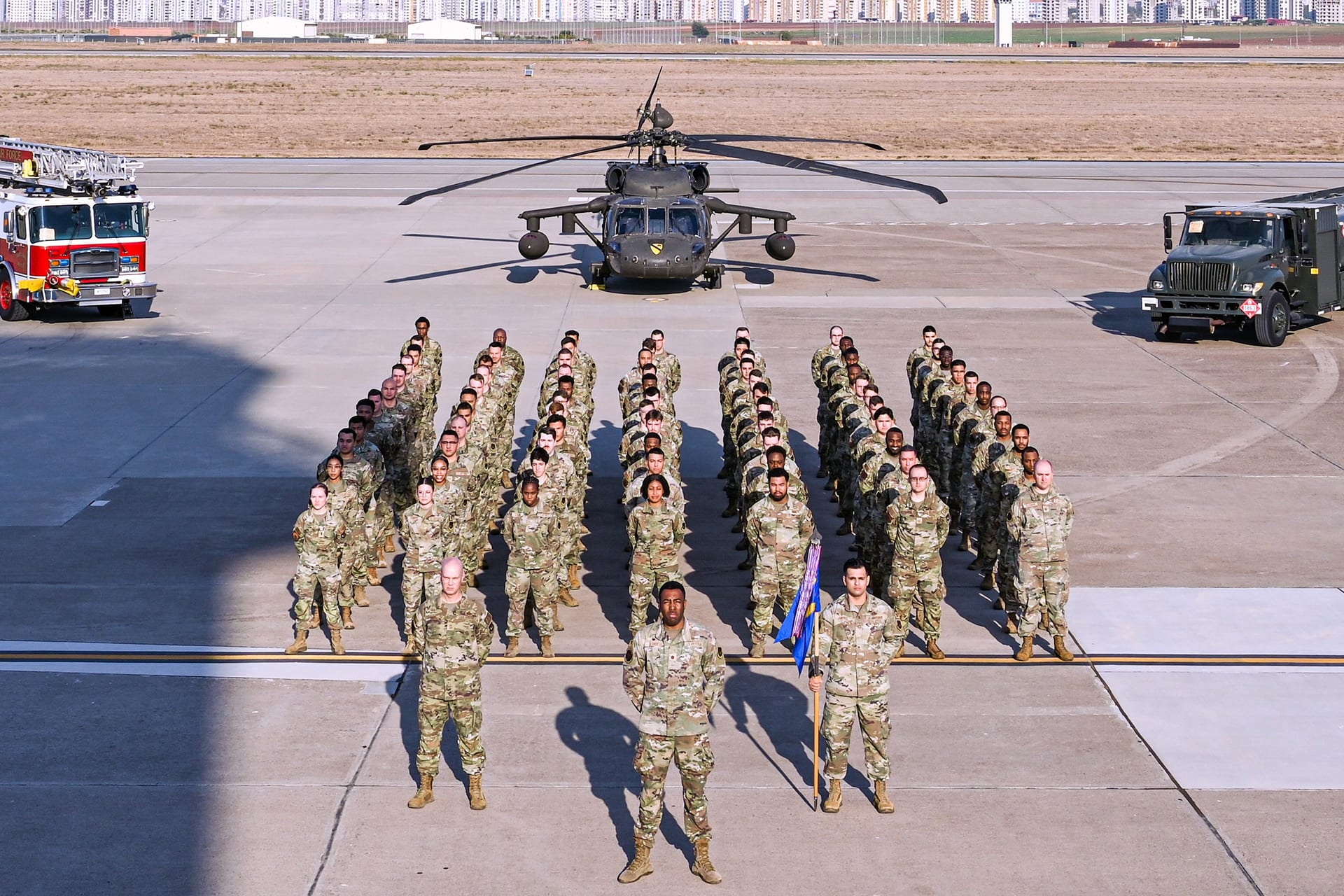
As of April 2025, the United States had roughly eighty thousand [PDF] U.S. service members stationed in Europe, according to the United States European Command (EUCOM). The total amount varies due to planned exercises and regular rotations of troops in and out of the continent. For example, following Russia’s invasion of Ukraine in 2022, some twenty thousand additional U.S. soldiers were deployed to states neighboring Belarus, Russia, and Ukraine. Over the course of the war, the total number of troops has ranged between approximately 75,000 and 105,000 military personnel, primarily from the Air Force, Army, and Navy.
More than forty U.S. military bases span the continent, from the Strait of Gibraltar to Turkey’s border with Russia. The bulk of bases are concentrated in western and central Europe—primarily Germany, Italy, Poland, and the United Kingdom (UK). EUCOM is headquartered in Stuttgart, Germany, alongside the United States’ Africa Command. Many of these bases are also NATO interoperable, meaning U.S. troops work alongside the alliance’s member states to ensure cohesion across NATO’s processes, technologies, and information networks.
What roles do U.S. troops serve?
U.S. soldiers serve a variety of functions, contributing to forward defense, providing logistics, and training allied forces. At Büchel Air Base in Germany, troops manage the ten to twenty B61 warheads—smaller, tactical nuclear weapons—housed there, while members of the Pennsylvania National Guard conduct joint drills with the Lithuanian military as part of the National Guard’s State Partnership Program. The 10th Special Forces Group (Airborne) trains Ukrainian troops in special operations, primarily in Germany.
The United States has also provided more military aid to Ukraine since 2022 than any other country, including significant amounts of weapons and equipment to boost its defensive capabilities. U.S. forces facilitate the transfer of weapons systems and ammunition, as well as train Ukrainian soldiers on how to operate the new machinery.
Generally, the following types of troops are based in Europe:
Permanently assigned forces. These are military personnel who are permanently or semi-permanently based in a European country for an extended period. Referred to as stationed troops, they are part of a long-term U.S. military presence in Europe, occupy established military bases and facilities, and engage in regular training exercises with host nation forces.
Long-term rotational forces. U.S. forces also undertake shorter deployments for specific missions or in response to events. In Europe, there are two primary operations involving rotational forces: NATO’s Enhanced Forward Presence (EFP) and Operation Atlantic Resolve. EFP was established in 2017 to unify NATO soldiers from multiple member states under a single command. The four so-called multinational battlegroups are located in Estonia, Latvia, Lithuania, and Poland, and are led by the UK, Canada, Germany, and the United States, respectively. EFPs have doubled in size since Russia’s 2022 invasion of Ukraine.
Launched in 2014, Operation Atlantic Resolve [PDF] sends U.S.-based troops to Eastern European NATO member states for nine months at a time. Atlantic Resolve hosts multinational training events in Bulgaria, Estonia, Hungary, Latvia, Lithuania, Poland, and Romania.
National Guard State Partnership Program. This security partnership program was established in 1993 after the collapse of the Soviet Union to help former Soviet states interested in joining NATO—primarily the Baltic states—reform their militaries. The United States now has twenty-nine such partnerships with European countries.
Temporary regional training exercises. These large-scale training exercises involve multiple branches of the U.S. military as well as fellow NATO member militaries. U.S. troops that take part remain only for the duration of the exercise.
U.S. forces also manage the country’s nuclear arsenal in Europe. During the early days of the Cold War, the United States created a nuclear-sharing program through NATO. This program served to deter Soviet aggression and prevent the proliferation of nuclear weapons among NATO allies. The United States once kept over seven thousand nuclear weapons in Europe. Currently, it is believed to house roughly one hundred nuclear weapons—specifically B61 gravity bombs—in Belgium, Germany, Italy, the Netherlands, and Turkey. No country may use these weapons without U.S. permission.
How has the second Trump administration changed U.S. security policy toward Europe?
The Trump administration’s 2025 National Security Strategy adopted a confrontational posture toward Europe, calling for a “readjustment” of the U.S. military presence on the continent and for “ending the perception, and preventing the reality, of NATO as a perpetually expanding alliance.”
In October 2025, the Pentagon chose not to replace about seven hundred troops stationed in Bulgaria, Hungary, Romania, and Slovakia. The following May, it announced plans to withdraw about five thousand troops from Germany over the next year and to cancel a Biden-era plan to deploy a missile-equipped artillery unit in Europe. Trump also threatened to pull troops from Italy and Spain after the two countries declined to offer base access to U.S. planes involved in the Iran war, and later said the United States would be cutting troop numbers in Germany “a lot further.”
Trump’s desire to acquire Greenland has also threatened NATO’s cohesion and prompted further changes to U.S. security posture. In a symbolic move, the Pentagon redrew its command map in 2025 to bring Greenland under the jurisdiction of U.S. Northern Command rather than EUCOM.
However, congressional opposition has slowed momentum for policy change. In the 2026 National Defense Authorization Act, Congress stipulated that U.S. troop levels could not be reduced below seventy-six thousand for more than forty-five days without NATO consultation. Legislators also codified the Baltic Security Initiative (BSI)—which finances training for the militaries of Estonia, Latvia, and Lithuania—to ensure continued funding amid the Trump administration’s proposed cuts.
If the Trump administration decides to further drastically reduce the United States’ security presence in Europe, it would require disentangling decades of military integration—a process that could take years and cost billions of dollars. European countries have significantly increased their military spending in response to Trump’s threats, pledging at last year’s NATO Summit at The Hague to contribute 5 percent of GDP to defense by 2035. But this spending does not cover the costs of maintaining U.S. bases in Europe, which are governed by bilateral agreements with host countries. Poland, for example, has pledged to invest in more than one hundred projects on its military sites to meet U.S. requirements.
Some experts say reducing U.S. troops in Europe weakens the credibility of NATO’s Article 5, which commits member states to collective defense in the event of an armed attack. Concerns over a potential U.S. drawdown have already spurred new thinking on the place of nuclear weapons in Europe. The removal of the United States’ so-called “nuclear umbrella” would leave a significant gap in Europe’s collective nuclear arsenal, which Russia could readily exploit.
Against this backdrop, as well as expanding nuclear threats from Russia and China, French President Emmanuel Macron amended France’s nuclear posture in March 2026 to strengthen cooperation with its European partners.
Colophon
Data Visualization
- Will Merrow
- Austin Steinhart