At Munich, Europe Found Its Voice, and It Belonged to Women
This year’s Munich Security Conference showed that the United States and Europe want to work together. The question is, on whose terms? Europe appears to be rallying around its own vision of a strong alliance, undergirded by the common values of democracy. Women leaders are playing central roles, crafting defense policy and calling for unity and accelerated action.
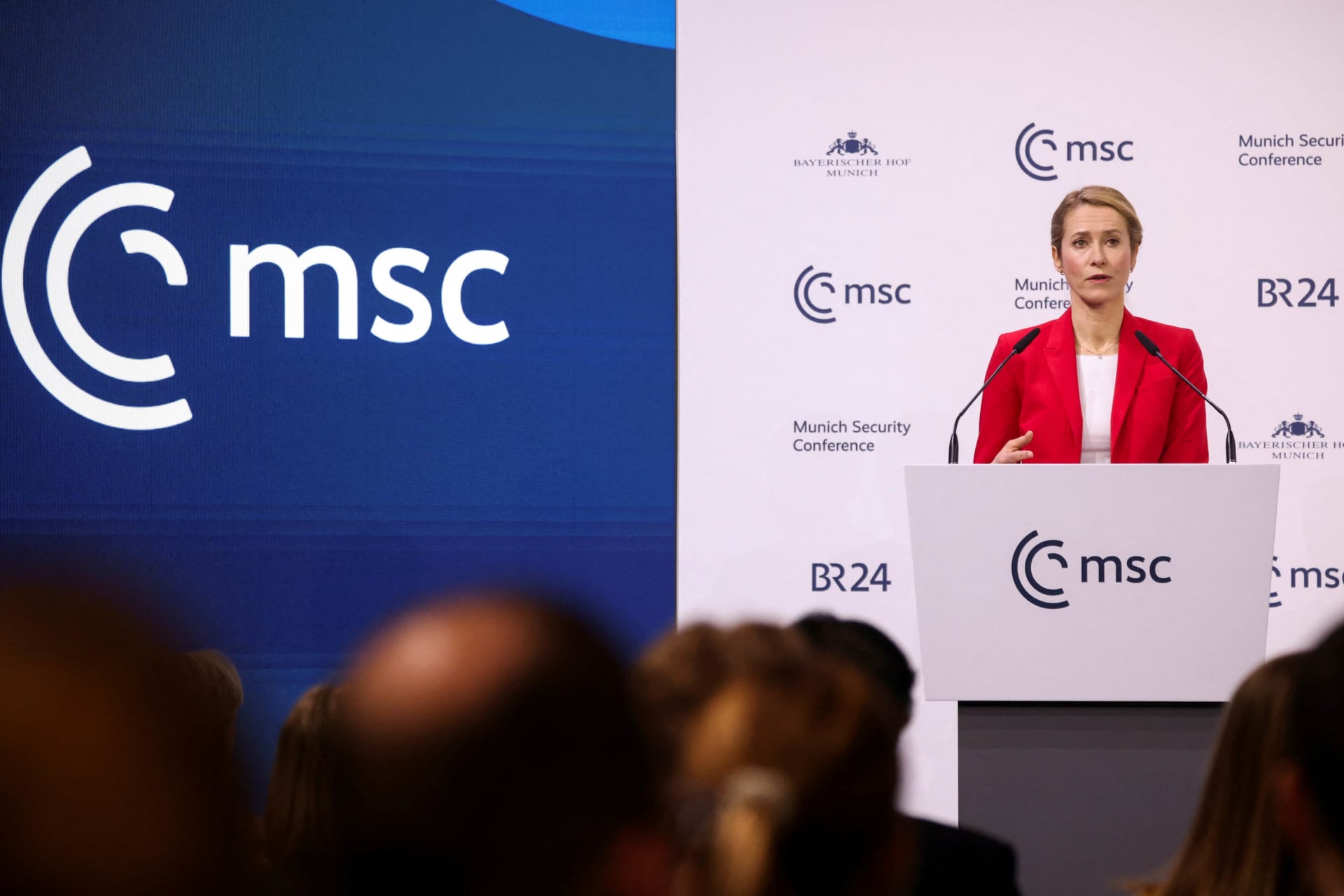

World leaders’ speeches at this year’s Munich Security Conference posed two visions for Europe, one touted by U.S. Secretary of State Marco Rubio and another by a vocal band of Europeans including women leaders who minced no words on the stage of the Hotel Bayerischer Hof. Marco Rubio was applauded for being less abrasive than U.S. Vice President JD Vance, whose name-calling speech last year offended most of the attending leaders, but the head of the U.S. delegation still came to Munich to lecture Europe with not-so-veiled ultimatums. At a time when Washington has sidelined many women in national security roles, Europe’s women are front and center in formulating sound defense policies.
Trump Administration Values Brought to Munich
The centerpiece of Rubio’s speech was the charge, made in the Trump administration’s recently released National Security Strategy, that Europe is threatened with civilizational erasure, the same theme that Vance sounded last year. Rubio proposed to mend the U.S.-European rift by uniting around a shared white Christian civilization heritage that does not reflect today’s reality in either the United States or Europe.
The speech would not have been out of place in a Christian nationalist convention. Referring to the conquest of America, Rubio invoked Christopher Columbus, who “arrived on our shores carrying the memories and the traditions and the Christian faith of their ancestors.” He then proposed to make that the basis of the alliance, declaring that “We are bound to one another by the deepest bonds that nations could share, forged by centuries of shared history, Christian faith, culture, heritage, language, ancestry, and the sacrifices our forefathers made together for the common civilization to which we have fallen heir.”
If Rubio’s words were not clear enough, he underlined them by departing Munich to visit Hungary and Slovakia, two of the countries most known for backsliding on democracy and gender equality—intrinsically linked phenomena that are part of the new authoritarian playbook. By contrast, democracy and gender equality are core conditions around which the European Union member states have agreed to base admission to the union.
Rubio brought his exclusionary and regressive civilizational message to Hungary with an explicit purpose: to try to rescue Hungarian Prime Minister Viktor Orban’s lagging political fortunes ahead of April elections that, if fairly conducted, may dislodge him after twelve years as Europe’s longest ruling head of government. Orban’s steady rollback of political rights and erosion of checks on executive power led V-Dem to categorize his government as an “electoral autocracy.” Rubio also visited Roberto Fico, Slovakia’s populist leader who has followed Orban’s playbook in rolling back civil and gender rights. The two leaders also diverge from the European consensus on foreign policy in refusing to implement EU sanctions on Russia, and Orban has blocked both aid and Ukraine’s planned accession to the EU.
The secretary was acting on the vow stated in the National Security Strategy to intervene directly in European politics to favor those aligned with the Trump vision. In his press conference with Orban, Rubio repeatedly noted that President Trump is personally committed to Orban, has promoted aid, trade, and investment, and will offer more. He said, “Especially as long as you’re the prime minister and the leader of this country, it’s in our national interest that Hungary be successful.” Questioned by a reporter, Rubio even declined to affirm that the United States would recognize the outcome of the elections if someone other than Orban wins.
Europe’s Women Leaders Offer a Different Path
The alternative vision for Europe was announced by Kaja Kallas, foreign affairs and security policy chief of the European Union, who declared in her keynote address: “Contrary to what some may say, woke, decadent Europe is not facing civilizational erasure.” She noted the long line of nations that want to join the EU, the eighty trade deals the EU has inked with countries around the world that seek relief from the punitive and chaotic U.S. tariff policy, and most of all, Europe’s commitment to shoulder its own defense and support Ukraine.
As Estonia’s prime minister, Kallas led Europe in raising defense spending immediately after Russia’s 2022 invasion of Ukraine, sending weapons and trainers to help blunt the Russian advance. Singled out for a Russian arrest warrant, she is no stranger to Moscow’s probes and sabotage in the Baltics over the past two decades. For years, she has prodded Western Europe to increase defense spending, revitalize the defense industry, and hold Russian President Vladimir Putin accountable for war crimes. Kallas also noted the EU priority of enlargement, which aims to stabilize the Western Balkans, Europe’s soft underbelly, as well as Moldova and others threatened by Russian destabilization.
Kallas has been matched in her defense initiatives by Danish Prime Minister Mette Frederiksen, who pledged the country’s F-16s to Ukraine and tripled the length of Danes’ mandatory military service. During her first term, Frederiksen curtly dismissed Trump’s previous overture to acquire Greenland, saying Greenland is for Greenlanders. She repeated that “red line” again at Munich, and rebuffed Senator Lindsay Graham’s belittling reference to her as “little lady.” Oddly, the two have been on the same side for years, goading Joe Biden to send more air defense to Ukraine and allow use of U.S. weapons to halt strikes from Russian soil. “We are at war,” she said at the Council on Foreign Relations, when asked about Russian hybrid attacks into Europe in 2024.
Thanks to these and other leaders, Europe is finding its voice and beginning to pull together in the face of mounting threats. Pledges of defense spending have been made and now must be executed, interoperable defense capabilities built, and investment in technology and trade pacts made. While the EU is often derided, it has wielded significant influence of late: Trump backed off his recent Greenland bid after the EU mused about imposing countervailing tariffs of its own, and the EU has become the largest donor to Ukraine, even before President of the European Parliament Roberta Metsola secured the Parliament’s approval of the 90 billion euro loan to Ukraine. At Munich, European Commission President Ursula von der Leyen proposed strengthening the EU’s mutual defense Article 42.7 to backstop NATO’s Article V against any possible defection by the Trump administration from its NATO obligations. And Kallas is overseeing development of an EU national security strategy around themes that she previewed.
While Europe has found its voice and begun to flex its muscles, EU member states and the United Kingdom will have to deliver if the Europeans’ vision for saving the alliance is to materialize. Progress depends above all on Germany, the economic engine of Europe, which has finally made a historic commitment under Chancellor Friedrich Merz to boost its defense spending to the agreed NATO target (5 percent including defense and defense-adjacent spending). In Munich, Merz made clear that he is determined to give form to the stronger, more self-sufficient Europe to bolster the vision that his fellow Europeans articulated. Merz also followed Kallas, Frederiksen, and others in rejecting the formula Rubio offered, declaring that “The culture war of the MAGA movement is not ours.”
The United States may wish to dictate terms to the rest of the world, but other countries have agency, and they have been mightily galvanized by the bullying approach of Washington. But frontal application of raw power does not always win the day, as shown by Russia’s and China’s adroit use of hybrid warfare including economic, cyber, disinformation, and political pressure. Russia has successfully employed it to create frozen conflicts on its periphery and increasingly in Europe; rising China is a global practitioner who is maneuvering to reap the benefits of a transatlantic alliance torn asunder. Europe has more aptitude and experience in confronting hybrid warfare than any other region, and shares its knowledge in NATO centers across the continent.
American Support for Europe Runs Deeper Than Washington Admits
Europe and the United States are not inevitably set on a collision course. Europe’s approach to revitalizing the transatlantic relationship enjoys significant support in the United States. In a letter published on the eve of the Munich conference, eight former US ambassadors to NATO who served both Republican and Democratic administrations since 1997 penned a letter touting the value of the defense alliance as a force multiplier and not a “charity” or one-way street that only favors Europe. The letter notes that 1,100 allied troops lost their lives in Afghanistan, and without NATO, the U.S. defense budget would need to be $100 to $200 billion higher. Even then the United States could not replicate their intelligence or basing options.
Notably, eight retired U.S. four-star officers who had served as Supreme Allied Commander at the head of NATO’s military command also signed the letter, a departure from the norm that keeps retired officers out of the political fray. It was a sign that these military professionals deem NATO a matter of U.S. national interest and integral to the military’s mission to defend the nation. Moreover, lest such support be dismissed as existing only among the American “global elites,” the 2025 Chicago Council Survey released last month showed that six of ten Americans say maintaining U.S. alliances is a good way to support U.S. foreign policy aims. Even larger majorities—two-thirds of both political parties—support the use of U.S. troops to defend Europe from a Russian invasion. As Kallas noted, while Russia fights alone, the United States is a superpower in part because it has allies who will fight alongside it. And many Americans agree.
Senior Fellow Linda Robinson’s forthcoming book is Women in Power: Fighting for Democracy in An Age of Authoritarianism.
This work represents the views and opinions solely of the author. The Council on Foreign Relations is an independent, nonpartisan membership organization, think tank, and publisher, and takes no institutional positions on matters of policy.