Beyond Conventional Aid: Institutionalizing Public-Private Partnership in Ukraine’s Humanitarian Response
As the war in Ukraine continues, the country’s humanitarian needs are mounting while funding is vanishing. The collapse of key aid programs has exposed a critical gap in the international response—one that the United Nations cannot fill alone.
Sam Vigersky is an international affairs fellow at the Council on Foreign Relations.
This Ukraine Policy Brief is part of the Council Special Initiative on Securing Ukraine’s Future and the Wachenheim Center for Peace and Security.
Executive Summary
With growing needs and dwindling funding, Ukraine’s humanitarian response is under extreme strain. The United States slashed aid by 74 percent in 2025, and the U.S. Agency for International Development (USAID) Office of Transition Initiatives (OTI)—an agile program that worked with Ukrainian partners to address the country’s dynamic humanitarian requirements—was eliminated entirely. The early response revealed a fundamental gap: the United Nations mobilizes resources effectively yet struggles to deploy them with speed and dexterity. Ukraine needs a public-private partnership that institutionalizes OTI’s fast-and-flexible model while integrating private-sector capabilities and Ukrainian partners, coordinating with UN operations without replacing their constraints. This initiative would adapt to shifting frontlines as the war continues and pivot to recovery and reconstruction if a ceasefire materializes.
Introduction
The humanitarian response in Ukraine is entering a new and difficult phase. Chaos and budget cuts at USAID reduced the United States’ aid to Ukraine by 74 percent in 2025. European partners, already under domestic pressure to downsize international assistance, surrendered to demands for increased NATO spending in part by cutting humanitarian budgets. Ukraine’s second-largest donor, Germany, cut assistance by 62 percent.
With fewer funds, the UN-led response has been forced to scale back. A global directive from headquarters forced UN aid providers to prioritize relief, rendering 1.2 million fewer people eligible for assistance in Ukraine. Small national nongovernmental organizations (NGOs)—often the most agile and efficient responders—were disproportionately affected by program cuts, leaving significant capacity gaps, particularly on the front lines. Today, Ukraine’s humanitarian narrative echoes most other crises around the world: life-saving needs far outstrip traditional resources.
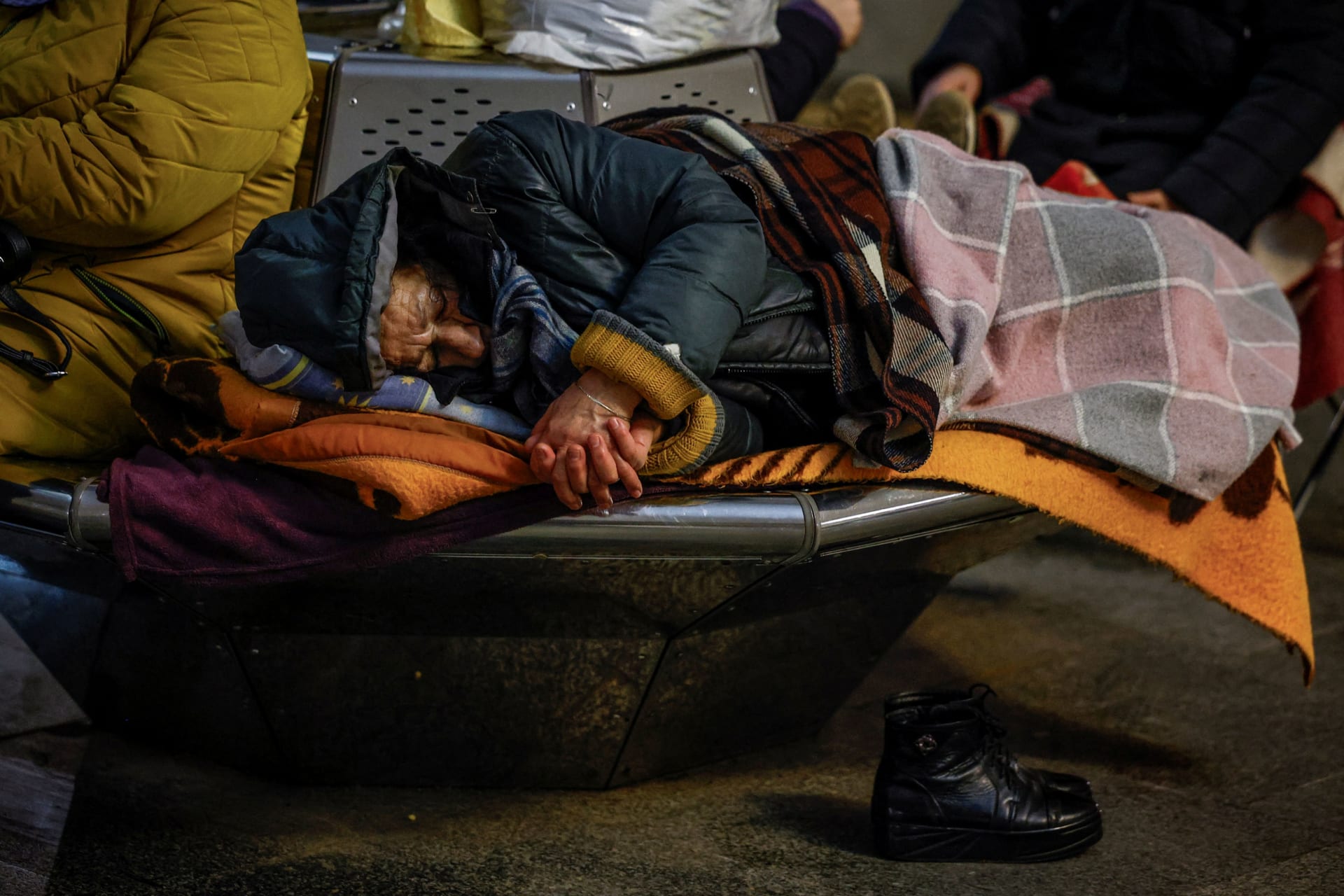
This funding contraction coincides with intensifying violence. The UN Human Rights Monitoring Mission in Ukraine documented a 30 percent increase in civilian casualties in 2025, the war’s highest to date. Meanwhile, the World Health Organization has confirmed more than 2,850 attacks on health care facilities, transport, and supplies since February 2022. Repeated shelling of civilian infrastructure has caused electricity, heating, and water outages in the depths of winter, critically endangering the most vulnerable.
When Russia launched its full-scale invasion of Ukraine four years ago, the world came together in a historic show of solidarity, in forms both novel and conventional. Beyond public financing, an unprecedented outpouring of private sector partnerships offered cash, technical assistance, and in-kind donations. USAID’s Office of Transition Initiatives (OTI), previously focused on democracy and development, pivoted to crisis response programs through a network of skilled civil society partners. Local businesses and volunteers organized mutual aid.
Ukraine continues to need international support, but the response playbook should be calibrated to adapt to an uncertain future. With a catalogue of lessons to draw on, the humanitarian community now has the resources to build something that can last longer and work smarter.
International Assistance Surges
In the days following the Russian invasion of February 24, 2022, an immediate and global humanitarian response was launched for Ukraine. On March 1, the United Nations issued a humanitarian flash appeal. Donors responded quickly, covering 88 percent of assessed needs within ten months—an extraordinary achievement given the $4.3 billion price tag and the chronic underfunding typical of most global crises.
Private giving surged alongside government funding. UNICEF USA, the domestic fundraising arm of the United Nations Children’s Fund, raised more than $1 billion in 2022, doubling its previous year’s balance. World Central Kitchen raised $547 million, a 450 percent year-over-year increase. By the end of 2022, the cumulative sum of private contributions placed private giving among the top five donors for Ukraine—an unprecedented ranking.
On the surface, the system appeared to be working exactly as designed: identify needs, issue an appeal, raise capital at scale. But money can obscure a deeper problem. The UN system is highly effective at mobilizing resources. It is far less effective at deploying those resources with speed and flexibility. Layers of bureaucratic approval and rigid donor conditions are often at odds with dynamic needs in an active war zone.
Ukraine revealed the actors capable of filling that gap—agile government programs, decentralized civil society organizations, and disciplined private-sector giving—but it also exposed the limits of relying on patchwork solutions. The assistance that emerged from the humanitarian impulse to help today lacks a structure for coordination and sustained engagement. As funding contracts and the war grows more complex, the challenge is not only mobilization, but integration: how to deliberately pair institutional scale with operational speed for sustained impact.
A Dynamic Response Takes Shape
Perhaps the best example of agility came from USAID’s OTI. In early 2022, as Russia’s military buildup shifted from a growing concern to an imminent threat, OTI began preparing for the humanitarian consequences of invasion. OTI was not a traditional disaster relief organization; rather, it was a political instrument of U.S. foreign policy designed to seize narrow windows of democratic transition. Yet its core operating principle—be fast and flexible—gave it unusual freedom (and resources) to respond in real time. Unencumbered by burdensome headquarters reviews, OTI’s program model empowered country directors in the field to greenlight small grants as events dictated.
For example, OTI contracted a fleet of private buses in anticipation of bottlenecks at train stations it predicted would be overwhelmed by fleeing civilians before the February 2022 assault. The move paid off: when the full-scale invasion began, dozens of buses fanned out across the country in close coordination with government officials and civil society organizations, helping the elderly, children, and disabled evacuate west.
As fighting intensified in Zaporizhzhia and Kharkiv, OTI used flexible accounts to procure supplies for blood banks facing shortages. When critical infrastructure came under siege, it secured truckloads of fuel—a humanitarian lifeline for hospitals, generators, and evacuation routes.
After the destruction of the Kakhovka dam in June 2023, OTI helped evacuate civilians within hours: first with buses, then boats. As floodwaters contaminated drinking supplies, it pivoted again to source filtration equipment and generator fuel. Traditional humanitarian actors struggled to mobilize, and many arrived days later with just bottled water.
Those were not set-piece interventions. They targeted bottlenecks—fuel, medical equipment, transportation—improvising solutions wherever and however they could. What is more, while larger UN agencies and international NGOs often expanded through international deployments, with compliance structures that made rapid partnerships with local actors administratively difficult, OTI took a different approach.
Anchored in Kyiv, but with Ukrainian staff throughout the country, OTI partnered with Ukrainian civil society and government entities to shape strategy and implement hundreds of small grants in the years before the invasion—and continued investing in those embedded local partners as the war unfolded. Indeed, if OTI’s playbook demonstrated what an agile response could look like, Ukrainian civil society made it possible at scale.
Those civil society organizations held logistical advantages: they required no visas and no orientation. But more than that, their proximity conferred trust, language fluency, and established networks. In a rapidly evolving crisis, those elements translated into faster and more appropriate interventions than many international actors—no matter how well intentioned or well resourced—could deliver.
At the same time, a surge of corporate intervention flooded the response. Multinational firms and private entrepreneurs, motivated by personal ties to Ukraine and a broader defense-of-democracy ethos, decided to do their part to help Ukrainians in need. The results were mixed.
Airbnb.org used its existing infrastructure to provide housing for up to 100,000 refugees. The Ikea Foundation supplied housing materials and grants. The logistics outfit Flexport moved ten million pounds of aid across six impacted countries. Microsoft provided $540 million in assistance. Mastercard built two platforms—WhereToSettle and WhereToStart—to help refugees assess cost-of-living differences across Polish cities and identify viable neighborhoods to start businesses. In partnership with OTI, Visa provided grant funding to women entrepreneurs and business owners in Ukraine’s hardest-hit regions.
Though varying in sector and scope, those corporate interventions shared a common pattern: firms deployed what they already did well, which in some cases had unforeseen consequences. In-kind donations often undermined local businesses with supplies readily available on the open market. Schools received high-end technology when books and chairs were in short supply.
The fact that those corporations lacked the ability to engage with the broader humanitarian system was not for a lack of effort; some private organizations tried to work with United Nations and donor governments but typically left frustrated, rerouted over and over like a call center, only to be disconnected. Mastercard, for example, worked for months to connect with the UN Refugee Agency; time and time again, their offers were waved away. This pattern held across numerous corporate partnerships: strong interest and real capacity to make an impact met with institutional indifference.
Separately, some humanitarian actors remained suspicious about the private sector’s motives—questioning whether their actions were a subversive attempt to grow businesses under the guise of humanitarian goodwill. Far from an atmosphere of positive intent, the two sides struggled to bridge mutual suspicions.
There were exceptions to this rule. The Howard G. Buffett Foundation provided more than $1 billion in support across food security, agriculture, mine clearance, and displacement programs. Its approach resembled OTI’s: prioritize speed, local partners, and intervention fit over procedural risk aversion. Buffett himself has traveled to Ukraine nearly two dozen times since February 2022, grounding funding decisions in direct observation and interaction.
But few private actors possess that combination of capital, expertise, and sustained engagement. Without humanitarian response embedded in long-term strategy, most lack the relationships and operational infrastructure required for continuity.
Outside the UN system, too, there were few, if any, places the private sector could turn to understand how they could fit into a response. Without an intermediary to vet needs, match capabilities, and integrate private actors into verified response plans, opportunities for durable collaboration dissipated.
The Next Chapter of Innovation and Integration
Ukraine’s early experience exposed a clear structural gap. The UN system can mobilize resources at scale. Local actors and agile programs can deploy assistance quickly. Private firms can contribute specialized capabilities. But no institution is designed to bridge those elements. Addressing that shortcoming has become urgent following donor retreat and the conflict’s growing complexity.
Right now, no standing intermediary is capable of vetting Ukraine’s needs, matching external capabilities, channeling funds rapidly to national organizations, and coordinating with UN operations without replicating their bureaucracy.
The absence of that bridge has limited donors’ ability to convert goodwill, capital, and expertise into sustained impact—a problem that has become existential as Ukraine’s humanitarian architecture itself is under fiscal and political strain.
The moment calls for innovation. A new mechanism should be created under the auspices of a public-private partnership, one that institutionalizes the fast and flexible small grant model pioneered by OTI while integrating private-sector capabilities and local civil society into a coherent vehicle.
Such an approach would rapidly deploy grants, cash, and technical assistance, matching corporate and philanthropic capabilities to verified local needs. It would channel funding efficiently to national NGOs, which continue to provide the backbone of the humanitarian response in Ukraine. It would coordinate with UN operations—without replicating their structural constraints. Most of all, it would do what the moment demands: adapt to shifting frontlines and disruptions as the war continues and pivot to recovery and reconstruction if a ceasefire materializes.
This work represents the views and opinions solely of the author. The Council on Foreign Relations is an independent, nonpartisan membership organization, think tank, and publisher, and takes no institutional positions on matters of policy.