Campaign 2012: Awlaki, Iran, Mexico
By experts and staff
- Published
 James M. LindsayCFR ExpertMary and David Boies Distinguished Senior Fellow in U.S. Foreign Policy
The decision by the Red Sox to pass on the baseball playoffs gave me some time to catch up on the latest foreign policy developments on the campaign trail.
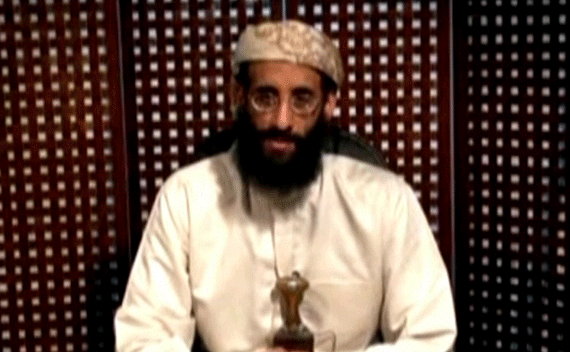
The Awlaki Killing. Rick Perry, Mitt Romney, and Newt Gingrich all praised Barack Obama and the U.S. military for Friday’s killing of Anwar al-Awlaki, the American-born leader of al-Qaeda in the Arabian Peninsula. Michele Bachmann praised the U.S. military and intelligence community for carrying out the strike; she pointedly failed to thank Obama in her statement. Ron Paul criticized the killing, arguing that Awlaki had been denied his rights as a U.S. citizen: “But if the American people accept this blindly and casually that we now have an accepted practice of the president assassinating people who he thinks are bad guys. I think it’s sad.” Gary Johnson similarly argued that Awlaki was “entitled to due process.” (Back in May, Herman Cain said that Awlaki should be arrested rather than made the subject of a shoot-to-kill order.) Rick Santorum criticized Paul, praised the killing, and called on Congress and the president to change citizenship laws to remove any doubt about the killing’s legality.
Israel and Iran. Perry used a question from ten-year-old Maya Levine at a campaign event in New Hampshire to again make the case that he would stand by Israel and stand up to Iran:
Iran is one of the great problems in the Middle East. They are, I would suggest, the greatest threat to the future of Israel. And in ‘09, we naively were having conversations with the Syrian and the Iranian governments, rather than supporting that civil uprising in that country.…We should have been using everything that we had available— our diplomatic abilities, our economic sanctions, overt, covert and civic—to impact and help overthrow one of the most oppressive regimes that there is in the world, and we failed.
Perry did not say what he would do as president, but presumably regime change in Iran would be high on his agenda.
Mexico. At another campaign event in New Hampshire, Perry said stopping the drug violence south of the Rio Grande “may require our military in Mexico working in concert with them to kill these drug cartels and to keep them off of our border and to destroy their networks.” Perry’s spokesman subsequently said that the Texas governor planned to work closely with the Mexican government. Among other questions left unanswered was whether Perry would rule out unilateral American action. As you might expect, Perry’s remarks have drawn criticism both north and south of the border. Expect to hear a lot more on this issue, which recalls the Punitive Expedition, or if you prefer, the Perishing Expedition, of 1916-17.