China in Latin America: February 2026
In February, tensions escalated between China and Panama following the annulment of two Chinese port contracts, prompting public threats and retaliatory measures. The United States imposed visa restrictions on Chilean officials over a proposed underwater fiber-optic cable and hosted a critical minerals summit that led to agreements with Argentina, Ecuador, Mexico, Paraguay, and Peru. China signed more than twelve agreements during a state visit by Uruguayan President Yamandú Orsi and made meaningful infrastructure investments across the region.
By experts and staff
- Published
- Jonas Wright-Lee
Security and Sovereignty
On January 29, Panama’s Supreme Court of Justice decided to annul the contract for two ports operated by Panama Ports Company (PPC), a subsidiary of Hong Kong’s CK Hutchison. The Chinese government’s Hong Kong and Macao Affairs Office (HKMAO) labeled the ruling “absurd,” and warned Panama that it would pay a heavy political and economic price. Panamanian President José Raúl Mulino rejected China’s threats and demands, insisting that Panama upheld the rule of law and respected the independence of the judiciary.
PPC filed an international arbitration against Panama, seeking over $2 billion in damages. At the same time, China asked state firms to freeze new project talks in the country and pressured shipping firms to reroute cargo through other ports. China’s customs authorities also indicated they would ramp up inspections on Panamanian imports, as part of the country’s broader retaliation.
On February 23, Panamanian authorities seized the two ports and forcibly removed PPC employees. In response, the Hong Kong government sent a strong protest to the Panamanian consul in the special administrative region regarding the takeover. Two days later, Mulino stated that China “need[s] us more than we need them,” inflaming tensions.
Meanwhile, the Trump administration expressed serious concern that China was eroding Peru’s sovereignty after a Peruvian court ruling restricted local regulatory oversight of the $1.3 billion Chinese mega-port in Chancay.
In Chile, the government is evaluating the possibility of an underwater fiber-optic cable connecting the Valparaíso region with Hong Kong, while avoiding areas under U.S. influence. As a result, the United States imposed visa restrictions on Chile’s minister of transport and telecommunications, Juan Carlos Muñoz, and two other government officials for allegedly undermining regional security.
According to a new investigation released by the U.S. Select Committee on China, at least eleven People’s Republic of China–linked space facilities, including ground stations, radio telescopes, and satellite laser ranging sites, are located across Argentina, Bolivia, Brazil, Chile, and Venezuela. The sites possess dual-use capabilities and are connected to numerous People’s Liberation Army–linked entities.
Brazil’s National Telecommunications Agency authorized the Chinese company Qianfan to operate up to 324 satellites in low Earth orbit in Brazilian territory, with a license in force until 2031.
Costa Rica filed a public complaint about the massive theft of gold in its northern border territory, identifying a criminal network that has extracted gold-bearing material and transported it to Nicaragua, where Chinese mining companies collect and process it.
Diplomacy
Colombia, as president pro tempore of the Community of Latin American and Caribbean States (CELAC), chaired a working meeting with the People’s Republic of China to advance the implementation of the CELAC-China Joint Action Plan 2025–2027, the main operational instrument of the two regions’ relationship.
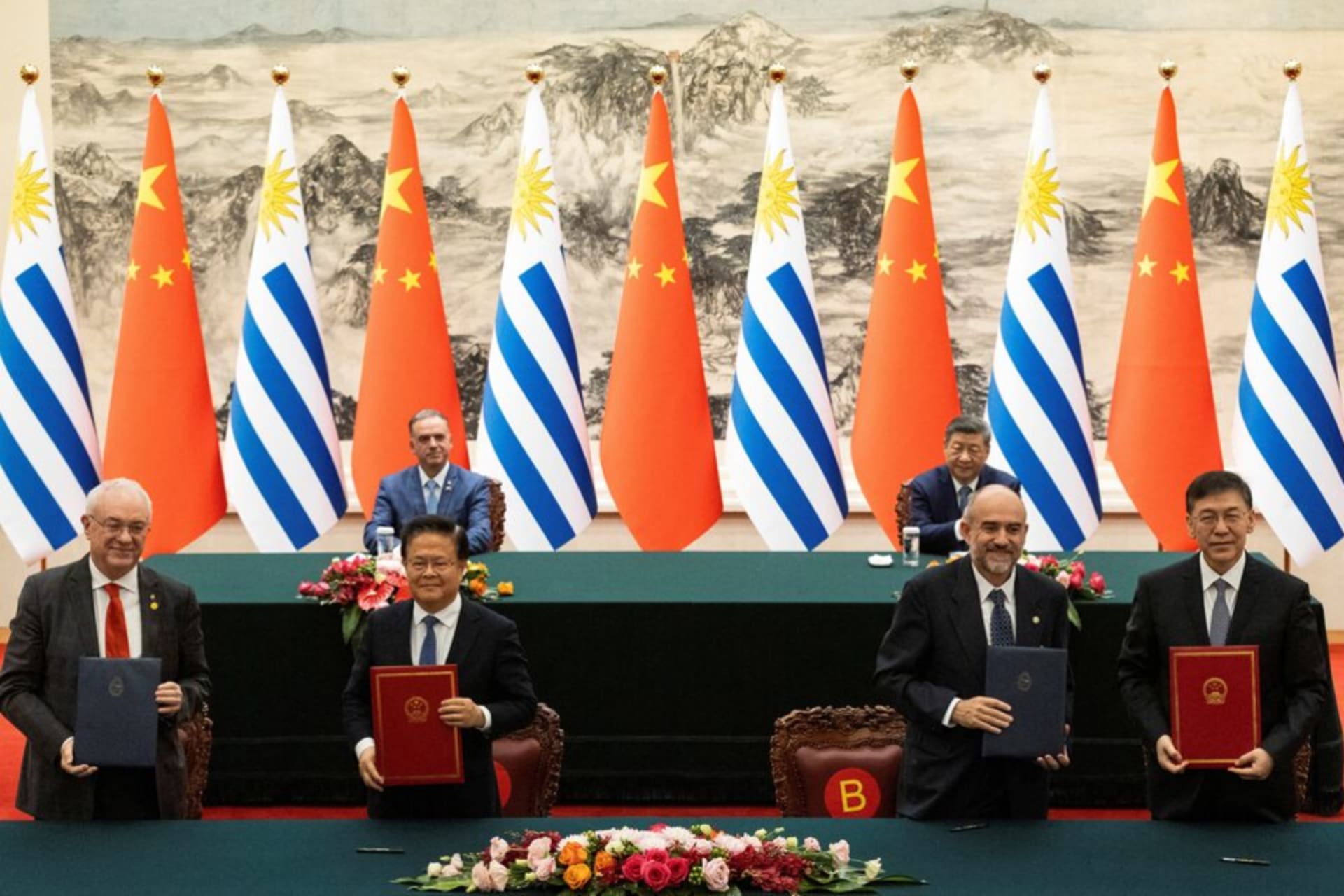
Uruguayan President Yamandú Orsi led a delegation of government officials, labor leaders, and business representatives on a state visit to China, during which they signed more than twelve agreements spanning science and technology, the environment, intellectual property, and the meat trade.
Chinese Foreign Minister Wang Yi and his Argentine counterpart, Pablo Quirino, pledged to strengthen cooperation and the two countries’ comprehensive strategic partnership, following a meeting on the sidelines of the Munich Security Conference.
Wang stated that China supports Cuba in protecting its national sovereignty and security while expressing a willingness to help amid jet fuel shortages.
A month after the United States launched military strikes against Venezuela and seized President Nicolás Maduro and his wife, Cilia Flores, the Chinese foreign ministry declared its support for the country in safeguarding its sovereignty, dignity, and legitimate rights.
U.S. Secretary of Energy Chris Wright told reporters that legitimate deals by legitimate Chinese companies are fine in Venezuela, but that the Trump administration wants to avoid “damaging” agreements that Chinese enterprises have made elsewhere in the region. He also stated that China had already bought some of the crude offered by the U.S. government.
Honduran President Nasry Asfura is considering reversing the country’s 2023 decision to switch diplomatic recognition from Taiwan to China. Vice President María Antonieta Mejía stated that Tegucigalpa is reviewing economic agreements it signed with Beijing as part of a push to develop ties with Taipei.
The Congress of the Republic of Peru ousted President José Jerí over undisclosed meetings with a Chinese businessman. The scandal, dubbed Chifagate, began when Jerí was filmed arriving at a restaurant in Lima to meet with Zhihua Yang, who owns Chinese import shops and holds a concession for a multimillion-dollar energy project.
Trade
During a working visit to Beijing by Mexican Deputy Economy Minister Vidal Llerenas, Mexico urged China to move toward more balanced trade relations to reduce the trade gap between the two countries.
Brazil is considering pushing for a partial trade agreement between the Southern Common Market (Mercosur) bloc and China for the first time. Although a formal, comprehensive trade agreement is unlikely, two Brazilian government officials said a partial China-Mercosur deal is now considered plausible, spurred by U.S. tariffs. The country also ended a temporary tariff exemption that allowed electric and hybrid vehicles assembled using imported Chinese parts to enter Brazil at sharply reduced costs. The exemption expired on January 31, 2026, and was not renewed. Brazil imposed antidumping duties on a wide range of Chinese steel products and hypodermic needles following investigations that found the imports were being sold at unfair prices.
Brazil is on course to hit its annual beef export quota to China by September after China imposed new restrictions in late 2025 that limited the amount of beef major suppliers can send under a reduced tariff rate. The Brazilian government warned that uncontrolled shipments could lead to a collapse in domestic prices and jobs in the cattle sector.
Investment and Infrastructure
Two Chinese car companies, BYD and Geely, are among the finalists attempting to purchase a manufacturing plant in Mexico.
The top executive of Chinese automaker BYD in Brazil stated that the company aims to produce and source 50 percent of its vehicle components locally at its new Brazilian factory by the end of 2026. BYD aims to become Brazil’s top carmaker in terms of sales volume by 2030.
The Chinese textile group Texhong is moving forward with its investment project in Honduras, which includes the construction of a textile industrial park and a solar plant. The estimated investment is up to $400 million, and it is expected to create at least seven thousand direct jobs.
Argentina received more than $130 million from China to restart a major hydroelectric project in Patagonia.
In the Bahamas, tensions with the United States rose over Chinese financing and construction of a major hospital, which involved a $195 million package from the Export-Import Bank of China, with China Railway Construction Corporation serving as the project’s main contractor. U.S. Ambassador Herschel Walker argued that the terms were not in the Bahamas’ best interests, pressuring the administration to seek alternative funding.
Companies from Chile and China signed a long-term financing agreement to build two hospitals in Chile’s O’Higgins Region, serving 276,000 residents. A consortium comprising China Railway Construction Corporation International Limited and China Railway Construction Group Corporation Limited won the bid. The total investment is approximately $180 million. Also in Chile, the Chinese state-owned company CWE was awarded the tender for the Zapallar reservoir construction project, which involves an investment of approximately $158 million.
In El Salvador, the China State Construction Engineering Corporation is building what is to become the largest stadium in Central America.
Nicaragua and China began the construction of 720 homes as part of the second phase of the bilateral New Victories housing project in the municipality of Managua.
Bolivia’s state steel company, Empresa Siderúrgica del Mutún, is feuding with the Chinese firm Sinosteel Equipment & Engineering Co., which built its $460 million flagship plant. Since the complex opened a year ago, it has produced no steel. Mutún received about $400 million from the Export-Import Bank of China to finance the plant and could seek to deduct some of the $100 million in losses from its repayments.
China’s Jiangxi Naipu Mining Machinery stated that it would cancel a nearly $150 million investment plan for a Colombian gold mine, citing geopolitical risks and volatile prices.
Minerals and Natural Resources
The Trump administration hosted fifty-five countries, including eight from Latin America, at acritical minerals summit, proposing price floors and a flood of U.S. private equity to reduce dependence on China. Argentina, Ecuador, Mexico, Paraguay, and Peruall reached agreements with the United States to set up new policies to help reduce critical-mineral supply-chain vulnerabilities.
Following the summit, the United States and Argentina finalized a reciprocal trade and investment agreement. Argentina committed to prioritizing the United States as a trading partner for its copper, lithium, and other critical minerals over “market-manipulating economies or enterprises,” in reference to China. According to Argentine Foreign Minister Pablo Quirno, the agreement does not prevent Chinese investment in the country’s mining sector.
China’s state-owned aluminum giant Chalco and Anglo-Australian mining company Rio Tinto agreed to buy a controlling stake in Brazil’s Companhia Brasileira de Alumínio in a deal valued at $886 million.
China’s Tianqi Lithium Corp. announced plans to reduce its stake in Chilean lithium producer SQM, the world’s largest lithium company, where it held a 21.9 percent share as of February 6. The decision came after Chile’s supreme court ruled against Tianqi Lithium, which sought to block SQM’s lithium partnership with state-owned copper giant Codelco to develop resources in northern Chile.
The Nicaraguan government granted two new mining concessions to the Chinese firm XinXin Linze for approximately 40,000 hectares (nearly 100,000 acres), growing the company’s control in the country to nearly 132,000 hectares (about 326,000 acres).