George Washington’s Neutrality Proclamation
The 1793 declaration that the United States would remain neutral in the war between Britain and France divided the country but saved the nation.
By experts and staff
- Published
 James M. LindsayCFR ExpertMary and David Boies Distinguished Senior Fellow in U.S. Foreign Policy
President Donald Trump has complained vociferously in recent weeks about the failure of NATO countries to come to the aid of the United States in its war against Iran. Whatever the merits of Trump’s complaint, the question of when an alliance obligates its signatories to act is as old as the American Republic. Indeed, George Washington had to decide whether the colonies’ 1778 treaties with France obligated the United States to join France when it declared war on Great Britain in 1793. Washington’s answer was no. He instead issued a proclamation declaring the United States intended to pursue an impartial policy toward all belligerents. A recent survey I conducted on behalf of the Council on Foreign Relations with members of the Society for Historians of American Foreign Relations ranked Washington’s Neutrality Proclamation the nineteenth best foreign policy decision in U.S. history.
The French Revolution
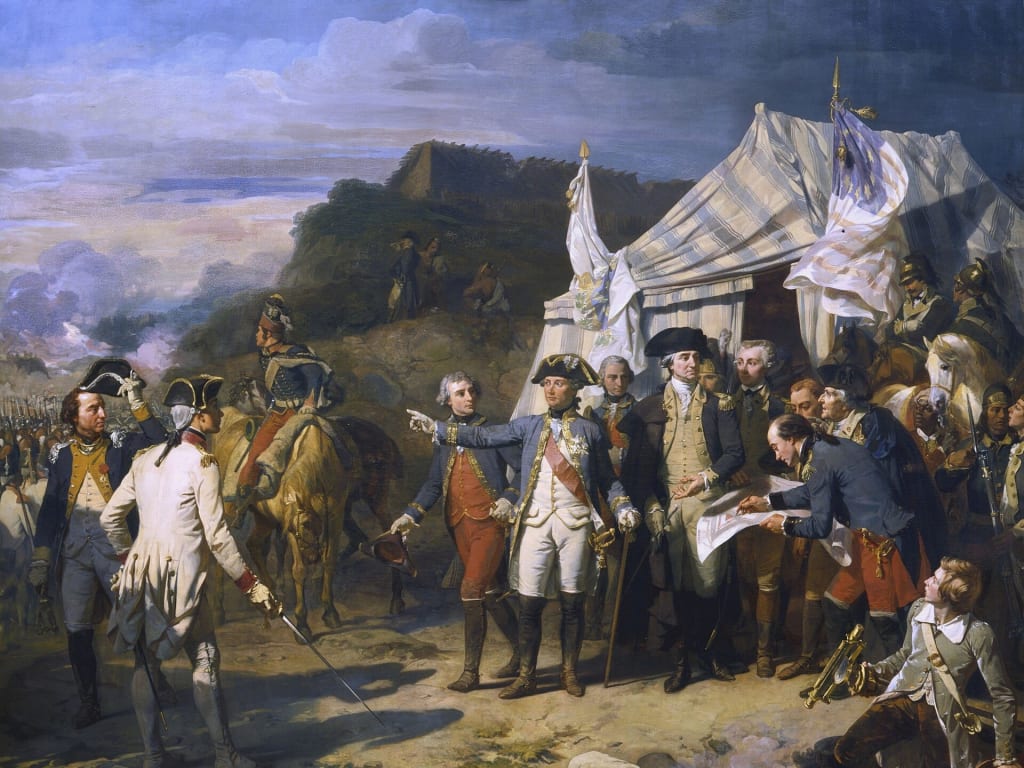
News of the French Revolution in 1789 stirred the hearts of most Americans. It had been just six years since the War of Independence ended. French support had been critical to the American victory. France had signed treaties of alliance and amity with the United States in 1778, when the outcome of the colonists’ rebellion was very much in doubt. France provided weapons as well as military advisers, most notably the Marquis de Lafayette. A French fleet and expeditionary force helped secure General George Washington’s victory at the Battle of Yorktown three years later. That victory persuaded London that the war could not be won at an acceptable cost. Now France looked to be following America’s lead in seeking liberty by rejecting monarchial rule.
The enthusiasm and optimism stoked by the 1789 Declaration of the Rights of Man and of the Citizen, which Lafayette helped write, ebbed, however, as the French Revolution took a darker, more radical turn. In August 1792, the noble-born Lafayette was forced into exile. The following month, the French Republic was proclaimed. Alone on a continent still ruled by monarchies, France soon found itself at war against Austria, Prussia, and others. In January 1793, the French Republic beheaded King Louis XVI in Paris.
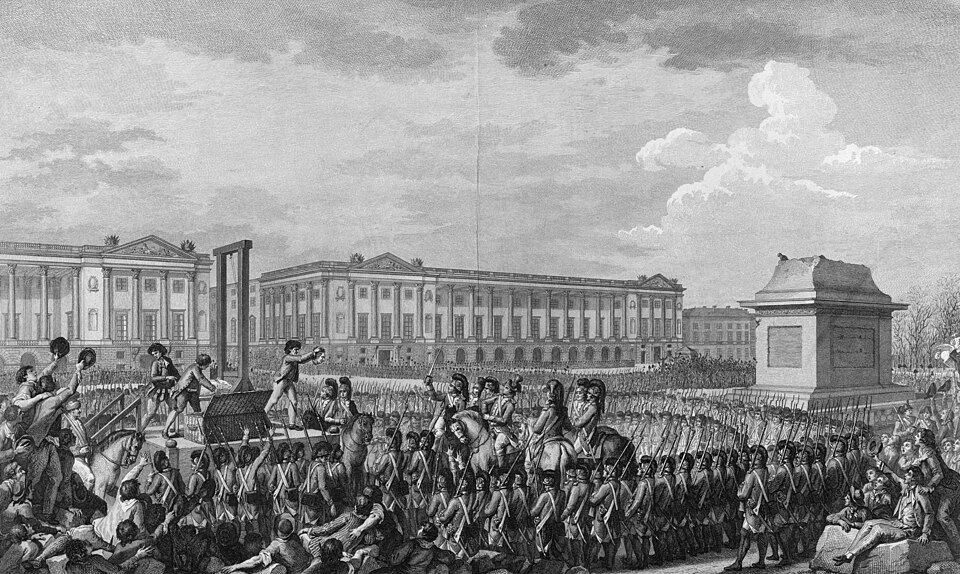
The execution sent shockwaves through the rest of Europe, further galvanizing the anti-French coalition. Anticipating that London would soon join the conflict, the revolutionary French government preemptively declared war on Britain on February 1, 1793. That decision would cause a political earthquake on the other side of the Atlantic.
America’s Alliance Obligation
Washington was at Mt. Vernon when he learned in early April that Britain and France were at war. Worried that the United States might be drawn into the conflict inadvertently by the actions of Americans helping one side or the other, he rushed back to Philadelphia, then the nation’s capital. An obvious question he had to confront was whether the 1778 treaties required the United States to side with France against Britain.
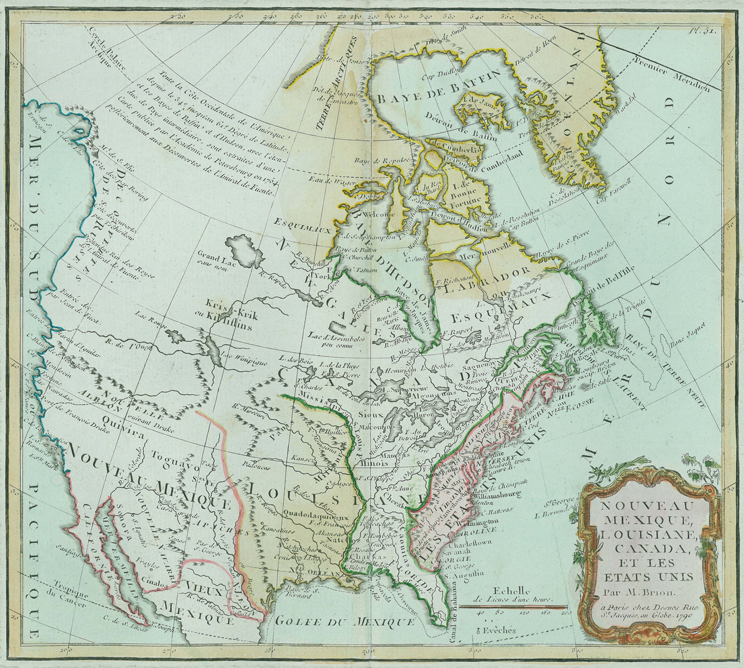
Washington concluded almost immediately that, whatever of its legal obligations, the United States should stay out of the war. He disliked of the radicalism of the French revolutionaries and their treatment of his valued friend. But more important to his decision was his calculation of U.S. interests. Fighting a new war with Britain could destroy the fledgling republic. The British controlled Canada and maintained forts around the Great Lakes—in violation of the 1783 peace treaty. British forces and their Native American allies could easily attack vulnerable U.S. settlements. Meanwhile, Britain remained the main destination for U.S. exports, and the British Navy dominated the seas. If the United States chose war, Britain would likely blockade U.S. ports and seize American ships, choking the U.S. economy.
A Cabinet Debate
On April 18, 1793, Washington submitted thirteen questions to the four members of his cabinet: Secretary of State Thomas Jefferson, Secretary of the Treasury Alexander Hamilton, Secretary of War Henry Knox, and Attorney General Edmund Randolph. Several of the questions dealt with how the United States should deal with the new government in Paris. But the core question was whether the United States was bound by the 1778 treaties to side with France.
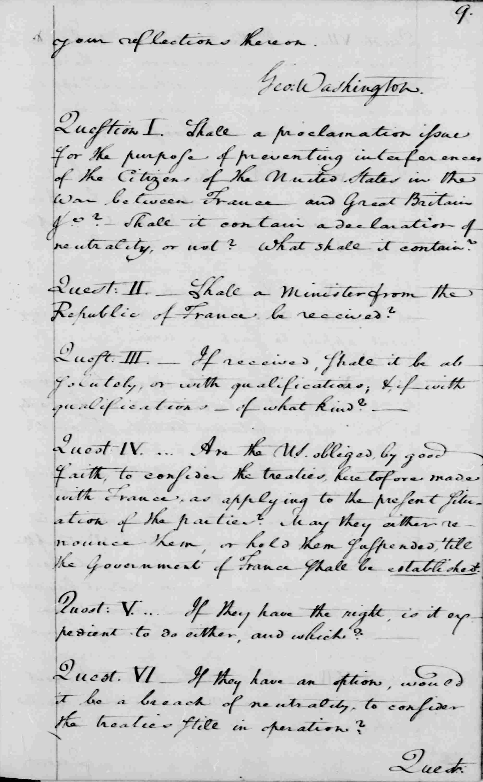
The group met the next day to discuss the questions. The cabinet members agreed on the central point. The United States should avoid being drawn into the war in Europe and make that position clear to all the combatants. But they disagreed on the particulars.
Hamilton argued for abandoning the 1778 treaties on the grounds that the government in Paris had changed. The pledge the colonists made to King Louis XVI did not carry over to the French Republic. Jefferson countered that treaties were binding agreements between nations and not between governments. So they remained in effect despite the end of monarchy. However, in Jefferson’s view, the United States was not obligated to invoke the treaties’ terms. The United States could pursue a policy of neutrality provided it publicly avoided using the term, as that would imply it was revoking the treaty commitments it had made fifteen years earlier.
A Proclamation
While sympathetic to Hamilton’s arguments, Washington opted to pursue the course Jefferson suggested. The United States would not terminate either treaty or formally declare itself neutral. However, it would announce to the world that it intended to stay out of Europe’s war and that it would prevent its citizens from aiding either side.
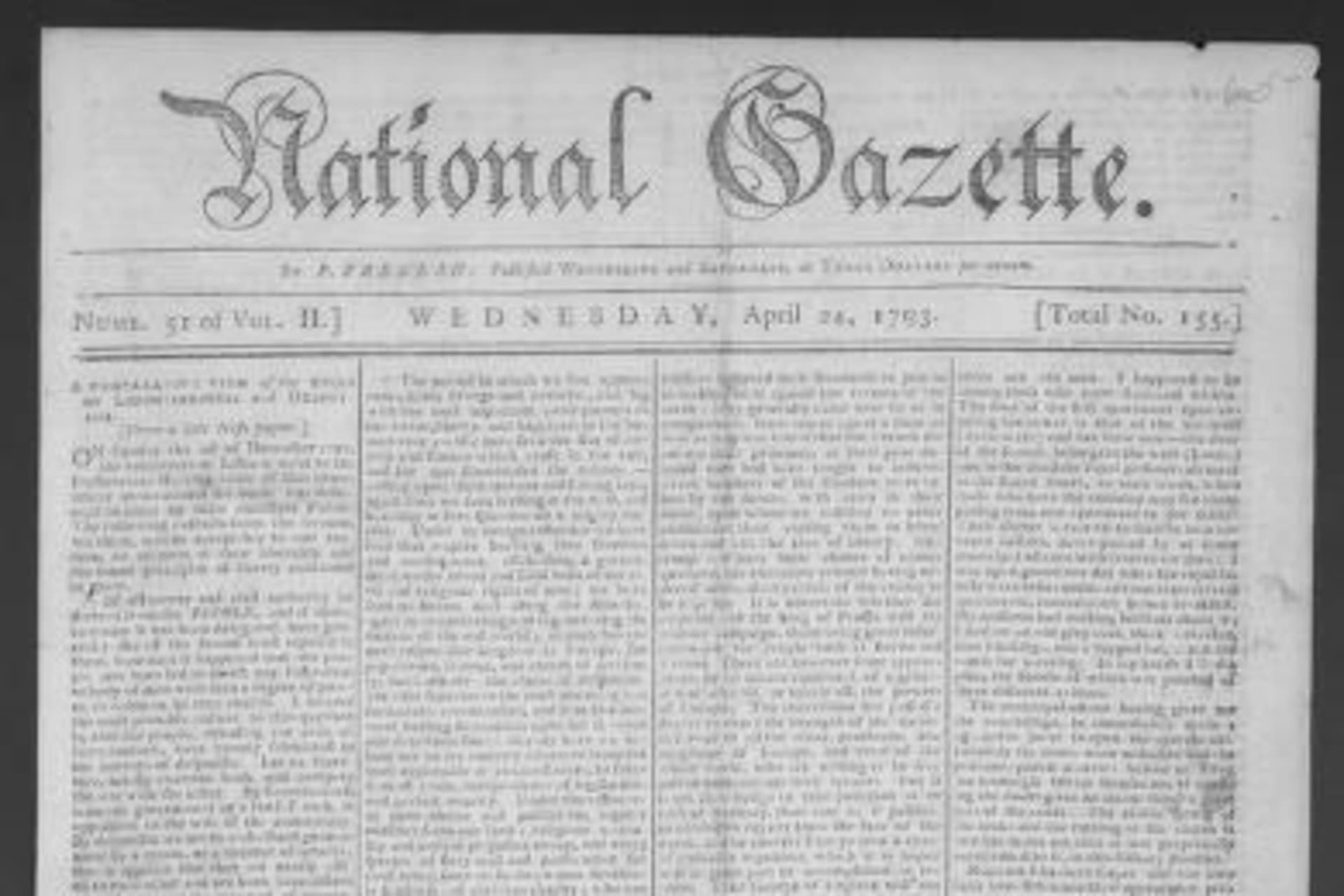
Randolph wrote the 288-word proclamation that Washington issued on April 22. It deftly avoided using the word “neutrality” while declaring that “the duty and interest of the United States require that they should with sincerity and good faith adopt and pursue a conduct friendly and impartial toward the belligerent powers.”
The proclamation went on to say:
I do hereby also make known that whosoever of the citizens of the United States shall render himself liable to punishment or forfeiture under the law of nations by committing, aiding, or abetting hostilities against any of the said powers, or by carrying to any of them those articles which are deemed contraband by the modern usage of nations, will not receive the protection of the United States against such punishment or forfeiture; and further, that I have given instructions to those officers to whom it belongs to cause prosecutions to be instituted against all persons who shall, within the cognizance of the courts of the United States, violate the law of nations with respect to the powers at war, or any of them.
These words seem unexceptional to modern ears. To many Americans at the time, they were anything but.
Surging Political Passions
The debate over neutrality quickly turned bitter. Vice President John Adams would later describe the spring of 1793 as a time “when ten thousand people in the streets of Philadelphia, day after day, threatened to drag Washington out of his house and effect a revolution in the government or compel it to declare war in favor of the French Revolution and against England.”
The bitterness of the debate partly reflected deep-seated policy differences. Many Americans believed that the United States was duty-bound to aid France. In their view, neutrality was both dishonorable and helped the hated British. These passions were inflamed by the coincidental arrival in Charleston, South Carolina, earlier in April, of Edmond-Charles Genêt, the representative of the revolutionary French government. As he traveled north to Philadelphia, he whipped up pro-French and anti-British sentiment.
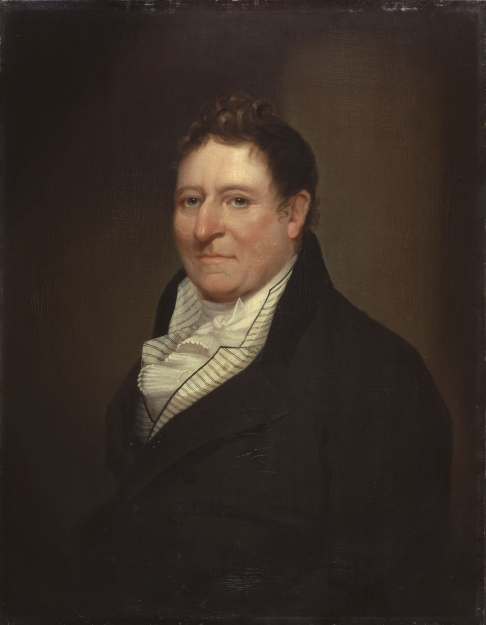
But many critics also thought that Washington had exceeded his constitutional authority with his decision on how the United States should respond to war in Europe. The Constitution said nothing about neutrality. It certainly did not assign the power to decide that question to the president. The Constitution did, however, explicitly give Congress the power to decide matters of war and peace. Thus by declaring the United States neutral, Washington had, in the view of his critics, infringed on Congress’s constitutional authority and begun to assume monarchical powers.
Pacificus v. Helvidius
Jefferson was among those who believed that Washington should have deferred to Congress. Indeed, that was part of his rationale for avoiding the word “neutral” in the first place. The third president, who would frequently set aside his narrow conception of executive authority when it served his interests once he sat in the White House, wrote:
My objections to the competence of the Executive to declare neutrality (that being understood to respect the future) were supposed to be got over by avoiding the use of that term.
Jefferson’s private qualms shifted to private resistance after Hamilton, his archenemy, defended Washington’s decision in a series of essays written under the pen name “Pacificus.” Jefferson, who was still secretary of state, urged James Madison, then a member of the House of Representatives, to respond to Hamilton. Madison took up Jefferson’s request reluctantly, writing under the pen name “Helvidius.” He called the task “the most grating one I ever experienced.”
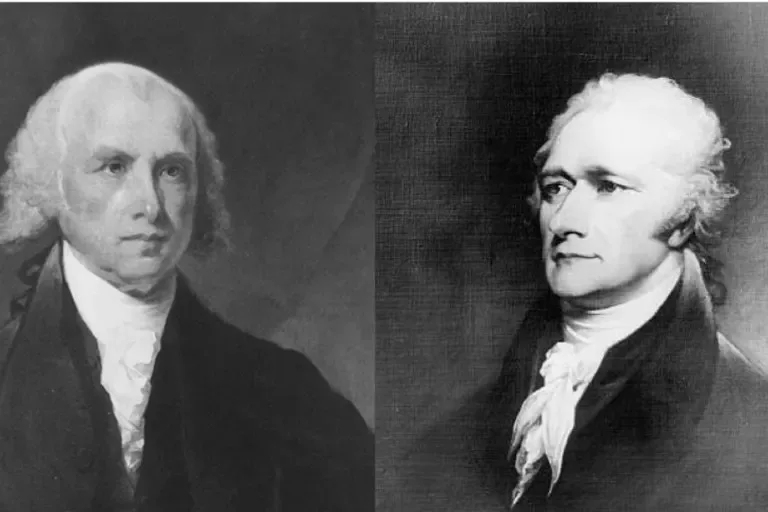
The resulting Pacificus v. Helvidius debate became a classic exposition of competing conceptions presidential and congressional power over foreign policy. Hamilton sketched a vision of presidential leadership; Madison a vision of a dominant Congress. In making their cases, both men abandoned positions they had championed when writing The Federalist Papers. Principles were adapted to suit political needs.
A Changed Public Mood
Even as Hamilton and Madison were dueling in print, public anger over U.S. neutrality was diminishing and support for the policy growing. Part of the change owed to the natural tendency of passions to cool with time. But it also reflected a backlash against Genêt. The French representative sought to organize Americans to attack British shipping, ignoring repeated administration demands that he stop. Genêt suddenly looked less like a fellow defender of liberty and more like a foreigner disrespecting the United States.
Jefferson acknowledged the changing public mood in a letter later that summer to Madison:
With respect to the Proclamation, as the facts it declared were true, and the desire of neutrality is universal, it would place the republicans in a very unfavorable point of view with the people to be cavilling about small points of propriety; and would betray a wish to find fault with the President in an instance where he will be approved by the great body of the people who consider the substance of the measure only, and not the smaller criticisms to which it is liable. The conduct of Genet too is transpiring and exciting the indignation it is calculated to excite. The towns are beginning generally to make known their disapprobation of any such opposition to their government by a foreigner, are declaring their firm adherence to their President,
The changed circumstances meant, Jefferson concluded, that “it will be true wisdom in the Republican party to approve unequivocally of a state of neutrality, to avoid little cavils about who should declare it.” It was not the last time in U.S. history that a political leader changed course on a policy to stay on the right side of an issue with the public.
The Neutrality Act of 1794
While Pacificus and Helvidius gave their partisans ammunition for their respective positions, and practical politics persuaded Jefferson, Madison, and their followers to drop their claims that Washington had erred in declaring neutrality, neither development settled the neutrality issue. A court case did.
The Washington administration charged Gideon Henfield, a U.S. citizen who joined a French crew that captured a British vessel, for violating the Neutrality Proclamation. The facts of the case were not in dispute. Whether Henfield had committed a crime was. The jury found him not guilty because the government could not point to any law he had violated. Whatever the merits of Washington’s proclamation, it was just that—a presidential proclamation. It did not carry the weight of a law. That required congressional action.
Washington acknowledged the need to involve Congress. On December 3, 1793, in his fifth annual message, he said “it rests with the wisdom of Congress to correct, improve or enforce” his plan for dealing with the war between Britain and France. Specifically:
it will probably be found expedient, to extend the legal code, and the Jurisdiction of the Courts of the United States, to many cases which, though dependent on principles, already recognized, demand some further provisions.
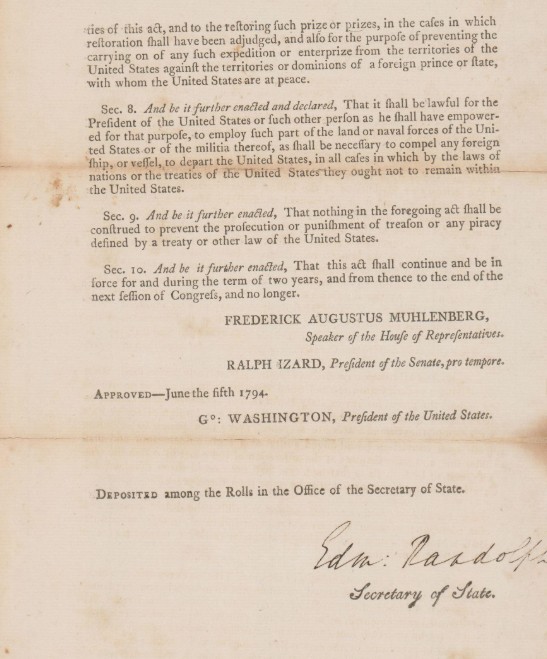
Congress addressed Washington’s request six months later when it passed the Neutrality Act. Among other things, it barred U.S. citizens from serving foreign powers and prohibited using U.S. ports to arm vessels to prey on foreign ships.
The Legacy of the Neutrality Proclamation
The immediate outcome of the Neutrality Proclamation was to establish the right of the president to declare the United States neutral in foreign conflicts along with the right of Congress to determine what penalties should result from violating U.S. neutrality. Whatever the breadth of Congress’s war power, no one would again argue seriously that the president could not take the initiative to keep the United States from being drawn into a war.
The proclamation likely also helped preserve the Republic. A war with Britain would have been devastating, perhaps even catastrophic. That because clear two decades later during the War of 1812 when a stronger United States saw Washington sacked and the New England states debate secession.
What the participants in the debate over the Neutrality Proclamation did not know at the time is that they were also witnessing the consolidation of America’s first party system. Jefferson resigned as secretary of state at the end of 1793. He would devote the remainder of the decade to working with Madison to thwart many of the policies that Washington and then Adams pursued. Jefferson and Madison would privately encourage attacks on Washington and Hamilton, helping give rise to what history now knows as the Democratic-Republicans. Their opponents would be known as the Federalists. They would hold the upper hand in American politics through Adams’s presidency.
Just as important, the debate over the Neutrality Proclamation signaled that foreign policy could become a rough-and-tumble affair in American politics. The proud Washington was deeply wounded by the accusations that he was acting like a king and betraying the principles of the American Revolution. The fact that his fellow Virginians and erstwhile allies Jefferson and Madison were behind the charges only made them cut deeper. Washington’s anger made him more determined to stand his ground. As he told a political ally: “The people of this Country it would seem, will never be satisfied until they become a department of France: It shall be my business to prevent it.” In Washington’s view, that meant keeping Jefferson from succeeding him as president. To that end, Hamilton helped him craft his famed 1796 Farewell Address. Released just two months before the presidential electors met, many of its arguments were designed to damage Jefferson’s presidential chances.
So while early Americans might talk about a “national interest,” they disagreed over what it was and how to advance it. Rather than stopping at the water’s edge, American politics then, as now, would go far beyond it.
Oscar Berry assisted in the preparation of this article.