How I Got My Career in Foreign Policy: Sebastian Mallaby
Sebastian Mallaby spent more than two decades as a journalist at the Economist and the Washington Post before joining the Council on Foreign Relations. He sat down with CFR to discuss his travels as a foreign correspondent and love for writing books.
By experts and staff
- Published
- Editor
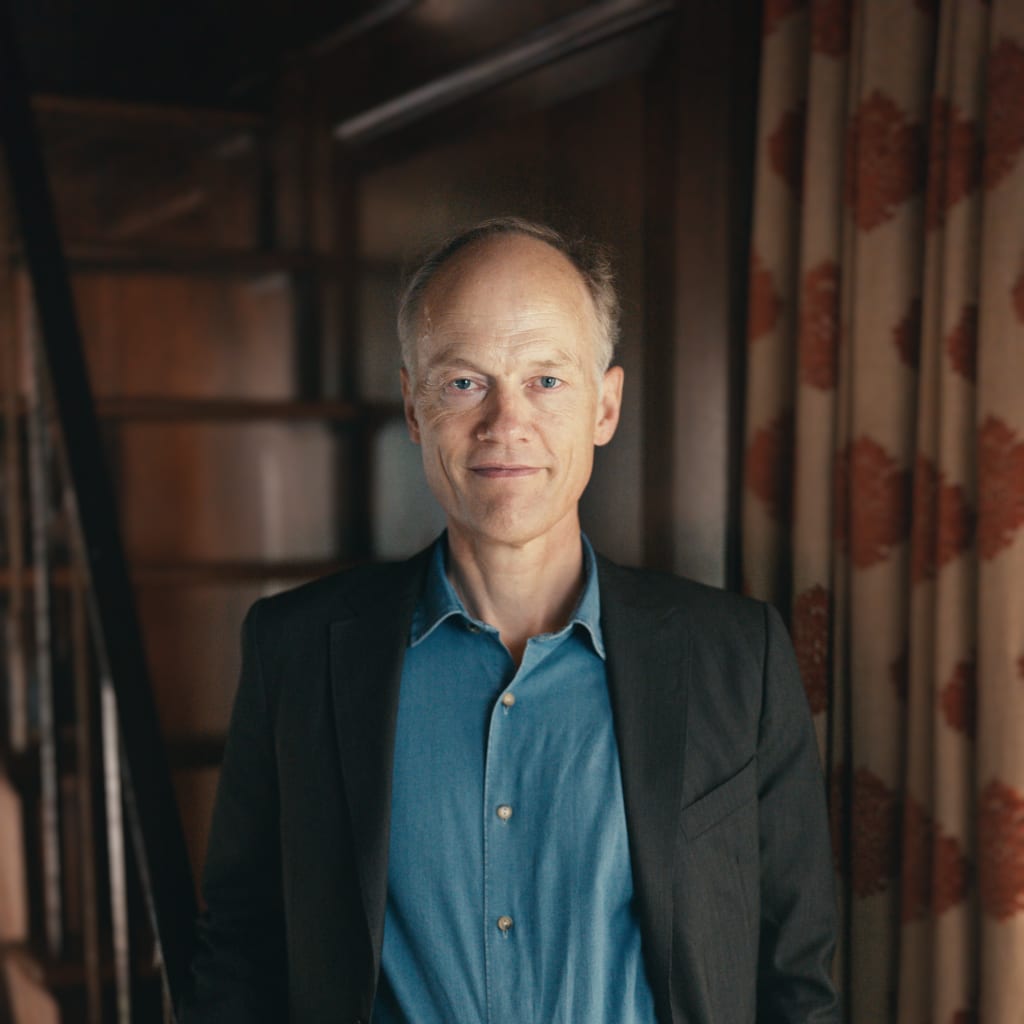 Sebastian MallabyCFR ExpertPaul A. Volcker Senior Fellow for International Economics
Sebastian Mallaby’s nomadic childhood inculcated a fascination with international affairs that led him to a career in journalism. He began his foray into journalism at the Economist, a job that took him to Africa, Asia, and the United States. He then joined the Washington Post as a columnist and member of the paper’s editorial board. In 2007, he joined the Council on Foreign Relations, where he is currently the Paul A. Volcker senior fellow for international economics. His next book, The Infinity Machine, is out on March 31. Mallaby talks below about his childhood memories of the Soviet Union, working as a foreign correspondent in South Africa and Japan, and why he says joining CFR was “probably the best decision I ever made.”
Here’s how Sebastian Mallaby got his career in foreign policy. If you’re interested in this series, check out more editions here.
What did you want to be when you were little?
When I was fifteen—maybe that’s not very little—I did some kind of questionnaire at my school where they were trying to advise me on what subjects I should do in my last two years and what I might do at college. One question was, “What do you want to do after college?” And I wrote down journalism and writing, and that’s kind of what I’ve done.
Amazing. Do you remember when you specifically became interested in foreign affairs? Did that always exist for you as well?
Yeah, that always existed because my father was a British diplomat, and when I was growing up, we lived in Germany, New York, Russia, and also Britain. And my mother was not British, she was French. So I came from a sort of bilingual, international household, and traveling and understanding other countries was always my passion.
When I finished high school, before I went to college, I spent six months backpacking around Latin America, just getting to know the area. During my summer vacations from college, I would do the same in Asia—mostly India, but also Bangladesh and Myanmar. So the passion for traveling was deep in me. Later, when I became a journalist and joined the Economist, my objective was to be sent abroad as a foreign correspondent as fast as possible. And that’s what I did.
I’m intrigued that you were living in the USSR. How old were you? What do you remember about that?
I was ten, and we lived there until just before thirteen. My parents lived there full time, as did my sisters. I was sent to a boarding school in England, but I did spend all my vacations in Moscow, so I got a little bit of a sense of it.
I remember one memory from a childhood perspective on central planning in the Soviet Union. I was going for a walk with my dad, and there used to be these kiosks all over Moscow that only sold one thing, which was vanilla ice cream. You could buy this vanilla ice cream sandwich and take it with you as you walked around the street and ate it. My dad took me up to one of these kiosks to buy me this ice cream, and I was eleven years old, so I was very happy with this. The depressed guy behind the counter said, “Well, sorry, we’re out.”
My dad said, “Well, but you don’t sell anything else, do you?” He said, “No.” “So you’re not really selling anything today at all?” “No.” “How many days has it been since you had any vanilla ice cream to sell?” “I think it’s eighteen.” “Oh, so you’ve been coming to work for eighteen days without any work to do because there’s nothing you can sell?” “Yeah, that’s right.”
I remember my frustration with not getting the ice cream was overwhelmed by my fascination at a system where people would sort of robotically show up to work.
Fascinating. After you finish college—you graduate Oxford—you join the Economist pretty much right away. What drew you to the Economist?
My plan B was to be a diplomat, and I got an offer from the British Foreign Office at the same time. But I liked the Economist idea better because at a very young age you could be out there writing pieces and expressing yourself. The path to having that kind of autonomy and ability to have your own view if you joined the government—eventually you might get there, but it was going to take quite a while. So I was excited by the more immediate gratification of joining the Economist and at twenty-two being able to already write pieces.
You mentioned you wanted to be a foreign correspondent, and very early in your career, you became the Economist’s Africa correspondent. You end up going to South Africa, and you covered the end of apartheid and the release of Nelson Mandela. How did witnessing these monumental events shape your career or your trajectory? What do you remember about that time?
I had been at the Economist for about two years in London and was anxious to get out and live in a foreign country, particularly a developing country. I had fixed up a plan to go to Pakistan and help with an English language school. When I told the Economist editor I was resigning to do that, he immediately said, “Absolutely, you should go live in a developing country. But why don’t you do it as the Economist correspondent in Africa.”
He suggested Zimbabwe—he was originally Zimbabwean—and said he could help my fiancée get a job there. So that became the new plan. My logic was that if you based yourself in Johannesburg, because of apartheid you couldn’t travel around the rest of Africa due to sanctions and visa obstacles. I really wanted to write about development in Africa, not just the political struggle against apartheid. So I wanted to be close to South Africa because that was the dominant political story, but not in South Africa.
But then I got there, and contrary to everybody’s predictions, the new president, F.W. de Klerk, who had been described as a stick-in-the-mud conservative, actually turned out to be quite radical and decided to release Nelson Mandela. It became clear I was going to spend at least a third of my time living out of a suitcase in South Africa for the next year.
I was in South Africa when the news came that Mandela would be released the next day. I got on a plane, flew to the prison, stood outside, waited for him to come out, followed him into Cape Town where he was going to give his first major speech. I remember being in this crowded square waiting for him to come out. People were so excited that the pressure of the crowd literally lifted you up—your feet were no longer on the ground.
Eventually, Mandela came out and gave this incredibly magnanimous speech, totally not bitter towards the white regime that had imprisoned him for twenty-seven years. That was an incredibly moving moment, and it gave me the opportunity to write my first book, After Apartheid, an assessment of South Africa’s prospects.
After that, you were a foreign correspondent in Japan. Was there something that surprised you about going from being a foreign correspondent in Africa to going to Asia?
Japan had some of the excitement of going to Africa because it was so different. I went in 1992 and stayed with a Japanese family to learn Japanese in a provincial town. The husband designed kimonos, and he had a studio of artists working for him who painted these kimonos. Very traditional family, incredibly nice and welcoming to me. So it had that exoticism of going somewhere really, really different. But instead of being poor, it was rich—richer per capita than Europe at the time, probably on a par with the United States.
It felt like the big mystery was that Africa had been different because it was poor. I had traveled in India and Latin America, and those were different—you could think of that as being because they’re poor. But Japan was proof that you could be extremely different, and it wasn’t because you were poor. In a way, that was an even more fascinating question: Why did Japanese society have such different assumptions, such a different form of gender relations?
I remember moving into an apartment in Tokyo and chatting with one of my neighbors, a friendly Japanese woman. I said, “How long have you lived here?” She said, “Oh, we only just moved into this building four months ago. I remember I gave my husband a little map so he could find it when he went to work that morning, so he knew where to come back home to.” I said, “Wait a minute, so your husband didn’t know you were moving until the morning you moved?” She said, “No, no, he’s a salary man. He just goes to his work. I do all that stuff about organizing where we live.”
That sense of the difference of Japan was just everywhere. I came to develop this idea that there are kind of three revolutions or evolutions that countries go through. One is an economic one, where you industrialize and become rich—an industrial revolution. Then there’s a political revolution where you become democratic. And then there’s a psychological revolution where you become individualist.
In Europe, individualism had begun to emerge in the Renaissance, which I’d studied at Oxford. Then there was the Industrial Revolution, and then later democratization in Britain—basically peacefully and gradually, in other countries, suddenly and violently. So it went from psychological change to individualism first, then economic change to industrialization, then political change.
Japan had industrialization first with the Meiji Restoration, democratized second after the Second World War, and then it was still waiting for the psychological shift toward individualism when I lived there. I thought of it in terms of a shuffled, interesting sequence of development.
You then become Washington bureau chief and come here stateside to cover American politics and foreign policy. Was there something that surprised you coming covering politics from this side of the pond?
I had lived as a kid in New York, second grade through fifth grade. I used to play baseball, chew gum, support the Mets, all that kind of stuff. But I hadn’t really been back much to the United States. I had made a couple of small trips as a journalist, but not a lot. It was kind of a huge blank space in my awareness.
By the time I arrived in my early thirties, I really felt it was high time—the United States was the most important country in the world, and if I wanted to understand the world, I needed to understand the United States. I arrived with this sense that it wasn’t going to be just Washington, DC. I needed to travel a lot.
I remember arriving and immediately going to Kansas to write a piece about the backstory of Bob Dole, who was later the Republican candidate for president that year. It was January 1996. He was not yet the nominee, but he seemed quite likely to win the primaries. So I did this trip around Kansas and spoke to lots of Christian ministers and farmers and people who gave me a sense of where Dole came from.
Then I remember going to Indianapolis to write about a police chief who had a new approach to crime. Right after that, I went to Arizona and wrote about the Republican primary there. I traveled a lot and just drank it up. I loved it from the moment I landed. I wound up staying in the United States eighteen years and getting an American passport.
Had you wanted to come to the United States, or was this again your editor saying, “Why don’t you do this?”
No, I’d been keen to come to the United States.
You eventually join the Washington Post as a columnist and member of their editorial board. What prompted the shift from news reporting to opinion?
The joke about the Economist is that it calls itself a newspaper, but really it’s a views paper. There’s always a bit of opinion in the Economist, even in the reported pieces, the non-editorials, the sort of normal pieces. You’re allowed to have a point of view. You need to back it up with facts, of course. But there isn’t that religious church-state divide that you have in American newsrooms between the news and editorial sides.
I’d already written the Economist’s Lexington column for a while, so coming to the Washington Post and writing editorials and columns came quite naturally, and it was a pretty easy transition.
Another transition came in 2007 when you joined CFR. What made you move from journalism into the think tank side of the world?
It was really a desire to do deeper work and to write books. I had written one book, as I mentioned, about South Africa after apartheid. I always wanted to write another book, but I didn’t find the right subject when I was living in Japan, so I didn’t do a book about Japan. Then I still had this desire to write a book, and I came up with this idea of a book about the World Bank in 2002. I’d been writing a lot about development policy, which obviously went back to my time in Africa. So although I was living in Washington, I was still focused on global development as a subject.
When I did that book, I was offered a visiting fellowship at CFR, which I did. I came for twelve months, and it was a great home to write that book. Then I went back to the Washington Post. I got another book contract in 2006, this time to write about hedge funds, which was a bit of a jump. I went back to the Council and said, “Could I come for another year to write another book?“ They said, “You know what? Last time you came, you seemed to like it. We liked you. What about if you just came permanently?”
I decided I would do that, and it’s probably the best decision I ever made. CFR has been a fantastic home, giving me the freedom to do a mixture of book writing and commentary in newspapers and Foreign Affairs pieces, as well as just be part of the CFR community—both in terms of the staff but also the members. I think it’s a very rich pool to swim in.
Speaking of your books, you have one forthcoming on artificial intelligence (AI) and DeepMind. How do you choose what you focus on, or what drew you to this topic? I know it’s the topic du jour.
It’s a good question, because it wasn’t quite the topic du jour when I conceived the idea. I had thought about doing a book about AI back in 2017 when I finished my book on Alan Greenspan and central banking. AI was a rising technology and I had this feeling AI was going to be super exciting and important. But in discussion with my editor at Penguin [Random House], we agreed it was a bit early. So I did instead a book about venture capital and Silicon Valley, which felt like a good fit because it was about technology but also had the finance element. I had written, by that point, three other books on finance—the World Bank, central banking, and hedge funds. Venture capital was the fourth, but it had this tech side to it, which I was excited by.
Coming out of that one, I looked again at my old idea of AI. At this point, it seemed riper because there had been this breakthrough on protein folding, where the DeepMind AI system figured out all the protein shapes in nature—it was the biggest event in AI thus far. My editor agreed this would be a great topic. You always need a topic, but also a way in. The way in was going to be Demis Hassabis, this extraordinary chess prodigy and British scientist who had led both the AlphaGo project and the protein folding breakthrough.
I needed two or three months to read enough about AI to feel ready to approach Demis. I finally got to see him in November 2022, and after our first discussion, about two weeks later, ChatGPT came out. All of a sudden, AI went from a rising topic to a household discussion. So I was very lucky that Demis agreed to spend a lot of time with me, and that my timing was great. I was embedded in DeepMind from the beginning of when it became a household discussion.
This series is also geared towards young people. For those starting out right now, who are interested in foreign policy, what’s your advice to them?
To be curious about the world and interested in foreign policy, international relations, what makes countries tick, what makes them rich, what makes them poor—these are profoundly important and interesting questions that go right to the heart of the human experience. Are people going to be healthy and prosperous and happy or not? Will we have peace or will we have war? I would encourage anyone with that set of interests to pursue them. It won’t get boring. It’s super engrossing.
I think the trick and the difficult thing is: What is the professional platform you choose to approach it through? Some of the traditional routes are more at risk from technology than others, and that shifts over time. When I went to college in the mid-1980s, my way of approaching foreign policy was to do either diplomacy or journalism. For various reasons, government service is a very noble calling, but it’s a tough calling because governments may not get the respect they should from electorates these days, and politicians don’t give them the funding they need. Also, the nature of modern communications means that a lot of what is really international relations takes place through private citizens communicating with each other, businesses going direct to other countries and doing investments and trade. There’s a lot of activity not in the government sector that’s very important to international relations.
Equally, journalism has been disrupted by AI and the internet and is on a less secure commercial footing than it once was. If you really have a passion for government or journalism, it’s good to pursue it, but I would kick the tires on it and ask yourself: Is there another way you could pursue an interest in international relations that might be satisfying? Options range from multinational businesses with a global footprint to big law firms that do cross-border law cases, to banks or financial houses that invest or facilitate commerce on a global basis. There are just lots of global institutions.
I think academia is probably a better career these days than journalism because journalism is so squeezed by the proliferation of free quasi-journalism from bloggers and Substack writers, whereas with academia, there’s a fundamental purpose of educating students. So teaching, I think, is less likely to be disrupted. Although, of course, AI may make some impact, I feel universities have a stronger business model than newspapers.
Our last question is always a fun question. Over the years, I’m sure you’ve had many fascinating work trips and dinners. Is there a favorite or most memorable one that you could share?
It was probably going into North Korea, which I did when I was based in Tokyo. I think it was 1994, and the only way you could do it was to pretend that you were a tourist. So I made up some identity, I said I was an English teacher in Tokyo just curious about North Korea.
I took this train from Beijing across the border into North Korea and down to Pyongyang. I was met at the station by the tourism official who was supposed to keep eyes on me at all times. They introduced me to another tourist—another journalist based in Tokyo, who was a friend of mine who had a different made-up story. I had no idea that he was coming too. So we hung out with this North Korean spook who was supposed to be keeping an eye on us for a week, and we were shown around the country.
I remember the level of regimentation among people, and people’s fear of speaking to us. My colleague spoke Korean and we tried to run away from our minder and go for a walk to talk to people in the street. And they just looked white with fear if you walked up to them. So that sticks in my mind as an extraordinary trip.
This interview has been edited for length and clarity. It represents the views and opinions solely of the interviewee. The Council on Foreign Relations is an independent, nonpartisan membership organization, think tank, and publisher, and takes no institutional positions on matters of policy.