How I Got My Career in Foreign Policy: David J. Scheffer
David Scheffer grew up in Oklahoma, always interested in the world far outside his home. His curiosity and “fill the gap” ethos led him to forge several war crimes tribunals to seek justice for global atrocities.
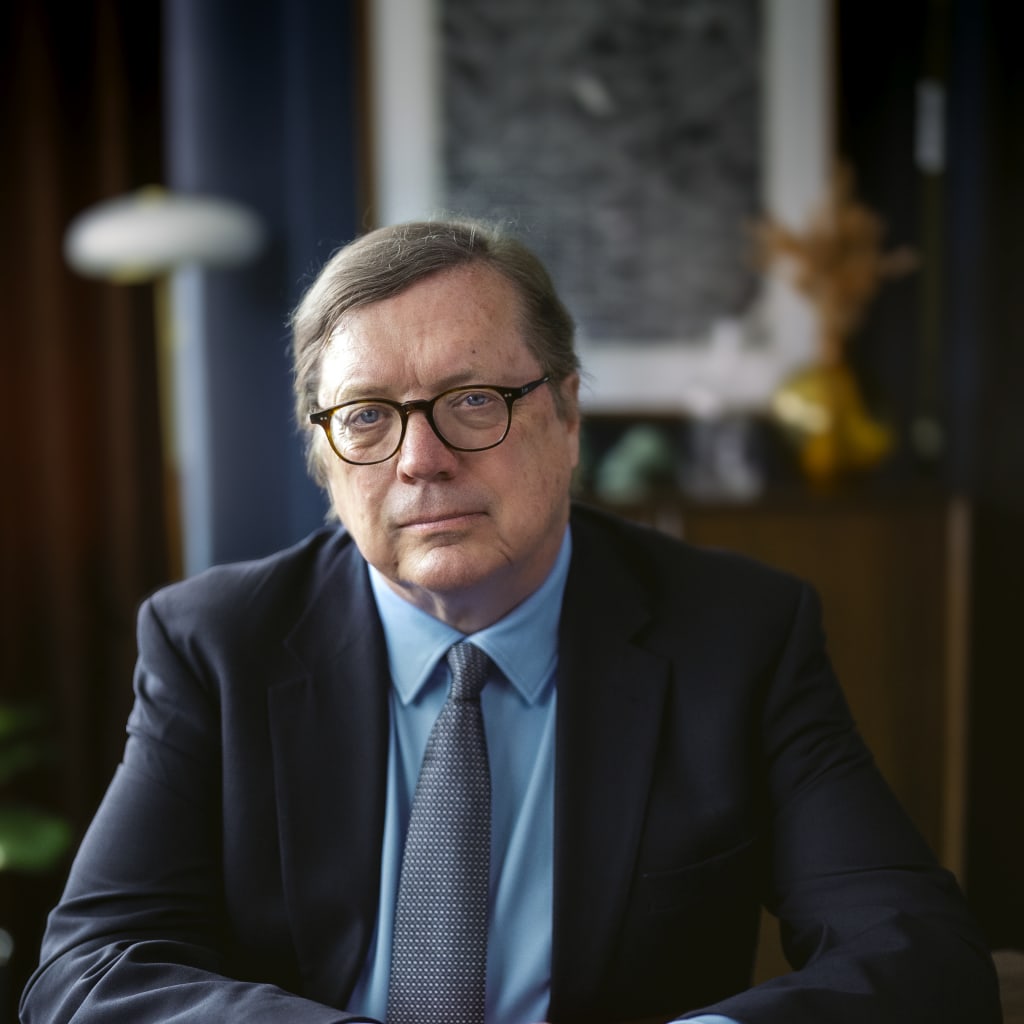
Raised by a mother who became disabled after contracting one of the last U.S. cases of polio, David J. Scheffer saw firsthand the challenges that some groups of people faced, and the gap in efforts to address them. This drove him to study international law, learning how he could bridge that gap for communities far outside his home in Oklahoma. He worked closely with Madeleine Albright when she was U.S. ambassador to the United Nations, before he became the first-ever ambassador-at-large for war crimes issues. These positions allowed him to expand international justice law by establishing five war crimes tribunals to prosecute global atrocities. He is currently a senior fellow for international law and international criminal justice at the Council on Foreign Relations. Read more about how Scheffer wound up on Albright’s team, what it was like being the first ambassador of his kind, and how his life changed in a New York law library.
Here’s how David Scheffer got his career in foreign policy.
What did you want to be when you were little?
I grew up on the plains of Oklahoma, and at seven years old, I was inspired by John F. Kennedy’s run for president. I actually got a “Kennedy for President” hat and went around my neighborhood knocking on doors in very conservative Oklahoma to promote his campaign, with doors being slammed in my face.
He really touched a chord in me, to the extent that I kept a scrapbook on things he was doing while he was president, particularly the Cuban Missile Crisis. He got me immersed in politics in my earliest years, such that my first ambition was to actually enter politics and be the JFK that arises out of the state of Oklahoma. But of course, that changed.
I can’t imagine people shutting the door on your seven-year-old face! When did that ambition morph into human rights and international law?
During that time, my mother was one of America’s last polio victims. She contracted it shortly after I was born in 1953, so I grew up with a mother who was disabled. She had been so active before being hit with polio, but then she could not walk at all. This meant that throughout my childhood, I was helping out around the house. That instilled in me, at a very early age, an awareness of the human rights of disabled people.
My interest in international law took off once I arrived at college. In my sophomore year, I read How Nations Behave by Louis Henkin, and that was my introduction to the importance of international law in our lives. I decided then that I would go to law school and focus on international law. I applied to Oxford for law school, because it had such a great international law program, and was fortunate to get a fellowship from Harvard to pay for it. Then when I came back, I went to Georgetown Law because I wanted to get a master’s in international and comparative law. I entered legal practice after that.
What a beautiful and powerful story about your mother, I’m sure she’d be so proud of you today. After law school, you had several different roles—including a stint as the CFR International Affairs Fellow. Was there a strategy in mind, or were you just trying different things out?
There were always two strategies in my mind. The first objective is that I have always looked for opportunities to fill the gap in humanitarian endeavors. At my time at the law firm Coudert Brothers, for example, I would take on pro bono projects that, if I weren’t there doing them, no one else would be. I was sent to Singapore right after the fall of the Pol Pot regime, which had committed massive atrocity crimes—genocide, crimes against humanity, war crimes—in Cambodia. The Cambodian people were starving; they needed rice, and the way to get it to them was from Thailand on barges up the Mekong River to Phnom Penh. Those barges needed to be properly contracted and insured so that NGOs and humanitarian agencies would be covered for the investment they were making. They needed a lawyer to make all that happen, so I just stepped forward and said, “I’ll do that.” For me, it was filling the gap for a very good cause.
That notion has followed me throughout my career and paired with my other strategic focus, namely public international law. The eight years I spent on commercial transactions in Asia, Latin America, and elsewhere were fascinating, but in the back of my mind, I always wanted to step into the realm of public international law. That’s why I applied in 1986 to the CFR International Affairs Fellowship. That was a transition point in my career. After a year working on the House Foreign Affairs Committee, I was hired permanently by the committee, which started my life in Washington, DC. All this led me to work under Madeleine Albright and eventually negotiate the creation of five war crimes tribunals.
Possibly the best plug I’ve ever heard for the CFR fellowship. So, we’ve arrived at Madeleine Albright. How did you end up on her team?
I had met her occasionally at think tank gatherings in the late eighties and early nineties when I was at the Carnegie Endowment for International Peace. I had also worked intensively on the Clinton foreign policy team, and she was on it, too.
I had applied for a job in the Clinton administration after Bill Clinton was elected. I did not try to lobby people. I just followed the rules. Nothing happened. Finally, I called someone who had worked with me at the Carnegie Endowment who was on the Clinton State Department transition team. I said, “I filed my application, and I haven’t heard anything.” She responded, “Oh, David, we thought you just wanted to stay at the Carnegie Endowment.” And I said, “What? I was on his campaign’s foreign policy team. I thought this was clear.”
She said, “Well, tonight I’m going to the opera with one of my best friends, Madeleine Albright. Can I raise your name with her? She needs someone to brief her for her confirmation hearing to become the U.S. permanent representative to the United Nations.” And I said, “Of course.” The next day, Madeleine called me as I was sitting at Carnegie and said, “David, I need to be well prepared for this confirmation hearing. Can you come over this afternoon?”
So I took a leave of absence from Carnegie to do this with her. She got through her confirmation hearing and thereafter I was her second permanent hire. That started an eight-year journey with Madeleine Albright.
Wow. It’s funny, albeit mildly concerning, that the team saw your application and thought you didn’t mean it. That story is a true testament that going after what you want often requires more than just applying, unfortunately.
Yeah, it requires a phone call or human contact. You know, to this day, I still don’t understand how they reached that assumption.
Of course, we all want to know: What was it like working for Albright? How did it prepare you for your eventual role as the first-ever Ambassador-at-Large for War Crimes Issues?
Madeleine was a tremendous leader. She was very conscious of advancing the role of women in decision-making, in peace negotiations, overseas and in the State Department. She demanded perfection. For example, if prior to a congressional hearing, I came in with a brief or a memo that outlined how much was being spent at the UN on peacekeeping operations and in which theater, she would pick apart my data and say, “Oh, but you haven’t really covered the right piece of data that I need for this hearing. So please go get that done within thirty minutes.” She was very good at directing you to get it done correctly.
She also had a great sense of humor, for which I have scads of anecdotes in my head. I have shared almost none of those with the public, but they are fantastic memories of Madeleine that I carry with me.
Then in February 1993, her early weeks at the United Nations, she was confronted with the Balkan wars and the atrocity crimes occurring there. I became very engaged with her on the resolution that would create the International Criminal Tribunal for the former Yugoslavia. After that, she essentially handed me the atrocity crimes brief, which was growing enormously. She enabled me to pursue the atrocity crimes agenda that she had initiated for the next eight years, first as her senior advisor and counsel during Clinton’s first term, and then as ambassador-at-large for war crimes issues in the second term.
It sounds like this prepared you well for the role you would step into next, the first-ever ambassador-at-large for war crimes issues. What was it like to take on a totally new role, without any predecessors to shape the position for you?
It was right up my alley. Madeleine got the president’s approval for the ambassadorship, and there was, frankly, no opposition in the Senate because we had worked so hard on creating the Yugoslav Tribunal and the Rwanda Tribunal. The issue of accountability and of addressing atrocity crimes globally was now very much on the table of discussion in Washington, whereas before the Clinton administration, it really had not been.
When she created this position, it gave me the opportunity to be very innovative and continue what I started in the first term, which was essentially to be a carpenter of war crimes tribunals. I was flying all over the place, but the harder part of the job was interagency work here in Washington, because other agencies were not necessarily as dedicated or supportive of using U.S. influence to build these tribunals. I had to wage a constant struggle in Washington to achieve that. In fact, in 1998, because of my persistence, another agency literally wanted me fired. Luckily both Madeleine and Sandy Berger, the national security advisor at that time, had my back. So I have always been very grateful for the support that she gave me.
The characterization of “carpenter of tribunals” couldn’t be more apt—how much of this field felt undefined when you were entering it?
The field of atrocity crimes and of accountability—and bringing those two together into a coherent process of investigation, adjudication, and prevention—was mostly unwritten before the 1990s. There had been the Nuremberg trials and the Tokyo trials, but they had become important historical novelties that had been put aside during the Cold War. When the Cold War ended, we had a few years of a more open sense of cooperation with our Cold War adversaries, namely Russia and China.
That allowed us to work within the UN Security Council to build those first two tribunals covering the former Yugoslavia and Rwanda. But thereafter, it became a much harder challenge, because the Security Council essentially had tribunal fatigue. These types of tribunals cost millions of dollars to undertake at the international level. The Security Council did not want to get into the habit of building a new, costly tribunal for every situation of atrocity crimes that erupted around the world. So we had to come up with different formulations for the civil war in Sierra Leone and the atrocity crimes in Cambodia under Pol Pot in the 1970s, which still needed to be accounted for. Then, finally, to build the permanent International Criminal Court (ICC) that would, in large part, alleviate the need to constantly build separate tribunals at high cost.
As a negotiator, it became more difficult because I couldn’t just focus on the fifteen members of the Security Council. Now we had to deal with a much broader range of countries. For the Sierra Leone and Cambodia tribunals, we needed the support of the relevant country and the UN Security Council or General Assembly to enter into a joint venture between the United Nations and the particular country at issue. Building both tribunals were multiyear endeavors. I was also engaged in negotiations for the ICC for six years. The challenge through all of this was to stick with it, to try to convince governments that were not really eager to prioritize accountability, to indeed prioritize accountability.
Being heavily involved in creating an international institution is a rare opportunity. What was the process of establishing the ICC like?
The emergence of these tribunals marked a shift in the post-Cold War era in which it was no longer tolerable in either international affairs or international law to essentially avoid the issue of justice and accountability for these crimes.
In January 1993, one could plausibly argue at a policy table in Washington to simply ignore the issue of accountability. Immunity was not a radical notion whatsoever. I’ll never forget, during the transition period, sitting at a policy table in the State Department where we discussed Haiti. We were talking about an idea for [Lieutenant] General [Raoul] Cédras of Haiti being flown out, parked at a nice beachside bungalow in Panama for the rest of his life, and just forgetting about what he was responsible for in Haiti. That was a normal proposal at the table. No one objected to it. Cédras, in fact, departed Haiti in 1994 and has lived in Panama ever since.
Since then, military and political leaders responsible for atrocity crimes may get away with them without justice being rendered, but it’s less common now. The idea that you would just assume that any such individual would have immunity for the rest of his or her life from judicial or legal responsibility for committing these crimes is no longer plausible at policy tables thirty years later.
I think it’s important for people to remind themselves that when you read about or hear about these atrocities, there are real victims. That is what propels you to keep working at it.
But it doesn’t mean that the world has miraculously achieved justice. The classic example today would be [Russian President] Vladimir Putin. Will he ever enter an international court or tribunal for the commission of aggression and atrocity crimes in Ukraine? I don’t know, but it is an issue on the table now, and it has to be factored into the policies that are being crafted in the United States, the European Union, and Ukraine itself, with respect to how one renders justice for these massive assaults on civilian populations.
You’ve talked about visiting atrocity sites sometimes just hours after the killings stopped. Did these on-the-ground experiences change your approach to understanding human rights law?
When one is in the field witnessing the immediate aftermath of atrocities, that tends to diminish in your mind the significance of many other things that you could be thinking about. The most serious issue you must pay attention to is right in front of you.
Some of the most dramatic things I’ve seen took place not long after the atrocity had occurred. When you see victims who have survived but are in terrible shape, that’s when it would hit me the most. I was in Freetown, Sierra Leone, right after a massive conflict within the city. I went to a maternity hospital that had been turned into a hospital for civilians seriously injured in the civil war. It had a lot of children who had suffered unbelievable injuries and were hanging on for their lives. It hit me so hard that from that day forward, I have great difficulty enduring the pain expressed by children. If a child is screaming within my vicinity, my thoughts immediately go to Freetown, Sierra Leone, and that I have to stop the crying somehow.
What drives you to keep working on these issues, given their inherently distressing scenarios?
Just outside a camp called Mudende, in northwestern Rwanda, right after a massacre, I was in a small hospital crammed with victims of the atrocity. The sole doctor onsite that day had been up for forty-five hours straight, treating patients. He walked me through the hospital, and I’ll never forget one child whose spine was so deformed that she was clearly in agony, and there was no anesthetic. I could bear witnessing that only for a short period of time.
But these are the realities of atrocity crimes. I think it’s important for people to remind themselves that when you read about or hear about these atrocities, there are real victims. That is what propels you to keep at it. I give so much credit to the humanitarian workers, but also to the investigators and the prosecutors of the tribunals who are exposed to all of this. You can see that they’re inspired to invest years to achieve that moment of justice with a conviction of the individual who orchestrated these mass crimes, particularly the senior leaders who are responsible. Those who do the actual killing and injuring are often brought to justice in domestic courts that adjudicate atrocity crime cases for twenty, thirty years or more.
In my book, All the Missing Souls, you can tell how impactful the plight of the victims were on me. I start the book with a reflection of leaning over a young girl in Sierra Leone who had been gang-raped and whose eyes had been incinerated by molten plastic, trying to have a sort of a mumbled conversation with her.
I can’t imagine how many of these stories you have. What would you say to young people who want to get involved in this field?
Get out in the field as early as possible and experience those features of global affairs that intrigue you. The world is an oyster of opportunities. Taking advantage of summer trips during college to go overseas is always recommended. If young people are contemplating a life in global affairs, it’s also best to try to instill some flexibility in your lifestyle early on, because you may be required to travel or even live overseas for several years.
Multilingual capabilities are fundamental to having the greatest range of opportunities, too. I’ve seen so many people in my field of work who have been able to capitalize on knowing other languages. All I did was learn French, but when I arrived in Singapore in the early stage of my legal career, I found two of the other lawyers in the firm’s office spoke Bahasa Indonesian because they had been in the Peace Corps or an NGO. So the two of them were able to develop a large Indonesian client base for the firm, because they spoke the language. My French was only useful, frankly, for going to the French restaurants in Singapore.
Last, if you are really focused on wanting to learn about global affairs, you need to divert your attention from endless social media and go back to legacy media where you’re reading well-edited news coverage, whether it be the New York Times, the Financial Times, The Economist, CNN, BBC, Reuters, or our publications, Foreign Affairs and CFR.org. They are going to give you professionally researched, written, and edited news, and you need to learn from that on a daily basis.
We’ve made it to our last question: We always like to end kind of on a more fun note. I realize we may not get a Madeleine Albright anecdote, but we’ll make do—any stories from times on the job that we wouldn’t have covered in this conversation?
For my first year of law practice, I had interviewed with the best international law firm there was, Coudert Brothers, but they didn’t invite me for a follow-up. So I joined Dewey Ballantine, working on international banking and corporate matters. We had a large transaction involving two major American insurance companies and the client needed a huge research memo drafted about the insurance laws of all fifty states, and I was the guy given that job. So I was sitting in the New York law insurance library, completely out of my mind going through all states’ insurance laws. I had gotten to Iowa when, suddenly, a female voice with a Brooklyn accent yelled out to the entire library, “Is there a David Scheffer in this library?”
I poked my head out from the stacks and said, “Yeah, I’m here.” She said, “You have a phone call.”
On the other end of the line was a partner of Coudert Brothers in New York and he said, “Would you like to practice international law in Singapore with us?” That’s the first question he asked me. I looked around at this law insurance library, and said, “Yes, I’m very interested.” By that afternoon, I had agreed to join Coudert Brothers and delivered a two-week notice to Dewey Ballantine. Six months later, I was on a plane to Singapore.
It turned out that I got on the partner’s radar because during my studies at Georgetown Law, I wrote a paper on U.S. relations with Taiwan and China that got published in the Harvard International Law Journal. He was a Harvard Law graduate, read my article, and immediately called me. So that article was what triggered the interest of the very law firm that I had originally always wanted to work with. It just shows the power of an article.
Suffice to say, I think you made the right decision in moving firms.
This interview has been edited for length and clarity. It represents the views and opinions solely of the interviewee. The Council on Foreign Relations is an independent, nonpartisan membership organization, think tank, and publisher, and takes no institutional positions on matters of policy.