The House Votes to Rein in Trump’s Canada Tariffs
The passage of the resolution revoking the president’s national emergency declaration is a symbolic victory that shows why Congress struggles to constrain presidents.

By experts and staff
- Published
 James M. LindsayCFR ExpertMary and David Boies Distinguished Senior Fellow in U.S. Foreign Policy
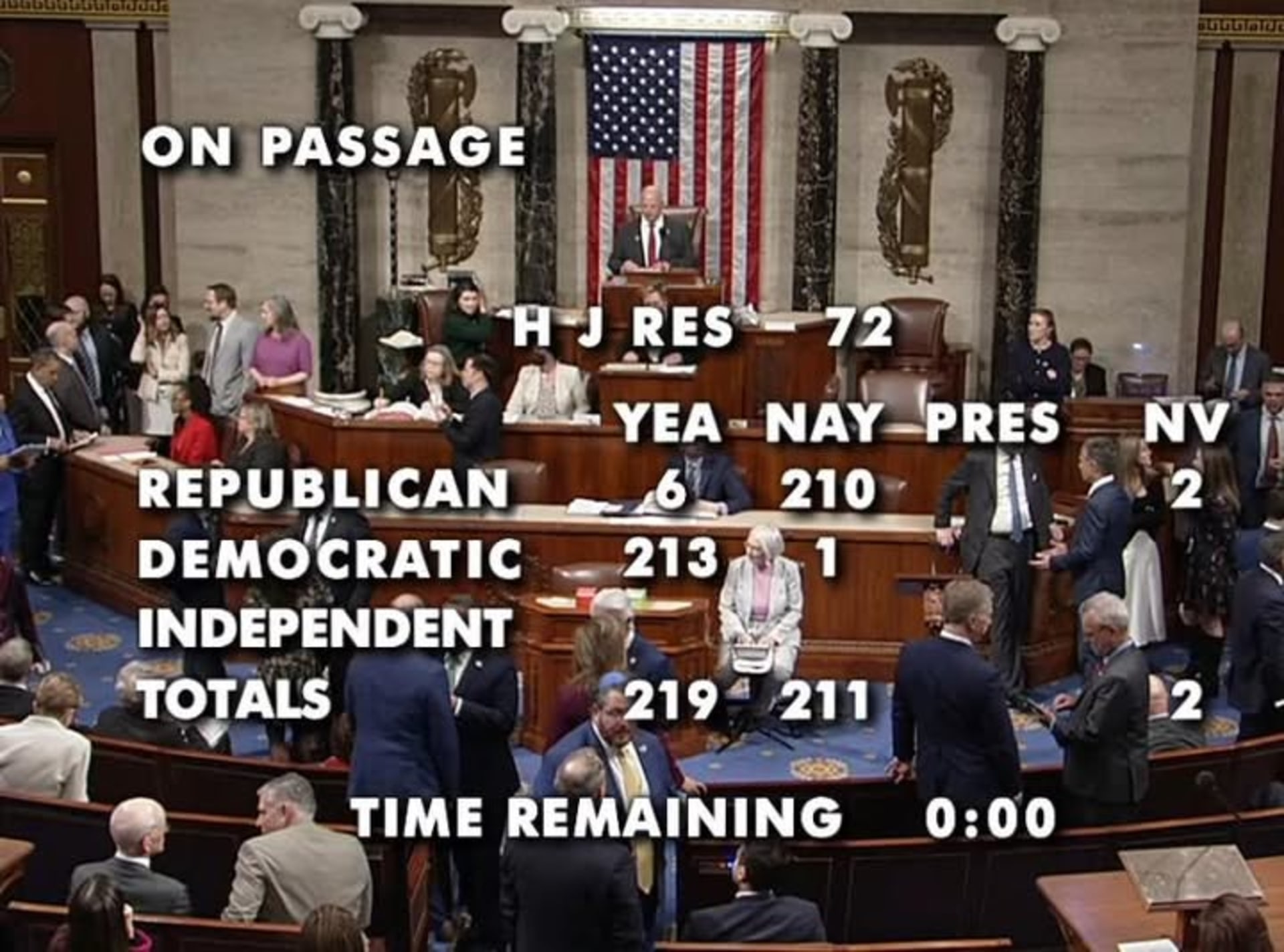
The House of Representatives voted 219 to 211 yesterday to revoke the tariffs that President Donald Trump imposed on Canada last year. The move is being portrayed as a political rebuke of the president given that six Republicans crossed the aisle to join with nearly all Democrats on the motion. The vote is better viewed, however, as example of why Congress struggles to constrain presidents.
Yesterday’s vote was made possible because of a quirk of the law that Trump used impose tariffs on Canada, the 1977 International Emergency Economic Powers Act (IEEPA). Trump argued that Ottawa’s supposed failure to stem the flow of fentanyl into the United States constituted a national emergency under the provisions of IEEPA, empowering him to impose tariffs, even though the law does not expressly give him that power.
Congress passed IEEPA a half-century ago to rein in what it saw as the abuses of Richard Nixon’s presidency while recognizing that presidents will inevitably confront national emergencies. To provide a check on the White House, IEEPA authorized the House and Senate to challenge presidential emergency declarations using fast-track procedures that skirt many of the internal obstacles that slow down and often derail legislation on Capitol Hill.
Democratic Representative Gregory W. Meeks of New York, the ranking member of the House Foreign Affairs Committee, introduced a resolution last spring to terminate the national emergency Trump declared on fentanyl. Speaker of the House Mike Johnson had succeeded until this week in blocking Meeks’s resolution from coming to the floor for a vote. Republicans adopted a rule that barred floor debate on revoking the emergency declaration until after the U.S. Supreme Court rules on whether Trump’s expansive and unprecedented use of IEEPA passes legal muster. (The U.S. Court of Appeals for the Federal Circuit ruled last August that IEEPA did not authorize presidents to impose tariffs.) The Supreme Court’s ruling is expected before its term ends this summer.
The ban on Meeks’s resolution expired on Tuesday. Johnson put forth a new rule that would have extended the ban until August. However, three Republicans—Thomas Massie of Kentucky, Don Bacon of Nebraska, and Kevin Kiley of California—joined all Democrats in opposition.
Tuesday’s rebuff opened the door to yesterday’s vote. Three more Republicans joined the anti-tariff cause: Dan Newhouse of Washington, Brian Fitzpatrick of Pennsylvania, and Jeff Hurd of Colorado. Only one Democrat voted against the Meeks resolution: Jared Golden of Maine.
Consideration of the Meeks resolution now moves to the Senate. Because the resolution enjoys privileged status, it cannot be filibustered and can pass with a simple majority vote. Last April, the Senate passed a similar resolution revoking the president’s national emergency designation on a 51 to 48 vote. Republican Senators Susan Collins of Maine, Mitch McConnell and Rand Paul of Kentucky, and Lisa Murkowski of Alaska joined all forty seven Democrats on repealing the designation.
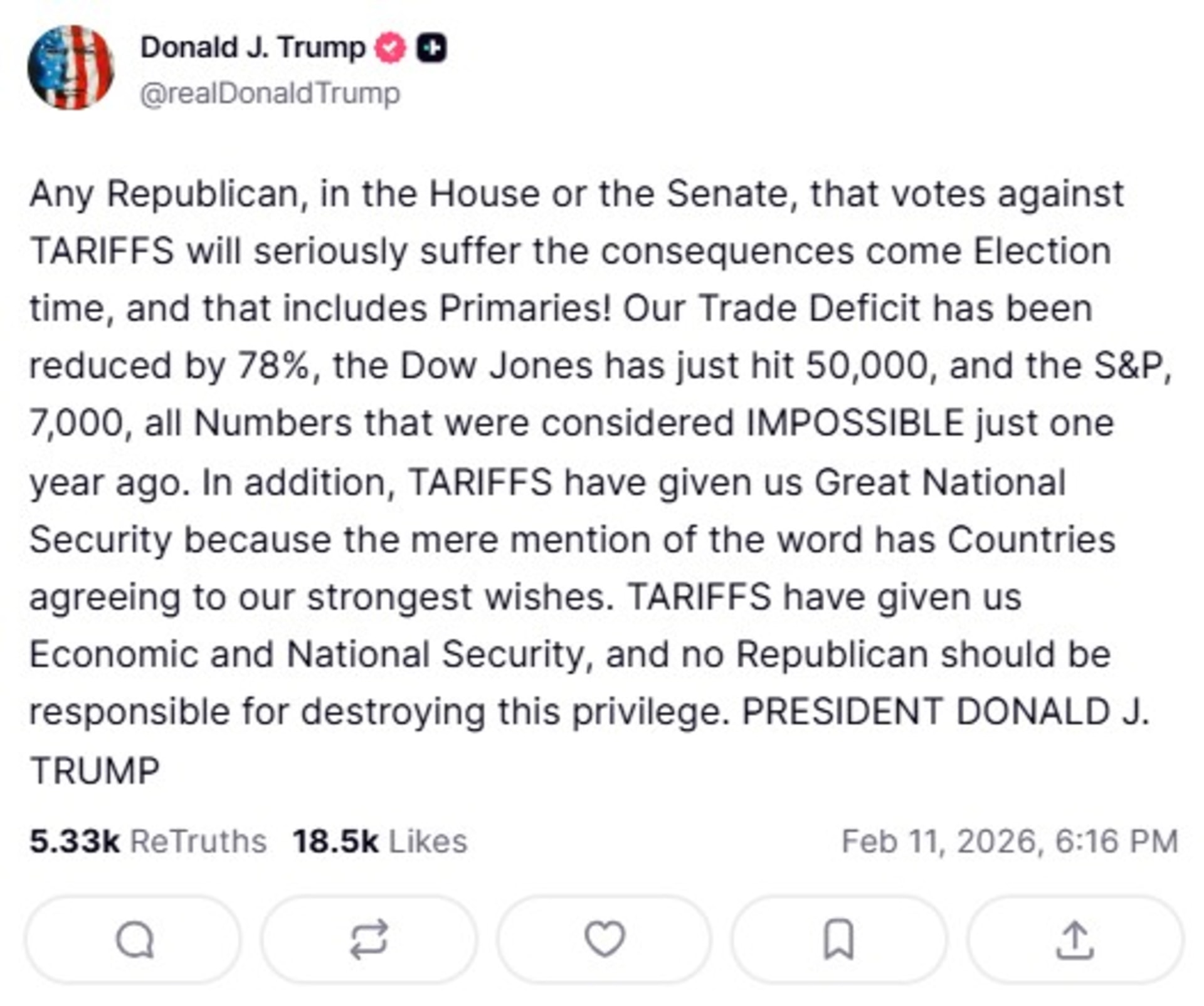
Assuming that this voting alignment holds, the Meeks resolution will head to the Trump’s desk, where he will veto it. The chances that the House and Senate will override that veto range between zero and nil. Indeed, within an hour of yesterday’s House vote, Trump took to Truth Social to threaten retribution against Republicans who crossed him.
And therein lies the rub for any Congress looking to rein in a president. To do so, it must pass legislation. That requires navigating numerous procedural hurdles on Capitol Hill, hurdles that derail most bills. Even when congressional rules clear the path to a floor vote, as happened with the Meeks resolution, lawmakers confront an unalterable fact: the president will almost certainly veto their handiwork, forcing them to muster two-thirds support in both the House and Senate. That seldom happens, particularly in today’s highly polarized political environment, because members of the president’s party are typically reluctant to defy the White House. Just last month, the House failed to override Trump’s veto of two pieces of domestic legislation. Even though both bills had passed by veto-proof margins, large numbers of House Republicans switched positions on the override vote to side with the president.
Lawmakers understand these dynamics. It is why the many Republicans House members who privately oppose Trump’s tariffs nonetheless voted against the Meeks resolution. As one told Semafor, “I am no fan of tariffs.” But with Trump poised to veto the bill, the vote seemed to be more of “a political thing.”
Indeed, the more important message from yesterday’s vote is not that some Republicans voted against Trump, but that 205 Republicans stood with him despite widespread doubts about the wisdom of the tariffs. Lawmakers are self-interested actors. They are not inclined to jeopardize their careers by tilting at windmills. That is especially the case when they can hope that events or another actor—the Supreme Court in the case of IEEPA—will spare them from antagonizing the president.
Oscar Berry assisted in the preparation of this post.