The Real Cost of the U.S.-Canada Trade Breakdown
Canada is the first U.S. ally to absorb tariff pain rather than settle. CFR’s Brad W. Setser explains what the breakdown costs both economies—and why other countries are likely watching the fallout closely.
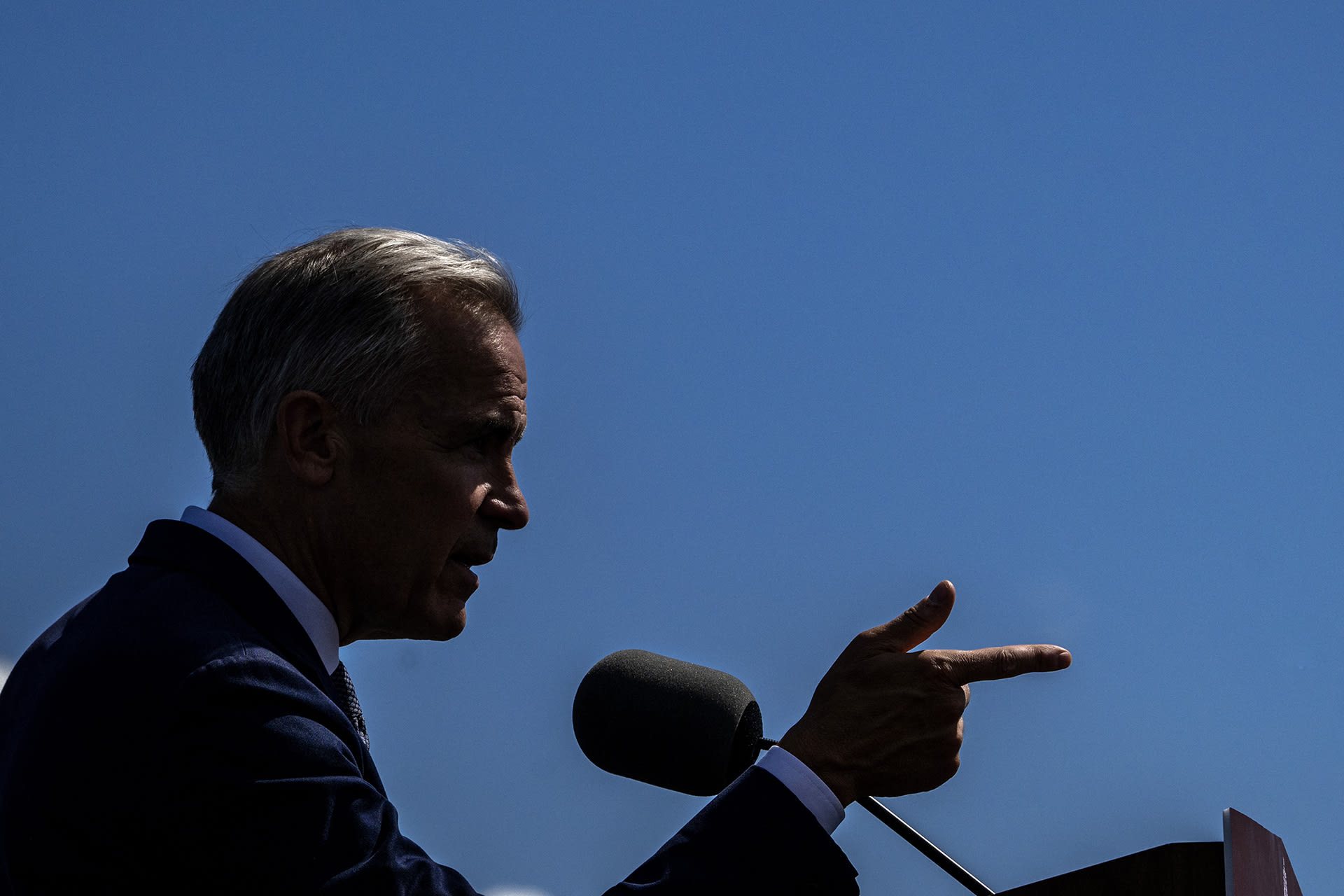

Brad W. Setser served as a senior advisor to the U.S. Trade Representative from 2021 to 2022. He had previously served in the U.S. Treasury from 2011 to 2015, where he worked on currency policy, financial sanctions, commodity shocks, and other issues. He is the author of the Follow the Money blog.
Trade talks between the United States and Canada collapsed last week, clearing the way for the Trump administration to impose new tariffs on Canadian goods.
President Donald Trump laid out the administration’s next move on Monday, August 24, writing on social media that tariffs on Canadian cars, trucks, automotive parts, and steel would rise to 50 percent on January 1, 2027. He accused Canada of “ripping off” the United States for years and said companies could avoid the levies by producing their goods in the United States. Canadian Prime Minister Mark Carney has since said his country would match U.S. tariffs “dollar for dollar,” with retaliatory levies placed on U.S. steel, dairy, appliances, agricultural equipment, pulp and paper products, electronics, and other goods beginning on September 8.
The Trump administration is imposing the tariffs on Canada using Section 338 of the Tariff Act of 1930. The White House says this dormant tariff authority permits the president to act by proclamation and override the U.S.-Mexico-Canada Agreement (USMCA), negotiated during the first Trump administration.
CFR’s Whitney Shepardson Senior Fellow Brad W. Setser, who served as a senior advisor to the U.S. trade representative from 2021 to 2022, explains what the breakdown between the United States and Canada could cost both countries and why other U.S. trading partners will be paying attention.
How much economic damage could this cause and what did both sides lose by not closing the deal?
The out-of-pocket cost of the new 50 percent tariff is $10 billion, which isn’t nothing, but it is small relative to the overall U.S. economy—less than a twentieth of a percentage point of U.S. GDP. For some products there will be substitutes available at a lower price, reducing the harm. U.S. exporters to Canada also will face new tariffs and that will cut into their sales. But there won’t be a gigantic economic cost to the United States if this doesn’t escalate further. The effect on Canada will, of course, be much larger, as Canada’s economy is one twelfth the size of the U.S. economy and Canada’s geography complicates finding alternative markets.
The real cost of the breakdown in the negotiations, though, is higher than the “just pay it” $10 billion cost of the tariffs and a similar loss of export sales. The proposed deal would have brought down some of the earlier tariffs, including tariffs—such as those on primary aluminum—that have increased costs for U.S. businesses without generating much of an increase in U.S. production. The U.S. aluminum market doesn’t clear without primary aluminum imports from Canada, so the tariff pushed the U.S. price of aluminum well above the global price—and new investment in aluminum cannot compete with the hyperscalers that are bidding up the price of needed electricity.
Trump leaned on Section 338 to override the USMCA for these tariffs. Why, and what does that mean for the USMCA?
The USMCA was already functionally dead in many ways. The Section 232 national security tariffs on steel, aluminum, autos and trucks had already ended open and tariff-free trade in key sectors. To be sure, the USMCA exception to other tariffs has mattered, and it kept most North American trade tariff-free. But there is no doubt that the United States was already in violation of its USMCA commitments.
Section 338 in theory provides the legal basis for the United States to impose tariffs to retaliate for measures that discriminate against U.S. goods, like Canada’s ban on U.S. alcohol purchases by provincial liquor stores that was put in place after earlier U.S. tariffs. Section 338 is also legally untested—it literally has never been used before—and there is a decent chance the courts rule that the Trump administration has overstepped its legal authority.
But the precise legal tool used here matters less than the reality that the United States and Canada have entered a new round of escalation. The 338 tariffs are in response to measures that Canada put in place after the 232 tariffs on industrial metal, industrial machinery and autos. Canada has announced it will retaliate for the 338 tariffs. And the United States is threatening to raise the auto tariff to a prohibitive 50 percent if the Canadians don’t back down. The end result will be a progressive reduction in the amount of tariff-free trade between the two countries. For now, though, neither side has restricted the biggest trade flow between Canada and the United States: the four million barrels a day of oil that Canada sends south.
Carney says the talks collapsed over a U.S. demand that would have limited Canada’s ability to make trade deals with other countries. Is this a fight about China, or about something more fundamental about North American trade?
Let’s step back a minute. The USMCA is a traditional free trade agreement, which reduces trade barriers among its three members. But it doesn’t limit each member country’s ability to tariff, or not tariff, trade with third parties. So, in theory, auto trade between the United States and Canada should not have any tariffs, but Canada is free to extend tariff free trade with Europe or China, while the United States is free to impose substantial auto tariffs on Europe or China to protect its own market. That is fundamentally different from a customs union, like the European Union (EU), which is defined by a common external tariff and a common external trade policy.
In many ways, the existing free trade agreement worked better—when overall U.S. tariffs were relatively low and global trade was relatively open. But now U.S. tariffs are relatively high, which has meant that producing goods in Mexico or Canada with imported parts from countries that the United States heavily tariffed has become an obvious way around the U.S. tariff wall.
And concretely, the United States has high tariffs on certain goods from China, including on Chinese autos, that haven’t always been matched by either Mexico or Canada. Although Canada did a deal with China that allows the importation of a limited number of Chinese cars, Mexico is the bigger current market for Chinese autos. China now makes roughly one in four new cars sold in Mexico. General Motors has been making cars in China for sale in Mexico, and the market share of the Chinese brands is also now substantial.
It isn’t completely clear what the United States asked of Canada in the most recent round of talks. The New York Times has reported that Canada was open to creating a Fortress North America—with aligned tariffs for countries outside the agreement—but only so long as the United States completely dropped its current auto, steel and aluminum tariffs on Canada, something Trump hasn’t been willing to consider.
The current structure of the USMCA—with, at least in theory, open internal trade and different national trade policies toward third parties, including big players like Europe and China—works differently in a world of high U.S. tariffs, and likely does need to be changed. At the same time, the Canadian view that any changes to the core structure of the USMCA should be worked out in the renegotiation of the broader free trade agreement, not in a deal that only reduces some of the latest tariffs, is hardly a surprise.
Canada is the first U.S. ally to accept real economic pain rather than give in to tariff pressure. Could other countries follow suit?
Europe’s so-called capitulation to U.S. trade threats—the EU agreed to reduce its tariffs on U.S. goods even as the United States raised tariffs on EU goods—is not politically popular in Europe. For now, though, the EU remains committed to the deal brokered with the Trump administration, preferring the certainty of a flat 15 percent (or lower, after the Supreme Court struck down IEEPA) U.S. tariff to the risk of an even higher rate.
But there is no doubt that Brussels is watching Ottawa closely. And it is, of course, also watching Washington. If the United States goes ahead with various existing tariff threats against European Union countries—over pharmaceutical pricing or digital regulation—I would expect the EU to retaliate by ripping up its current deal with the United States.
Another point to watch: Canada’s trade surplus with the United States isn’t nearly as large as Mexico’s—or, for that matter, Vietnam’s. At some point the United States may want to change the terms of some of the other Trump second term deals, and that always risks a cycle of retaliation and counterretaliation.
This work represents the views solely of the author(s). The Council on Foreign Relations is an independent, nonpartisan membership organization, think tank, and publisher, and takes no institutional positions on matters of policy.