The U.S. Corporate Tax Base That Now Resides in Ireland
America’s largest companies often pay more tax in Dublin than they do in D.C.
By experts and staff
- Published
 Brad W. SetserCFR ExpertWhitney Shepardson Senior Fellow
- Research Associate, Geoeconomics
This is a joint post with Michael Weilandt, a Research Associate at the Council on Foreign Relations.
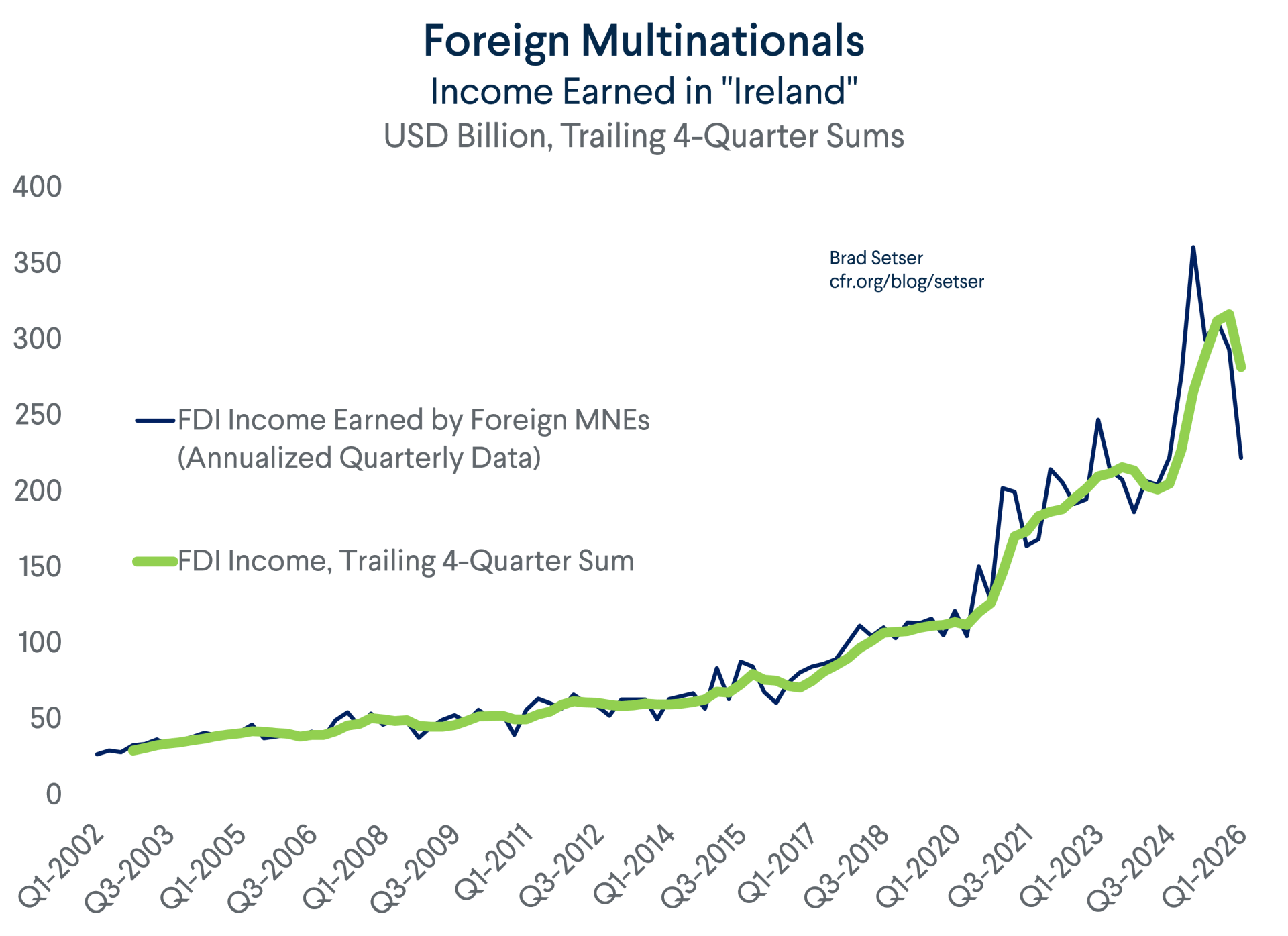
Foreign multinationals, mostly American multinationals, booked just under $300 billion in profits in Ireland last year.
That isn’t just because Ireland used to have a 12.5 percent headline corporate tax rate, and its current 15 percent rate on large firms is below the U.S. headline rate of 21 percent.
Ireland also permits deductions for qualifying expenditure on intangible assets, including the purchase of intra-group intellectual property, which can substantially reduce firms effective Irish tax rate.* And since Ireland is a member of the OECD and most firms now want to book their profits in “BEPS” compliant jurisdictions, Ireland is the center for corporate tax avoidance that isn’t (quite) a pure tax haven.
The names of the firms that take the most advantage of lower tax rates in Ireland aren’t exactly a secret.
Apple—widely thought to be Ireland’s largest individual taxpayer thanks to its mostly Irish $80 billion “global” profit—hasn’t reported the amount of cash it paid the Irish government in 2025.
Microsoft has reported the tax it pays the Irish government. Per its latest 10-K (p.75), in FY 2026, it booked over 80 percent of its $62.5 billion international profit in Ireland. Microsoft also reports that it actually paid $6.5 billion to the Irish government (and another $5.5 billion in tax in other foreign jurisdictions), more than the $6.25 billion it paid to the U.S. Treasury. Paid here means a transfer to the Irish treasury, not a set aside to cover expected FY 2026 taxes.** It set aside $12 billion to cover expected 2026 foreign tax payments, and $2.5 billion for expected U.S. federal income tax.
Eli Lilly, like Microsoft, paid more in tax to Dublin than to D.C. Eli Lilly’s 10-K states that it paid $6.6 billion in tax to Ireland in 2025, and only $3.3 billion to the U.S.
Now, Eli Lilly likely also played a bit of a tax game in (calendar year) 2025, as its Irish tax payments were unusually high.
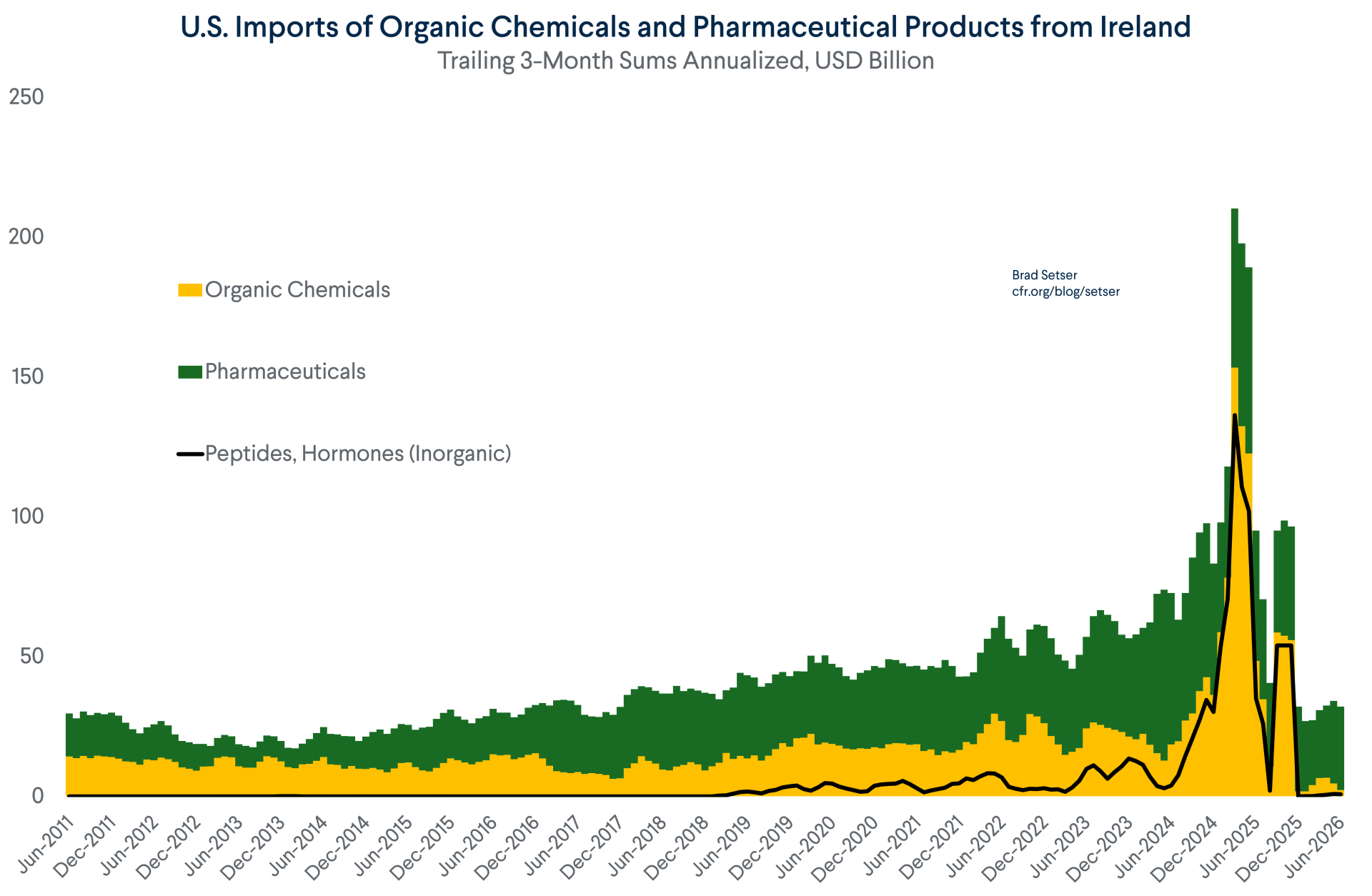
Lilly and the other big pharmaceutical companies shipped to the United States back in the first quarter of 2025. Back then the pharmaceutical companies were petrified that President Trump might actually impose real tariffs on profitable American firms playing tax games abroad. Those tariffs though never materialized. Firms did “deals” with the Trump administration instead.
But the threat of tariffs had a huge impact on the trade data—Lilly rushed to produce Mounjaro’s active ingredient in its Irish factories, and it then rushed the product to the U.S. ahead of the tariff deadline (there is a six-digit line item in the trade data that is more or less Mounjaro, for the curious). And it seems like Lilly’s Irish subsidiary booked the profit on its sales to Lilly U.S. ahead of any actual sale to U.S. consumers.***
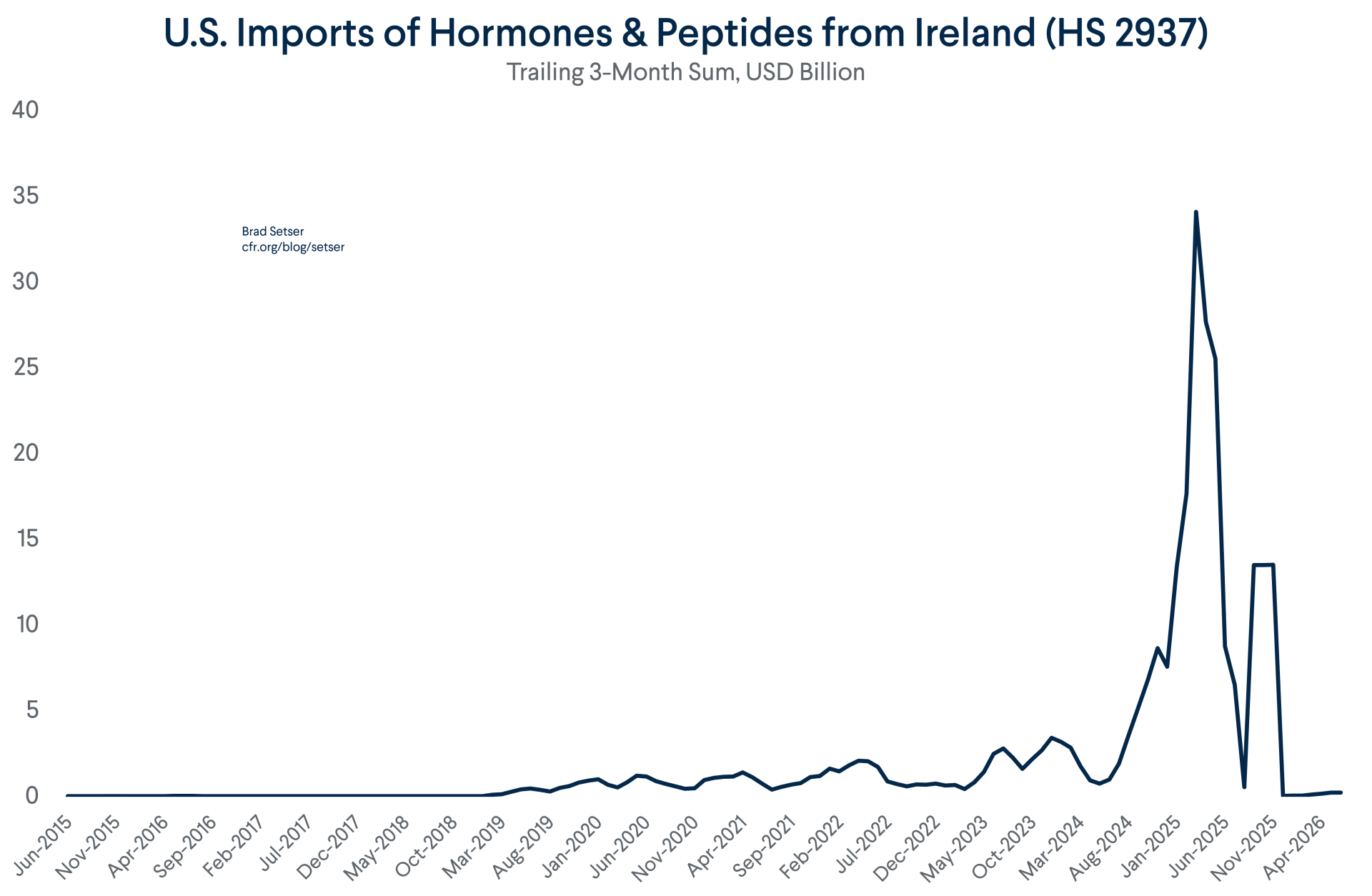
The net result, obviously, was a big Irish tax liability. And a big windfall for Ireland’s Treasury, as Lilly displaced Pfizer as Ireland’s third largest corporate tax revenues.
The $15 billion a year that these firms generally pay in tax in Ireland is real money, as they say (they paid €13 billion in 2024 according the Irish fiscal council; the 2025 number will be out soon).
Ask the top brass at the Pentagon. $15 billion a year is probably three new attack subs, or five Arleigh Burke class destroyers (think mobile air defense systems). Or for several batteries of Patriots (if Raytheon can make them). Had those funds been paid to the U.S., it would not quite cover the cost of an aircraft carrier (costs have increased recently) but it would have come close. $30 billion over two years is a carrier task force. Enough, in other words, to make the tradeoff between guns and butter a bit less acute.
That is simply from tax that firms are paying in Ireland on the profit from intellectual property largely developed in the United States.
And profit shifting remains a real problem.
That is what the Irish data from 2025 shows us. And there is no sign that 2026 will be much different.
A lot of that is Apple and Microsoft.
Both have global profits will in excess of the total profits of all the large American pharmaceutical companies.
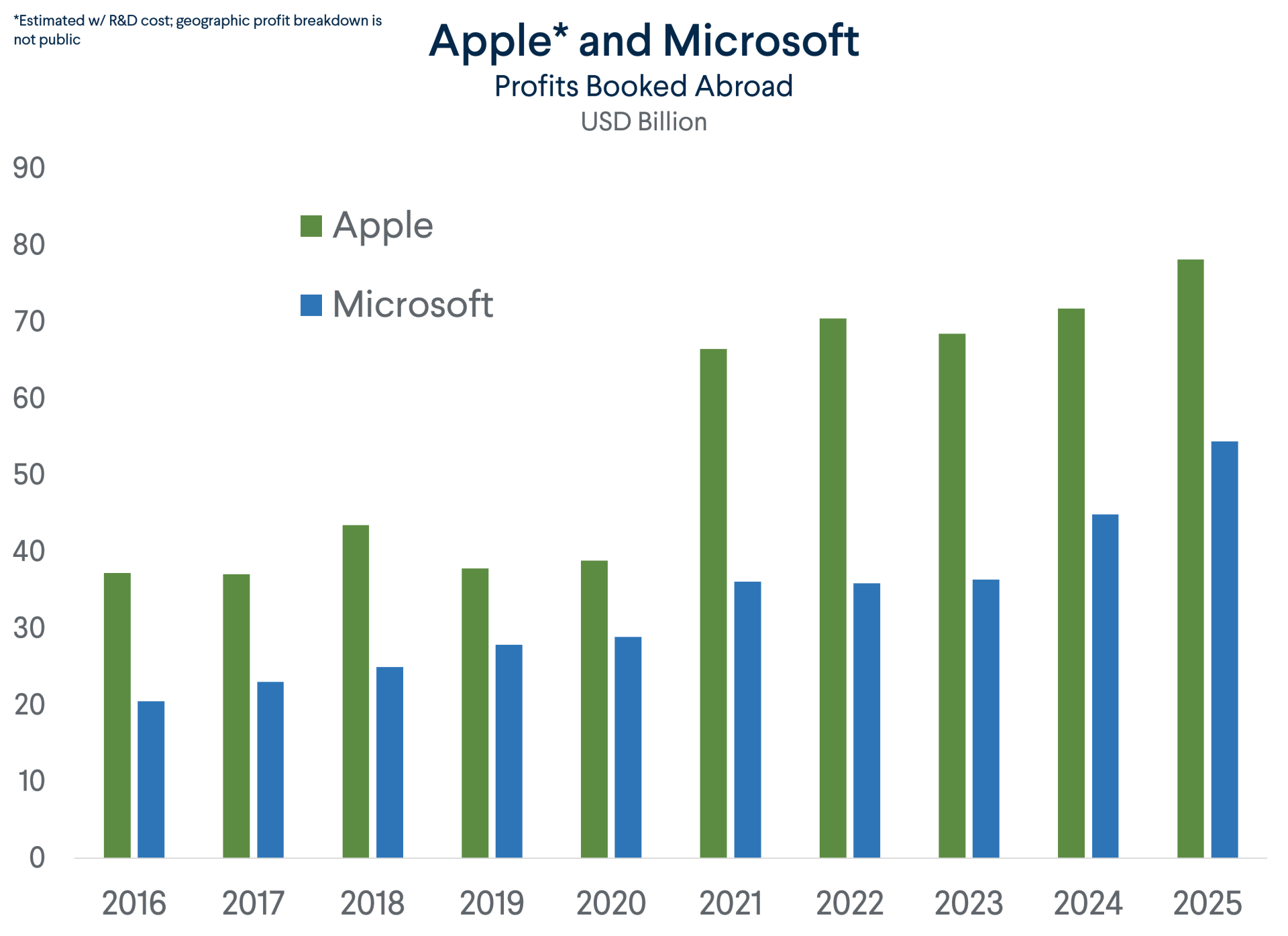
But Apple and Microsoft are essentially moving the profit from their foreign sales to Ireland. They still pay a decent amount of U.S. tax (as do Alphabet and Nvidia, which both U.S.-shored their intellectual property a few years back).****
The tax game of “Big Pharma” (the top six U.S. pharmaceutical companies by revenue) is a bit different. Most aggressively try to move the profit on their U.S. sales out of the U.S., which generally has required offshoring both their intellectual property and the actual production of the active ingredients for their most profitable drugs.
Back in 2023 and 2024, the top six U.S. pharmaceutical companies didn’t set aside anything to pay expected U.S. tax. They have pointed out (to me, and to Senator Wyden) that they did make cash payments to the U.S. Treasury, but those payments were the settlement of the legacy tax liability on their pre-2017 profit (don’t ask, it is complicated—the key words are deferral and deemed repatriation).
In 2025, the major pharmaceutical companies did set aside a few billion dollars to pay U.S. tax. Eli Lilly doesn’t seem to be quite as aggressive in sweeping profits out of the U.S. as its peers; it has consistently reported setting aside a bit of money to pay expected U.S. taxes on its global profit. Johnson and Johnson, which historically has swept all its profit out of the United States, also had to set aside funds to pay U.S. tax as part of some litigation related tax gymnastics.
But make no mistake, Big Pharma continues to engage in aggressive forms of tax avoidance —and still pays almost nothing in U.S. tax. See the chart below.
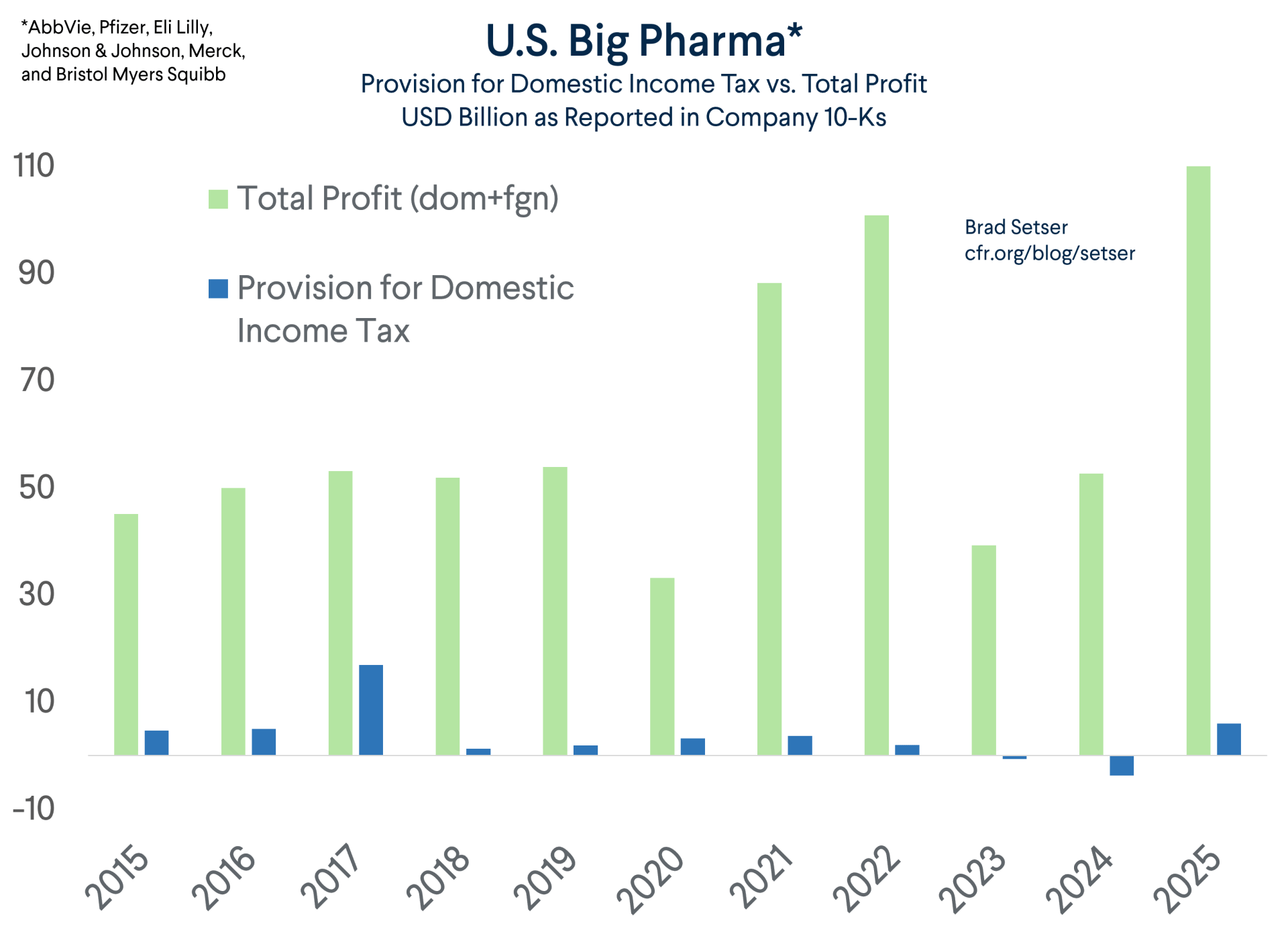
And there is no evidence—at least, none that we see—that suggests any of the Trump deals have changed the core tax structure of big pharma.*****
The top six generally still report losing money on their U.S. operations.
The big companies also generally report that the U.S. accounts for most of their revenue.
And they generally report that they make most of their money offshore (particularly if “special situations” like corporate reorganizations, mergers, and litigation set asides are left out). Just look at the firms’ own 10-Ks.
AbbVie reports losing $3.5 billion in the U.S. and making $10 billion abroad.
Pfizer reports just $776 million in U.S. profit and almost $7 billion abroad.
Bristol Myers Squib reported a $19 million loss in the U.S. and $9.3 billion profit abroad.
Merck reported a $5 billion loss in the U.S. and $26 billion profit abroad.
Johnson and Johnson would be the same in a typical year. Back in 2024, it reported a $500 million loss in the U.S. and $17 billion profit abroad, but its 2025 tax liability was driven by the reversal of some litigation set asides (see page 69 of J&J’s latest 10-K).
Lilly seems to have a more balanced tax structure: in 2025, it reported making $14 billion in the U.S. and $12 billion abroad.
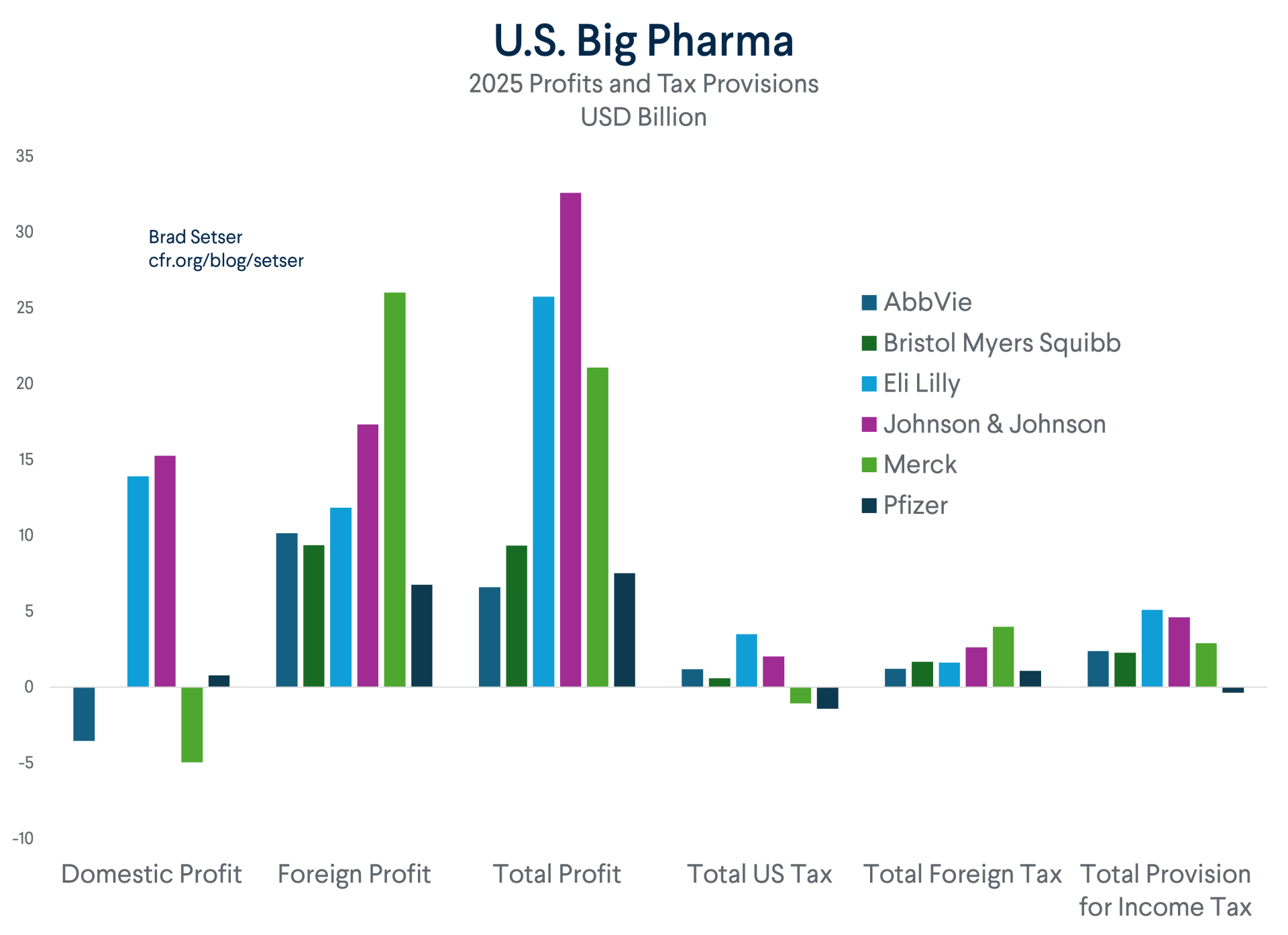
As a result, the leading U.S. pharmaceutical companies pay more in tax abroad than in the United States, with several firms setting aside nothing to cover their expected U.S. income tax liability.
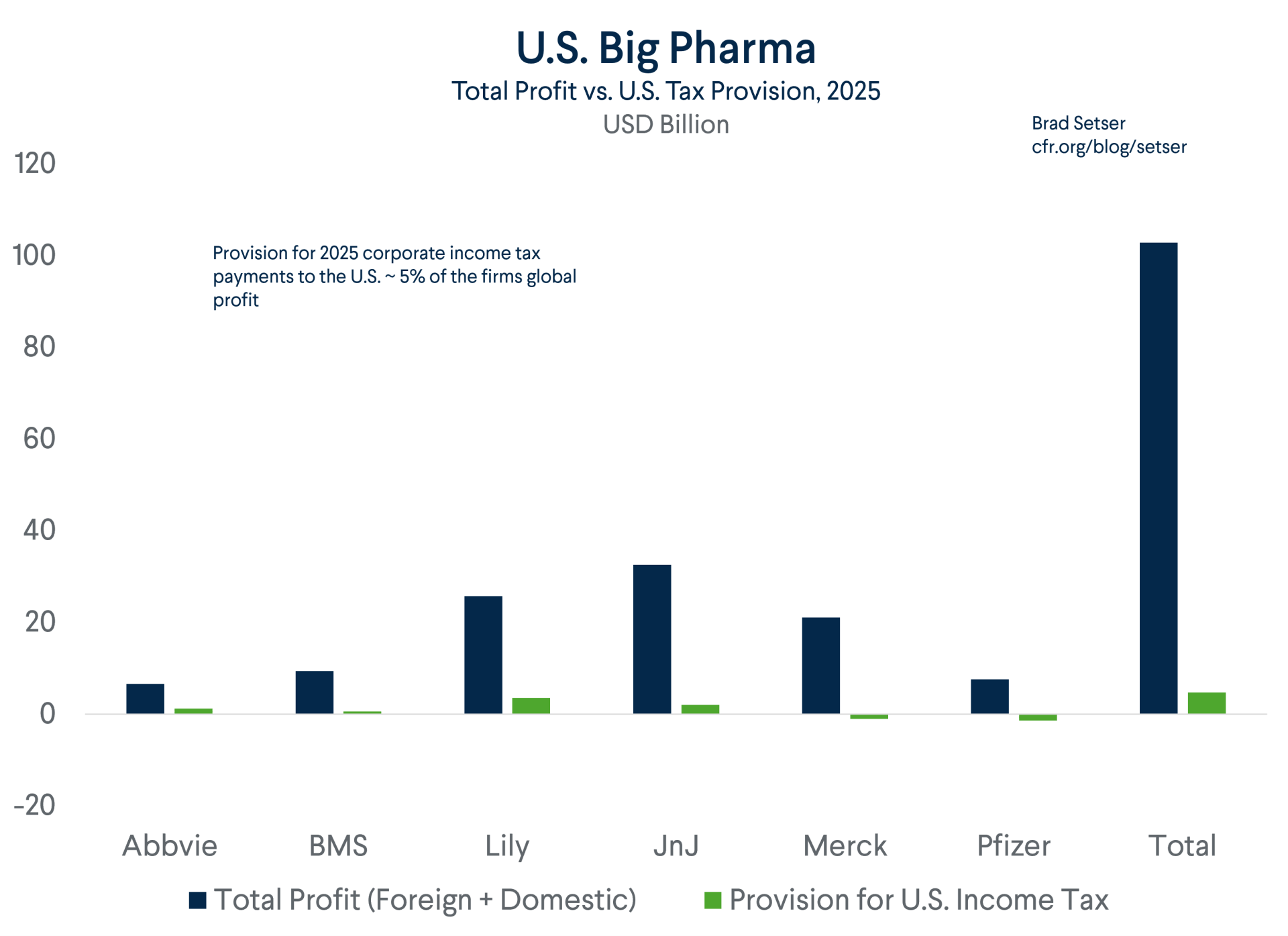
In a normal year, without any corporate reorganizations or litigation related profits, only one of the top six would set aside a meaningful sum to pay U.S. tax. So, in a typical year, there would something like $100 billion in profits and only a few billion set aside to pay expected U.S. tax.
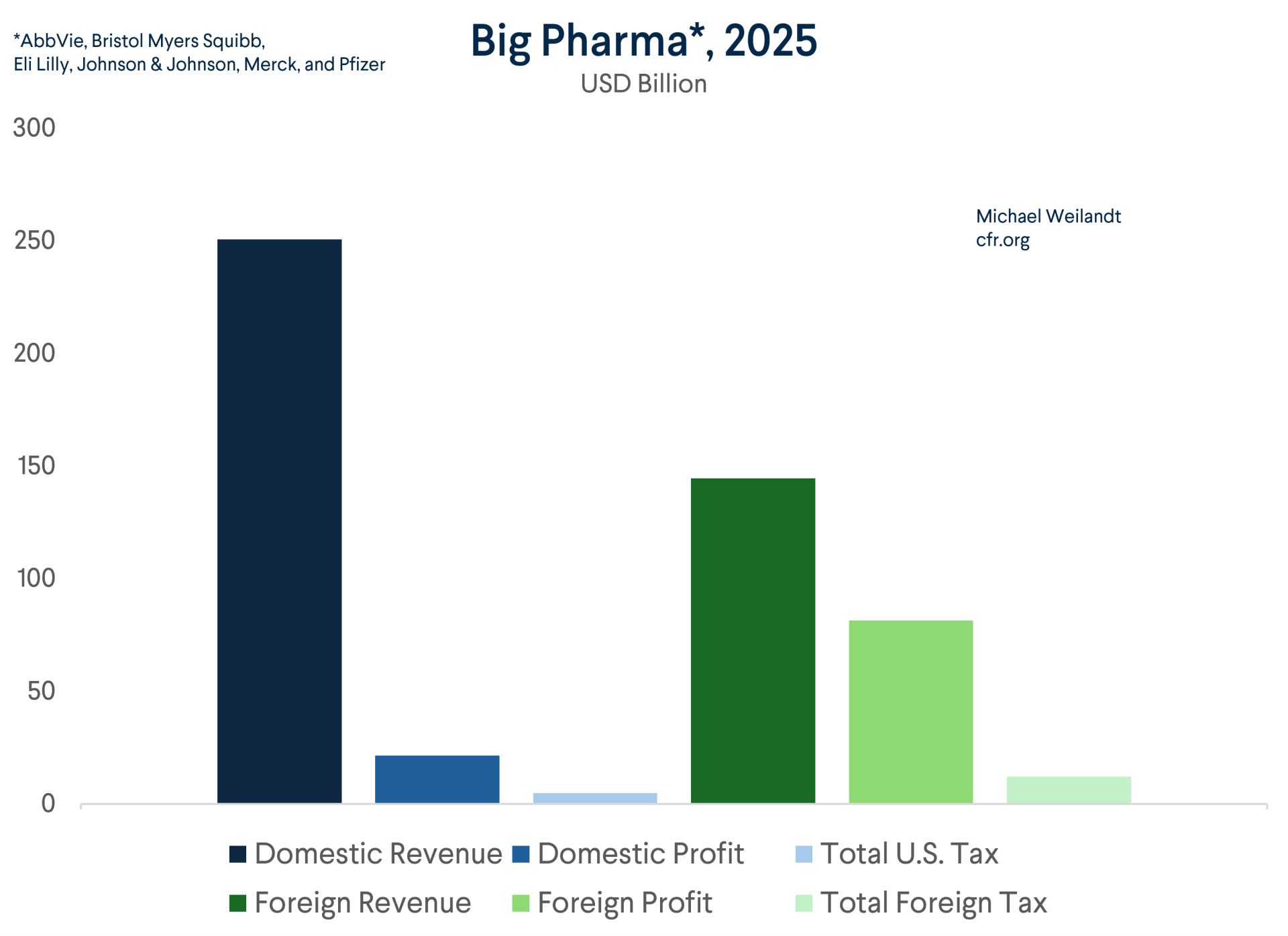
This shows up in a couple of easily verifiable plots.
While Big Pharma is the most obvious case, the incentive to offshore jobs, production, and profits isn’t limited to one sector.
In the technology sector, for example, a number of firms set aside much less to cover expected U.S. corporate tax payments than would be expected given their large global profits.
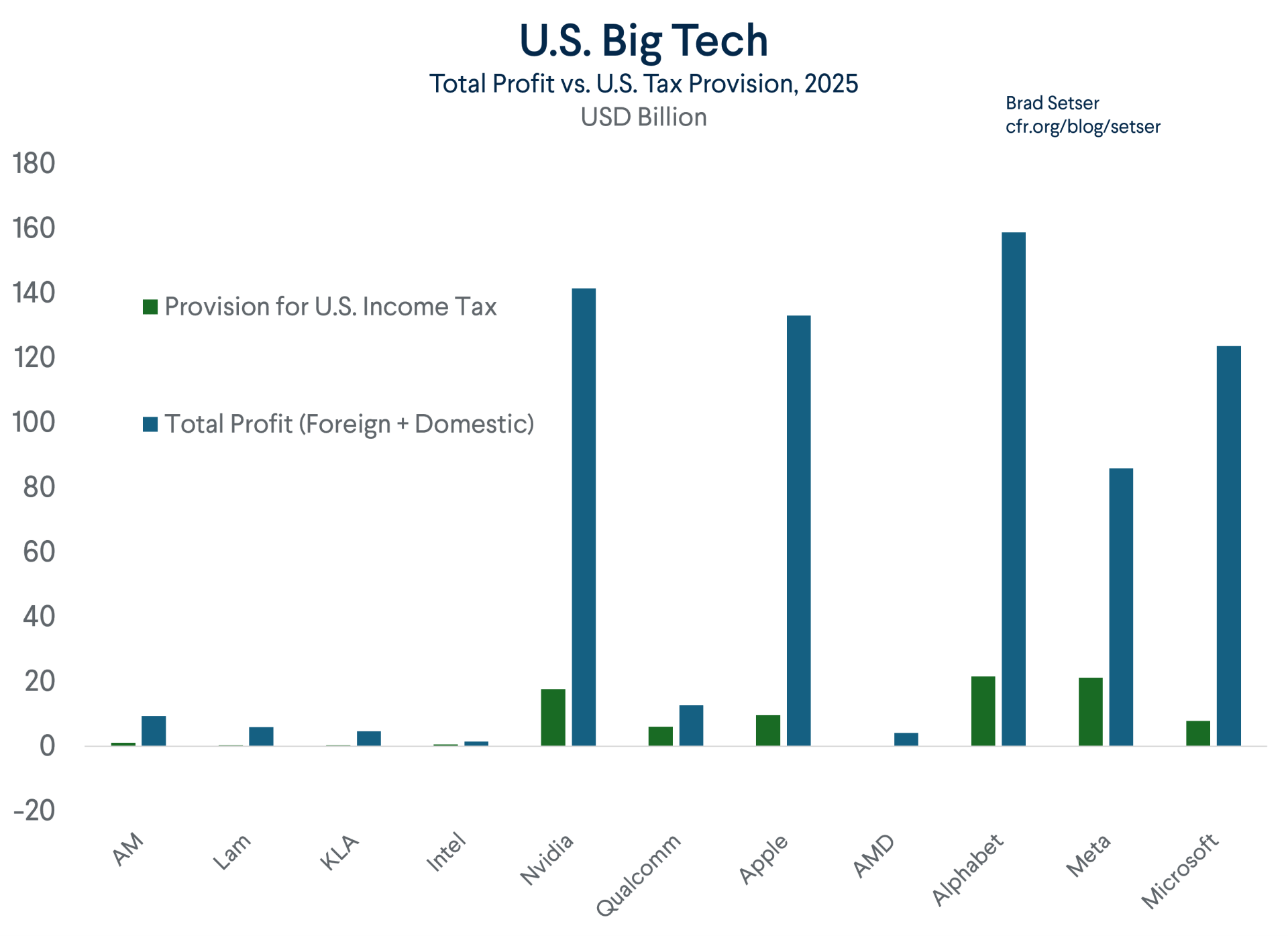
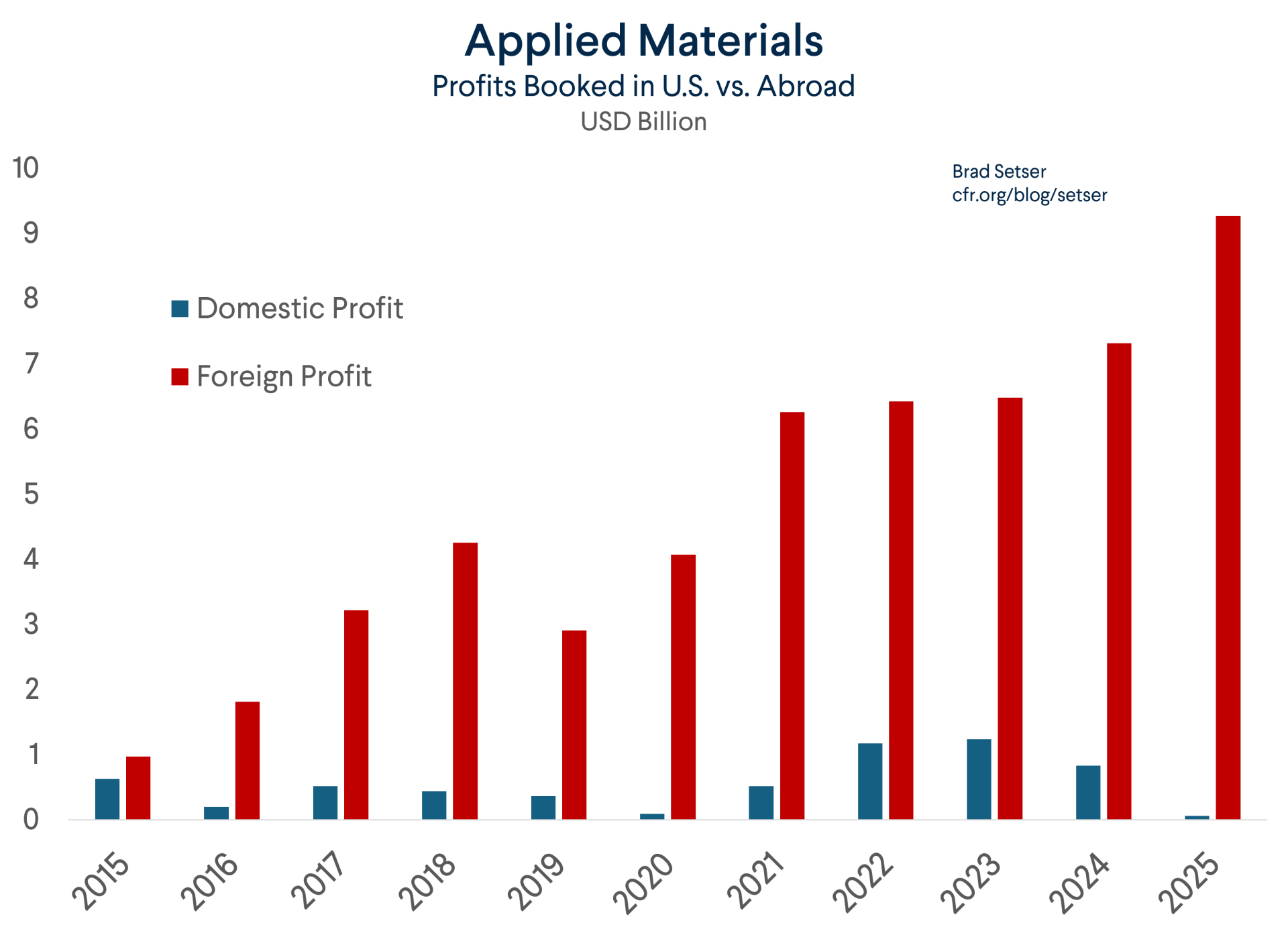
Take a very strategic sector, the production of the equipment used to manufacture semiconductors.
Applied Materials reports making all its money abroad (almost certainly in Singapore, as noted in its 10-K, where Applied Materials “have been granted additional conditional reduced tax rates” which expire in fiscal 2030) and almost nothing in the U.S.
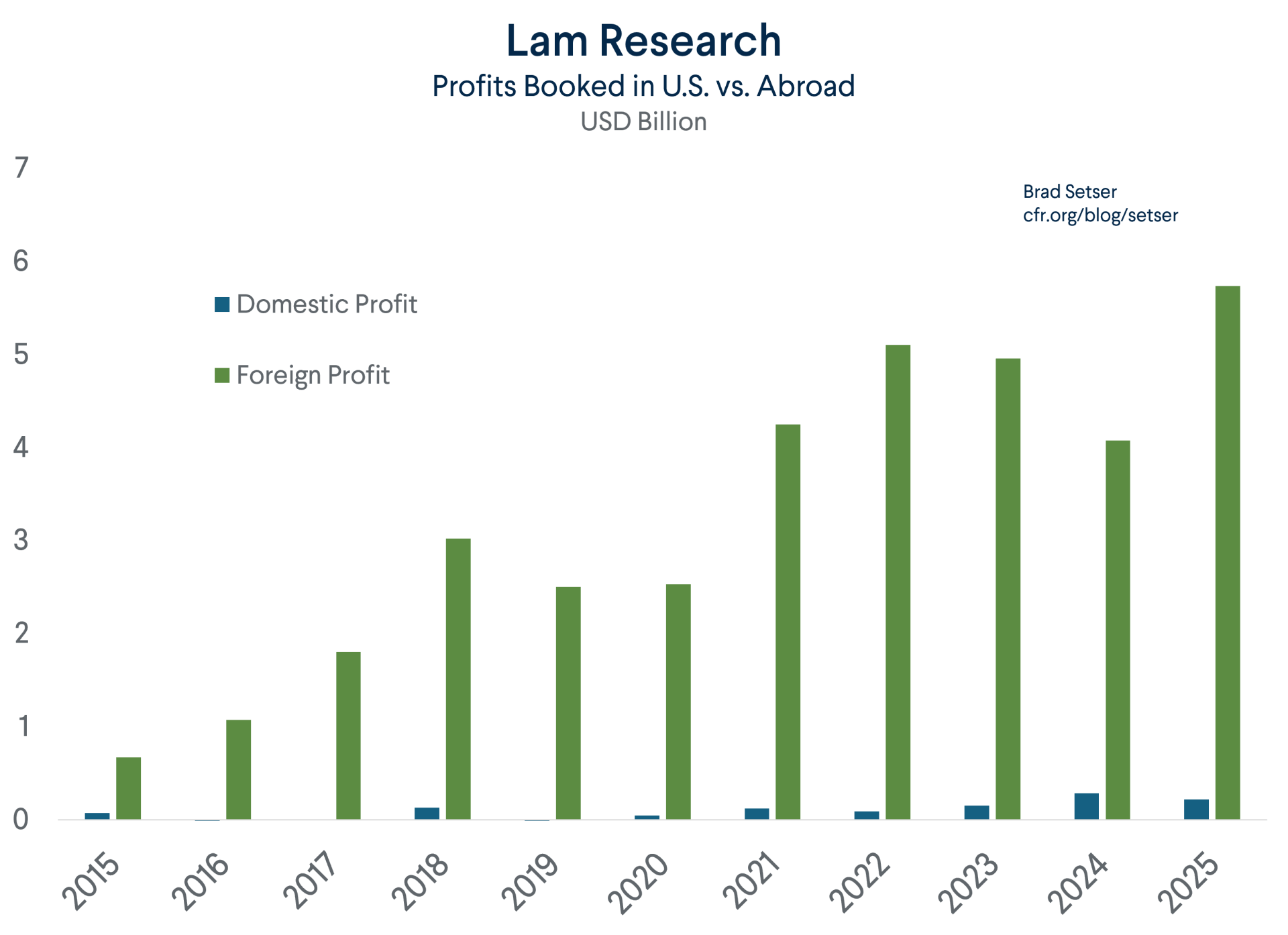
Lam Research also reports making all its income abroad, using Malaysia as its tax hub (from its 10-K: “Effective from fiscal year 2022, the Company has a 15-year tax incentive ruling in Malaysia for one of its foreign subsidiaries.”)
KLA is a bit more patriotic; it actually pays a bit of U.S. tax.
To be sure, none of this is in any way illegal. Every firm can honestly report that it pays all the tax that it is legally due.
The issue is the law, which continues to create “pay tax in America last” incentives, and often “produce in America last” incentives too.
This can and should be changed, likely through a bipartisan coalition that unites around a patriotic tax agenda.
* Most U.S. big pharma firms are still paying a bit of cash to the U.S. Treasury to settle their deferred international tax liability from the ere Tax Cuts and (Irish) Jobs Act; the cash tax paid thus exceeds the amount they set aside out of current profit for expected current tax. A few firms have tried to use this fact to obscure the fact that they don’t think they owe anything to the U.S. federal government out of their 2023 or 2024 profits.
** Alphabet and Nvidia benefit from the lower tax rate on foreign profits in the U.S. tax code; they aren’t paying tax on their foreign profits at 21 percent. But because their IP is in the U.S., the U.S. government gets the lion’s share of their tax paid. When the IP is offshore, the U.S. only gets a small top up tax.
***
**** Large groups with annual consolidated revenues of at least €750 million are subject to a 15 percent minimum effective tax rate under Pillar Two.
***** Gilead is much less aggressive in its profit shifting.
This work represents the views solely of the author(s). The Council on Foreign Relations is an independent, nonpartisan membership organization, think tank, and publisher, and takes no institutional positions on matters of policy.