De-reservification, Not De-dollarization
The world isn’t moving away from the dollar. It is shifting its dollars from traditional reserves to state banks, pension funds, and other quasi-sovereign investors.

This is a joint blog with Alex Etra, Senior Macro Strategist and head of Flow of Funds at Vanda Research.
The IMF’s data on the currency composition of foreign exchange (FX) reserves is scrutinized carefully for any signs that the world is shifting way from the dollar.
Yet it doesn’t really matter that much if the dollar’s share of reserves has shifted from 56.5 percent to 57 percent. The ink-to-impact ratio of the quarterly reporting on the latest COFER data is all off.
Neither the stock of global reserves nor the stock of dollar reserves has changed much in the last ten years.
The action is elsewhere.
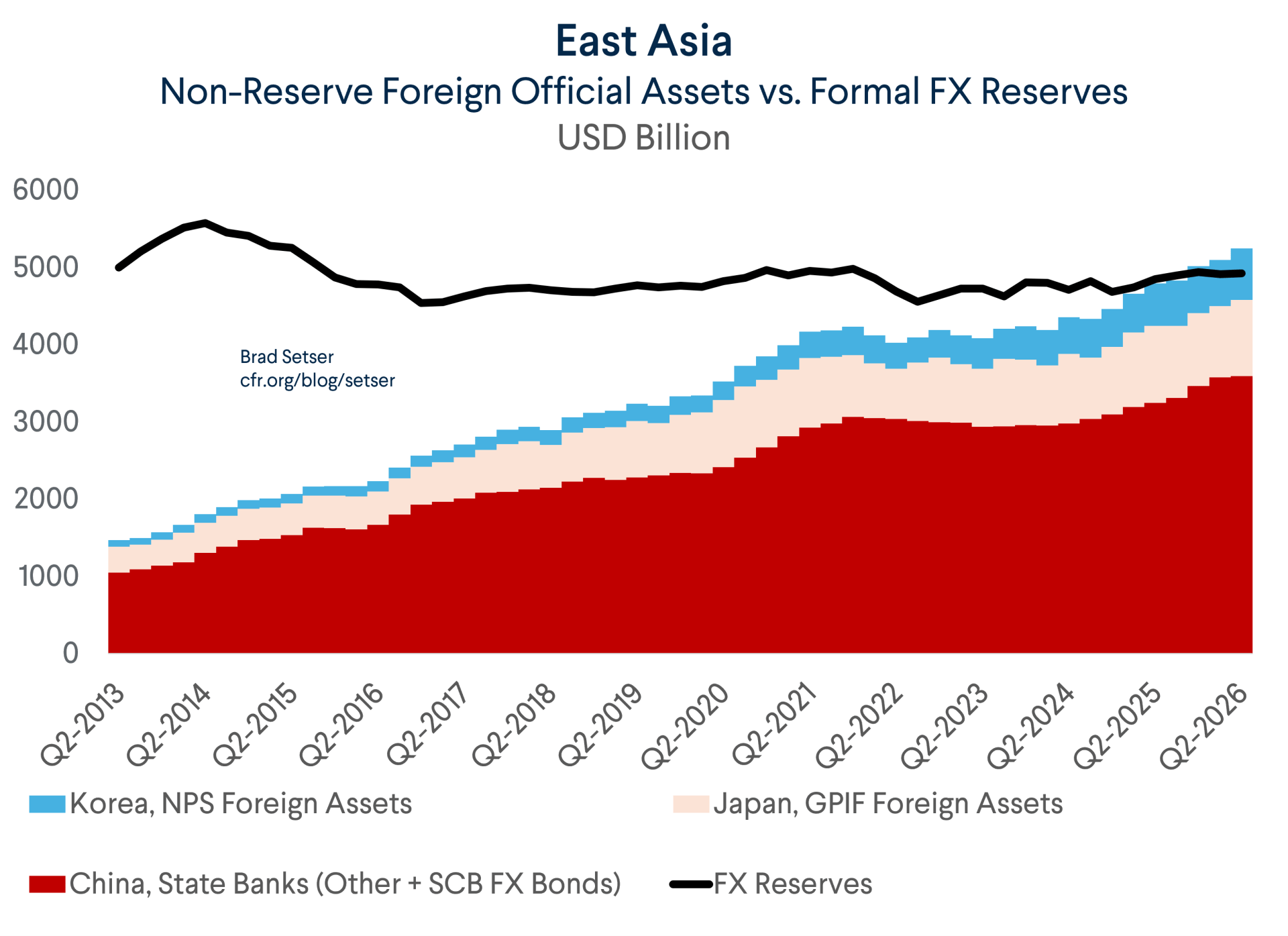
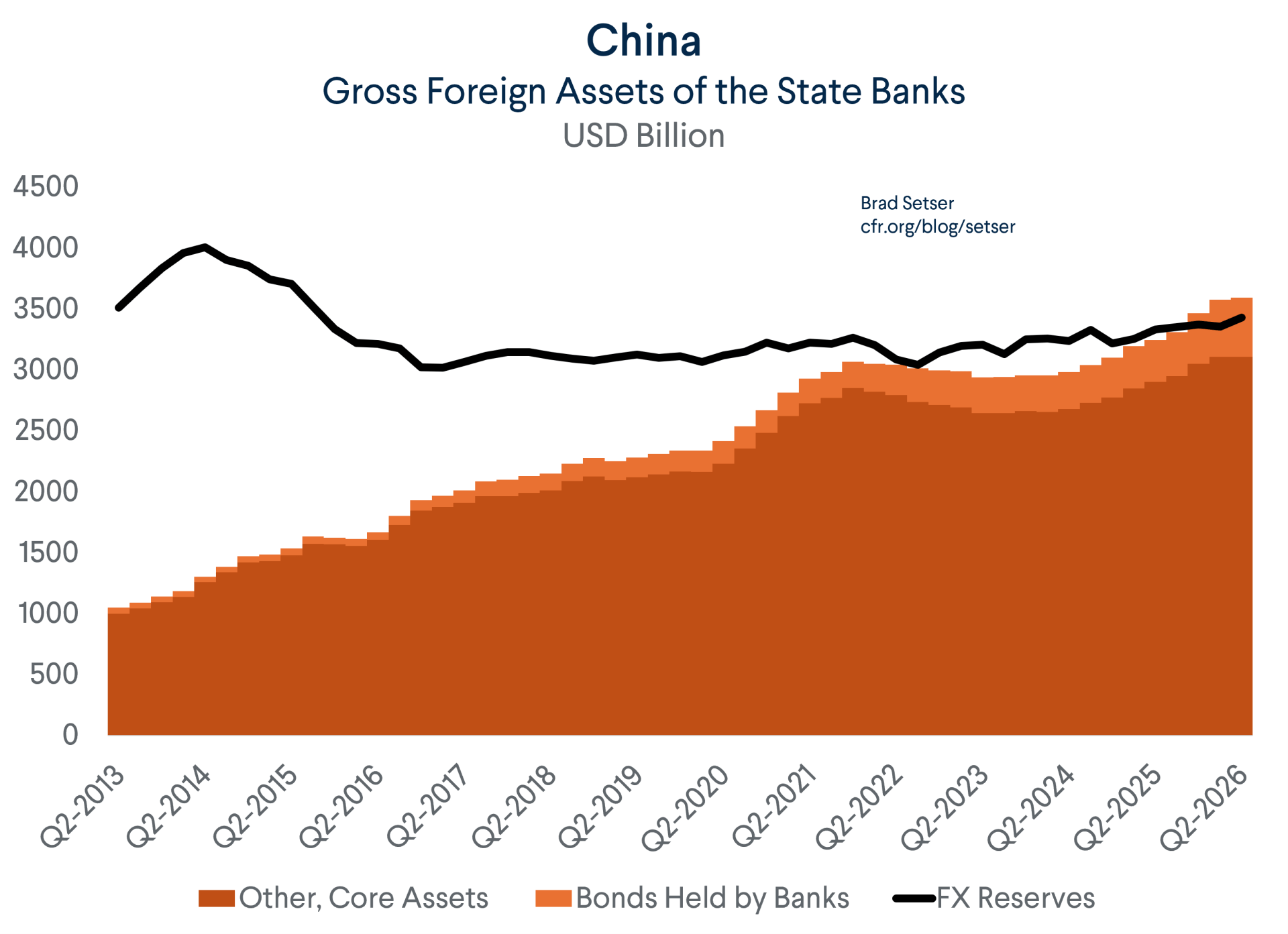
China’s state banks (per the Bank of International Settlements) have almost as many foreign assets as the central bank (PBOC).
Japan’s Government Pension Investment Fund (GPIF) has almost as many foreign assets ($986 billion) as the government has FX reserves ($1.1 trillion at the end of August). Japan’s FX reserves are on the books of the Ministry of Finance and the GPIF is overseen by the Ministry of Health, Welfare and Labor—so these are almost all assets of the Government of Japan or the broader public sector, not its central bank.
Korea’s National Pension Service has more foreign assets than the Bank of Korea has FX reserves.
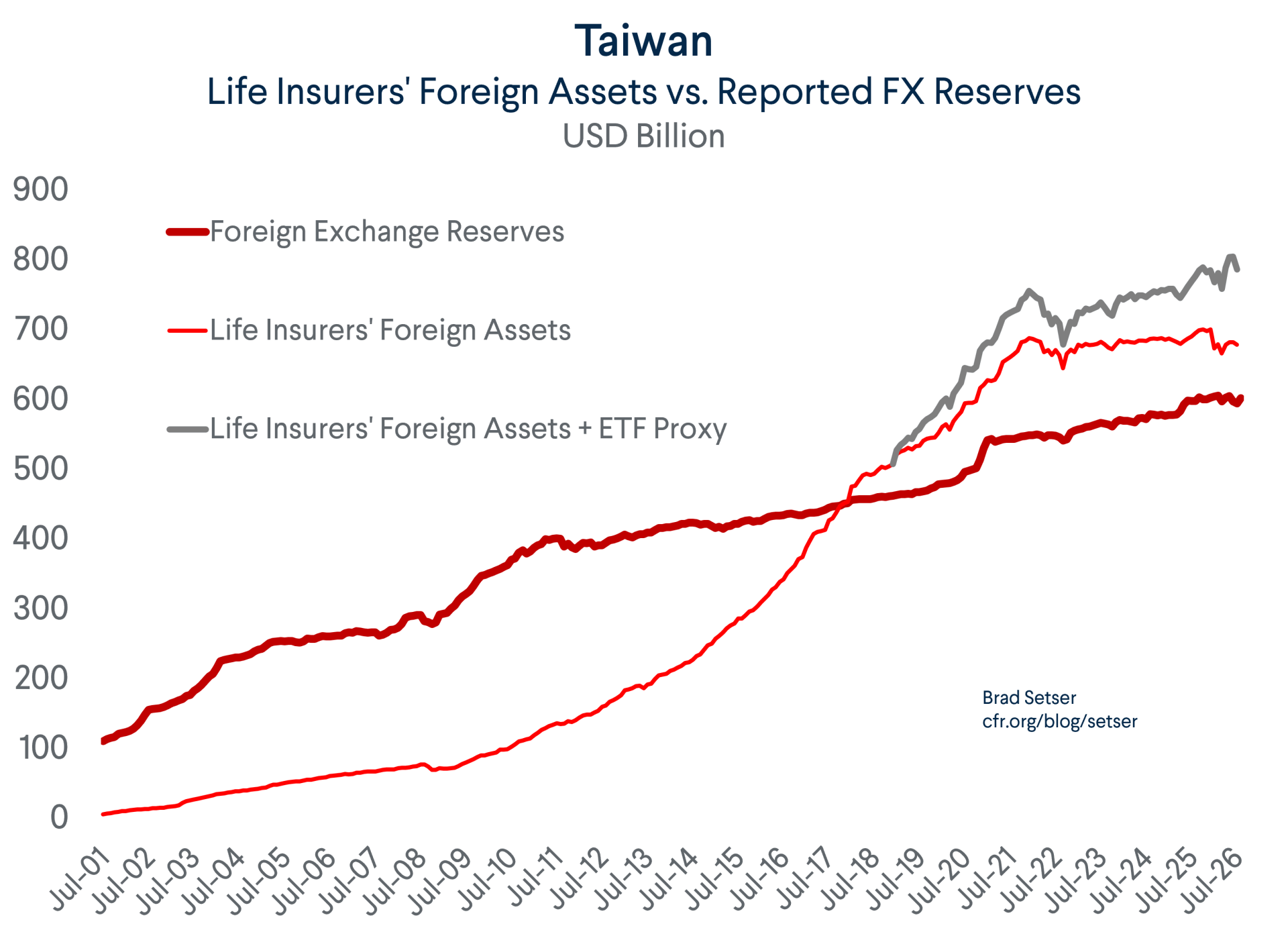
A different dynamic is in play in Taiwan, as the government doesn’t run a big retirement fund. But in a world where the hedge ratio of the life insurers has been (and still is) used as a policy tool, the shift in Taiwan’s foreign asset accumulation away from the Central Bank of China (CBC) and over to institutions whose activities in the foreign currency market it directly influences broadly fits into the same theme. So too does the PBOC’s use of the “macroprudential adjustment factor” effectively adjust banks’ net foreign assets in much the same way that CBC regulations adjust lifer hedge ratios.
In the last year, the lifers’ hedge ratios—and their direct hedges with the central bank—have been one of the key tools the CBC has used to manage the Taiwan dollar (and guard the lifers’ solvency).
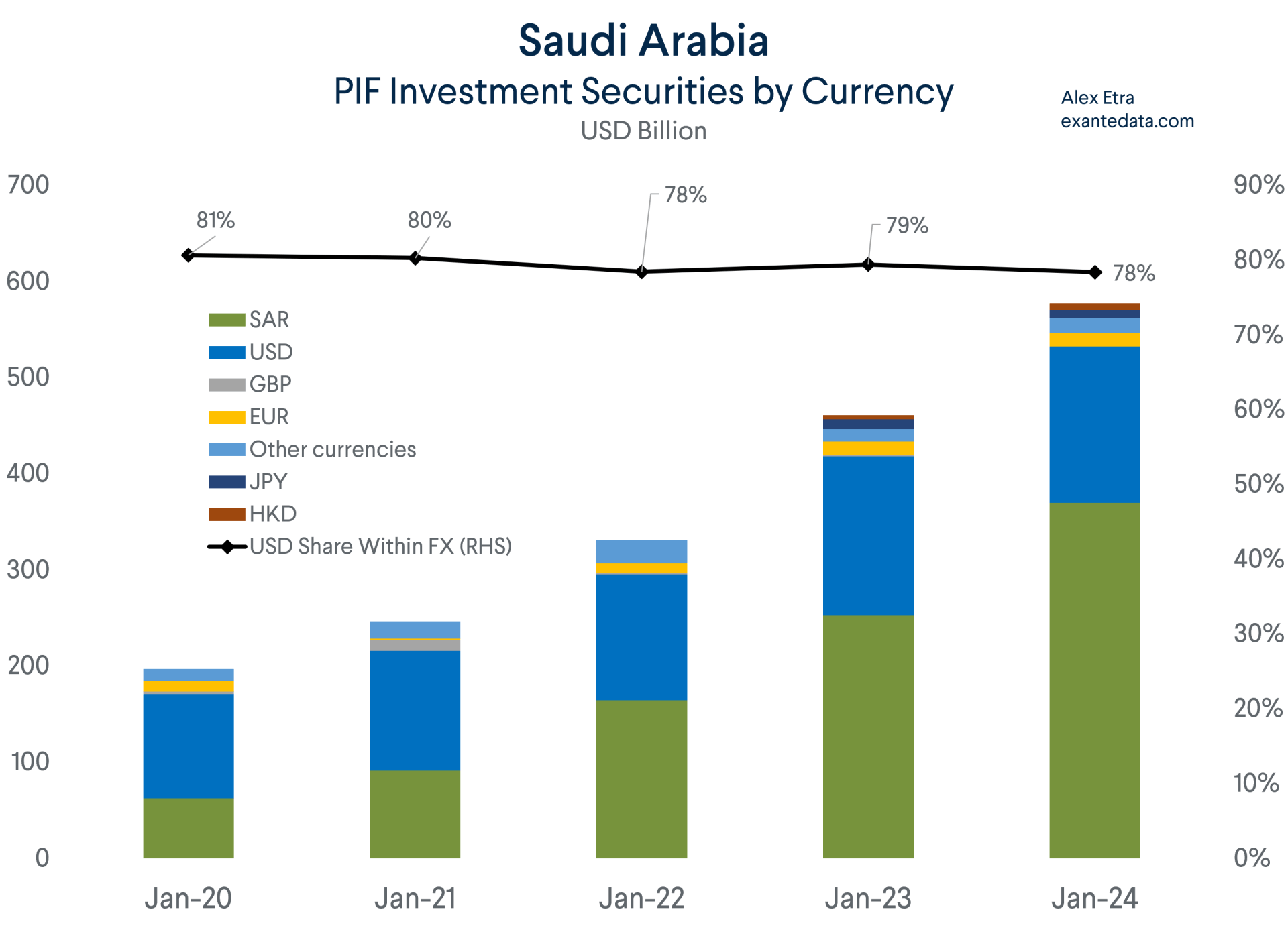
Asia’s big surplus economies are in a sense just catching up with the world’s oil exporters. Norway put its oil surplus into a sovereign wealth fund from the start. Kuwait, Qatar, and Abu Dhabi (the most oil-rich emirate) all also have large sovereign funds. And the world’s biggest oil exporter has joined them: The Public Investment Fund has almost as many foreign assets as the Saudi Central Bank (SAMA).*
What’s more, the available evidence suggests that the dollar share of these pools is in line with or higher than the dollar share of global FX reserves (it depends on the institution and jurisdiction).
In other words, by looking at the (easily available) data on the world’s static holdings of formal FX reserve assets, scholars and analysts miss most of the growth in the world’s sovereign and quasi-sovereign foreign assets.
Consider China.
No serious analyst now disputes that China’s state banks—including the policy banks (the China Development Bank, China Exim)—hold several trillion in foreign assets.
China reports $3.3 trillion in gross foreign assets to the BIS (the net position, counting foreign bank claims on the entire Chinese economy not just the banks, is $2.5 trillion). That maps to the BOP data, which shows almost $4 trillion in gross outflows through the banking system (technically, the sum of gross outflows in “other” plus the $500 billion in foreign currency bonds held by the state commercial banks)
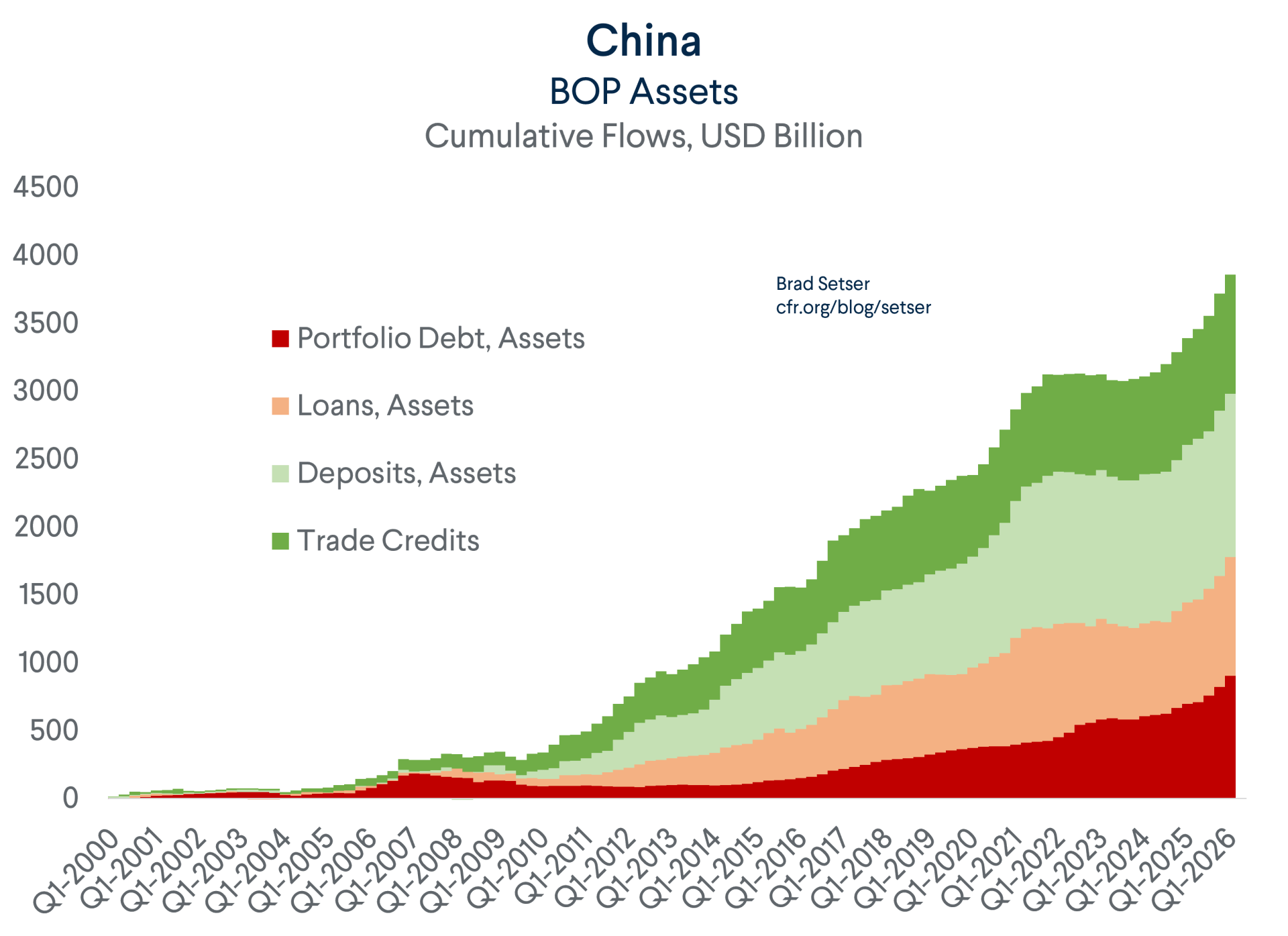
Since 2010 (and even more so after 2014) the net outflow through the state banks has exceeded reserve accumulation.
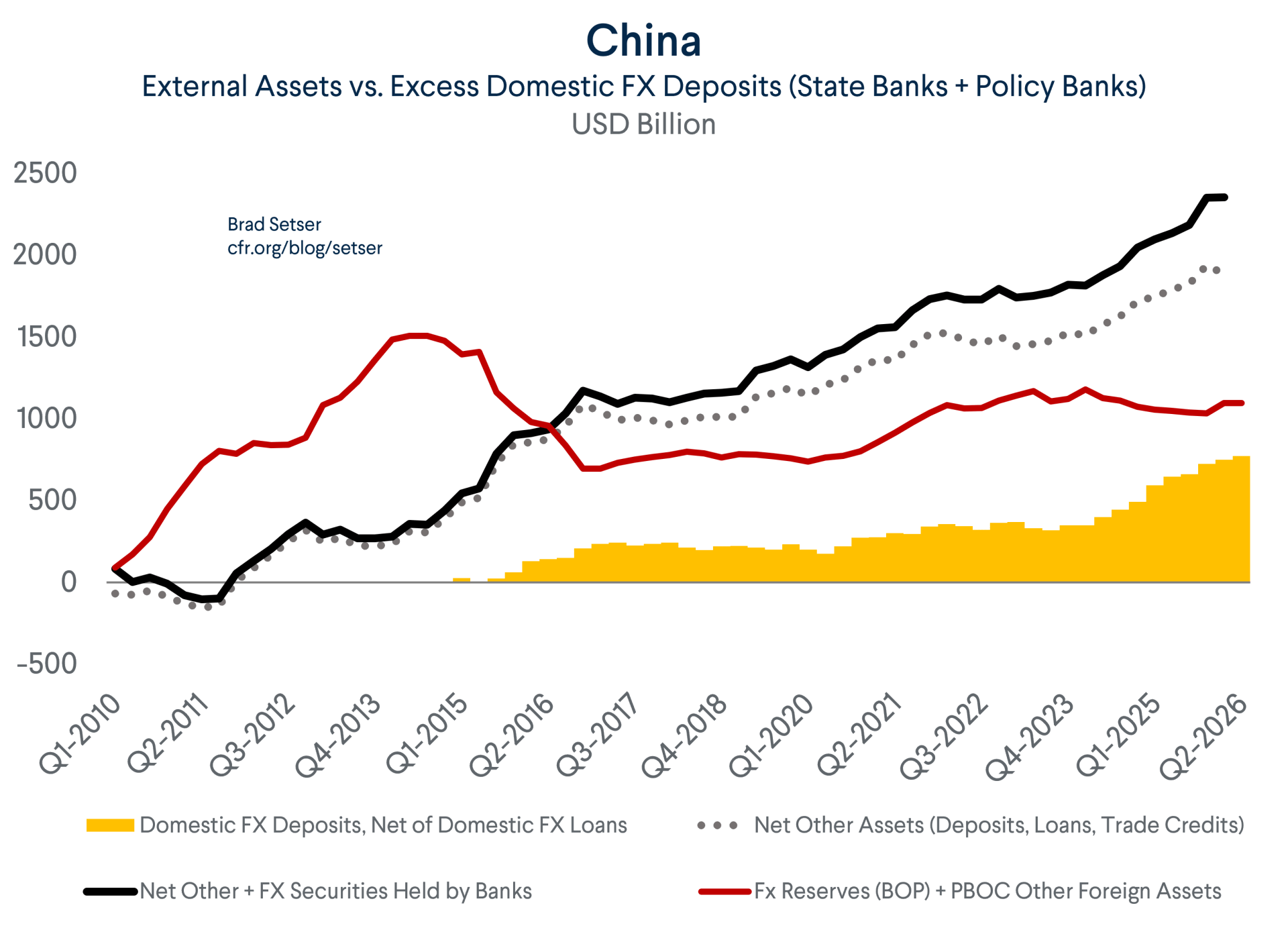
The broad contours of this story are confirmed by the balance sheet data reported by state commercial banks in their 2025 annual reports, which showed that the top five banks held a combined $2.5 trillion in foreign currency assets (mostly held abroad).
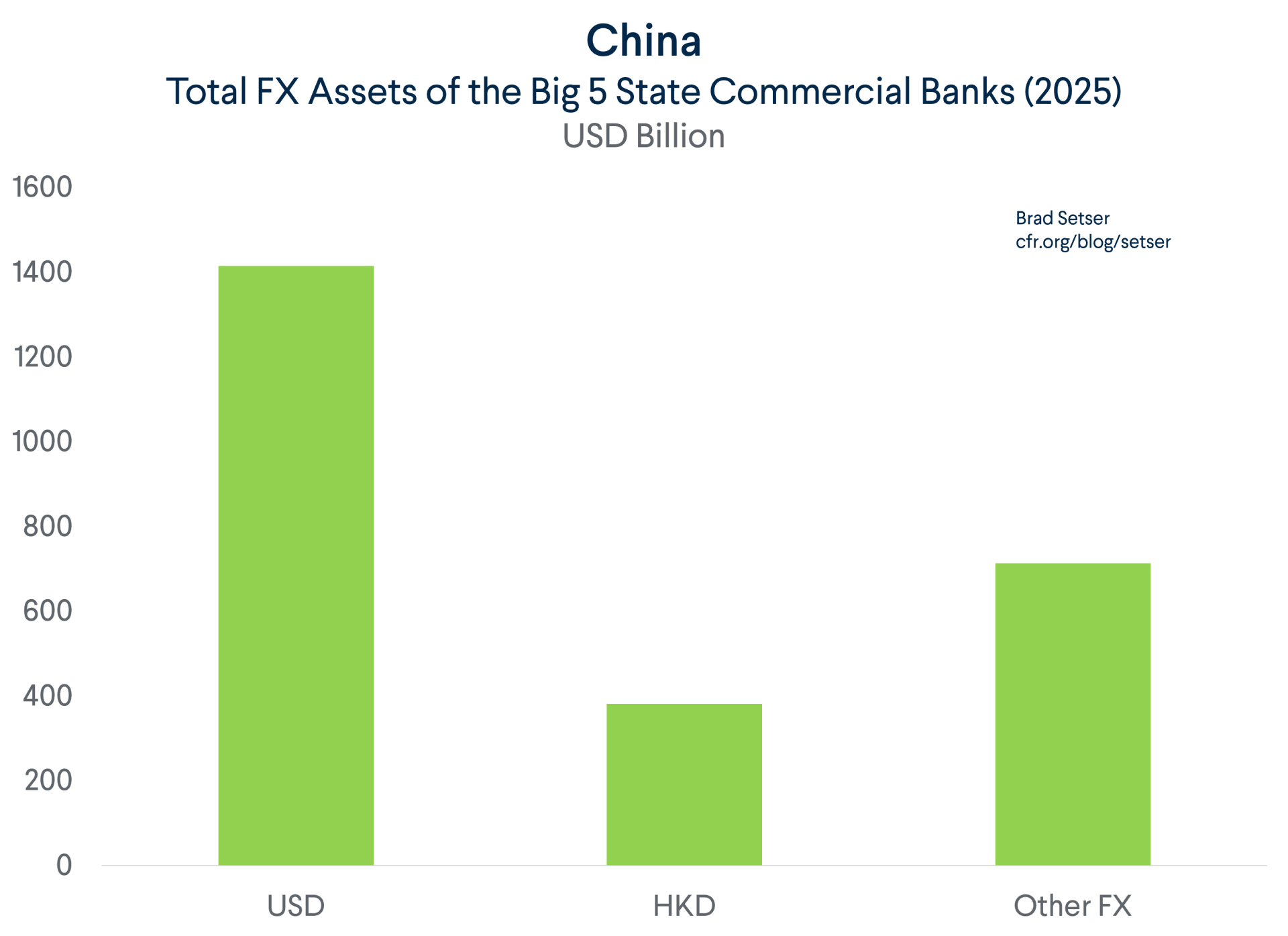
The Chinese haven’t disclosed the foreign assets of the two policy banks (with at this stage the complicity of the IMF, which has neither analyzed the role of SAFE policy bank financing, nor highlighted the glaring gap in China’s own reporting). But the work of AidData points to nearly $1 trillion in foreign assets, with a hefty dollar share.
The available data sources all suggest that the bulk of the foreign assets of the state banks are in dollars.
SAFE’s disclosure—which covers the commercial banks—puts the dollar share of their offshore foreign currency assets at around 70 percent. That is well above the last disclosed dollar share of China’s formal reserves (55 percent in 2019). The banks’ annual reports suggest that about 70 percent of the banks’ assets are in dollars and Hong Kong dollars (55 percent USD/15 percent HKD)—a bit below the dollar and Hong Kong dollar share of their liabilities (swaps out of the HKD fund a decent share of the banks euro assets).
Put simply, SAFE’s static dollar holdings aren’t the important story.
The real story is the rapid growth of the state banks dollar holdings.
Japan holds a high (though undisclosed) dollar share in its FX reserves, and those reserves are primarily invested in Treasuries—so Japan’s MoF is now clearly the largest contributor to the U.S. data on foreign official holdings of Treasuries. (SAFE has shifted its funds out of U.S. custodians, and thus increasingly appears in the data as a “private” holder in a European custodial center)
Japan’s formal reserves haven’t changed much in the last ten years; periodic sales to limit the yen’s weakness have offset most of the MoF’s accumulated interest income. Foreign currency reserves were $1.2 trillion in 2014 and $1.16 trillion at the end of Q1. They dipped to about $1 trillion at the end of August after sales of close to $100 billion at the end of July/start of August.
What has grown is the foreign portfolio of the GPIF. it was around $400 billion in 2014, ~$1 trillion in Q1 of 2026.
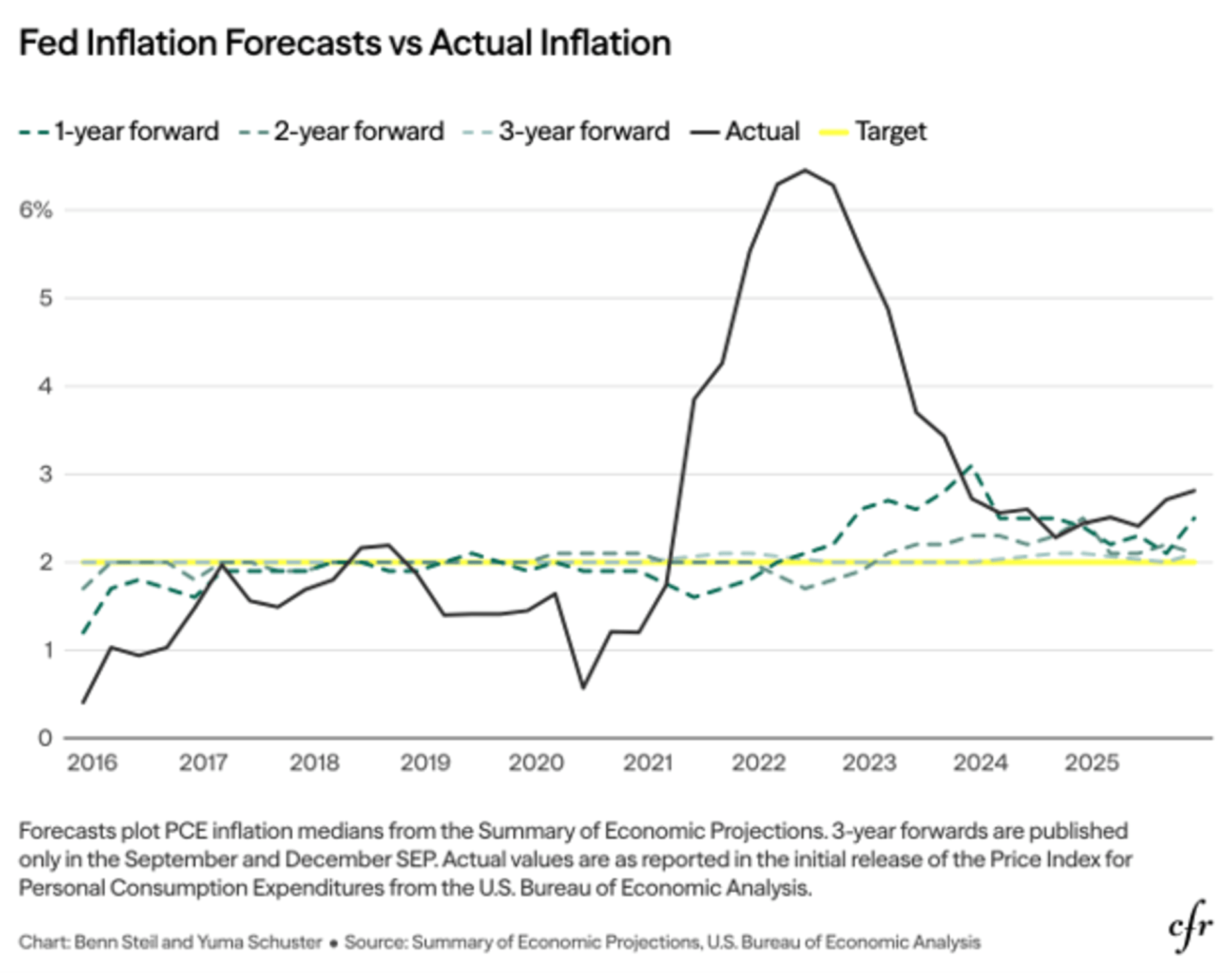
GPIF’s foreign bonds aren’t held exclusively in dollars, but roughly 52 percent of its foreign bonds (26 percent of all bonds) are USD-denominated.
But the GPIF, like most international investors, holds a large share of its equity portfolio in the U.S. (~$165 billion, 65 percent of the foreign equity portfolio).
Korea is a more extreme version of Japan.
The Bank of Korea’s FX reserves have been roughly $375-450 billion over the last ten years or so. Around two-thirds of those are now in dollars (as of the end of 2025).
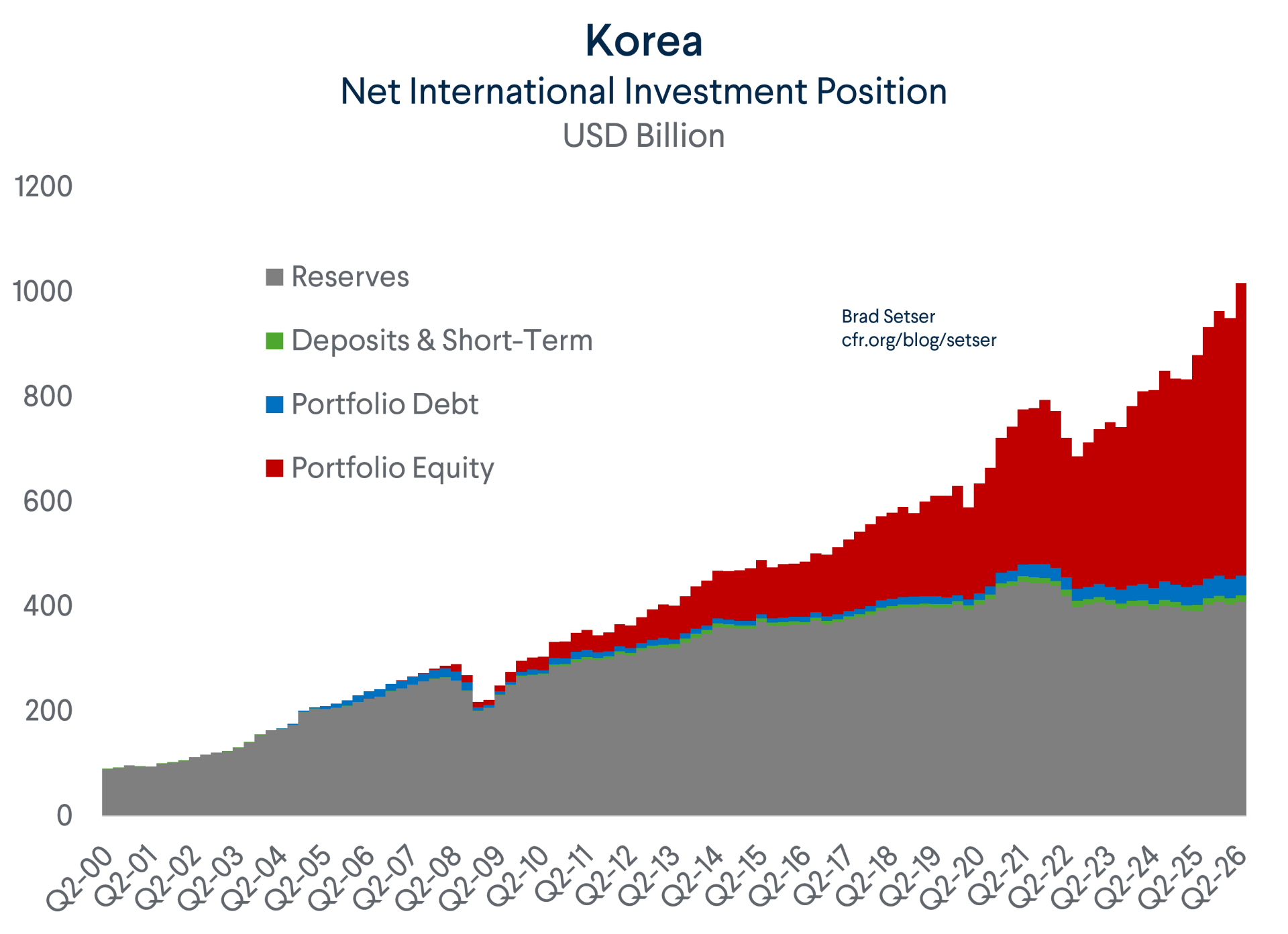
From 2012 to 2025, the foreign assets at the NPS have grown from ~$80 billion (around 21 percent of total assets) to over $660 billion (55 percent of total assets)—and something like 70 percent of those are in dollars. 76 percent of the fund’s equities are in dollars, and 66 percent of its debt. And while a lower share of its “alternative” portfolio is in North America, most alternative mandates are awarded in dollars.
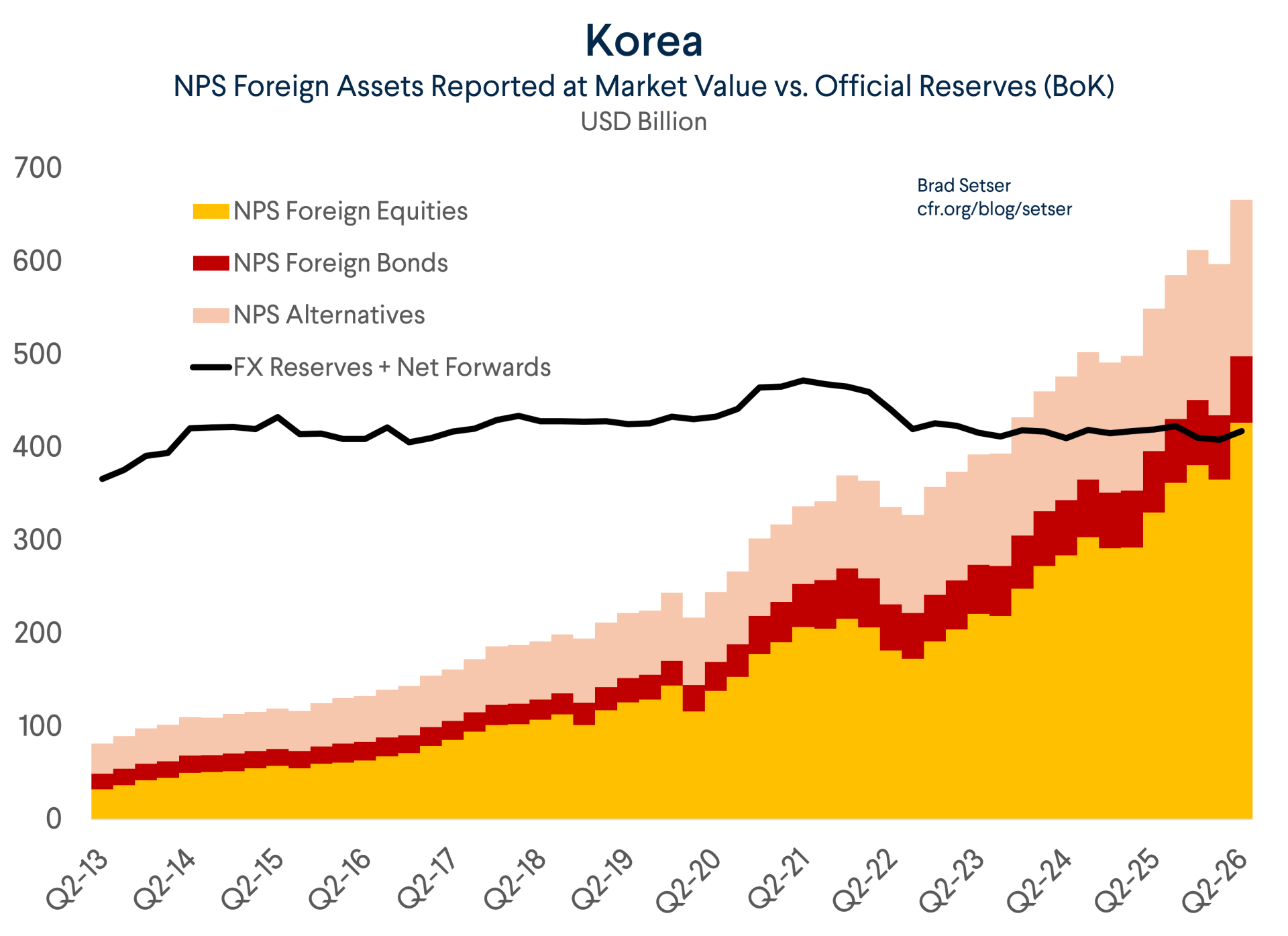
In other words, the majority of the dollar assets held by Korea’s government (the NPS reports to the Ministry of Health and Welfare, and the Minister of Health chairs its asset allocation committee) aren’t held by the central bank and aren’t in the IMF’s COFER data set.
Taiwan is an unusual case, as the life insurers aren’t technically sovereign investors. But with their regulator now explicitly encouraging the them to hold an unhedged foreign currency book and hence they now rely on the state for their solvency, they have a bit of an official character (a significant appreciation of the TWD would blow through their volatility reserves and leave them with fewer assets than liabilities, as their foreign assets are largely held against TWD policies). The CBC certainly now uses the lifers desire to unwind existing hedges to help manage the Taiwan dollar. And they have an exceptionally high dollar share in their foreign assets—over 95 percent.
The Saudi Public Investment Fund (PIF) is another example.
It keeps roughly $200 billion of its $250 billion in foreign investments in dollars—well above the U.S. share of a standard global stock index. Almost all of the PIF’s $30 billion in external debt is also in dollars.
And the PIF now has only slightly fewer foreign assets than the Saudi Central Bank has reserves.**
The broad story is thus pretty clear: the growth in the world’s sovereign and quasi-sovereign assets is not coming through an increase in FX reserve holdings managed by the world’s central banks.
And, in the critical case of China, the dollar share of China’s quasi-sovereign foreign assets is likely higher than the dollar share of their formal FX reserves.
Adam Tooze has noted that inflows into the U.S. are now coming from investors looking for a profit, not investors looking for safety. What he calls the “profit dollar” manifests itself in a number of different ways. More inflows into corporate bonds and equities for one. Less official demand for Treasuries for another. More opacity too.
Those same trends are at play among sovereign and quasi-sovereign investors.
So don’t obsess about the dollar’s chare in formal FX reserves. Do recognize that the dollar’s “reserve currency role” isn’t the source of any significant new inflows into the dollar.
The dollar’s dominant role in the international monetary system depends on much more than the size and composition of central bank FX reserves. It is as much, perhaps more so (given that FX reserve managers are themselves ultimately liability matchers) a function of the portfolio choice of a set of private/semi-private/quasi-sovereign investors that are much more difficult to observe. Reserve currency status is not only about FX reserves in a strict sense.
That’s been true for some time. Most of the current flow into U.S. from the “official” sector is coming from investors who are not classic reserve managers.
Those flows remain heavily tilted toward the dollar, at least for now.***
And any real de-dollarization would likely occur first among these investors.
Put differently, the dollar’s global role is increasingly as a source of returns, not a source of safety. The foreign bid, private and public, is for risk, not for Treasuries. That doesn’t help Scott Bessent much right now, but it has helped keep valuations in the stock market extended. And the global debate on the dollar’s role lags the evolution in the dollar’s role, and the risks associated with that new role.
It is currently fashionable in some circles to point to the diminution of the “convenience yield” on Treasuries even while the U.S. dollar continues to enjoy such a privilege. But the shift in the global investor base, and their apparent portfolio preference for U.S. risk assets in lieu of Treasuries, may help explain the divergence between the convenience yield on UST and the convenience yield on USD.
And of course, if the negative convenience yield implies that Treasuries are trading at a historical discount, the persistence of the latter—and its concentration in risk assets—suggests that the “profit dollar” itself is likely trading at a historical premium. That apparent premium on U.S. risk assets deserves as much (or more) scrutiny as the currency composition of central bank FX reserves.
* The PIF and Saudi Aramco also now have a certain amount of debt.
** Reserves (now mostly in Treasuries, so should appear in the TIC data, unlike at some times in the past.
*** Japan is the main exception; the GPIF’s dollar share is below the likely dollar share of Japan’s MoF.
This work represents the views solely of the author(s). The Council on Foreign Relations is an independent, nonpartisan membership organization, think tank, and publisher, and takes no institutional positions on matters of policy.