Three Questions About China’s Hidden Foreign Exchange Assets
A trillion-dollar gap in foreign exchange purchases raises questions about where China’s foreign currency assets are held.

The PBOC argues—unpersuasively, I think—that it doesn’t have any hidden foreign exchange reserves. I would reframe that as hidden foreign currency assets, as foreign currency lent out (or swapped out) with domestic financial institutions is a classic way of masking reserves.
Many in Asia—and some in the IMF—are inclined to believe the PBOC. Fair enough, it is hard to challenge an institution as large and powerful (in some ways) as the PBOC.
But to convince, the PBOC really needs to provide answers to three questions.
1. What explains the current gap between foreign exchange settlement and the PBOC’s reserves?
Settlement is the purchase of foreign exchange in the market by the PBOC and the state banks. It technically implies taking an open foreign currency position, as the foreign exchange is being bought with renminbi.
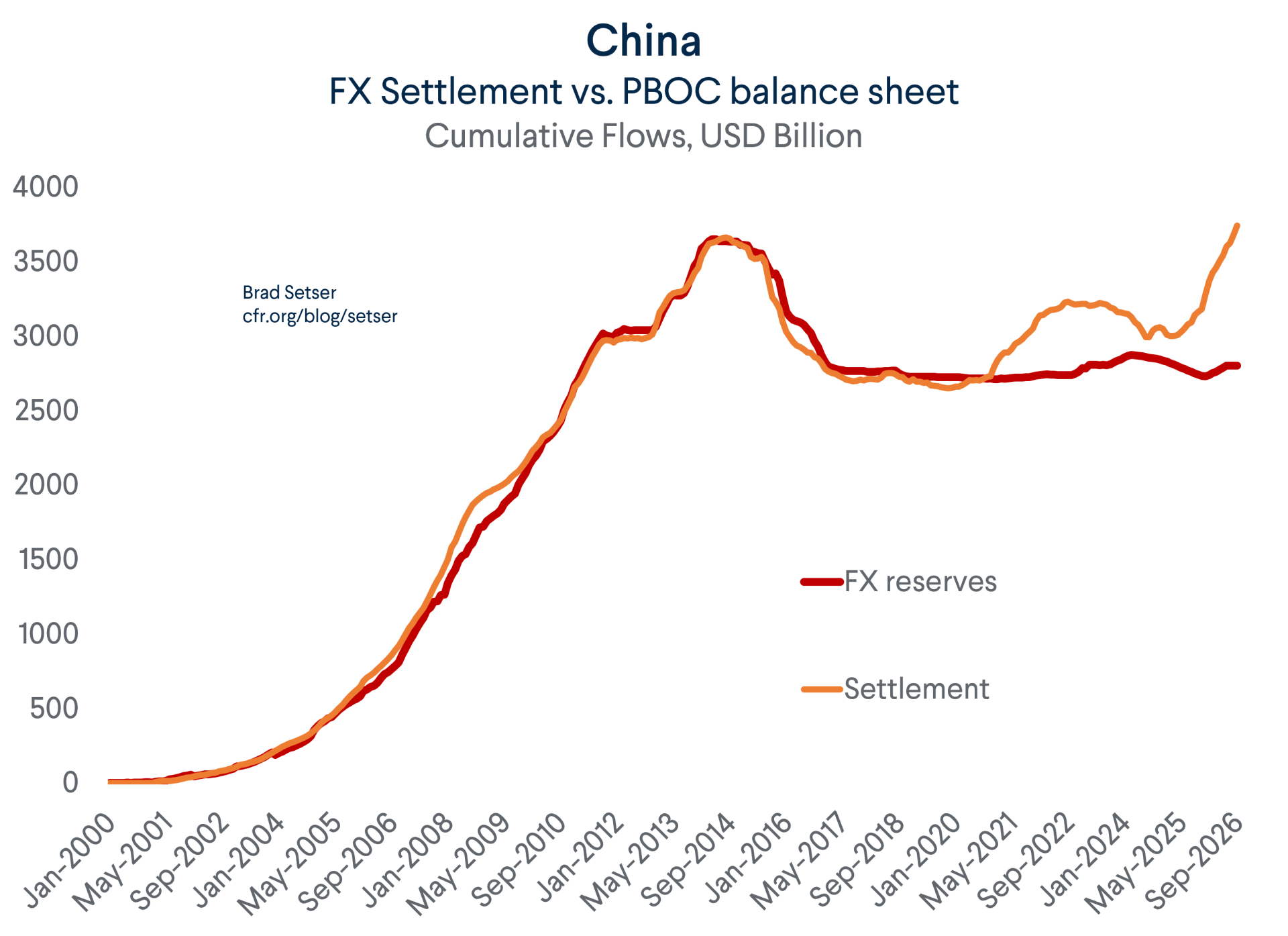
Historically, it correlated with changes in the PBOC’s balance sheet.
And some gaps before 2012 can be explained. In late 2005 and 2006, the PBOC did over $100 billion in swaps with the state banks, who used the FX to buy foreign bonds (portfolio debt outflows surged). Those swaps were unwound after the global financial crisis, and actually provided some of the foreign currency that “funded” the China Investment Corporation when it initially scaled up.
And in 2007 and 2008, the PBOC required that the state banks hold FX against their domestic RMB deposits (to keep the FX out of reserves; it was held on deposit at the PBOC and shows up as “other foreign assets” on the PBOC’s balance sheet and as “other, other, short-term” in the balance of payments.*
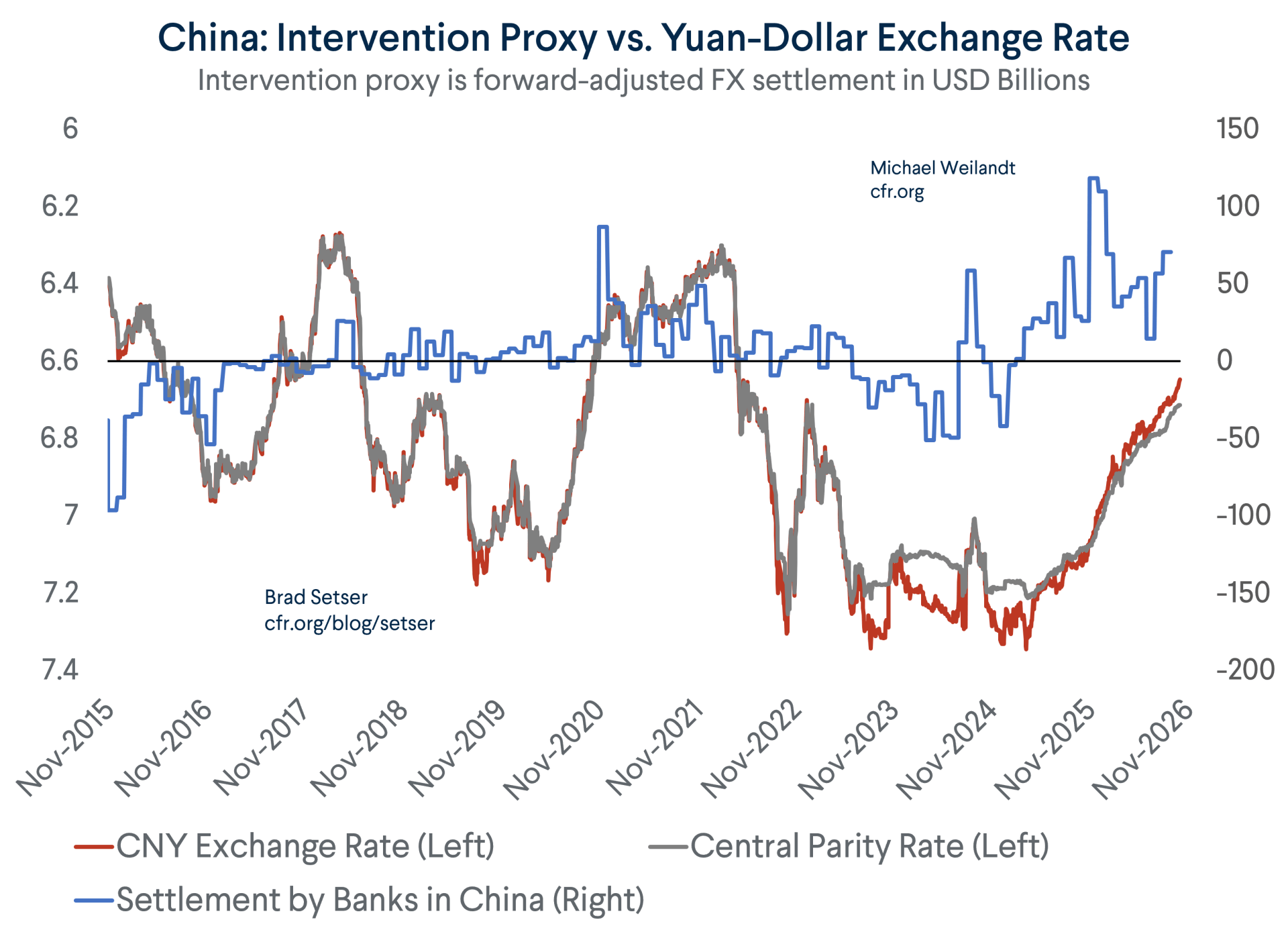
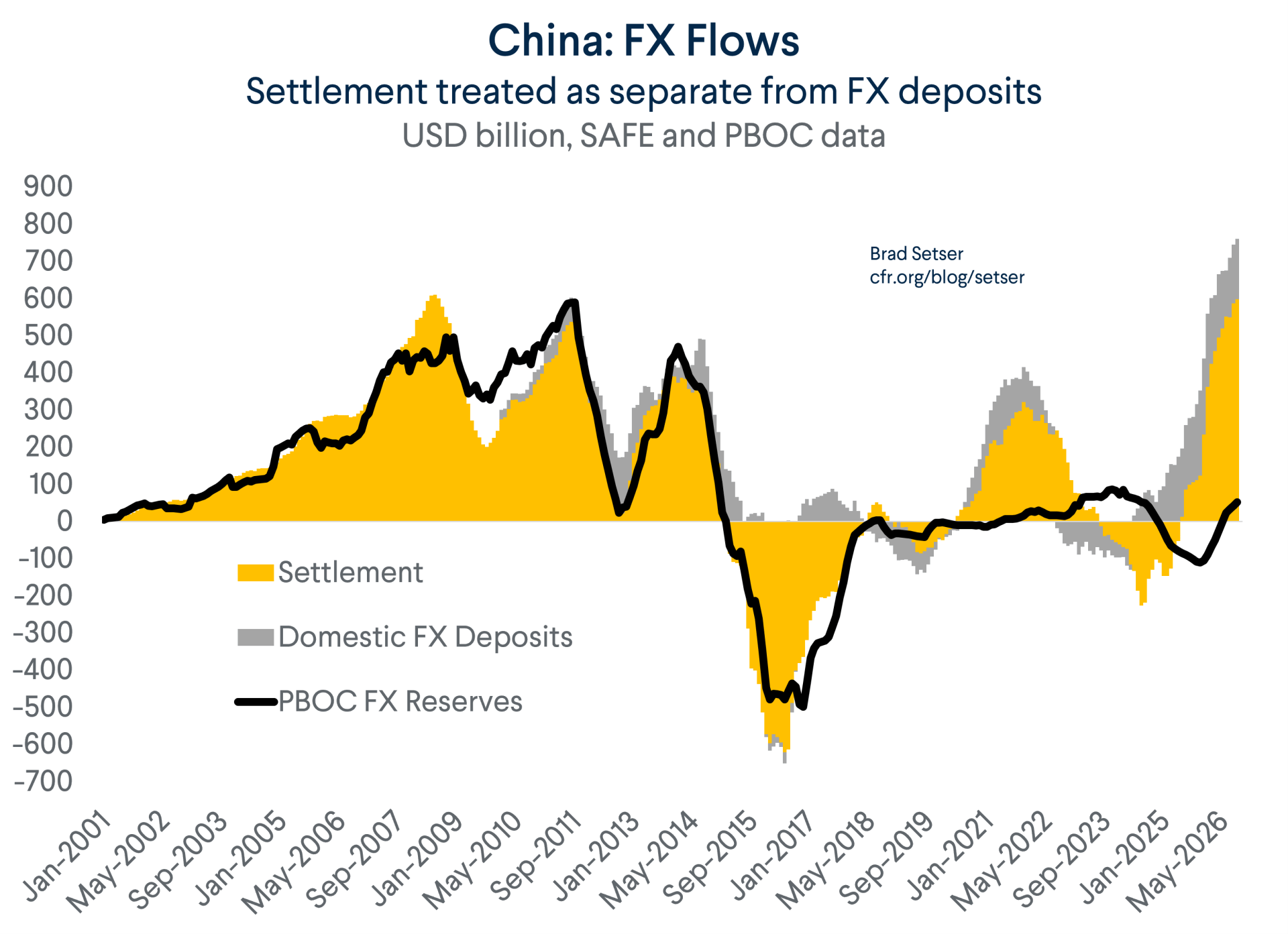
After 2018, though, there are unexplained gaps between the FX bought in settlement and the PBOC’s balance sheet (technically cumulative monthly changes to capture the fact that FX is held as its initial CNY purchase price).
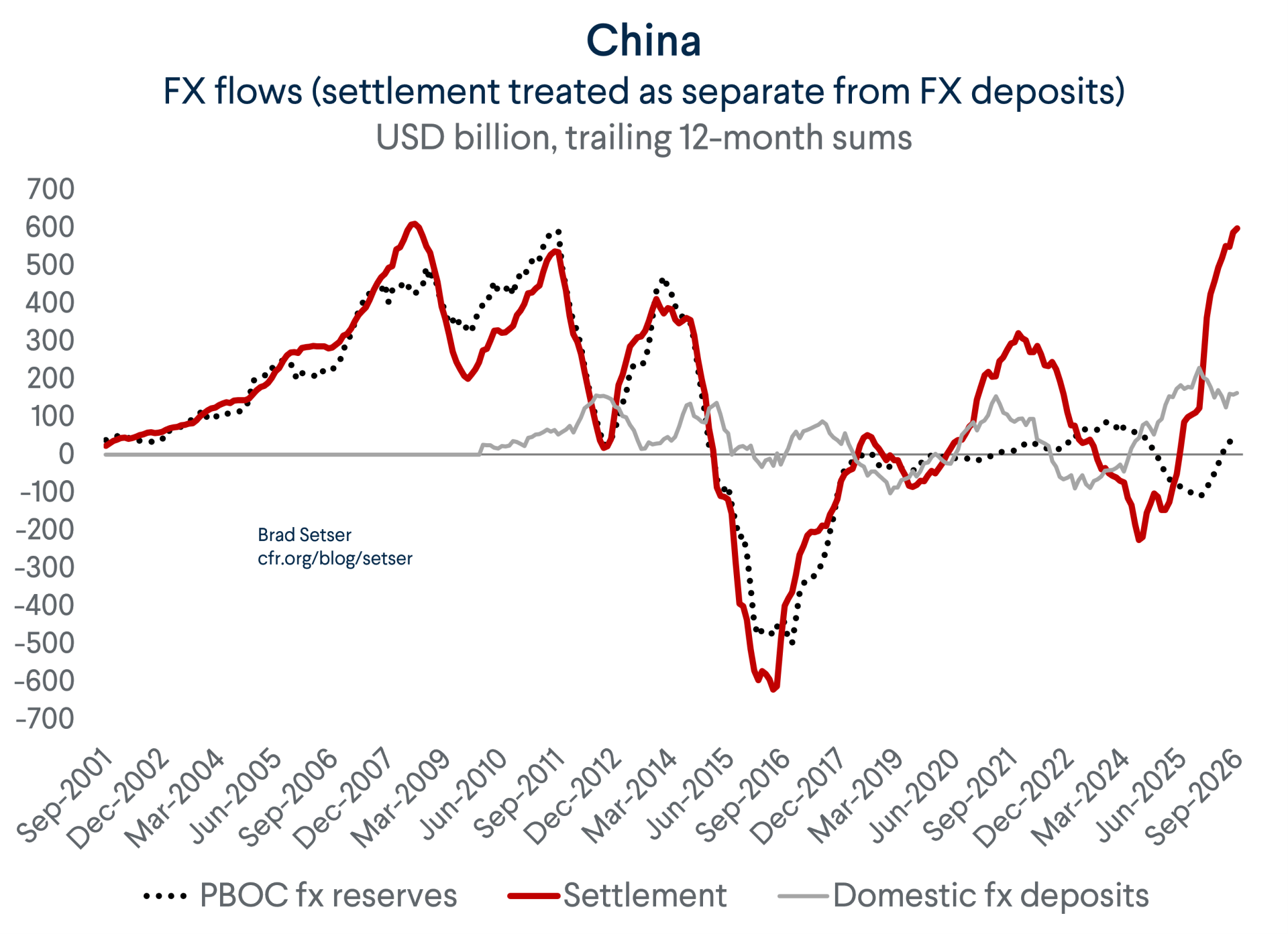
There was a net accumulation of FX outside the PBOC’s balance sheet in 2020 and 2021, when the CNY was under pressure to appreciate. There are modest sales in 2023 and 2024 when there is depreciation pressure. And there are large purchases in 2025 and the first 9 months of 2026—total purchases in settlement in the last 12 months (spot) are $500 to 600 billion, while the increase in the PBOC’s balance sheet is only around $50 billion over the same period.
The gap over time is now $1 trillion. The PBOC needs to be able to answer a simple question: who holds this FX, and who holds the associated FX market risk (given the FX has been purchased with RMB).
The monthly pattern of growth in settlement strongly suggests it is backdoor intervention; there are sales when spot is weak (economically) relative to the fix, and purchases when spot is either at the fix or just stronger than the fix (the strong edge of the band hasn’t been used). The pattern of purchases and sales thus looks exactly like that of a central bank maintaining a tight band around a (crawling) peg.
If the PBOC cannot credibly explain this gap, there isn’t much more to discuss. The PBOC argues that it hasn’t swapped FX with the state banks or put foreign currency on deposit at the state banks. Fair enough.
But someone is buying in settlement; the PBOC ought to know who…
2. Missing interest income
There is an obvious tell here—Bloomberg reported back in 2022 that the PBOC transferred $158 billion in accumulated interest income to the Ministry of Finance as part of a special dividend to hold the budget deficit down. Again, fair enough. But absolutely nothing changed in the FX reserves held on the PBOC’s balance sheet or in the balance of payments.
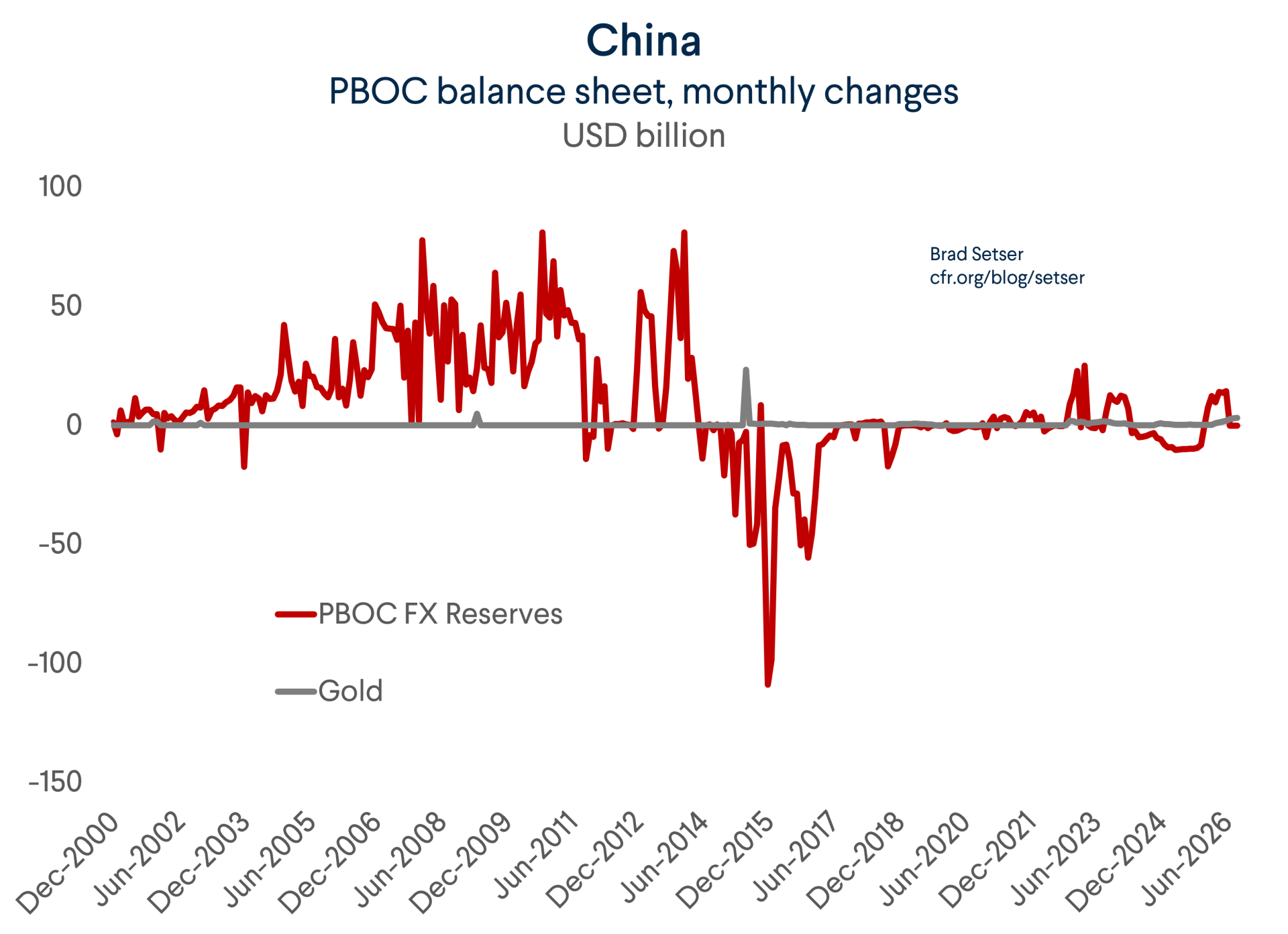
That highlights a broader issue. Since the end of 2016, the PBOC’s balance sheet FX hasn’t really changed.
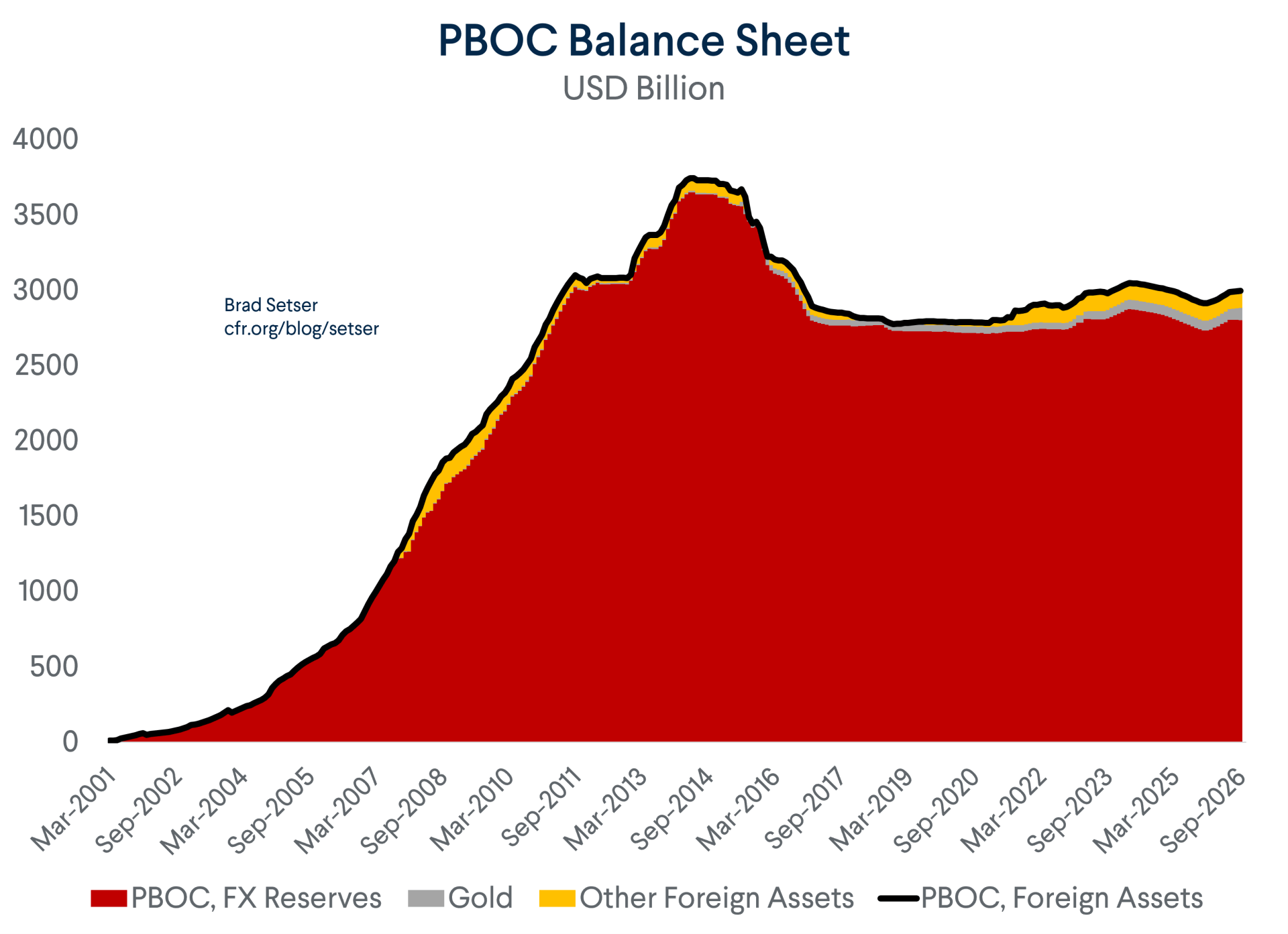
Peer institutions generally have an upward slope to their reserves as a result of “gains from reserve management” or “reinvestment of interest income.” ** The Central Bank of China (Taipei) and Japan’s Ministry of Finance are good examples.
The interest on ~$3 trillion in reserves should be around $100 billion a year. A bit less during the “low-for-long” era before the pandemic, when SAFE wasn’t getting much income out of its euro portfolio. A bit more now, when U.S. short-term rates are well above 3 percent and SAFE’s legacy agencies carry yields of 5 or 6 percent. $100 billion over 10 years is real money—roughly a trillion dollars.
If SAFE has steadily been selling its interest income, it should say so (the fact that BOP reserves have often diverged from the PBOC balance sheet suggests a more complex story).
Moreover, if SAFE has been transferring the FX to one of China’s many sovereign wealth funds (including those controlled by SAFE) or the policy banks, it should say so.
But SAFE cannot say what you see is what we really have if it cannot explain how it handles the interest on its now $3.5 trillion in reserves.
3. The accounting for the PBOC’s entrusted loans and other foreign currency claims on domestic financial institutions, notably the policy banks
FX handed over to a sovereign wealth fund to manage doesn’t appear in reserves. It isn’t a liquid reserve asset.
But it should appear elsewhere in the balance of payments as either portfolio debt or portfolio equity.
And FX handed over to the policy banks through mechanisms such as entrusted loans (or a simple deposit or swap) doesn’t count as a foreign reserve—the foreign currency claim is on a domestic financial institution, and that isn’t considered a “foreign” asset.
There is no doubt that the PBOC has domestic claims on China’s financial institutions. The use of “entrusted” loans to fund the policy banks in 2010 was reported by Caixin and the Financial Times.
$95 billion in entrusted loans were converted into equity in the CDB and China Exim back in 2015 (giving SAFE majority equity stakes in both institutions through its Buttonwood investment vehicle).
And the SAFE’s 2020 annual report contained a ten-year progress report on the “diversified use” of China’s FX (basically, the non-reserve use) which indicated that SAFE continued to provide entrusted loans to small, medium, and large Chinese financial institutions.
Now perhaps these instruments have been unwound—the China Development Corporation (per Stephen Green, a friend) has reduced its foreign currency balance sheet over the last few years. But that should lead the foreign currency to flow back to SAFE absent another use—and that increase in FX isn’t showing up in the PBOC’s reserves.
In other words, SAFE should provide a transparent accounting of the FX that has been bought but transferred to other financial institutions and any ongoing foreign currency exposure to the domestic banking system (including the policy banks).
These aren’t big asks. The settlement gap is big and obvious, interest income is a known issue, and SAFE itself has reported its use of entrusted loans in the past. There is no issue around the past use of swaps either. A substantial share of the banks’ foreign currency assets are funded domestically. It should be possible for SAFE to explain the role, if any, it has played in this funding.
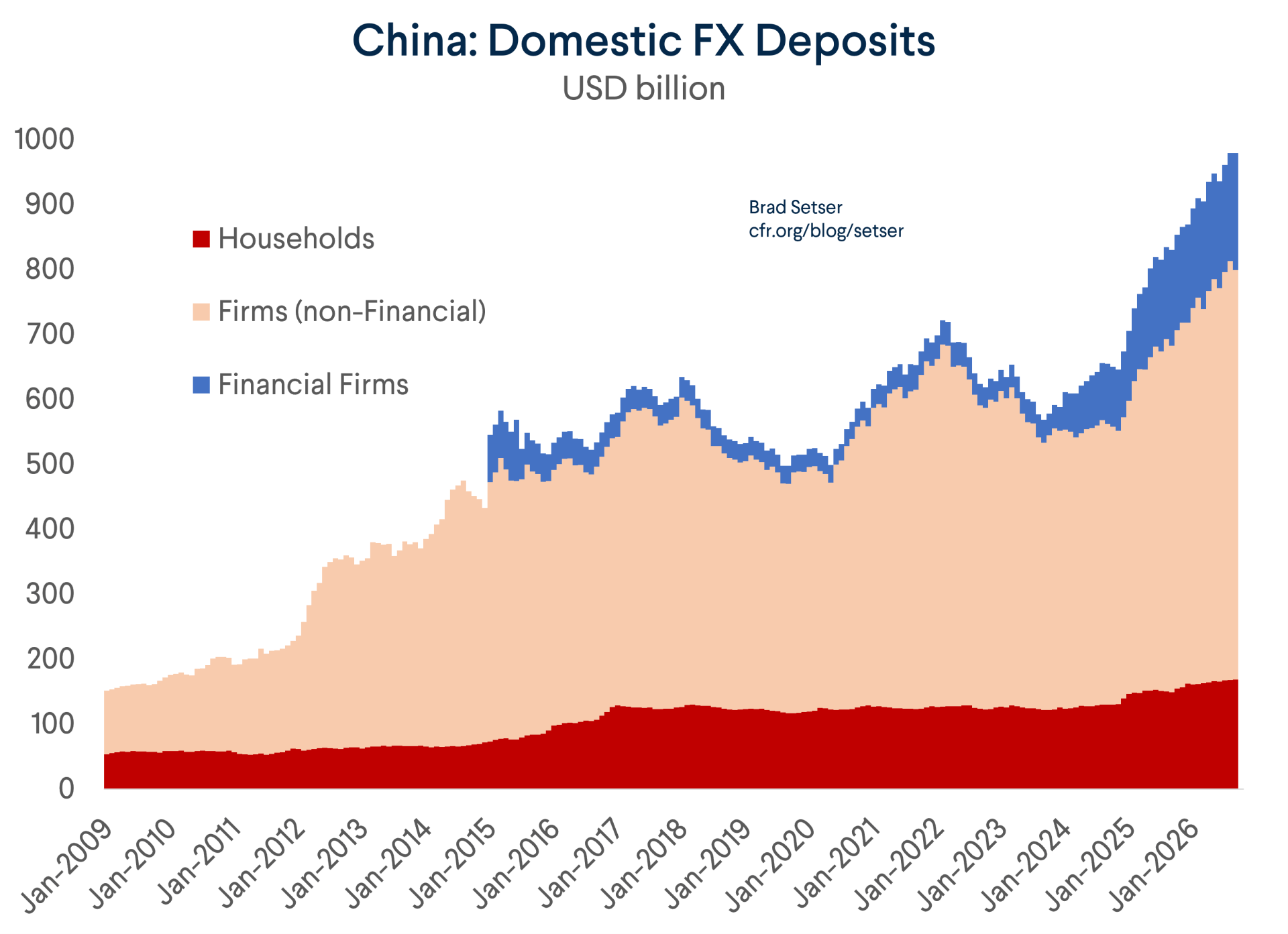
There is, of course, another issue around China’s balance of payments: the growth in foreign currency external assets funded out of domestic foreign currency deposits.
China argues that the growing foreign assets of its state banks are simply a natural part of a growing domestic financial system. But there is more to the story.
Onshore FX deposits have tended to rise when economics say they should not, and fall when the economics say they should (offshore FX deposits behave as expected). In 2020 and 2021, FX deposits rose even when there was more yield on RMB deposits.
And RMB deposits have continued to rise in 2025 and 2026 even with the RMB’s appreciation offsetting the higher dollar deposit rate. This isn’t an accident: banks just raised the interest rate that they pay on dollar deposits to encourage exporters NOT to convert their export proceeds into RMB and thus take pressure off the PBOC (per Reuters).
In other words, the pattern of the banks’ foreign currency asset growth suggests that they are offsetting appreciation pressure by bidding for FX (or receiving it from other state actors), not that FX flows into the banks during periods when onshore residents worry about depreciation.
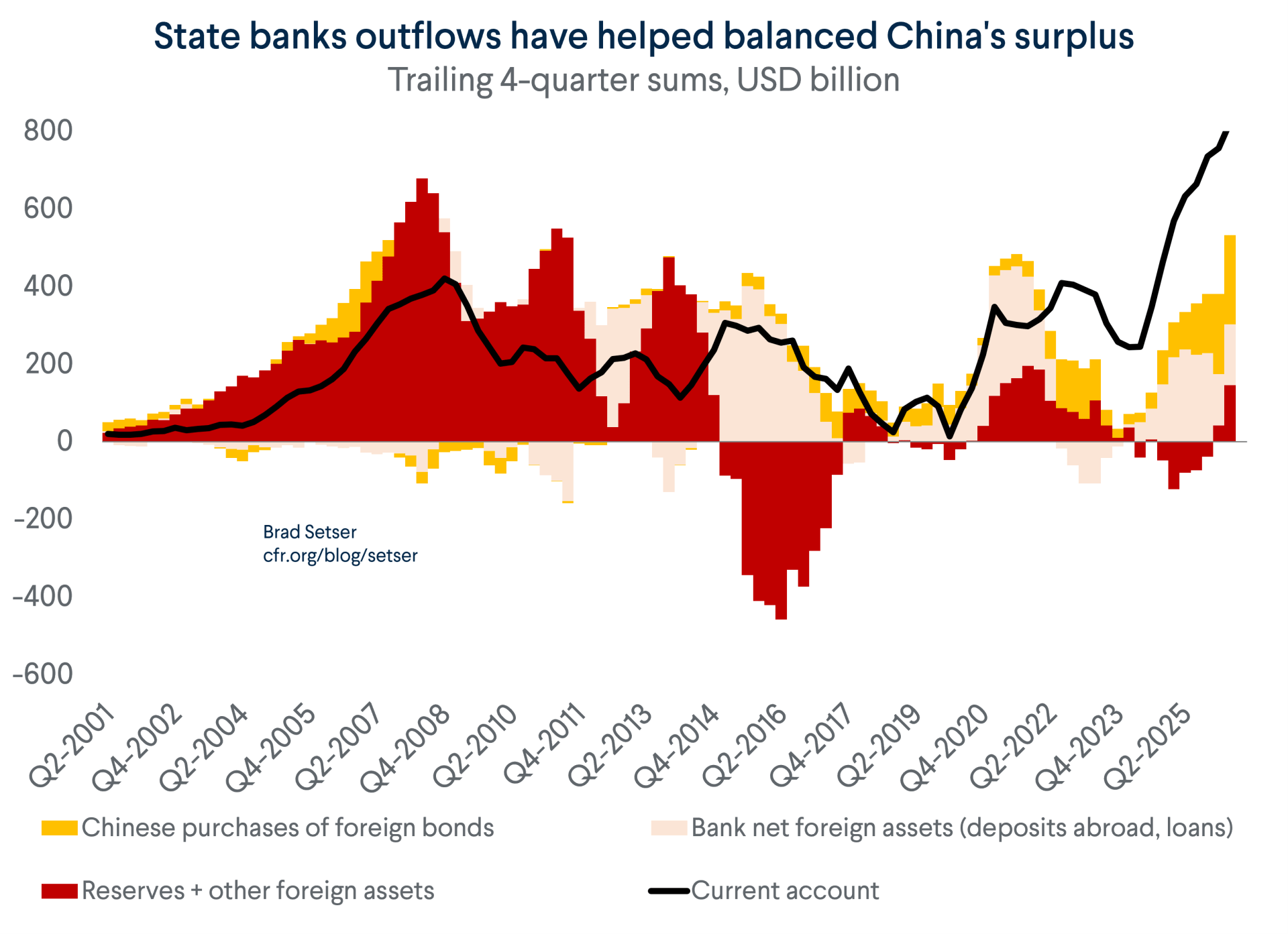
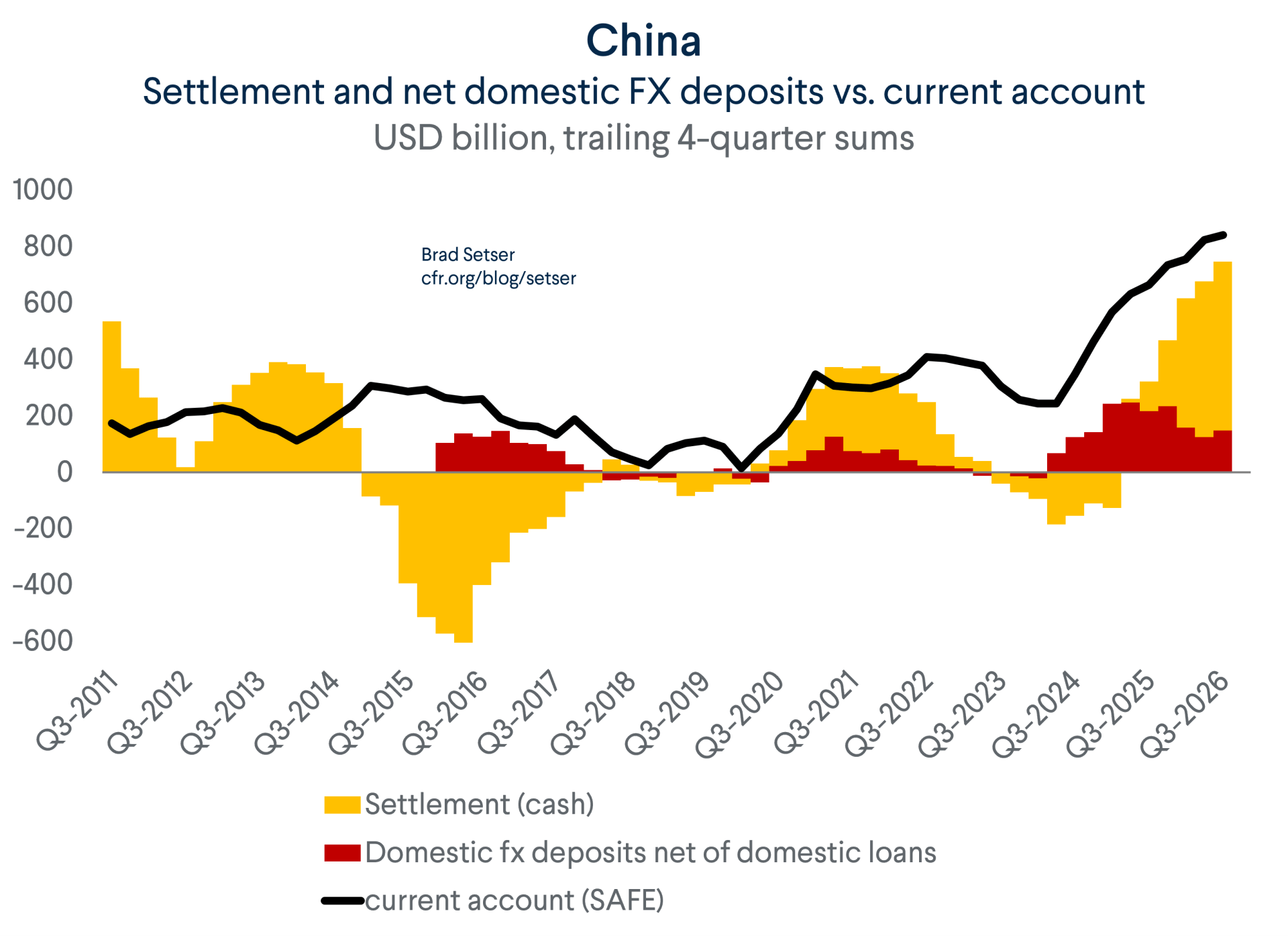
Right now, the “settlement gap” is the most pressing issue. FX deposit growth in excess of FX loan growth can explain FX outflows of around $150 billion in the four quarters to Q3. The FX outflows implied by settlement reached $600 billion over the last four quarters. Together they account for the bulk of China’s reported $825 billion plus (I estimate a Q4 2025 to Q3 2026 surplus of around $900 billion) in outflows implied by the reported current account.***
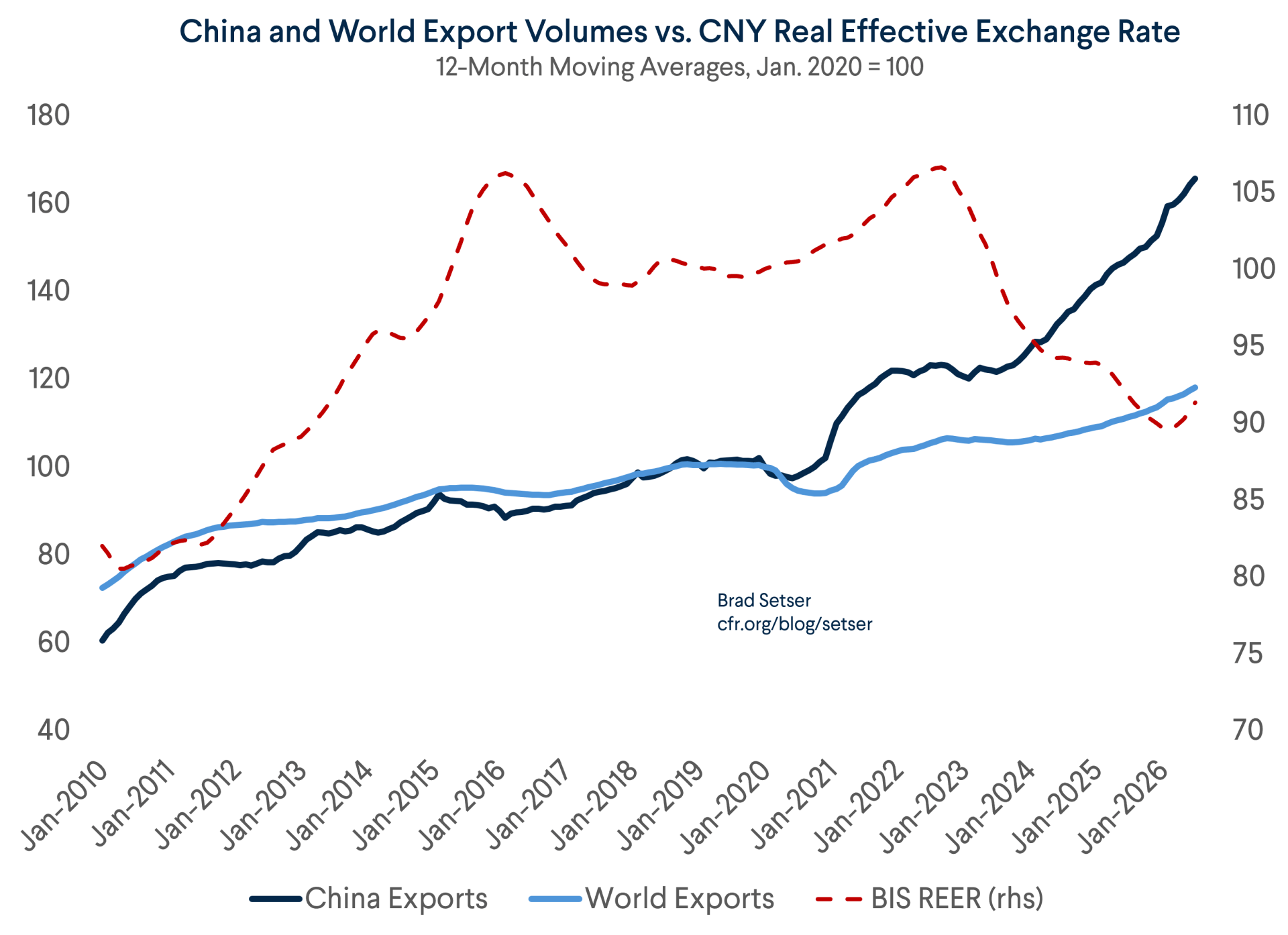
It goes without saying that this matters because the weak RMB is the central reason for China’s massive export outperformance since 2023—and that export outperformance has continued in 2026.****
* I have been doing this a long time; I actually do know most of the historical quirks in China’s balance of payments data.
** The MoF can count a portion of its unrepatriated gains from accumulated interest on its large reserves against the budget deficit, but since the actual interest is held abroad, it still needs to borrow domestically against those reserves (domestic JGB issuance and foreign reserves both go up).
*** My estimate of a larger “true” current account comes from moving gold imports over to the financial account, and from an assumption that undercounting of the reinvested earnings of funds held offshore explains the obvious problem in the investment income account.
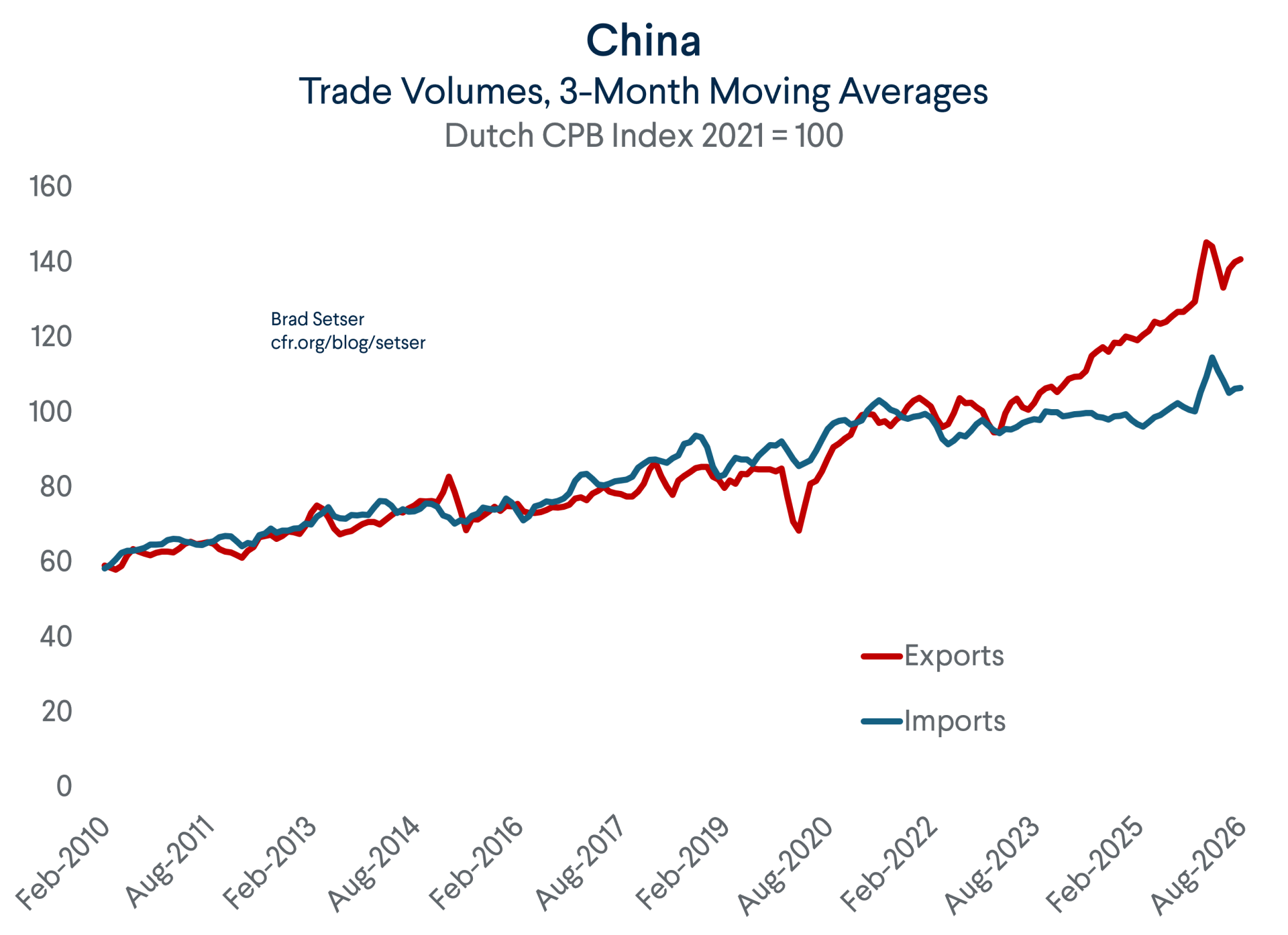
**** The spike in imports in Q1 wasn’t entirely real. China was slow to adjust its import price index for the rise in semiconductor/chip prices. This inflated both import and export volumes in Q1. The rise in gold imports this year also registers in the import volume series—though the rise is best understood as “importing” a financial asset.
This work represents the views solely of the author(s). The Council on Foreign Relations is an independent, nonpartisan membership organization, think tank, and publisher, and takes no institutional positions on matters of policy.