Twenty-Four Hours or Twenty-Four Months: It’s Time for Peace in Ukraine
CFR President Michael Froman analyzes this week’s talks in Abu Dhabi.
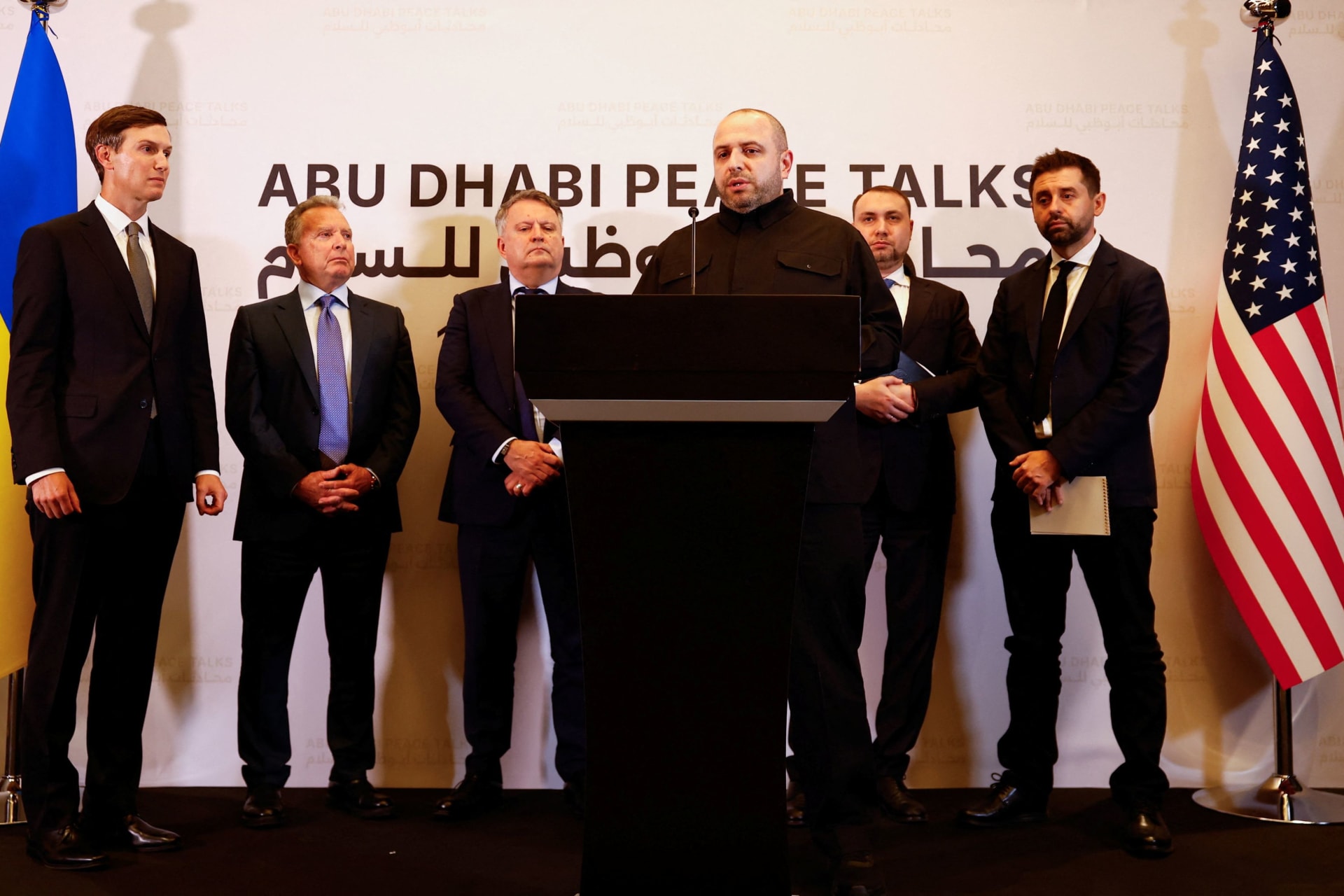
A Ukrainian spy, a Russian historian, and two U.S. real estate developers walk into an Abu Dhabi hotel. Sounds like the beginning of a bad joke, right?
It wasn’t a joke, but the talks this week did not produce a sustainable peace, at least not yet. It was good to get the parties back to the table for direct discussions. And it was good to see the military-to-military talks restored, including the presence of General Alexus Grynkewich, commander of U.S. European Command and NATO supreme allied commander Europe. That said, the lack of a ceasefire, let alone meaningful progress toward a sustainable peace agreement nearly five years into this conflict, is noteworthy.
While the number of issues on the negotiating table are relatively few—territorial control/recognition, security guarantees/associations, economic autonomy, political independence—they are existential in nature.
Ukrainians have been eager to bring this war to an end for some time. Quietly, some Ukrainians have even ruminated that the state of Ukraine has had different shapes and borders at different times in its history and that there is nothing sacrosanct about the pre-2022 borders, let alone the pre-2014 ones. That doesn’t mean Ukrainians are prepared to give up territory Russia has failed to conquer and that thousands of men and women have died defending, nor that they are prepared to formally or legally recognize the dismemberment of their own country. But there does seem to be openness to options for how the territorial issues might be dealt with—in the context of real security guarantees that deter Russia from launching yet another war. Even there, Ukraine has shown flexibility, no longer insisting on NATO membership, just meaningful, credible security guarantees.
Russian President Vladimir Putin, on the other hand, appears not to have moved off his maximalist demands, notwithstanding the fact that the war has now gone on longer than World War I, “the Great War.” Russia has suffered more than a million casualties, Ukrainian drones have knocked nearly a third of its refining capacity offline—and Russia has only gained control of about 12 percent of Ukraine’s territory since February 2022. Not a great victory.
The trilateral talks in Abu Dhabi didn’t bridge this gap, though they did produce an agreement on prisoner exchange. U.S. envoys Jared Kushner and Steve Witkoff subsequently went to Moscow to meet Putin and then traveled to Dublin, where they met Ukrainian President Volodymyr Zelenskyy. No puffs of white smoke yet, but good that attention is being paid, particularly with winter approaching and given the other issues on the U.S. envoys’ agenda.
This is happening in the context of two important developments. At home in the United States, in the aftermath of the midterm elections, there is a question about whether the new Congress will put pressure on the Trump administration to be more supportive of Ukraine. It’s hard to imagine how Congress could force the administration to ship arms to Ukraine if it is dead set against it, but Congress does retain the power of the purse and could use it to fund or defund priorities that a bipartisan majority, willing to break with the president, cares about. They could certainly make clear they want the U.S. government to provide critical intelligence and Starlink to make its assets available to Ukraine.
Abroad, Europe has been working hard to be relevant. Ironically, Europe has not been at the table in negotiations over the most significant threat to European security. European nations were not directly involved in the three-party talks in Abu Dhabi, but at least they were in the next room, available to be consulted. This must certainly stick in the craw of European leaders: as they raise European spending on defense toward their 5 percent of GDP commitment, together with the steps they have taken to provide economic and military aid to Ukraine, they have certainly earned a seat at the table. Witkoff’s announcement Thursday that Russia had agreed to let Europe participate in the next round of negotiations is a positive step in overcoming this awkward situation and perhaps in the Trump administration’s recognition of the importance of working with allies.
On the eve of Abu Dhabi, there was some scrambling in Europe as President Donald Trump’s mention that European security architecture was on the agenda suggested he might be preparing for a withdrawal from or reduction in commitment to NATO, or that he might have been responsive to Putin’s demands that the United States and Europe agree to pull NATO back from Russia’s borders. At the end of the day, Witkoff and the European Council described a shared U.S.-European ambition to “build upon” Europe’s existing security institutions and to address “post-war security concerns” to reduce “the risk of conflict” in the region. And Kushner laid out the five pillars: permanent security consultations, reliable crisis communications, greater military transparency, reciprocal de-escalation measures, and an enduring framework for long-term European security. Sounds an awful lot like some of the practices NATO and organizations such as the Organization for Security and Cooperation in Europe developed during and after the Cold War.
The leaves are changing colors and falling; winter is on its way. It promises to be a brutal one for Ukrainians whose energy infrastructure and cities are under attack nightly. Both sides are trying to gain advantage on the battlefield to maximize whatever leverage they might have at the negotiating table. The situation seems ripe for progress. The Ukrainians have already signaled a certain degree of flexibility. Having the Europeans at the table suggests that, should an agreement be reached, the key stakeholders necessary for its implementation will be part of the process. The key now is Putin. The challenge is to change his cost/benefit analysis through a variety of sticks and carrots, and the only party potentially capable of delivering him is President Trump, if he chooses to do so. This conflict was never going to be resolved in twenty-four hours. We’re coming up on twenty-four months. It’s time.
Let me know what you think about the prospects of peace in Ukraine and what this column should cover next by replying to [email protected].
This work represents the views solely of the author(s). The Council on Foreign Relations is an independent, nonpartisan membership organization, think tank, and publisher, and takes no institutional positions on matters of policy.