At Vietnam’s Party Congress, To Lam Entrenches Repression and Targets Growth
Though Vietnam Congress Party General Secretary To Lam is expected to maintain his position, the conclusion of Vietnam’s 14th National Congress could usher in some seismic changes in policy.
By experts and staff
- Published
 Joshua KurlantzickCFR ExpertSenior Fellow for Southeast Asia and South Asia
- Annabel RichterResearch Associate, Southeast Asia and South Asia
On January 19, the Communist Party of Vietnam (CPV) opened its 14th National Congress. The Congress occurs only once every five years, setting the stage for a brief, yet intensive period of vital decision-making among roughly 1,500 party delegates from across the country, though in reality major decisions are made by a tiny handful of top party leaders.
This year’s Congress, however, was probably Vietnam’s most important in at least thirty years, even though it was abruptly cut short by nearly two days and is going to end today, instead of on the 25th. Its leaders had to decide how much, and how fast, to further open Vietnam’s semi-market economy, figure out how Vietnam can more quickly catch up with higher-income countries in the region, decide how to balance between China and the United States, and determine a leadership structure in a country that has increasingly turned toward one-man rule.
The reason the Congress was cut short, most likely, was because delegates agreed to de facto one-man rule, a shift from the 2000s and 2010s, when Vietnam was generally ruled by a group of four or five top leaders. Now, power is concentrated in the hands of General Secretary To Lam, who has been chosen again to fill that role, and is clearly more powerful than other figures at the top of the Party. Indeed, Reuters reported that there would be a “smooth reappointment” of To Lam as top leader; previous Congresses where there was more internal debate about leadership posts took much longer than this one. And while the Vietnamese army, a powerful political actor, has been skeptical of To Lam’s reforms and not particularly supportive of him, it appears to have been outflanked at the Congress.
The former Minister of Public Security, To Lam has always been known to be extremely tough on dissent or all kinds. In recent years, Vietnam, never a bastion of freedom, has become even more repressive, as To Lam has consolidated power and increasingly used Chinese-style surveillance and Internet control tactics to find and destroy any opposition. Expect that crackdown to continue, as the Vietnamese leadership knows the country is of major strategic value to both China and the United States, that all of Southeast Asia is regressing democratically, and that prominent democracies like the United States, Japan, and others are paying much less attention to rights issues in general, including in Vietnam.
While To Lam is a political hardliner, he seems to have recognized that Vietnam has reached the limits of its economic model of lower- and middle-value exports, combined with state control of many companies and land. He has cut deeply into the size of Vietnam’s enormous bureaucracy, warned money-losing state companies they might not survive, and indicated that he wants to promote a wide range of private companies, a sharp break from the past.
Indeed, he has eliminated the jobs of more than 100,000 Vietnamese public servants across a wide variety of sectors. (For reference, this number represents approximately 15% of Vietnam’s entire bureaucratic workforce.) In pursuit of a “streamlined” bureaucracy, Lam has literally redrawn Vietnam, almost halving the number of provinces in the country from 63 to 34, and drastically reduced the number of ministry-level agencies through a rash of merges and dissolutions. Much of this restructuring has been initiated under the auspices of “overcoming ‘localism’ and enhancing national cohesion through centralized decision-making and unified policy execution,” to quote one report from Singaporean think tank ISEAS.
And as The Economist notes, his new measures also “include Resolution 68, an attempt to boost the private sector through tax perks and lighter bureaucracy. Regulators have been told to take more risk when approving projects.”
He also appears to have recognized how destructive corruption has become to Vietnam’s leadership and credibility with investors. In his capacity as Minister of Public Security, Lam led an unflinching campaign against corruption within the government that ended the careers of two presidents.
Faster, higher-value economic development already has been at the forefront of To Lam’s ambitious policy agenda, popularized as the “Streamlining Revolution,” with Prime Minister Pham Minh Chinh announcing a target annual growth rate of 10% in 2026 at the most recent session of Vietnam’s parliament in December.
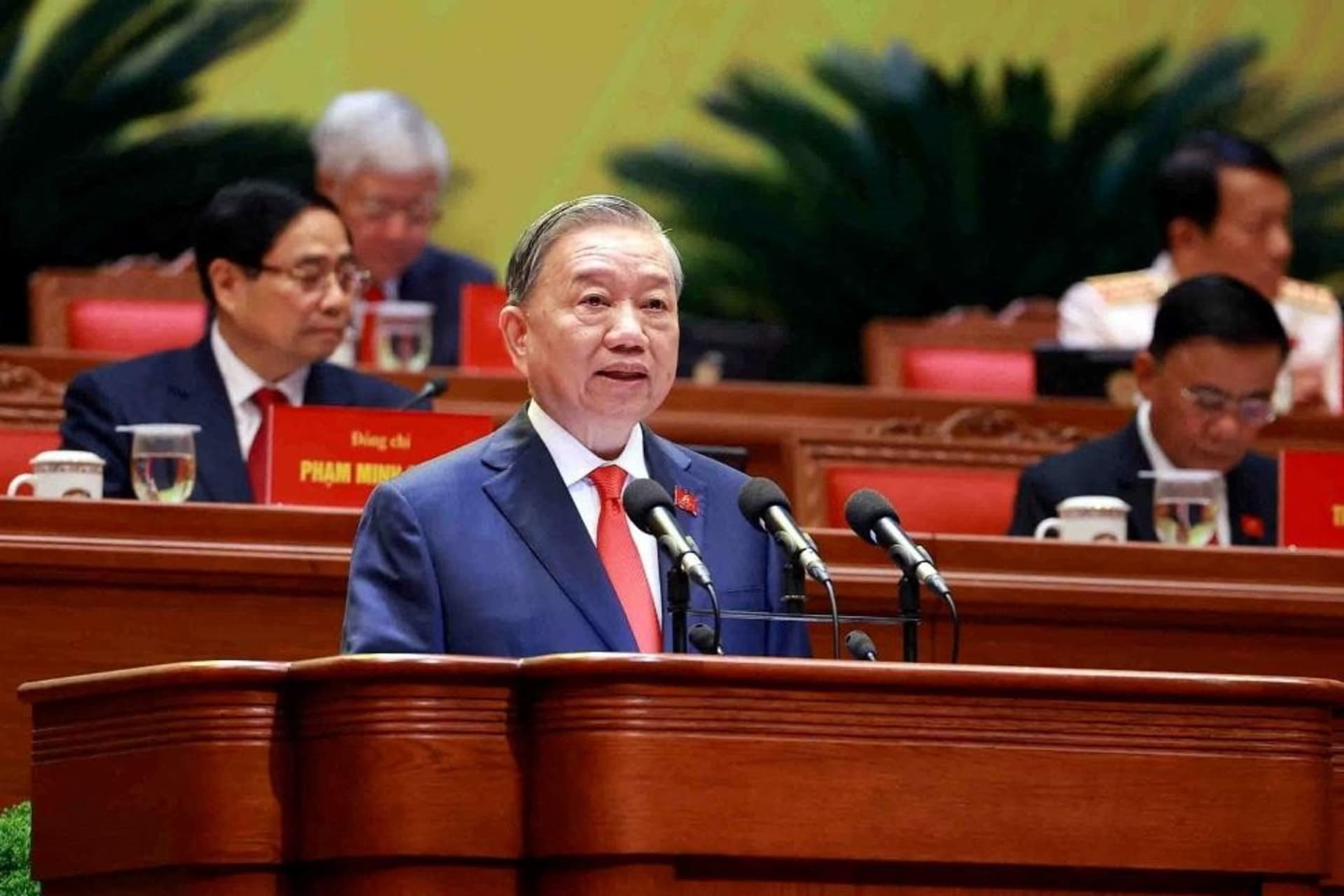
To Lam doubled down on this goal in his opening speech of the Congress on Tuesday, aligning the objective of 10 percent annual GDP growth between 2026 and 2030 with his government’s broader aim of achieving “high middle-income status” by 2030. Beyond 2030, the Vietnamese leadership is also angling to attain “developed country” or “high-income” status by 2045. So, To Lam has clearly put his own credibility behind these ambitious—almost dream-like—goals. And by fully endorsing him, the Party has thrown itself too behind these ambitions.
Vietnam wants to reach this status for a clear reason. It fears that it has only a handful of years to rapidly speed up growth and innovate higher-value products, by giving Vietnamese private companies more rein, because its prime-age labor force is aging quickly.
Such targets are extremely high, almost unthinkable—especially the plan to 2045. Even during China’s growth “miracle” years between 1979 and the late 2010s, considered the gold standard of development, its economy grew by an annual average of around nine percent.
Vietnam is already Southeast Asia’s fastest-growing economy; it faces challenges from tariffs and weakened supply chains in Asia, and overall global economic uncertainty. Though Vietnam was able to reduce the initial reciprocal tariff rate of forty-six percent set by U.S. President Donald Trump last summer to a much lower twenty percent—a percentage comparable to the rates levied against fellow ASEAN members Indonesia and Thailand—a high rate of forty percent remains for goods “transshipped” through the country to avoid higher tariff rates. Ostensibly, this tariff is intended to target Chinese manufacturers who make goods in China and assemble them in Vietnam and then export them, preventing Beijing from avoiding U.S. tariffs on Chinese goods But with the exact terms of what determines a “transshipped” good still unclear, uncertainty has continued to pervade Vietnam’s investment environment and discourage some new foreign investment.
In addition, Vietnam still has many money-losing state firms, an corruption remains a huge obstacle: Vietnam has actually become more corrupt in recent years, according to Transparency International, despite To Lam’s efforts. And although its attractiveness strategically to Beijing and Washington helps it in some ways, U.S.-China economic cooperation harms Vietnam.
Vietnam further has struggled to find higher-value economic areas it could successfully move into. To Lam’s solution, in part, is to try to create twenty huge national champion conglomerates by 2030—private sector firms, but ones receiving significant government input. This strategy is based in part on South Korea’s chaebol, which themselves have been plagued by corruption and opacity. Yet Vietnam so far has no clear strategy for overseeing these national champions at all. And by moving from collective authoritarianism to one-man rule, it makes it even harder to conduct real oversight of private or state firms.
Vietnam also does not seem to have any clear plan to help these national champions without running into the problems China has long encountered in pouring too much money into often-useless infrastructure projects. To help the national champions, The Economist notes, the government is building megaprojects like the “Dong Son Bronze Drum Stadium, a 135,000-seat sports complex named after the prehistoric bronze-casters who populated Vietnam from 1000BC … [and that this is hardly] the only megaproject under construction. The complex is one of hundreds to have been blessed by Vietnam’s communists in December. Others include a $32 billion road-building effort along the country’s northern Red River and a new motorway connecting it to Cambodia. Older projects are also coming to fruition. A new international airport near Ho Chi Minh City welcomed its first flight on December 19th (a plane full of party cadres). All told, state infrastructure spending [rose] by 27 percent [in 2025] … and the budget for 2026 suggests it will increase by another 34 percent.”
All this money sloshing around might help boost growth for awhile, even possibly to ten percent for a year, but it is hardly a guarantee that Vietnam’s wildly ambitious economic dreams will come true. And if it fails, since To Lam has eliminated his rivals, there is a clear place for blame.