What Canadian and Mexican EV Imports From China Mean for the United States
Auto trade and investment policy in Canada and Mexico may be diverging from that of the United States, creating serious challenges for the integrated North American industry.
By experts and staff
- Published
 David M. HartCFR ExpertSenior Fellow for Climate and Energy
- Research Associate, Climate and Energy
David M. Hart is a senior fellow for climate and energy at the Council on Foreign Relations (CFR). Mia Beams is a research associate for climate and energy at CFR.
The global auto industry is in the midst of a revolution that poses a serious threat to the United States. China’s producers have taken the world by storm, and their high-tech electric vehicles (EVs) are transforming the industry’s century-old core product. The Joe Biden administration responded to Chinese competition by adopting tariffs and regulations that exclude Chinese imports. The Donald Trump administration has retreated further, turning its back on EVs altogether.
The U.S. auto industry, however, does not face this threat alone; it has been tightly bound up with those of Canada and Mexico for decades. But these North American partners have begun to diverge. Chinese imports into Mexico surged last year. During a January visit to Beijing, Canadian Prime Minister Mark Carney agreed to admit a small number of Chinese imports into the country for the first time ever. These developments may mark a turning point for the U.S. auto industry that could ultimately isolate it from a global market increasingly dominated by China.
The USMCA and Auto Industry Integration
The United States, Canada, and Mexico are each another’s biggest trading partners. Motor vehicles and parts loom large in the trilateral relationship, making up about 22 percent of total trade under the U.S.-Canada-Mexico Agreement (USMCA). It’s the largest industry in U.S.-Mexico and Mexico-Canada trade and is surpassed only by energy in U.S.-Canada trade. About 30 percent of all U.S. auto exports go to the other two North American nations.
These relationships did not arise spontaneously but instead through a series of agreements that regulated auto trade flows among the three nations. The United States and Canada entered the first of these deals in 1965. The basic terms were extended to Mexico in the 1994 North American Free Trade Agreement, which was succeeded by the USMCA in 2020. While nominally about free trade, negotiations among the three nations—which will resume this summer—were actually a tug of war [PDF] between multinational firms seeking to rationalize production across the continent (as well as globally) and national governments seeking to preserve domestic jobs and economic activity.
The result of these carefully crafted arrangements is an industry highly integrated across the continent. Some parts, such as the automatic transmission of a Ford F-150 pickup truck, cross a North American border seven or eight times [PDF] as they get incorporated into vehicles.
The Rise of China: North America Reacts
North America’s integrated regional auto industry has rough analogues in Europe (under the auspices of the European Union) and in South and East Asia. But the Chinese auto industry, which was long sequestered domestically, exploded onto the global scene in recent years and is disrupting these regional structures. China became the world’s largest auto exporter in 2023, driven in part by its success in building affordable, attractive EVs.
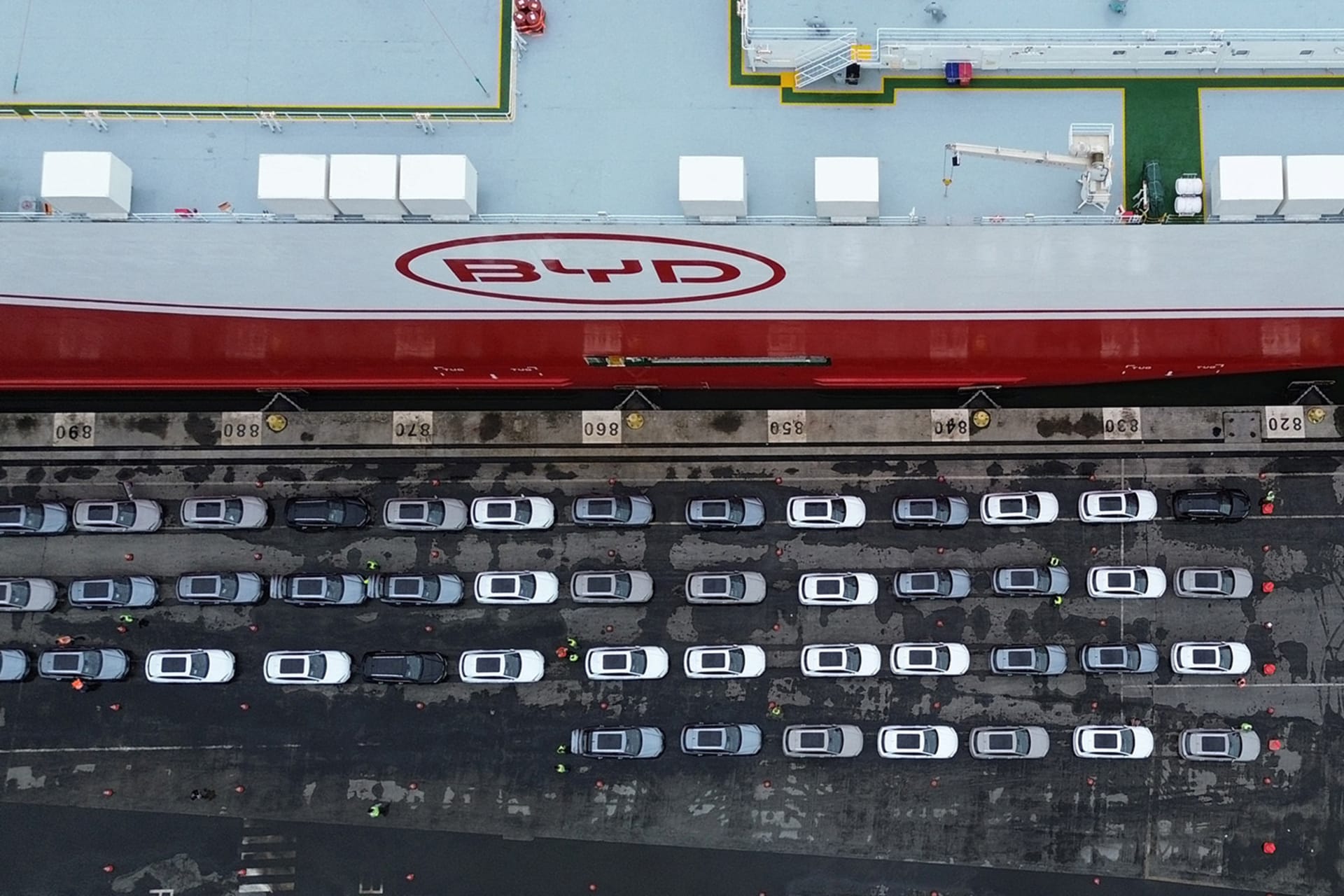
China’s rise prompted trade protections around the world. The Biden administration, citing national security and economic concerns, led this movement, imposing tariffs and regulations that have virtually prohibited all auto imports from China. Canada followed suit. Mexico has been more open, imposing only a 20 percent tariff through 2025, which led to Chinese imports seizing a 25 percent market share of the Mexican market. However, under U.S. pressure, Mexico backed away from a plan to let leading Chinese EV maker BYD build a factory on its soil, and, as of January 1, 2026, raised its tariff rate to 50 percent for all companies that do not have auto plants operating in Mexico.
The Trump Effect: North America Diverges
During his first year back in office, Trump threw sand in the gears of the North American auto industry. Among other actions, he rolled back federal policies aimed at accelerating vehicle electrification and imposed global tariffs on auto and auto parts imports, as well as on many inputs to the industry. Although USMCA-compliant imports from Canada and Mexico were ultimately exempted, the policy’s haphazard rollout and the president’s aggressive rhetoric created great uncertainty that undermined planning. More of the same seems to be in prospect in 2026. During a January visit to a Ford Motor plant in Dearborn, Michigan, Trump described the USMCA as “irrelevant” and stated, “we do not need cars made in Canada... [or] in Mexico.”
While Mexican President Claudia Sheinbaum has taken a measured approach to Trump’s disruption, Carney (who was propelled into office by anti-Trump sentiment) has traveled the world, seeking to diversify Canada’s trade relationships. In October 2025, he announced a goal of doubling non-U.S. exports in the next decade—with a particular focus on Asia—and electrified the World Economic Forum’s Annual Meeting in Davos in January by laying out a new path for Canada and other like-minded “middle powers.”
Canada’s agreement to import Chinese cars is a high-profile element of this strategy. Under this new strategic partnership, Canada is reducing its tariffs on Chinese EVs to 6.1 percent and allowing forty-nine thousand EVs into the country this year (in exchange for expanded access of Canadian canola oil to the Chinese market). This figure is expected to increase seventy thousand annually over the next five years. Moreover, according to Carney’s statement, “It is expected that within three years, this agreement will drive considerable new Chinese joint-venture investment in Canada... [and] ensure a robust build-out of Canada’s EV supply chain.”
Two weeks after the conference in Davos, Canada announced an additional auto deal with South Korea. That deal is also expected to lead to EV supply chain investments, although details are scarce. On February 5, Carney advanced a comprehensive strategy to position Canada “as a global leader in vehicle electrification, autonomous and self-driving technologies, and the battery supply chains that will power the future of mobility.”
What USMCA’s Renewal Means for the Future of the North American Auto Industry
Negotiations to review the USMCA are slated to begin this summer and could result in a less-integrated North American auto sector. Trump seems bent on drawing production from Canada and Mexico to the United States. Auto company General Motors’ June 2025 announcement that it would move some production of the Chevrolet Blazer and Equinox vehicles from Mexico to several states in the United States, for instance, was hailed as a triumph for Trump’s trade policy. The administration will presumably press its North American partners to make such moves more likely under the USMCA.
If Trump takes a hard line, Canada and Mexico might respond by drawing closer to China. Chinese EVs’ appeal to consumers—especially at the low end of the market—as well as their potential to reduce pollution, provide further impetus. Chinese manufacturing investments would undoubtedly be a significant part of any such deal, as Carney’s announcement suggests. However, whether either country would risk its relationship with the United States in this fashion or gain leverage to blunt USMCA revisions that the Trump administration wants is an open question. U.S. Transportation Secretary Sean Duffy, hinting at the stakes of the upcoming talks, said Canada would “regret” bringing Chinese EVs into its market.
Alternatively, Trump might strike his own deal with China, following through on a January 2025 speech to the Detroit Economic Club when he said, “Let China come in.” Such an approach would be a new chapter in an old story, following European, Japanese, and Korean auto firms that established production in the United States over the past forty years. At the same time, it would confound national security hawks and economic nationalists who strongly back the current exclusion, not to mention climate hawks who have seen Trump eviscerate his predecessor’s EV strategy. It would also further complicate USMCA negotiations, potentially undercutting Canadian and Mexican efforts to establish closer ties with China and leave them more dependent on the United States.
A Turning Point?
Many more moves are still to be played in this complex game. Hundreds of billions of dollars of investment in the North American auto industry and supply chain over decades will not be unwound overnight. Voters, workers, and companies in all three countries, along with their leaders, will have their say. But it is possible that Carney’s deal to admit Chinese EVs into Canada will be seen in retrospect as the camel’s nose under the tent. The movements it triggers could leave the United States as an isolated, self-reliant island of internal combustion vehicles in an EV world led by China.
This work represents the views and opinions solely of the authors. The Council on Foreign Relations is an independent, nonpartisan membership organization, think tank, and publisher, and takes no institutional positions on matters of policy.