Whither African Solidarity?
African intellectuals cannot continue to ignore the questions raised by recurrent xenophobia in South Africa.
By experts and staff
- Published
 Ebenezer ObadareCFR ExpertDouglas Dillon Senior Fellow for Africa Studies
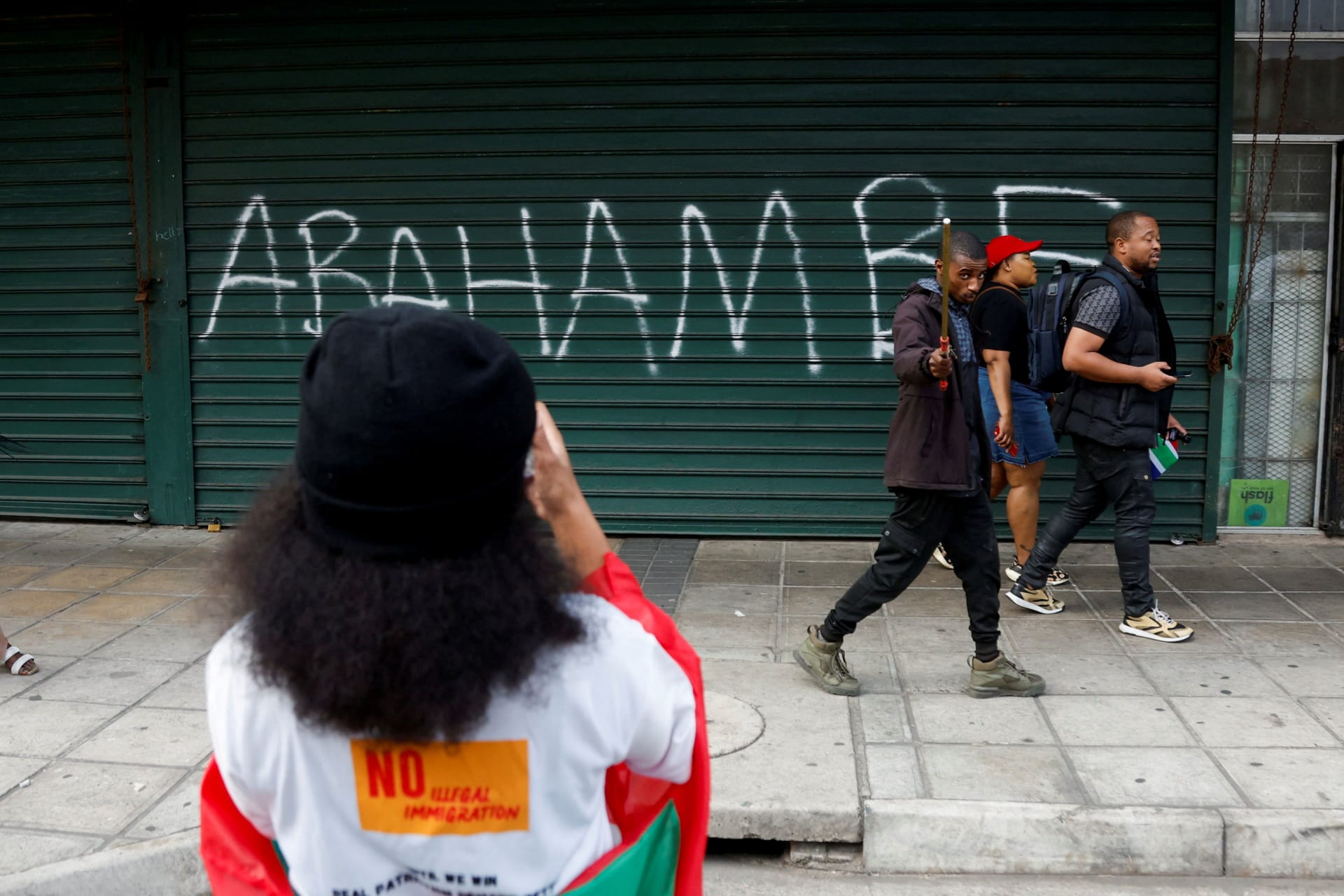
For those of us who like to brag about South Africa’s unique dedication to the idea of a “single citizenship” whereby all are admitted to and enjoy the same political and legal rights, the spate of anti-immigrant attacks in the country, which recently climaxed with a “get out” ultimatum to immigrants from other African nations, has been a rude awakening. Even after budgeting for the arguable legitimacy of the protesters’ demands (I return to this in short order), there is still something deeply upsetting about the spectacle of Africans attacking other Africans (but for the traditional Zulu attire sported by some of the protesters, the untrained eye might struggle to tell the “indigene” apart from the “foreigner”) in an African country, and for that matter one where the philosophy of ubuntu—“I am because we are”—has become a mantra.
While the dust will eventually settle—as it always does—on arguably the ugliest episode in post-apartheid South African history, the damage to relations between the country and the rest of Africa will take time to heal. Having already cost the country considerable goodwill within Africa and beyond, it will most certainly undermine its well-known aspirations to continental leadership, undermining regional networks and alliances that the leadership of the African National Congress (ANC) has labored to construct over the years. For the foreseeable future, too, South Africa will find it hard to project itself as the hub and driver of the African Renaissance, a campaign to which former president Thabo Mbeki (1999–2008) devoted considerable energy and resources.
The South African leadership could point to the fact that what the country is going through is by no means unique to it—and it would not be wrong. Postcolonial African history is indeed no stranger to such outpourings of xenophobia, including well-known examples involving Ghana (1969), Uganda (1972), and Nigeria (1983), respectively. However, the South African case is eyebrow-raising for a different set of reasons.
The first, as already flagged, is that it is taking place in a country expressly committed to the very opposite of the spirit that has taken hold of a sizeable portion of its population. Whatever reservations one may have about post-apartheid South Africa, one cannot deny the refreshing ambition of its constitution, especially its articulation of a modern conception of citizenship. As a matter of fact, that exception is what makes the tribalist impulse underpinning recurrent xenophobia in the country all the more disconcerting.
Second: While xenophobic rage in other parts of Africa has typically been a one-off, operating more or less like a bout of sickness that the host quickly managed to overcome, South Africans must be worried about the recurrent nature of its own infection. As I noted before, so intertwined are the history of post-apartheid South Africa and the recurrence of xenophobia that to speak of one is to speak of the other. It is one thing to experience one outburst of xenophobia, but another thing entirely to experience repeated outbursts (1994/1995, 1998, 2000, 2005, 2006, thrice in 2008, 2015, 2019, and 2026) as the country has. In the past, visitors to South Africa have observed a pattern whereby many South Africans talk about “going to, or never having been to, Africa (that is, north of the Limpopo River).” To what extent is recurrent xenophobia an expression of this disturbing psychology? If the average South African does not see himself/herself as African, should we be surprised at the venom with which vigilantes have treated foreign residents, including, as reported in the media, those in the country legally as refugees?
Third: While, as admitted, South Africa is not the first African country to experience xenophobic violence, it is significant that in its own case, this was entirely led from below, meaning, by vigilante groups organized in opposition to the state. In the case of Ghana and Nigeria, respectively, there is an argument to be made that the mass deportation of Nigerians and Ghanaians, respectively, was state-led, the same thing with the expulsion of Asians from Uganda in 1972 by Idi Amin. This is not to deny that there was popular buy-in in these ugly episodes, especially as the process gained momentum; my point is that they were primarily driven from the top by leaders who were economically illiterate, or in the case of the loutish Idi Amin, a combination of economic illiteracy and blatant anti-Asian racism. Accordingly, the point is moot as to whether a South African state that vacillated between condonement and censure could have done better; the real issue is that it was put on the back foot by grassroots organizations whose angst was directed against the state itself. To insist on this distinction is not to elide the fact that the well-documented ineptitude and corruption of the ANC-led state is one reason why things have come to this unfortunate pass in the country.
Nativist eruptions of the type currently being witnessed in South Africa tend to be blamed on social disaffection rooted in economic anxiety, and it does seem intuitive that amid general uncertainty—and as we have seen in other parts of the world—people should blame “outsiders” for their predicament. From this perspective, and given its prolonged and seemingly intractable economic crisis, xenophobia in South Africa is par for the course. Yet, care must be taken not to reduce xenophobia to economic grievance. I have suggested, for instance, that, beyond economics, (the persistence of) xenophobia in South Africa is a reminder of the continued failure of many African countries to embrace the idea of modern citizenship, one that uncouples “belonging” from “place” (including circumstances) of origin. Across postcolonial Africa, not only does this portability of citizenship continue to be refuted in law and practice by a misguided valorization of “indigeneity”; but individuals’ opportunities continue to be shaped and defined by something as accidental as where they (i.e., their parents) hail from. The ongoing 2026 World Cup tournament, where players of African descent have featured as citizens of many European countries, is a timely indication of the progress that Western society in general has made in the pursuit of this all-important principle.
At any rate, beyond “mere” citizenship, what the crisis in South Africa invariably does is to put an asterisk against the idea of a coherent African identity, something that is not just taken for granted, but is historically construed as the ideational anchor of Pan-Africanism. If, in a country that trumpets African solidarity at every turn, fellow Africans are not even treated with the courtesy one would normally extend to strangers, what is the meaning of Africanness? To reprise the provocative but essential questions posed by University of Notre Dame theologian Emmanuel Katongole, whose important work on the subject deserves a wide readership: “What does it mean to be African? What is it that I share with other Africans that make them ‘my people’ more than any history, friendship, or relationship with Europeans or Americans could ever make them ‘my people’? Is it the color of my skin, history, geography, or culture that makes me naturally, and this without effort, allied to other ‘Africans’ more than a Belgian or Norwegian? What does it mean to belong to a group of people called Africans?”
Allow me to supplement Katongole’s questions with four of my own: Why is it that, in a moment when agitation about African solidarity has never been more clamorous, Africans feel more welcome outside Africa than in African countries? What is the meaning of solidarity amid the crises and killings in Sudan, South Sudan, Somalia, and Ethiopia, to name just a few examples? What does it mean to speak of community given the way in which families are being torn apart by youth emigration and attendant social dislocation? If, as Kwame Anthony Appiah submits, all identities are relative, what, if anything, is fixed or stable about African identity?
Naturally, I have my own intuitions as to the best approach to these questions—and the above list is by no means exhaustive—but I happen to have a different goal here, which is both to attempt to set the terms for the debate as well as show why a confrontation with these questions is unavoidable. While there is nothing essentially wrong about affirmation of racial pride (though making it a criterion for moral judgment is problematic to say the least), it must be understood that it is a poor substitute for unflinching introspection. The unfolding tragedy in South Africa is an opportunity for a rigorous and earnest debate about African identity and solidarity. The continent has nothing to lose but its shibboleths.
This is the third piece I have written on the eruption of xenophobic rage in South Africa. The previous two can be found here and here. All three can be profitably read as a continuous argument on the question of citizenship, identity, and solidarity in Africa. I humbly welcome questions and comments. Thank you.