A Conversation About the Best and Worst U.S. Foreign Policy Decisions
When you create best and worst lists, prepare for disagreement and debate.
By experts and staff
- Published
 James M. LindsayCFR ExpertMary and David Boies Distinguished Senior Fellow in U.S. Foreign Policy
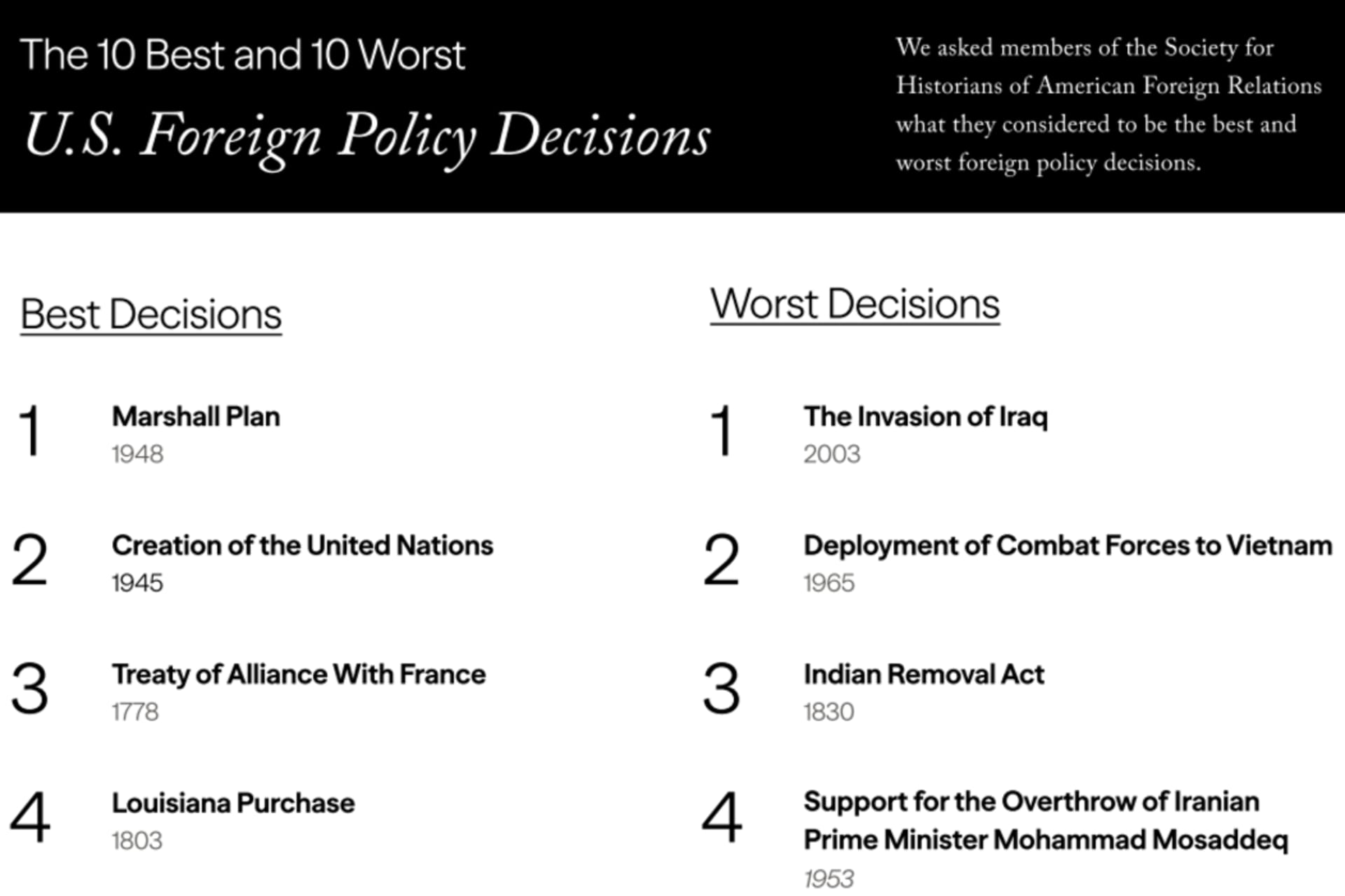
I wrote on Tuesday that the Council on Foreign Relations released the results of a survey of members of the Society for Historians of American Foreign Relations (SHAFR), the world’s foremost professional association dedicated to the study of the history of U.S. foreign relations, about the best and worst decisions in the history of U.S. foreign policy. On Wednesday, I participated in a panel discussion at the Council’s offices in New York on the results of the survey.
[Video: https://youtu.be/rQB4dZgDdlg]
I was joined by two distinguished historians, Mary Dudziak, Asa Griggs Candler Professor of Law at Emory University, and Christopher McKnight Nichols, Wayne Woodrow Hayes Chair in National Security Studies and Professor of History at The Ohio State University. David Rubenstein, chairman of the Council, kindly moderated.
Our discussion was rich and far ranging. I had three main takeaways:
1. Best and worst lists really can be, as I suggested on Tuesday, an invitation to have an informative conversation. Mary, Chris, I, and the others in the room and online had a great back and forth over which decisions should appear on the best and worst lists and where exactly they should land. Chris said that he had the 1778 Treaty of Alliance with France at the top of his list of best decisions rather than the Marshall Plan, because without French support the American Revolution likely would have failed. Mary noted that the U.S. effort to compete with the Soviet Union after World War II for support in Asia and Africa sparked efforts by U.S. officials to oppose Jim Crow laws in the United States. I noted that sometimes successful policies, like the George H.W. Bush administration’s management of the collapse of the Soviet Union and the reunification of Germany, get overlooked precisely because they succeeded; historical events can seem inevitable in hindsight when they were anything but.
2. Most of the decisions that top the Best list are part of the U.S. shift in the 1940s from spurning global leadership to embracing it: the Marshall Plan (#1), the creation of the United Nations (#2), the Lend-Lease Act (#5), the creation of NATO (#6), and the creation of the Bretton Woods System (#7). The legacy of the Greatest Generation weighs heavily on historians today. And the world that those decisions created is the one the United States is now rejecting.
3. None of the top twenty-five decisions on the Best list are from this century, but four of the top twenty-five decisions on the Worst list are: the invasion of Iraq (#1), the withdrawal from the Paris Agreement (#7), the enhanced interrogation of terrorism detainees (#17), and the invasion of Afghanistan (#18). One questioner noted the discrepancy and asked if that meant that the United States had lost its touch when it comes to foreign policy. The answer would seem to be yes. Three decades ago, the United States looked poised to remake the world in its image. That great promise was never fulfilled, and the foreign policy choices that successive administrations made have contributed substantially to the discord and division that now bedevils U.S. politics.
Oscar Berry assisted in the preparation of this post.