Myanmar’s Junta-Led Election Is Neither Free nor Fair
Despite banned opposition, mass displacement, and severe repression, the staged poll is already granting the military dangerous international legitimacy.
By experts and staff
- Published
 Joshua KurlantzickCFR ExpertSenior Fellow for Southeast Asia and South Asia
- Annabel RichterResearch Associate, Southeast Asia and South Asia
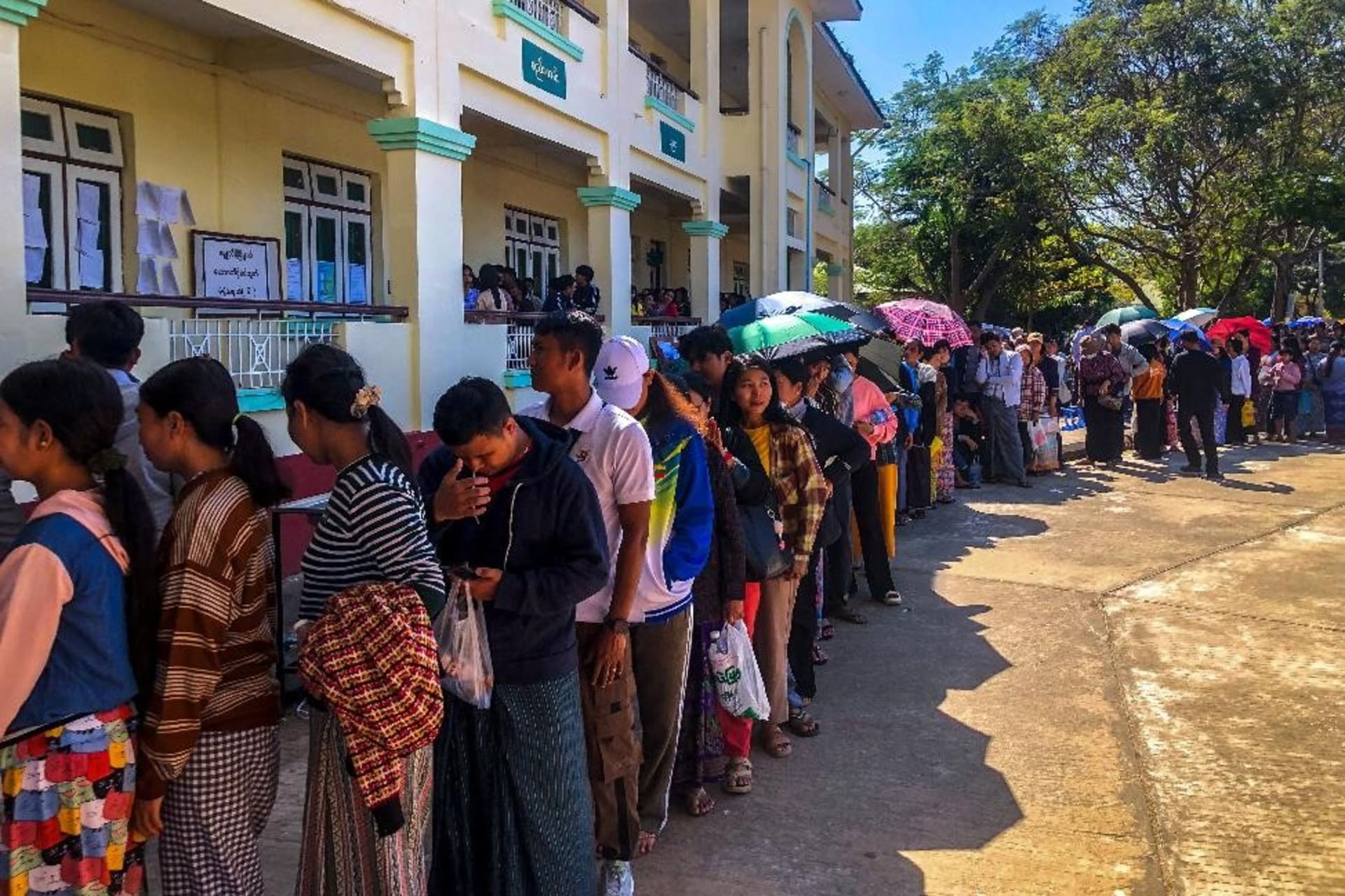
On December 28, Myanmar held the first of three phases of planned voting in a parliamentary election that a number of leading democracies and democratic groups—including the United Kingdom and the European Parliament—and international organizations such as the United Nations have decried as a sham. Those organizations are right: this is not a free and fair election. Under the direction of the military junta, which has controlled the country since seizing power in a coup five years ago, Myanmar nationals are voting in an election in which most opposition parties are banned, tens of thousands of political prisoners are in jail, and there is no real freedom of assembly or speech.
It is a contest that the junta-backed Union Solidarity and Development Party (USDP), essentially the military party, is guaranteed to win. A USDP victory is likely to make Senior General Min Aung Hlaing, the junta leader and interim head of state, the full president after the election.
According to recent reports from ABC, Reuters, and Al Jazeera, the USDP has reportedly taken an overwhelming lead ahead of the next phase of voting, set to take place on January 11. Statements from junta spokespersons have pointed to the rate of voter turnout in places where voting occurred, supposedly hovering just above fifty percent, as evidence of the free and fair nature of the elections.
Even at first glance, it is clear that the government’s claims of a real election are unfounded and that this voter turnout figure is likely inflated, according to most independent analyses. Because of the ongoing civil war, more than a third of Myanmar’s townships lack the infrastructure to safely set up polling stations, so people in those areas could not vote at all. What’s more, millions across the country have been internally displaced by constant fighting between the junta and the loosely-aligned resistance movement, or have fled into neighboring Thailand and Bangladesh. These people have no chance to vote either.
And beyond the massive crackdown on all sorts of opposition, the junta further limited the election to only six parties and instituted new, even more draconian rules about speech related to the elections. The junta arbitrarily disqualified forty political organizations from running candidates. Among the parties barred from contesting is the National League for Democracy (NLD), which won enough seats to control Parliament during Myanmar’s last free and fair election in 2020 before being ousted by the February 2021 coup.
Last year, the junta also enacted a law criminalizing any criticism of the election and seemed to threaten people who did not vote with retaliation. Those convicted of any critique of the election—by displaying boycott stickers, engaging in online discourse, and even saying the word “revolution” in public speeches or settings—can face punishments ranging from three years in prison to the death penalty.
Yesterday, UN Special Rapporteur on the situation of human rights in Myanmar, Tom Andrews, had harsh words for the “election.” “The results of the first round of voting in what the military junta of Myanmar claims is a legitimate ‘election’ are in and they are conclusive,” Andrews said. “By all measures, this is not a free, fair nor legitimate election. It is a theatrical performance that has exerted enormous pressure on the people of Myanmar to participate in what has been designed to dupe the international community.”
Although reporters from major news organizations have been able to speak with some voters, most who have spoken for articles do not seem convinced the election is going to bring any positive results for politics, the shattered economy, or any resolution to the civil war. Civilians interviewed by international outlets like CNN, The Guardian, BBC, and The New York Times seem exhausted, afraid, and hopeless.
Despite these numerous condemnations of the election, as we warned in a recent piece in World Politics Review, the junta’s election already appears to be bringing it greater international legitimacy, a key goal of having the vote.
The junta got nine countries to send observers to the election, a way of legitimizing it, including ones from Japan, a powerful regional democracy, India, another regional giant and longtime democracy, and Myanmar’s fellow ASEAN members Cambodia and Vietnam. Japan has long wanted to re-engage more in Myanmar, competing more intensely in the country’s business environment. Meanwhile, the Philippines—ASEAN’s rotational chair for 2026—sent an envoy to Myanmar in what junta-controlled media described as a “courtesy call,” flouting recommendations from Filipino parliamentarians to avoid engagement that could legitimize the military’s claims to power after the election.
China has celebrated the election, playing a central role in it. Meanwhile, other regional actors like India, Thailand, and Bangladesh, which need the junta’s help in dealing with refugees, crime, and other issues, are also likely to use the election to grant greater legitimacy to Naypyidaw and then-president Min Aung Hlaing.
As we earlier wrote for WPR, the White House also seems ready to use the election to grant the junta-created government significant legitimacy. In November, the Trump administration suspended Temporary Protective Status provisions for Myanmar nationals, claiming that Myanmar was gaining greater political stability, in part because of the elections.
It is likely that after the junta-installed government is sworn in, the White House will treat it with a significant degree of legitimacy, despite intense opposition to the junta from both GOP and Democratic House and Senate members. The White House may ease sanctions on Myanmar so that American natural resources companies can compete there with Chinese and other firms.