North Korea’s Deepening Economic Dependency on China
By experts and staff
- Published
- Scott A. SnyderSenior Fellow for Korea Studies and Director of the Program on U.S.-Korea Policy
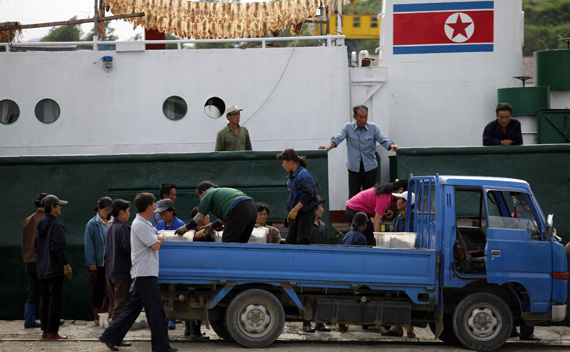
Yonhap reported this week that North Korea’s trade dependence on China has climbed as China’s proportion of North Korea’s overall foreign trade has risen from $1.97 billion, representing 41.6 percent of North Korea’s overall trade in 2007, to $3.47 billion, representing 57.1 percent in 2010. The report compares trends in China-North Korea trade relations with inter-Korean trade trends, which despite heightened tensions show a slight increase in trade volume from $1.8 billion in 2007 to $1.91 billion in 2010. But because of the growth in China’s trade with North Korea, inter-Korean trade as a proportion of North Korea’s overall trade has dropped from 38 percent in 2007 to 31.4 percent in 2010.
South Korea’s perceived failure to compete with China for economic influence in the North as a result of heightened tensions in inter-Korean relations remains an active subject of frustration in South Korea, especially among progressives, but North Korea’s continued pursuit of nuclear and missile tests and other tension-raising provocations against the South make it clear that China has been unable to use the North’s economic dependency on Beijing as a tool for imposing political restraint on Pyongyang.
To explore the significance of these developments in China-DPRK relations, the New York-based Korea Society hosted a series of three programs to explore the relationship in greater detail. USIP’s John Park argued that the Chinese have launched their own Sunshine Policy with Chinese characteristics, while the Mansfield Foundation’s Gordon Flake suggested that China’s tendency to shield North Korea from the consequences of its own provocations has become a source of mistrust in Beijing’s relations with the United States and South Korea.
In my presentation two weeks ago, the third in the series, I reviewed economic trends in the China-DPRK relationship, including the apparent economic competition between China and South Korea for trade share with North Korea during the Roh Moo Hyun administration (2003-2007) and the widening gap in China’s and South Korea’s shares of North Korea’s trade under the Lee Myung Bak administration. I also highlighted China’s strenuous efforts to strengthen high-level contacts, a strategy that appears to be paying off when one considers that Kim Jong Il has visited China on four occasions during the past two years (the latest being on his return from Russia last August) following a dip in high-level contacts in the year following North Korea’s first nuclear test in 2006.
In my presentation, I identified five contradictions that surround China’s current approach to North Korea:
The question of whose side is time on remains most directly relevant to policymakers, and it continues to influence prospects for cooperation among North Korea’s neighbors depending on whether one believes that proliferation or instability is the more likely risk that policymakers will face as they attempt to coordinate policy toward North Korea.