President Boluarte Impeached, but Peru’s Crisis Runs Deeper
Real power lies not with the president but with congress, which is building a mafia state.
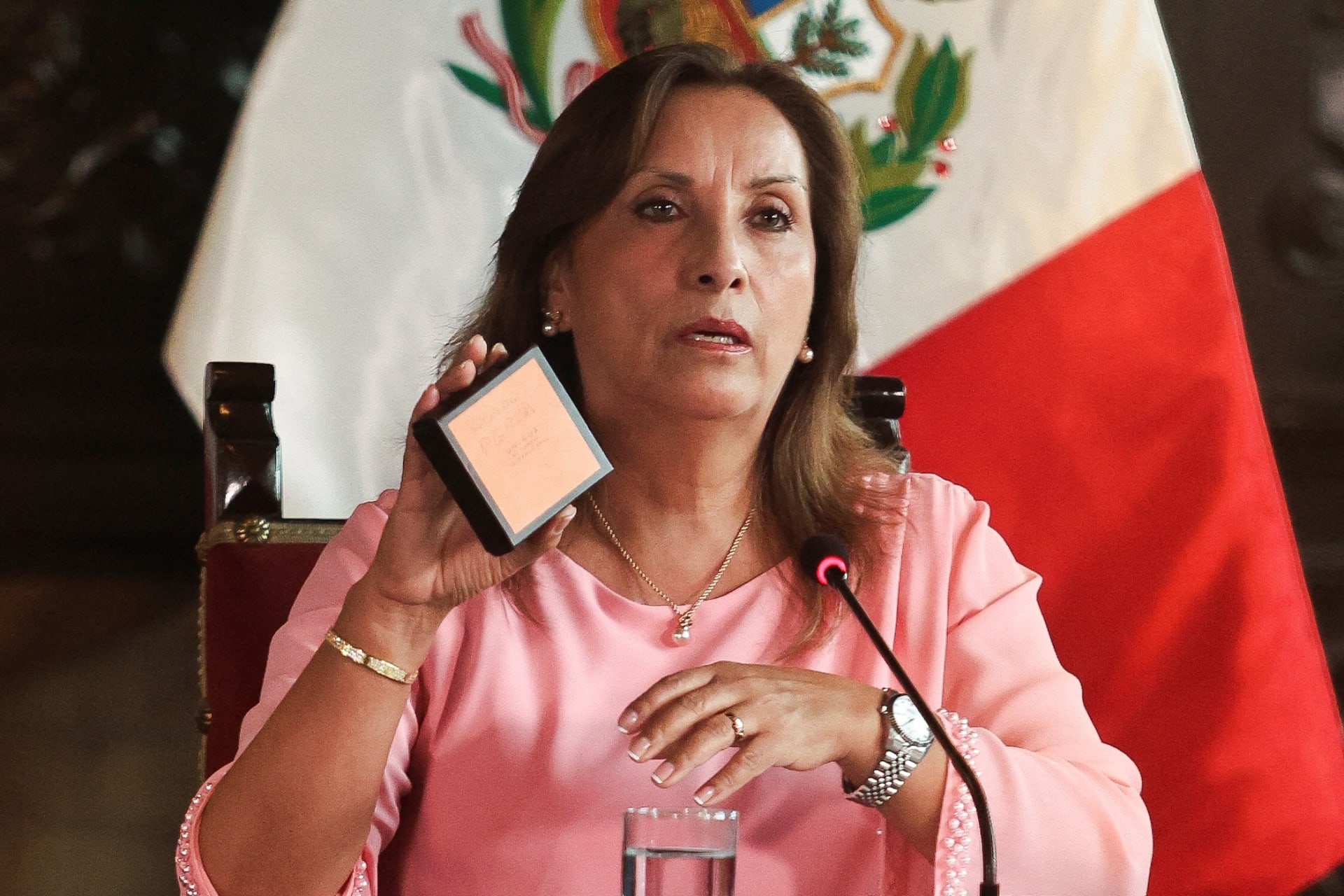

On October 10, Peru’s deeply unpopular congress impeached the country’s even more unpopular President Dina Boluarte, who recently polled at just three percent. José Jeri—a political novice elected with only around 11,000 votes in 2021, currently serving as president of Congress—became the country’s latest head of state.
Jeri becomes Peru’s seventh president to hold office since 2018, and the fourth thrust into office by a predecessor’s impeachment in the same time. No other country in Latin America—and few in the world—have seen so many rapid-fire presidential turnovers abruptly elevating so many total unknowns. For many outside observers looking in, Peruvian politics increasingly resembles a shapeless blur.
But there’s more to recent Peruvian politics than just churn, and Boluarte’s ouster is more than just another episode in a long saga of political instability. It’s a sign that the authoritarian coalition of lawmakers ensconced in Peru’s congress—the real power behind the throne since she took office in late 2022—is running out of options.
For the past two years, this coalition (more on who they are below) has quickly and effectively remade many of Peru’s state institutions in pursuit of three main objectives. First, stop Peru’s judiciary from investigating political corruption, which it did vigorously until recently. Second, weaken law enforcement and embolden criminal gangs and mafias: illegal gold miners, illicit loggers, and drug traffickers. Third, vest as much power as possible in congress—the institution the coalition controls—siphoning it away from the judiciary and executive. Boluarte, a weak president trailed by corruption scandals, went along with the coalition, enabling it. It served her interests. The coalition, in turn, backed her up—until the costs outweighed the benefits, and it pushed her aside.
The result: the rapid rise of a peculiar kind of mafia state: one in which a consortium of corrupt politicians and criminal actors rules instead of a single unitary clique or strongman.
For Peru, the results have been devastating. The state has lost legitimacy. Outmigration has surged. Even the technocratic economic policymaking that long underwrote Peru’s robust economic growth—once insulated from the political churn—is more and more exposed to lawmakers’ short-termism. Most pressingly for ordinary Peruvians, organized crime is booming—replacing Amazon rainforest with coca farms, invading legal gold mines, extorting small businesses, and carrying out brazen daylight assassinations against those who resist.
Peruvians—until recently living in a solid if imperfect electoral democracy—don’t want to live in a mafia state. They don’t want to live in a lawless country where crime and corruption thrive.
Sacrificing Boluarte seems to be congress’ short-term response to public outrage—most recently whipped up by Boluarte’s non-response to gunmen shooting up a concert in Lima and police repression of Gen-Z protestors with tear gas.
Forcing out deeply unpopular Boluarte may let off a little steam. But the public’s anger runs much deeper than any one politician, because it’s about a bigger question: will Peru become a lawless country of limitless extraction—run to the advantage of corrupt politicians and criminal gangs—or is there a path back to rule of law? That question will lurk in the background—or possibly foreground—of Peru’s upcoming April 2026 general elections. Those elections will decide whether the mafia state consolidates—or whether the frustrated yet fragmented public can identify and rally behind a political alternative.
How Peru Got Here (The Simple Version)
Nothing is actually simple about how Peru got here, but here’s the thumbnail sketch—with as few first and last names as possible.
For most of the 1990s, Peru was a traditional mafia state—that is, a strongman and his cronies ruled. Right-wing populist Alberto Fujimori and his inner circle siphoned huge sums into foreign bank accounts and persecuted the opposition. Drug traffickers and illegal gold miners did booming business—plenty of signs indicate, with government blessing.
But in 2000, after Fujimori robbed an election and huge protests pushed him from office, Peru’s trajectory brightened. Clean, competitive elections took hold. The economy grew robustly and from 2001 to 2014 poverty fell more dramatically than anywhere else in Latin America. Peruvians were not thrilled about their governments—especially as they found out their democratically-elected presidents also took bribes. Huge welfare gaps still existed between the more prosperous coastal cities and the poorer Quechua- and Aymara-speaking highlands. But presidents finished their terms, there was a baseline of stability, and there was—as of yet—relatively little criminal violence.
But then, starting around 2016, two things changed, launching Peru on its current, unhappier path. First, Alberto Fujimori’s daughter, Keiko—heir to his political movement—ran for president and lost, while gaining control of congress. Over the next four years, she, her party, and its allies used that control to oust two presidents with whom they clashed, substantially weakening the executive. Congress—fractious, short-sighted, often venal—started to rule, as it still does today.
Simultaneously, Peruvian prosecutors began aggressively probing corruption. A majority of Peruvians supported the investigations. But they scared lawmakers trailed by allegations of corruption and crime ties, who banded together to stop the prosecutors.
Much has happened since. Far-left President Pedro Castillo won office, fumbled a desperate power grab, and was impeached in late 2022. Many of those who voted for him—mostly poor and Indigenous Peruvians from the highlands—protested. Police and soldiers killed at least forty-nine with impunity. Boluarte, previously Castillo’s vice president, took office with no discernible agenda of her own, except to remain there. Along with the majority of congress, she staved off popular demands for fresh elections, which might have provided a peaceful, electoral path out of the crisis.
The upshot was “stability,” but not of a healthy kind. Boluarte remained, but as a deeply unpopular president who many Peruvians saw as illegitimate. Meanwhile, the authoritarian coalition in congress pressed forward with its goals.
Peruvian law professor Rosa María Palacios persuasively argues this coalition is led by four political “families,” each led by a distinct boss: the Fujimoris, the Cerróns, César Acuña, and José Luna Gálvez. Without going into too much detail about who these people are, the Fujimoris are nominally right-wing, the Cerróns nominally far-left, and it’s not even worth trying to place the other two clans ideologically (Palacios aptly describes Luna Gálvez as practicing “political Airbnb,” such is his tendency to rent out spots in his party to the highest bidder, of course, without background checks). U.S., European, and most Latin American governments (with a few exceptions) have been largely silent on Peru’s democratic erosion in part because the coalition doesn’t fit neatly into stories about either leftist or right-wing democratic erosion.
What the four families—the ringleaders of the coalition—truly share in common is a commitment to the three goals mentioned earlier: immunize themselves against justice, cater to crime, and amass power. Because congress has largely succeeded in cowing the judiciary and purging top independent prosecutors, we don’t know the exact extent of organized crime’s penetration of politics. But as I have written about in more depth elsewhere, congress’ spate of what Peruvians colloquially call “pro-crime laws” suggests it goes deep, with illicit campaign finance as a main vector.
What Happens Next?
Boluarte is out. The authoritarian coalition in congress is not. And general elections are just a few months away. At least 39 parties and 117 presidential and vice presidential candidates are planning to participate. The two candidates currently polling in the lead—right-wing Lima mayor Rafael López Aliaga and Keiko Fujimori—register just 10 and 8 percent support, respectively. Neither would clash with the dominant blocks in congress (Keiko is, after all, the leader of one of them). Thanks to self-serving reforms they, themselves, passed, members of congress will be eligible to run for seats in a newly-created Senate—if they can muster any support from voters whatsoever.
At least three scenarios seem plausible. First, an angry but fragmented and demobilized electorate fails to cluster around any challenger to the status quo. Two candidates aligned or at least aligned enough with the authoritarian coalition—like Fujimori and López Aliaga—make it to a presidential run-off and compete against one another without representing much change. Peruvians aren’t happy to see the status quo perpetuated, but find no means of rerouting the country. Protests simmer but don’t explode. Crime likely worsens and outmigration continues.
Second, a robust challenger to the status quo appears between now and April. This candidate may or may not be democratic. He or she could easily be a would-be authoritarian who simply opposes the current coalition, exposes their corruption, and gains a critical mass of support. The candidate wins—likely by a lot—and takes office. Then comes the challenge of undoing the damage the coalition has done to Peru’s rule of law—if this outsider is even interested in that.
Last, this same scenario plays out, but the coalition currently in power finds a way to block the challenger from successfully running, winning, or taking office. Something similar nearly played out in Guatemala in 2023, when that country’s “pact of the corrupt”—eerily similar to the one now in charge in Peru—almost barred anti-corruption candidate Bernando Arévalo from taking office. Peru explodes in protest.
Some saw Boluarte’s one year, ten months, and two days in office as a welcome reprieve from Peru’s recent instability. But that “stability” was illusory and never going to last. Peru is unlikely to find stable footing until it resolves a bigger question: will it accept the model of state and society foisted on it by congress, or find a way to articulate a different model and push back?