Sen. Arthur Vandenberg’s Conversion to Internationalism
A leading isolationist voice before Pearl Harbor helped build support for an internationalist U.S. foreign policy after World War II.
By experts and staff
- Published
 James M. LindsayCFR ExpertMary and David Boies Distinguished Senior Fellow in U.S. Foreign Policy
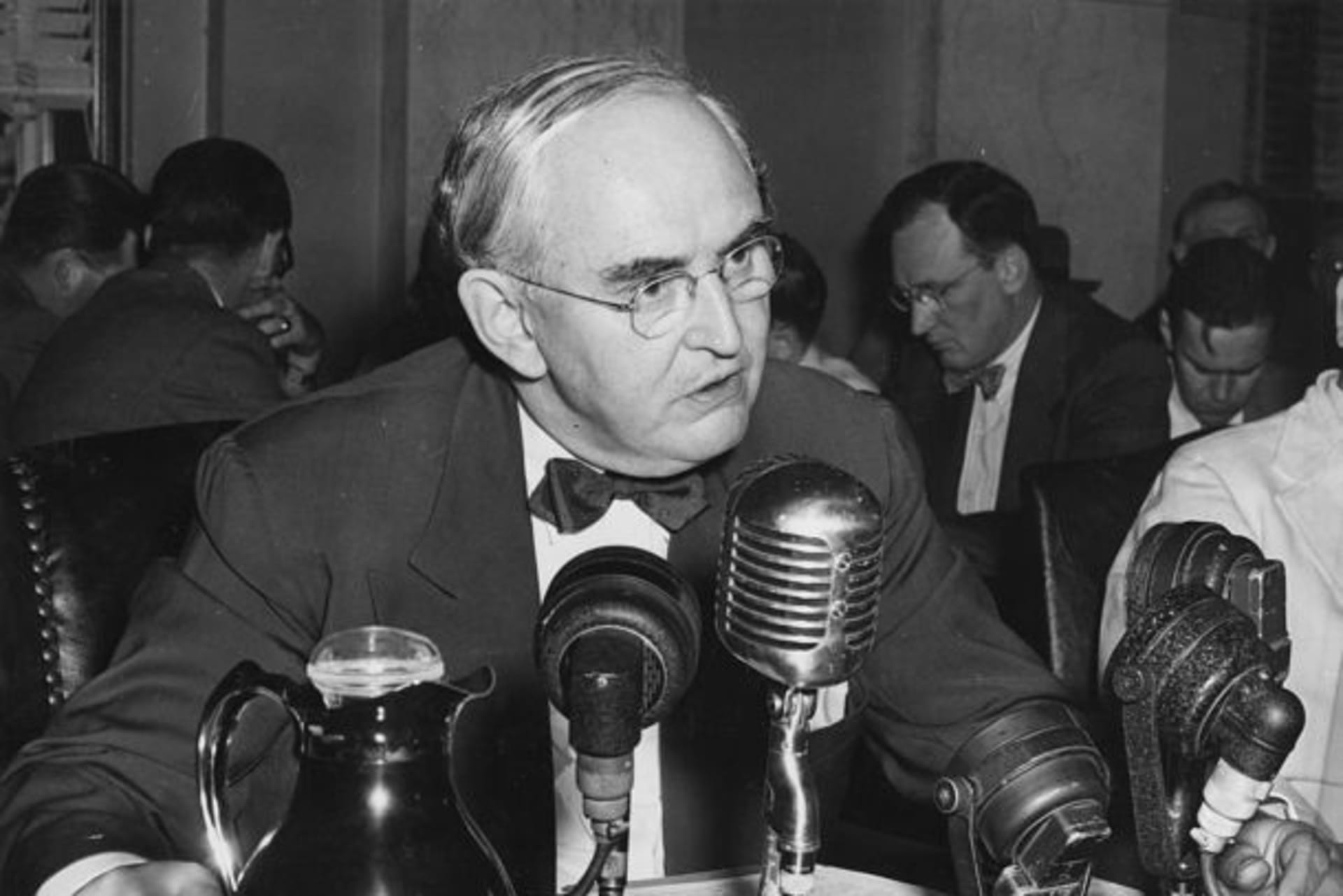
In a post earlier today, I mentioned that Sen. Arthur Vandenberg (R-MI), a leading isolationist voice on Capitol Hill in the years before World War II, dismissed the Ludlow Amendment as a terrible idea. Today also happens to be the anniversary of the major speech Vandenberg gave on the Senate floor in 1945 renouncing his isolationist views and urging the country to embrace an internationalist foreign policy.
Vandenberg spent much of the 1930s arguing that the United States should stand apart from the affairs of Europe. Fearing that President Franklin D. Roosevelt was bent on entangling the United States in a war in Europea that would not serve U.S. interests, Vandenberg championed the passage of a series of neutrality acts in the late 1930s. These laws restricted arms sales and other trade with potential and actual belligerents, while largely denying the president any discretionary authority in their implementation. (The neutrality acts are another example of a well-intentioned but ultimately counter-productive foreign policy idea.)
Even Japan’s attack on Pearl Harbor did not change Vandenberg’s mind about either Roosevelt’s motivations or U.S. interests overseas. Instead, he blamed what he called “Roosevelt’s private war” on FDR’s “secret diplomacy which pointed straight toward war for many months preceding” the attack.
So, it was surprising when Vandenberg, now a senior member of the Foreign Relations Committee, took the floor of the Senate on January 10, 1945, to make the case for internationalism and strong presidential leadership in foreign policy. The Senate’s website on classic Senate speeches summarizes his address:
Senators and spectators in the galleries listened for thirty minutes as Vandenberg … declared that, although he had once worked to limit the president’s discretion in foreign affairs. He “believed in our own self reliance,” the “gory science of mass murder” had transformed modern warfare into “an all-consuming juggernaut.” “I do not believe,” he reasoned, “that any nation hereafter can immunize itself by its own exclusive action.” Restraining himself from condemning Stalin’s plan to erect “a surrounding circle of buffer states” around the Soviet Union to prevent a resurgence of German aggression, he suggested “collective security” as an alternative approach. To Roosevelt’s surprise, the Michigan Republican offered an “olive branch” to promote a closer working relationship between president and Congress: “we can agree,” he conceded, “that we do not ever want an instant’s hesitation or doubt about our military cooperation in the peremptory use of force . . . to keep Germany and Japan demilitarized.” But “there should be no more need to refer any such action back to Congress than that Congress should expect to pass upon battle plans today. The commander in chief should have instant power to act, and he should act.”
To put Vandenberg’s reversal in contemporary terms, it would be as if Sen. Janine Shaheen (D-NH), the current ranking member of the Senate Foreign Relations Committee, took to the Senate floor to endorse President Donald Trump’s dismissal of international law and call for the United States to take Greenland by force.
Vandenberg’s conversion to internationalism helped persuade other Republicans to follow suit and laid the groundwork for a bipartisan foreign policy in the years immediately after World War II. Six months after Vandenberg’s speech, the Senate voted 89 to 2 to approve the UN Charter. Today, of course, foreign policy is seldom bipartisan, and many Americans doubt the wisdom of the internationalism that Vandenberg championed.
(Historical aside. Vandenberg Air Force Base is not named after Senator Vandenberg. It is named after his nephew, former Air Force Chief of Staff General Hoyt S. Vandenberg. Quite a family.)
The United States celebrates its 250th anniversary in 2026. To mark that milestone, I am resurfacing essays I have written over the years about major events in U.S. foreign policy. A version of the essay above was published on January 10, 2011.
Oscar Berry assisted in the preparation of this post.