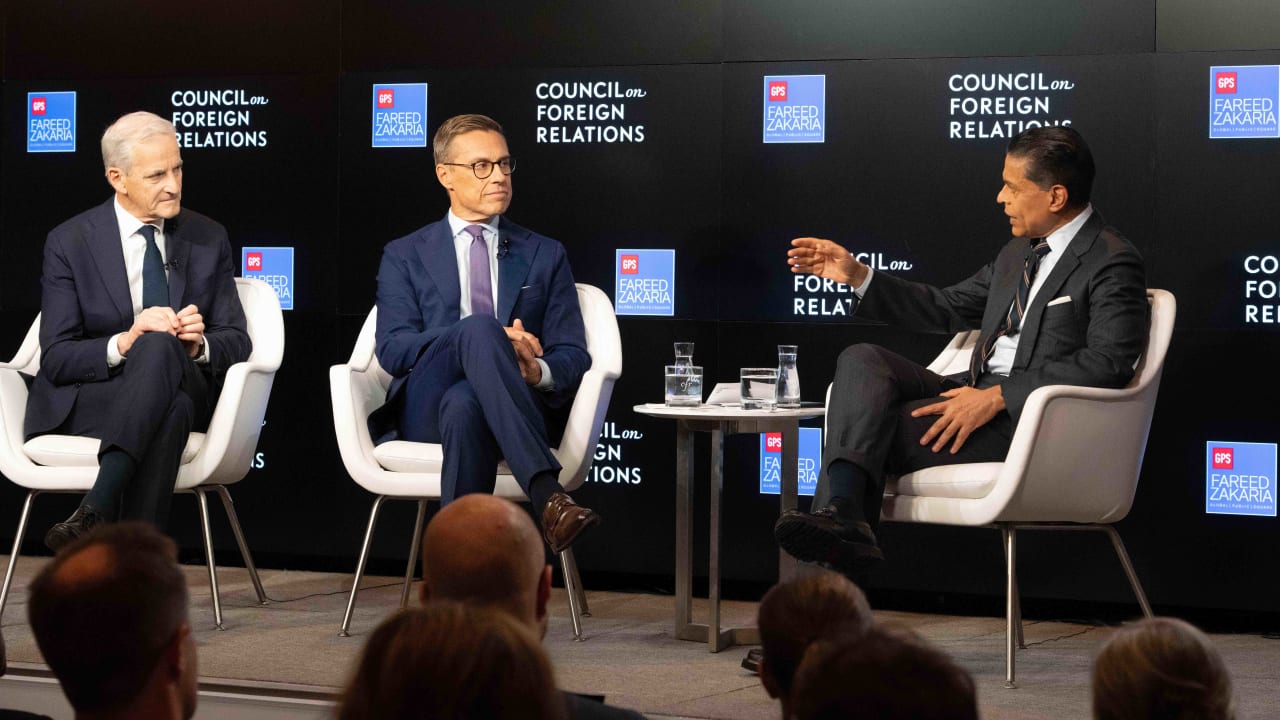
A Conversation With Prime Minister Jonas Gahr Støre of Norway and President Alexander Stubb of Finland
Event date
Speakers
- Prime Minister, Kingdom of Norway
- President, Republic of Finland
Presider
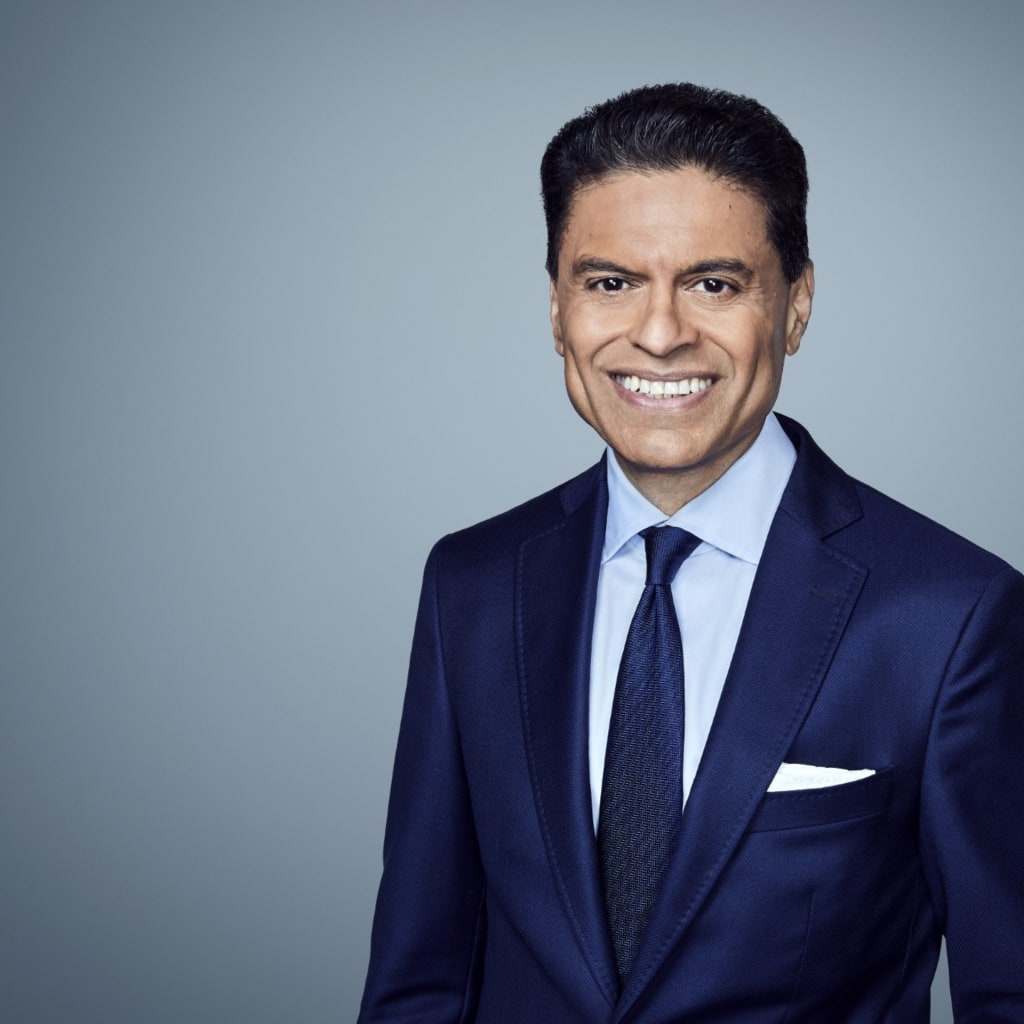 Host, Fareed Zakaria GPS, CNN; Member, Board of Directors, Council on Foreign Relations
Highlights of the interview were broadcast on CNN’s Fareed Zakaria GPS on Sunday, September 27 at 10:00 a.m. (EDT), with a planned replay at 1:00 p.m. (EDT).
ZAKARIA: All right. I’d like to welcome all of you. We have, of course, very distinguished guests with us today—the Prime Minister of Norway, the president of Finland.
This is called the Russell Leffingwell Lecture. And we do want to thank the Leffingwell family for their generosity in endowing this lecture, especially Tom and Ted Leffingwell Pulling. Appreciate it greatly. Russell Leffingwell was a charter member of the CFR who also served as its president from 1944 to ’46, and its chairman from ’46 to ’53.
You know the usual rules for the Council apply. We will begin with a conversation, and then about halfway through I’ll open it up to questions.
Welcome—I can’t say presidents, I can’t say prime ministers, so I’m going to say Your Excellencies. (Laughter.) Let’s start with the issue that really must be preoccupying you from a national security point of view, which is the war in Ukraine. It doesn’t seem like much is changing on the battlefield. There are some indications that—recently that actually the Ukrainians have been doing well. On the other hand, the Russians have been able to destroy much of Ukraine’s energy infrastructure. And they have these jet Shaheds that seem to be able to go faster and evade the Ukrainian efforts to intercept. How would you read the battlefront, to begin with?
STUBB: Well, I think there’s good news and bad news. The good news is that Ukraine is doing better politically, militarily, and financially than they have been doing at any time this year. I’d argue that they’ve been on top ever since December. On the battlefield, this means that the killing ratio is about one to five, one Ukrainian for five Russians. It means that since January Russia has advanced only 900 square kilometers, and Ukraine has taken back 800 square kilometers. It means that Ukraine is able to hit long-range targets, in terms of oil refineries and logistical centers. This is all good news. So it’s pretty much a stalemate.
The bad news, of course, is that winter is coming. And Ukraine right now desperately needs three things. One is air defense because, the ballistic missiles are coming through. Two is energy installments. And three is finances. So, you know, we’re working both to support Ukraine as best we can, together with Jonas and many others, and then on top of that we try to work with the peace negotiations as well.
ZAKARIA: Prime Minister, the big strategic reality that Ukraine faces economically has been the collapse of American support. American military assistance is essentially down to zero. The Europeans have stepped up extraordinarily, but now Ukraine says it has a $27 billion deficit. And it’s quite possible that this will get worse because, I was just in Ukraine, and the industrial economy has essentially shut down because of the—because of what President Stubb was saying. The energy infrastructure has been damaged badly enough that very few factories, big factories, are running. Do you think Europe will be able to do what it takes to support Ukraine?
STORE: Well, part of that finance is becoming more and more Northern European. I think that the Northern Europeans have stood, you know, the course until now. I think that the way Ukraine is resisting is telling us the following, how do wars end? They end when the warring parties see that, you know, the war is not going to deliver what they went into this, and the pain of the war is going to exceed what you can benefit from the war. I sense that we are getting closer to that point, in the sense that it’s a war that obviously should have not started. Every purpose that was defined when it started has not been achieved, basically. And now we’re five years into it soon, and it should stop.
So I think, yes, it will be critical during this winter. But I think, you know, the Ukrainians have shown us again and again their will to resist this. They are not going to lay down. The Donbas scenario, where President Putin, you know, he wants Donbas. There are 200,000 people living there. And Ukraine controls this area. And they will not give it up. They cannot give it up. It will be against their constitution. And no Ukrainian leader can give up a territory with people that they have died for. So that will not happen. So, you know, does that mean that we will approach a moment—and I think the president and I have, you know, been old colleagues in in foreign policy for almost twenty years now. We see that that moment must approach.
And that’s why I think the U.S., although, you know, I regret that there is not financial support. I think, you know, that’s a mistake. But they are critically important to get the diplomacy moving. So we need focus, and we will spend some time this week, I think, to make that voice heard. You know, to have an American role in that diplomacy to get it going. And then it will be our responsibility to see to it that Europe, which will have to live with the aftermath of this conflict. This is a conflict in our territory. Russia is our neighbor. That we can define a security structure for the future. But that moment has to come sooner than later, that there is a start of the end of this war.
ZAKARIA: President Stubb, you are sometimes called a Trump whisperer for the Europeans. You do have a good personal relationship with him. You talk to the negotiators often. Do you get the sense that there is any real movement on the negotiation side? Again, when I was in Kyiv the feeling was they were being—they were being given the same old offers, that there was no real progress.
STUBB: Well, I think, Jonas and I were there, I think, a week before you. And I think the mood then was rather positive. And we had spoken to the American negotiators a few times before they went in and right after they came out. And we spoke to president Zelensky, was it a week ago, a week and a half ago in in Oslo, and we’ll see him here this week. I think the fact that Jared Kushner and Steve Witkoff went to Moscow, that John Ratcliffe went to Moscow, that was significant. And then that the two negotiators went to Kyiv got the ball rolling.
Now, my feeling is that out of those early negotiations there’s now sentiment that the Anchorage deal is out of the window, so three plus two doesn’t exist anymore.
ZAKARIA: Just explain what that is.
STUBB: And that means that the Russians wanted to take three of the oblasts and leave two to the Ukrainians. And this was their sort of assumption of the deal in Alaska. And this is out of the window. As is Ukrainian neutrality. And I think they are going to get back to so-called trilateral negotiations—Ukraine, Russia, and the U.S.—on a lower level, trying to get perhaps a partial deal, which would have to do something with the Black Sea, with grain corridors, and energy corridors. So my sense is that things are moving. Does this mean that we’re going to get peace immediately? No. But there has to come a point when, you know, the Russians realize that enough is enough and they will not have achieved their goals, which was to basically take over Ukraine, deny its independence, sovereignty, and territorial integrity.
ZAKARIA: Prime Minister, let me ask you about the Russian activities beyond Ukraine in other parts of Europe. Various drones and other reports of hybrid war. It does seem as though—I mean, the train convoy I was in was—the Russians hit a—used a ballistic missile, it appears, or some kind of missile to hit very close to a train that had Boris Johnson and David Petraeus in it. It feels like the Russians are trying to test NATO to see whether, you know, if they do something provocative, will it trigger Article 5? Will you actually—you know, if they send a missile into Poland and it kills a certain number of Poles, will that? And the hope must be to show that it’s a bluff, to show that NATO is a paper tiger. How do you handle a situation like that?
STORE: Well, first of all, I think, you know, we in NATO, we study this very carefully. We share information and we analyze it. And we are not afraid of attributing when we see clear signs. Point one. Point two, every intelligence service in NATO countries make this clear, the intelligence threat from Russia is real, as it is from China, as it is from Iran. And part of that threat is in the hybrid sphere. What is the hybrid sphere? A military attack is assumed to be, you know, the tank that is rolling across the border. There’s the start of a military conflict. And in NATO, we will say it’s an Article 5 territory. The hybrid is under that threshold, so it’s hard to say exactly. So, you know, obviously—but this is not new to NATO. I think it is known to warfare. You know, the testing where are the limits.
And I think, you know, we follow that very carefully. The countries that are bordering Russia on continental Europe, I think, feel that much more intensely, like Poland, the Baltic states, and also a bit further south. Finland can speak for Finland. We speak for Norway. We follow it closely. And we should do, and we should attribute when we have a reason to attribute. But I will make one caution. And that is, we must not end up in a situation that every irregularity that we have is assumed to be a Russian hybrid attack, because then we play it into their hands. We create that uncertainty. So we have to be, you know, precise. We have to know what we talk about.
A lot of the drone frenzy we had last fall, for example, airports was closing down. Oslo Airport closed down. And our investigation showed us that there were no drones, basically. There were other interferences that led to that closing down. So at least we must sort out and react where we react. We’ve had in the Baltic Sea incidents on, you know, the maritime theater. We follow from Norway very closely the seabed infrastructure, protection of that, not to have interference. So I think—
ZAKARIA: And do you see Russian activity there?
STORE: We see Russian capacity. And it is proven for many years that they have capacity to be there, you know, with submarines and special vessels to do interference. But I can also say that we track it pretty well. So, you know, I take the notion from my friends in Finland that we are not afraid, but we are prepared.
ZAKARIA: The central question that I hear when I go to Europe around this issue is, we know what we will do. And, you know, there is a deep commitment to NATO. We’re not sure that the United States would come to our defense. And that is new. How do you think about that problem?
STUBB: Well, first of all, remember that we are a new NATO member state. So we’ve been in now for pretty much three years. When we didn’t join NATO after the Cold War ended, we had to go alone. Which meant that we were always prepared for this day. We still have conscriptions, so obligatory military service. We bought over sixty F-18s. We just bought sixty-four F-35s. The two first ones landed up in Lapland this week. We have the biggest artillery in Europe. We have one million men and women who’ve done their military service. So, you know, we’re kind of prepared for this situation. And we feel that we have created a strong enough deterrence along the 1,340-kilometer border with Russia.
Our defense cooperation with the United States is deeper than it has ever been. And, you know, when we pose a direct question to commander in chief of the United States, will you come and defend us and help us out in case of an emergency, the answer is always yes. The military-to-military cooperation that we have with the United States is deeper than ever before. And from that perspective, we don’t see any signs that the U.S. would not come in. Right now, we’re doing a burden shifting of conventional forces in Europe. We’re a big part of that. So, you know, Article 5 is hardware, in other words, the goods that the United States and its allies can provide, but also software, in other words, how do we communicate it about it. So for me, it’s a steadfast Article 5.
ZAKARIA: Prime Minister, let me ask you the same question. But I’d just add, I mean, the chancellor of Germany has publicly said that he does not believe that the United States is as committed to the defense of his country, and has talked about needing nuclear guarantees from Britain and France.
STORE: I don’t say that. I don’t say that. And I say the following, you know, when I meet the American president I say what the Norwegian prime minister should say, which is the following. Mr. President, 100 kilometer from my border with Russia—Finland has 1,300 kilometer, we have 200 kilometer of common border. A hundred kilometer from that border is the world’s largest nuclear arsenal. That’s where Russia has its second-strike capacity submarines. And then I follow up and say, that is not directed against me. (Laughter.) It is directed against you.
STUBB: And that would not be me either. (Laughter.)
STORE: No, no. (Laughter.) I’m trying to reach our friend Fareed over there. (Laughter.) But the point is this, that this is homeland security for the U.S. And we are NATO ally. And we are NATO’s ears and eyes. And this is strengthened in the north because Finland is there, Sweden is there. We know pretty much, you know, how things maneuver in and out around the Kola Peninsula. We have whole Cold War and recent years’ experience of managing what we call high north, low tension. And we track when they track their—when they test their new military hardware.
And as Alex is saying, you know, if anything during these last two years, this cooperation with the U.S. is closer and stronger. So, you know, on intelligence, on defense, on the way we work. And I think this is perceived by all the professionals in the U.S. So I take for granted, you know, we have two NATO summits with President Trump where we have reconfirmed the principles, we have reconfirmed—and we have—and we have, you know, made the pledges of 5 percent, 3 plus 5 plus 1 plus 5 (percent), for defense purposes inside NATO. And the last summit we had in Ankara, you know, we are united on that. So on that basis, I don’t speculate on anything, but, you know, countries living up to their obligations.
ZAKARIA: Talk about the nature and changing nature of the Arctic in terms of national security. I think it’s something most Americans don’t realize, how close, for example, the United States and Russia are there, and the nature of the new threats.
STUBB: Yeah. I mean, you know, we used to think about the Arctic as this kind of place for soft dialogue. We had the Arctic Council with eight Arctic countries in it. You know, the two big ones, Russia and the U.S., then Canada and the five Nordics. And then we talked about it being about, you know, climate change and possible opening of waterways, which would give economic benefits—if you have icebreakers, of course. And then at the end of the day, we mentioned, well, security issues. In reality, of course, for Russia, it was always about security. And now I think that the rest of the world is waking up to that reality as well.
We certainly, as Arctic nations, have had that always. I mean, Jonas can talk about Svalbard and the way in which he looks at the map of the Arctic. So I kind of welcome this new interest in the Arctic. We just had an Arctic summit in Lapland a week and a half ago with European leaders, and Jonas, and others. And I think this is going to be this sort of rejuvenated area, which will be seen as a mix of, yes, environment, climate, but also security and business. But it’s a key part, I think, for the alliance as well. And I’m happy that NATO is now focusing on that in a new way. And I’m also happy that it seems like the United States, Greenland, and Denmark have struck an agreement.
STORE: Well, I think—you know, I spoke at the University of Ottawa this morning about Arctic development up there. And I always use maps, because what I discover is that when I meet colleagues in Europe, in the U.S., New York, Washington—and I don’t blame them—they’re not really familiar about the geography. (Laughter.) The enormous geography.
STUBB: Well, it’s a really cool map. You should have brought it with you.
STORE: Yeah. I thought about it. I have it in my bag. (Laughter.) But, you know, I was making the joke that when I was a student in Paris, I made the approach to the professors that your weather report on TV ends on the sixtieth parallel. That is Northern Europe. And that is basically Helsinki, Stockholm, Oslo, Bergen, and then around. But north of that there is an immense territory that, you know, you need to know more about.
STUBB: The size of France.
STORE: Now France is becoming very small in this context. (Laughter.) So cutting them down to size. So I use a map where I put, you know, this northern Arctic in the center. And this is what is happening, because with the melting ice, and with everything happening in terms of space development, the Arctic becomes geostrategically key. And again there, I think for us as small Arctic states, it is in our part of the Arctic that people live. The percent of Norwegian people live in the Arctic. So, you know, and on the Russian side. So maintaining, you know, order and stability there, there are a number of things we, as Arctic states, have to do to set the agenda.
Point one, there’s a legal order in the Arctic. The law of the sea applies. And the impression that this is a kind of terra nullus, where you can just come and grab land, that is not the case. So these principles have to be repeated. And there has to be, you know, we—NATO is, of course, covering all of NATO territory. Fifteen years ago Canada would not talk about the Arctic and NATO in the same context, because they wanted to keep their Arctic out of the security perspective. That has completely changed now. And with Prime Minister Carney, I was with him for the last day, and you were there a couple of weeks ago, we work strategically to integrate Arctic in the NATO defense posture.
So this is a work that I think is ongoing. And my kind of motivation is that we as, Arctic states, and I work very closely with Finland on this. We work together. We are bordering states. I said, we should always try to be one step ahead on ideas on how we do Arctic in a way which is, you know, taking care of our security. Because the rest of the world, not living in the Arctic, are more kind of searching. I heard President Trump said that, you know, he feared that Greenland was surrounded by Chinese and Russian ships. (Laughter.) This is not the case. (Laughter.) You know, Russia’s part is further in our corner, and China is growing interest in the Arctic, but they’re not there with ships twenty-four/seven. So let us be, you know, sober and focused on what the realities are. That’s the way we can maintain, you know, certain stability and low tension in the north.
ZAKARIA: President Stubb, you’re a scholar of international relations. One of the things people talk about a lot now is the breakdown of the post-1945 liberal order. And they say that, to a large extent, it is happening because of actions the United States is taking. The Trump administration is pulling out of various kinds of fora. In fact, they are now trying to, through various means, gut the International Criminal Court, even though they’re not part of it. They’ve withdrawn from a whole series of dozens and dozens of U.N. agencies. Is this an unraveling that can be reversed, should be reversed? How do you think of it? Or is this now the new normal?
STUBB: Well, I think actually the, quote/unquote, “unraveling” of the international order started earlier than Trump two. It started, in my mind, with Russia’s war of aggression in 2022, when a P5 member of the Security Council blatantly violates the U.N. Charter. And I think we should always look at the long game. We have a tendency, you know—
ZAKARIA: But, Mr. President, that’s happened before, the Korean War. The difference is that the United States then came to the rescue of that country, where now it seems like it’s abandoned it.
STUBB: It’s true. But what I mean when I say we need to look at the long game, we need to understand that this is a change in order, as we saw after World War One, World War Two, and the Cold War. I mean, you wrote, I think, a really good book, The Post-American World, already in the early 2000s, where you made an argument that we’re moving from multilateralism to multipolarity. And I agree with that thesis. And I still think that the choice stands. Now, is it a reality that the United States is not leaning into multilateral institutions anymore? Yes, it is a reality. In the WHO, with the ICC, with the climate accords, et cetera. et cetera. Now, how do we salvage the system is the key question.
And the answer that I’ve tried to push for is an understanding that the Global South or so-called middle powers will have a more important role and get agency in the institutions. That’s why, you know, in my U.N. speech, I will call for a new San Francisco moment, where the leaders of the United Nations, 193 of them, get together and figure out what the U.N. stands for, and what it should do. So I think there should be a rebalancing of power. Now, of course, that is only architectural tinkering. We also need the artisans to keep on working at this. And that’s why I think, you know, the next U.N. secretary-general will be very important in that she, or perhaps he, should become a big peace mediator. So, again, you know, I think it’ll take about five years for the system to settle. And, of course, the U.S. administration is accelerating that change, but it is not the only factor of that change.
ZAKARIA: Let me ask you a version of the same question, Prime Minister, because one of the things that has collapsed is the foreign aid regime that has, I would argue, helped many, many people in very desperate situations around the world. And now you have the reality of Sudan and South Sudan. You have, for example, an Ebola outbreak in Congo. And something like 5(00,000)-600,000 people are on the verge of starvation. And yet, aid budgets everywhere have been cut. The United States most dramatically shutting down USAID, but, as you know, many European countries have done the same. I ask because Norway is particularly generous and has continued to be generous.
STORE: Well, I think this is happening in a phase where also foreign aid is changing in nature, as it should. Because foreign aid, in terms of money, is very marginal in terms of supporting development in countries in development compared to direct investment, money coming back, and really supporting that. So, you know, if you want to help something—somebody out of poverty, would you give the money to the poorest people? No, not necessarily. You would give money so that economies can start to thrive. And I think one of the—I mean, having worked, myself, at the World Health Organization some twenty-five years ago, I was chief of staff under Dr. Brundtland when she was there as director-general. I saw that, you know, making strategic investments in health protect us, and it really makes the economy grow and thrive. And that’s where we should channel money.
So, in one way, I think it is right that foreign aid is being rethought and, you know, we do it in new ways. We are going through a major rethinking back home in Norway. We will maintain a high level, but we will do it differently, more strategically. So that, I think, is called for. Of course, the significant drop among main donors is negative, in the sense that you get less freeway to support those critical functions, like humanitarian aid, food aid, interventions in crisis. To me, just, you know, having observed it, the dismantlement of USAID is, to me, in our times the most striking self-hurting measure of your soft capital out there in the political world. Because I have seen in so many corners traveling around what that meant, and what extraordinary political investment it was in demonstrating that you can be—you can follow up in vulnerable places. Taking away the way that is. I think—but that—you know, that happens. And we have to move on.
And I would like to see that countries that still are engaged in supporting—you know, we are making an extraordinary, exciting adventure into tropical rainforest preservation, led by Brazil, Norway, U.K., and other countries. New facilities where the World Bank come in and leverage money, mobilize private capital. Very exciting. You know, can help us reduce lodging and major climate change and development measures. So more of that. This week we will, together with the World Bank and IEA, we will make a big manifestation on clean cooking. Very important saving life of women who today cook over—you know, with wet grass. And they get pollution into their lungs. Very low-tech solutions can do away with that problem, save lives, spur economy. These are the new models which I think can also attract private money in a new way, which we will work on.
ZAKARIA: All right. We’re going to move to questions but I’m going to ask two quick final questions, just to move away from the most serious issues of state. So, Prime Minister, you have a little fund in Norway, the sovereign fund. (Laughter.) I looked at—I just checked, it’s reached $2 ¼ trillion. You have, what, five million people in Norway. That comes to, what, close to half a million dollars per person. What are you going to do with it? (Laughter.)
STUBB: Share it with—I think you should share it with the Finns. (Laughter.)
STORE: What we are doing is we live in a generation where we are transferring value from energy that is being sold mainly to Europe into a fund that will fund pensions in the future in Norway. So this is—you know, when oil prices go up and down, nothing goes into my budget. It goes into this fund. And from that fund, we can spend 3 percent or less of interest a year. So basically, we have not spent any money from that fund, only part of the interest. And it’s meant to be there for future generations. It basically is meant to be a fund there forever, if it is well protected. And it is differing from sovereign wealth funds in the Gulf, for example, where they are strategic funds which are being, you know, used by major shares. We never take more than basically 1 to 2 or 3 percent shares of companies. It is owning shares in about 7(,000) to 8,000 companies around the world. It’s an index fund.
ZAKARIA: But you do have some ethical guidelines, for example, relating to Israel-Gaza. You have—
STORE: And we have ethical guidelines. I mean, we are not—the fund is supposed to invest in countries that respect, you know, basic international conventions. We are not investing in companies, you know, that are in a major way invested in coal, tobacco companies, and so on. And now we have a review of those principles so that a fund, which is basically owned by all Norwegian and future generations, live up to, basically, the values we have as a people. So it is a major responsibility to manage that over time and to manage our economy in a way. You know, you can explain to people that the government cannot use money that you don’t have. I can tell you, it’s harder to explain that you cannot use money that you do have. (Laughter.) And that is why we have created institutions about that fund, that it is not under government, you know, management. It’s managed by the Bank of Norway, at a hand’s distance. We don’t want to enter into what was called the Spanish—
ZAKARIA: Disease.
STORE: Well, not disease, but, you know, spending that money too fast and ruining the mainland economy. That is the main point.
ZAKARIA: Alex, you’ve been—President Stubb, you’ve been a serious scholar of international relations. You’re now a serious player. What is the most surprising thing that you found, going from being a scholar to a practitioner?
STUBB: Well, I always had this sort of E.H. Carr type of an idea, that I had a dream when I was young or came out of Furman University, my alma mater, in 1993, that I would be able to oscillate between the world of academia and the world of politics, or actually at the time civil service. Politics came quite late, in 2004. And I don’t think I’ve been surprised by anything except how much more I get out of taking time in one domain and coming back. So, for instance, I mean, I left politics permanently in in 2016. And I fully admit, I would not sit here had not, you know, Russia attacked Ukraine in 2022. I was always a NATO advocate, and then I was asked to run for president. And I thought, OK, I’ll do it.
But I had four years in academia, you know, writing my book and thinking about big concepts. And then coming back into a situation where you feel that you have curveballs coming at you every day at the pace of a fastball. And then to be able to conceptualize things and categorize things has helped me immensely. And the final point, I think in this job if you don’t read books and if you don’t write, you only get into this sort of churning process. And I think it would be very difficult for me to cope with it. So I just need to stop and do my reading, you know, either on a plane, or early morning, or whenever it is. So I’m just very fortunate that I’ve been able to go back and forth between academia and practice.
STORE: Can I say that I welcome him back to politics? (Laughter.) So—
ZAKARIA: And I hope you will share that advice to read with some other world leaders. (Laughter.)
STUBB: Oh, he reads a lot.
ZAKARIA: (Laughs.) Mike Froman.
Q: Well, first of all, thank you both for being here. Thank you, Fareed, for moderating this.
Mr. President, you mentioned the importance of middle powers. Mr. Prime Minister, you’ve just come from Canada, talking with Prime Minister Carney, the recent proponent of the role of middle powers. What, in reality, do you think the prospects and the limitations are for middle powers to play a central role in the world going forward, without the United States involvement or leadership?
STUBB: Well, I think Jonas and I don’t consider ourselves to be middle powers. Perhaps Norway, but not Finland. (Laughter.) No. So, you know, we talk about ourselves being in the back office. So if foreign policy is about values, interest, and power, we have values and interest. And the way in which we project power is through sharing information and being in the back office and helping out. But I would consider myself to be more of an institutionalist than a middle power kind of guy. I know we live in a middle power world, where you have these unholy coalitions and alliances coming up. And they, you know, have an impact. But I still believe that regional integration is the best way for a small country to work. Middle powers are probably not going to gain that much traction with the big powers, who want to only play the power game with the bigger countries. So China, the U.S., India. That’s why I think trying to get things into an institutional framework is probably more effective for small guys like us.
STORE: I agree with that. And then I think, you know, there’s a particular moment now where there is an opportunity for pragmatism. What can work? And where are there opportunities that you, without prestige, can go in and say, you know, if we put this together it may work. And here, I think, you know, again, like-minded countries—as I said, the president and I, we come from different parties, but I think we share this kind of.
STUBB: I’m independent. (Laughter.)
STORE: You were elected on the bill. (Laughter.) No, but the point here is that—and here and here I see also, you know, the Mark Carney appeal. I mean, he’s in in a very special situation with this—you know, this U.S. tension which is there. But it is also going after what can work in this world, where kind of the news is that more and more is not working. And that’s creating, you know, a certain also idea of potential optimism, that we can get things to work. On trade for example, we see that trade is breaking down in the sense that tariffs are coming in again. I think it is a very bad idea. It is hurting all parties. But 70 to 80 percent of world trade is still according to the rules.
So how do we work with WTO to reform it and make it, you know, sustain? How do we make the international cooperation that works and deliver results, make them vibrant? And here I think the Arctic, you know, it is an area of pragmatism that we look after. So here countries, like ours, and I wouldn’t call us middle powers either, but, you know, pragmatic countries that have open economies, highly digitalized. We don’t invent much AI, but we are probably the ones who use them most, and, you know, can spread it to a population where the level of education can take it on board. So we are active and engaged.
STUBB: Can I steal one of Jonas’ examples that he gave already, I think, when we were foreign minister way back in the Stone Ages. And it’s linked to middle powers. If you put the five Nordic countries together, we would be G-10. So that—you know, if we’re together, that kind of gives us a middle power status. And I think that’s very much in our DNA.
ZAKARIA: Ma’am, in the blue, yeah.
Q: Michelle Caruso-Cabrera, longtime journalist. Thanks so much for doing this.
Prime Minister, the Norwegian sovereign wealth fund does not invest in private equity, despite its large size. I’m sure that breaks the hearts of many people here in the audience. (Laughter.) Even as the number of publicly traded stocks in the world get smaller and smaller. Just this past week, the fund asked if it could invest in private equity, and yet the answer is no. Do you think that will ever change, and why is that?
STORE: Well, I think, you know, it is by nature, because it’s this kind of fund owned by—it’s a sovereign wealth owned by people. It has a certain risk averse. I wouldn’t exclude that that could not come, because it should look at the—at, you know, what you call the kind of universe of investment, needs to be countries where there where there is a rule of law for the equity markets and so on. It has evolved into investing in infrastructure, which is one big step. There was also a chapter where it invested in in real estate. So I wouldn’t exclude that coming. But, you know, there are quite high demands on control mechanisms, transparency, and how things can be available. But, you know, I wouldn’t exclude. But it’s not for the immediate.
ZAKARIA: Let’s take—follow the good example of the lady who just asked the question, and if you can direct your question to one of the two leaders, it’d be easier. So I think I saw back there. Yes, sir.
Q: Hi, my name is Hall Wang.
I’ll direct my question to the prime minister. So, on top of your country being really good at winning Winter Olympic medals, you’re also a great adopter of electric vehicles. As you know, the electric vehicle industry is becoming increasingly present with Chinese companies like BYD. Do you ever think it’s an intelligent, pragmatic approach to put tariffs on Chinese EVs to potentially protect Western car companies? And also, if you could share your preference for electric vehicles, that’d be fun as well.
STORE: Well, we were early in incentivizing electric vehicles. You know, taking away—we had VAT. And now the fact is that about 98 percent of new car sales in Norway is non-fossil. So that is a major achievement, and it’s helping us to get emissions down, and it is doing the right thing. The number of Chinese cars is going up. It’s up to Norwegians what they want to buy. I think we have a challenge when it comes to government, both local government and central government. Do you buy Russian—do you buy Chinese busses, for example? If you know that there may be intelligence gathering through the bus system, transport system? There are important questions to be asked. And probably the answer can be no.
And then, you know, Norway, we are not producing cars. But when I am in China, I second my European colleagues who say that, you know, there are reasons to challenge and question the way you support your industry, the way you subsidize it not through traditional subsidies but through a whole set of mechanisms very hard to penetrate. And this is building. This conflict is building. For a car-producing country like Germany, it is it is a very, very complex and dramatic issue. And I support European colleagues, you know, taking a firm line on that. I was foreign minister back at the time when China got into WTO. And we thought that was the right thing to do because we would have level playing field and rules to support. But then it has to work both ways. And here there are really, I think, issues that need to be handled.
ZAKARIA: Sir, over there on the aisle, exactly you.
Q: Hi. Jay Markowitz, Regeneron Ventures.
You each commented about playing the long game with ideas. And I would argue that the way to do that is by supporting science and scientists who do it. Now I think is an historic opportunity for other countries to step up and fill some of the gaps, become a more welcoming place and more supportive place to fund that research. I won’t pile on, on the $2.25 trillion opportunity that you have in Norway that you’ve mentioned. You’re investing in—you have invested in the stock market as well as infrastructure. But I’m curious what each of you think of this. You talk about the Nordic region together combined is like the G-10. So what are your thoughts about moving science forward and using that as a way to advance your growth? Thank you.
ZAKARIA: Alex, why don’t you start?
STUBB: Well, I mean, I think it’s the basis of everything. I mean, education is the basis of civilization, research and development and innovation is the basis of the economy. And, of course, right now from the U.S., unfortunately, there’s been a brain drain. And I think a lot of us in Europe are trying to work on, OK, how do we deal with this? I also believe that when it comes to R&D, it’s not only public money. I mean, Finland got out of the—a difficult situation, a banking crisis, in the early 1990s by putting a lot of public investment into R&D. But now when money is scarce, it needs to also come from the private side.
I’m actually extremely bullish about the Finnish economy at the moment, because we have a lot of the, you know, chokepoints or key elements of what it takes to be driven in an AI economy. You know, in terms of networks with Nokia, or in terms of quantum computing with e-companies, or in terms of a satellite industry. But that needs some kind of a cluster. So therefore, we have, for instance, what we call Aalto University in the Helsinki region, which has a lot of incubators and sort of mixes academia, science, and business. And I think this is sort of the interaction that you need in order for you to thrive. And, as an academic, I also think that, you know, it’s quite often in research a system of trial and error. So you try to work on something on a scientific method, and then you fail, and then you try again, and then you fail, and perhaps on a third time you come and get a solution. So this is a type of mentality that I’d like to see us have in Finland when it comes to research and development and education and learning.
ZAKARIA: Prime Minister, you must be asked all the time why don’t you spend your 2.25 trillion (dollars) on X, Y, and Z, but—
STORE: Well, the point that we have to share with friends is that we don’t spend from the fund. We take an interest from the fund that comes into consideration in the budget. And there the research and science is, as any modern state, very important. You will find in in my country that a lot of research is going into energy, renewable, offshore wind, how we get CO2 out of gas and deposited through capture, major research undertaking. We are doing now major investment on Arctic affairs, Polar Year, the polar research year in 2032, which is going to mobilize all global polar research, will be led by Norway. And we are also putting government money into quantum research, together with private industry.
So, you know, we have to go where we have—not because we have a fund, but because we have science in our universities, in our research centers, and in our business. I was today with Kongsberg, Norwegian company, also present in Ottawa. And they are doing now software development, very impressive for somebody who cannot understand all the details, to how we protect our airports against drones in order to do the detection—
STUBB: Yeah, but you were late because of an airport problem today. (Laughter.) So we needed Kongsberg.
STORE: That was a U.S. airport problem.
No, so I agree with you. But, you know, I think there, again, each country has to go where it has, you know, comparative advantage. And we do.
STUBB: No one has asked us about our AI initiative yet. Just a hint. (Laughter.)
ZAKARIA: Want to get somebody at the back. I feel like there should be equal—yeah, the gentleman waving his hand. No, behind you, sir. Sorry.
Q: Sorry. Thank you, Fareed. Tom Nagorski with the Cipher Brief.
I want to come back to a question Fareed—
ZAKARIA: Can you keep the mic closer to you?
Q: A question Fareed asked earlier about—
ZAKARIA: We still can’t hear you. I think either you need a new mic, or—
Q: Can you hear me now?
ZAKARIA: Now we hear you.
Q: A question about Article 5, which Fareed asked about. I think it was you, President, who sounded very confident about President Trump’s commitment. Here at least, and I think Fareed’s question suggested that, it doesn’t seem at all clear. Can you say a bit more about why you are confident about the commitment from the United States right now? And are there plans within NATO for what happens if there is an incident and there is no response from the United States?
STUBB: Well, I mean, the few reasons I’m confident. First of all, the military cooperation that we have bilaterally and with the Nordics and us being under Norfolk command, there’s no indication coming from the military side that we would not have our operations, we would not have our planning in a peace situation, in a crisis situation, in long term, in any which way changed. And, you know, we have to look at the facts on the ground. If the military sits around the table and gives you the proof that if there was an Article 5 type, this is exactly what we will do, and we have a plan to do that. That’s, you know, point number one.
Point number two, also from a political perspective. It doesn’t matter who you talk to in the current administration, there has been no indications whatsoever that the United States would not give a political support or military support in an Article 5-type of a situation. So, you know, I don’t think—
ZAKARIA: Wait. I have to interpret you. The president has several times said, I’m not going to defend these guys. You know, and sometimes there’s a condition if they—you know, they’re not spending enough. Sometimes it’s you’re not being nice enough to me about Greenland. But there are several times the president of the United States has said—
STUBB: Well, I take what the president says inside a NATO meeting. And there has been no indication whatsoever in the NATO meetings. Quite the contrary. There has been—
ZAKARIA: But aren’t his public statements important? Because he would have to rally the United States’ public.
STUBB: I can’t speak—I can’t speak for the president of the United States, obviously, and I will not do that. But, you know, when we sit in the room, either bilaterally or in a bigger grouping, in the two summits that we have been in, quite the contrary. He has been very happy that in the first one we make a commitment to 5 percent, and in the second one we make a commitment on burden sharing. So, you know, again, of course, in deterrence rhetoric matters. I fully get that. But the indications that I have had, I have full confidence in Article 5.
ZAKARIA: Ma’am. Yeah.
Q: Thank you. Cynthia Roberts, fellow academic.
Following up on that question and European security. First, I salute Nordic countries for everything they’ve done since joining NATO, and helping to anchor the North and the Baltics. I think it’s the most extraordinary development in recent years. One additional thing that is happening is that Norway—I’m sorry—Finland changed its law about nuclear sharing and joining a nuclear alliance, and allowing nuclear weapons in transit, not hosting, not in peacetime, not using, not developing. And, if I read it correctly, that same arrangement—and that would help for crisis stability and for signaling, as you yourself have said, and the ultimate NATO nuclear deterrent function. But recently I’ve also read that Finland is joining the French forward defense. And my understanding is not as a replacement for NATO, but as a supplement.
ZAKARIA: Is there a question here?
Q: So the question is, is that correct? And how do you see the French role going forward in the nuclear domain, and the Nordic cooperation with that? Thank you.
STUBB: Yeah. I think your assessment is spot on. And the starting point for the change in that piece of legislation, which was a law on nuclear energy stemming from the 1970s with which we wanted to make sure that there would be no Soviet nuclear weapons on Finnish territory. And there was a feeling that, partially because of NATO membership, we needed to change that law. But actually, our policy on nuclear weapons is very similar. It’s basically one on one, and in many ways, you know, we’ve copied what you did since you became members in 1949, saying that we will not place nuclear weapons in our territory.
And, you know, one of the reasons that we joined as the tenth country in the French initiative was basically to strengthen our deterrence and to create the strategic dilemma for some parts of the world. And we felt that if other Nordic countries are in this initiative—because Norway, Denmark, and Sweden had joined before us—we wanted to be a part of it. That is by no means a replacement of Article 5 and the U.S. nuclear umbrella. Quite the contrary. What we have committed to now is to begin a process with the French, because we understand that the French nuclear weapons are there to protect France, but we could give conventional backing in a crisis situation. So your assessment is correct. And, you know, had someone told me five years ago that we’d be NATO members and change our nuclear policy, I would have said I don’t think you know very much about international relations. (Laughter.)
ZAKARIA: Sir.
Q: Thank you very much for doing this. Elliot Waldman, editor-in-chief of World Politics Review.
There’s a strong case to be made that when it comes to NATO the currency of the realm is not warheads or drones or jets, but trust. And that that trust has been eroded in the Trump era. How do you think about the process of repair when it comes to that trust? How do you think about the process of rebuilding, perhaps post the Trump era? What will it take for the next American president to rebuild that trust? Or, on the other hand, has that ship sailed, and, you know, there’s a rupture now, and Europe has to think beyond its relationship with the U.S.?
STORE: Well, let me put it this way. I think, you know, the focus on statements by the American president grabbing the headlines and discussions, I can understand that. But let us look at some of the realities. The point that Europeans have to take greater charge of their own security is an old one. It’s not with Trump. I mean, go back many precedents. It’s always been on the agenda. Now it is happening. Now the Europeans are increasing their share to 3 ½, 5 percent. And they’re doing it according to updated regional plans. What does that mean? It means that we’re not going to reach 3.5, 3.5, 3.5, duplicating each other. We’re going to do it in an integrated way. The president mentioned number of fighter jets. If you put together Finland, Sweden, and Norway, you get to 250 of the most modern. And they are going to train and operate together to be not three separate forces, but when need comes it can integrate.
ZAKARIA: Now, can you get the French and the Germans to do the same thing? (Laughs.)
STORE: But here comes the point, Fareed. (Laughter.) And that is that what happens now in Europe, and this is for good reason, each region has to look after its own reality. And the Nordics—all Nordics in NATO, all Nordics in Norfolk, that’s a good thing, that command. Then you have what is called the Joint Expeditionary Force. It sounds very exciting, but it is basically Netherlands, U.K., Nordics, and Baltics coordinating their defense for issues which are a bit above what you can do on your own and a bit under the threshold of Article 5. We are integrating. And Canada is now wanting to join that cooperation, because this is the Northern European security posture.
The Polish prime minister and the German chancellor are both saying we have a Nordic perspective for our security, so they also should be included in that. So that is—you know, I think that is happening now. And we are—for Norway’s part, you know, we are buying our frigates from United Kingdom, which means that we will integrate our navies. We are buying our submarines from Germany. They are basically designed by Norwegians together with the Germans. And Canada will also buy those submarines. So we are integrating our navy. This is a new way of Europe taking responsibility. It doesn’t mean a new institution. The command structure is there in NATO. It is fully supported by SACEUR and by the American defense, you know, thinking. They have advanced thinking on this.
And then we have to respect—the Italian prime minister was in Oslo last week. And, you know, when she is coming to us to understand our reality, we also have to understand what it means to be around the Mediterranean. What is the threat posed from there? So I see that Europe is taking, you know, much further—much more advanced grip of its own security. In the EU, there is the program of supporting industry. Norway is also part of that, although we are not in the EU. But NATO is the command structure framework of how we work. And then, you know, as Alex is saying, you know, there is a re-posturing of American conventional troops. That’s been on the agenda for many, many years. And that has to happen in a way which is based on, you know, consultation. And that happens. So the change which we have been waiting for is happening now. And we don’t sit, you know, kind of silent, waiting for it to happen. We take active part.
ZAKARIA: OK, we have to wrap up but I want to just quickly ask each of you a question. There was a point at which you made a plea to President Trump to essentially tone down some of the belligerent rhetoric around Greenland, when he was moving in that direction. And he tweeted back saying, my dear Jonas, I would do this, but I have lost interest in peace ever since the Nobel Prize Committee refused to give me the Nobel Peace Prize. (Laughter.) You have publicly tried to explain this, but do you think that President Trump has been persuaded that you are not actually the person awarding the Nobel Peace Prize? (Laughter.)
STORE: Well, he can ask his colleague Xi Jinping coming to Washington next week, because China put Norway in the freezer because the Nobel Committee awarded the Peace Prize to a Chinese dissident. I think China knew that this is not a Norwegian government decision. This is a committee which is staunchly independent. They take that decision every year. In a few days, they will announce the prize for ’26. But China—
ZAKARIA: Can you give us some early indications? Is it Trump?
STORE: No, I get that news at the exact hour as the rest of the world. And I think, you know, President Trump’s advisers know. But, you know, that was at a quite critical moment, because this was something that Alex and I, again, did together.
STUBB: It was a joint text message, actually.
STORE: We were suggesting—it was a joint message that, ahead of Davos, we were kind of suggesting a trilateral talk between the three of us on the few issues—Ukraine and this issue—to see, you know, what we can achieve together. And then came this response. You know my response to that. You know, I reiterated that Norway is the place where Alfred Nobel said it should be the Norwegian Parliament that should appoint a committee that should award this prize. And that has happened since around 1900. It will continue. But that is what it means to be Norway. When there are reactions like that, either from China or from the American president, we will stand firm and say, this is how it is. This is the integrity of it. And, again, that’s how it is. (Laughter.)
ZAKARIA: Alex, I give you the last word on, do you think U.S.-European relations—there’s a possibility the midterm goes in a direction that President Trump will not like. In any case, presidents in their last two years often focus on foreign policy because that’s an area outside of congressional control. What do you expect President Trump to focus on in the next two years in foreign policy?
STUBB: Well, you know, without taking issue, obviously, on midterms, I think for people like Jonas and I the key is to try to engage whichever administration we have in the United States. And I’m sure there will be a strong focus on foreign policy because of Iran, because of Ukraine, and actually because of the foreign policy that the current administration has driven in the Western Hemisphere and in Latin America, which one could argue has been quite successful from its perspective. But to all of my American friends, I always reiterate, you know, play the long game.
Transatlantic partnerships go through difficult times. There are, you know, ebbs and flows. And, you know, we are at each other’s throats, and we disagree, and we have done so, you know, throughout history. You’ve mentioned the Suez Canal, you know, mentioned Iraq, and many others. And, yes, it’s been challenging at times. But at times also I think we get closer. And at the end of the day, it’s the values that bind us. And at the end of the day, it is in the interest of the United States to be engaged in and with Europe, and with Europe to be engaged with the United States. So please don’t throw the baby out with the bathwater. The transatlantic partnership is a long endeavor. And it will survive these difficult times as well.
ZAKARIA: Gentlemen, thank you very much. You’ve been extraordinarily gracious with your time. (Applause.)
(END)
This is an uncorrected transcript.