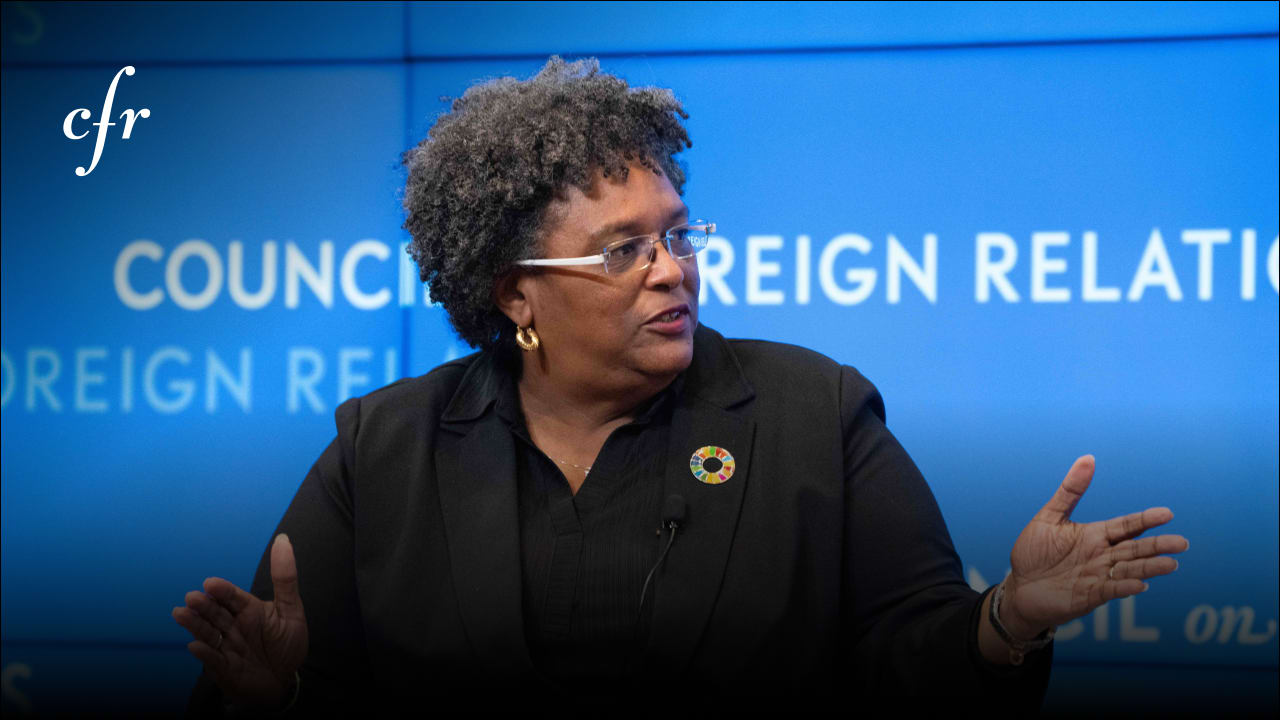
A Conversation With Prime Minister Mia Mottley of Barbados
Event date
Speaker
- Prime Minister, Barbados
Presider
- Former U.S. Ambassador to the United Nations (2021–25); Member, Board of Directors, Council on Foreign Relations
Prime Minister Mia Mottley discusses the challenges facing climate-vulnerable and developing countries, including efforts to reform the international financial architecture, expand access to development finance, and advance a more resilient and equitable global economy.
This meeting is presented in partnership with CFR’s Energy & Climate Program.
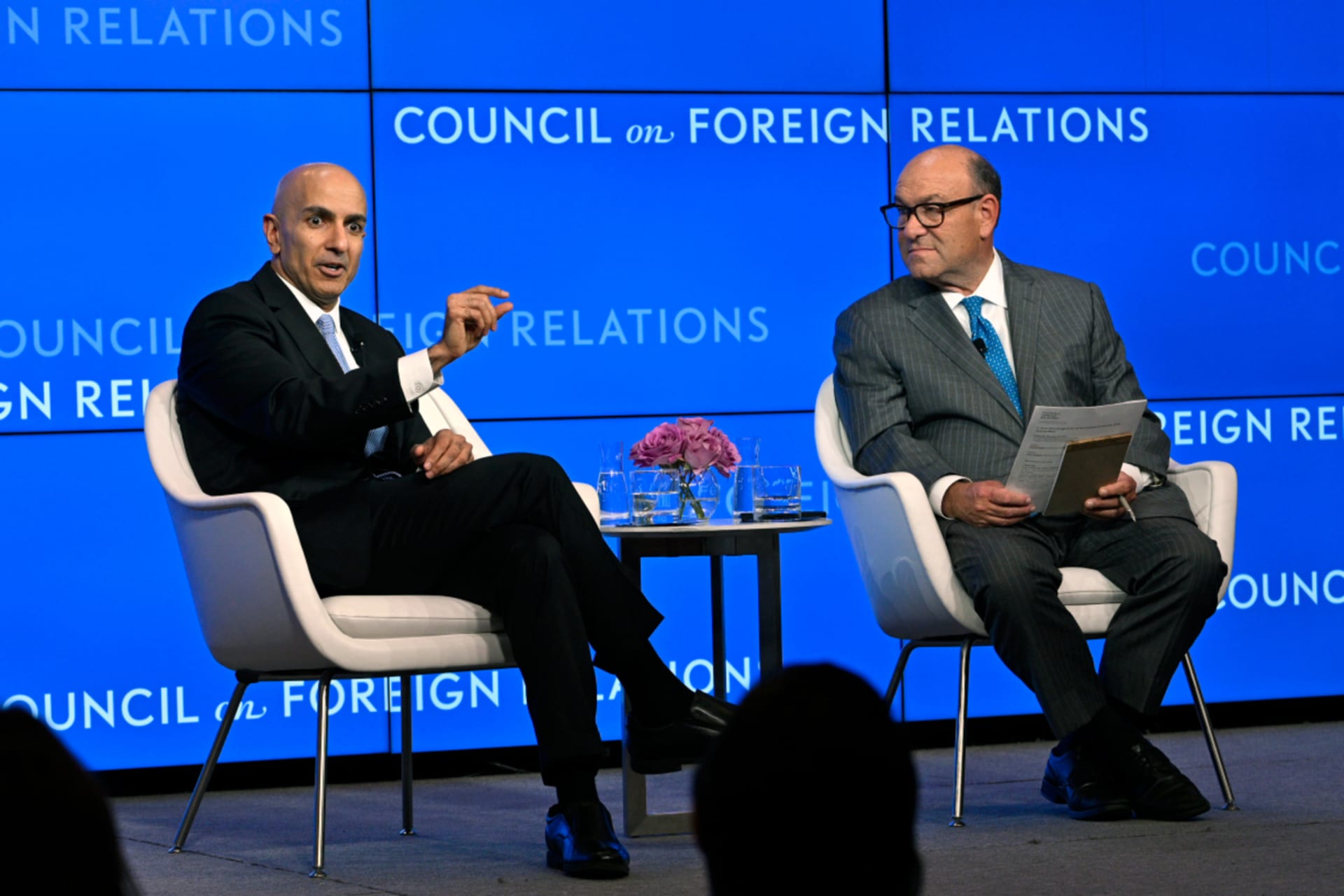
THOMAS-GREENFIELD: Hello, everybody. Great to see all of you here. So, as you know, we’re having a conversation today with Prime Minister Mia Mottley of Barbados, and let me welcome you to the Council on Foreign Relations’ meeting with the prime minister.
I’m Linda Thomas-Greenfield. I’m the former U.S. ambassador to the United Nations. I’m a member of the board of CFR and I will be presiding over our session today.
And we are joined today by CFR members attending both virtually and in person, Prime Minister, in person here in New York. And I want remind all of you that we are on the record.
Foreign Minister Mottley needs no introduction, but I’d like just to highlight some of her firsts. She was the first female attorney general of Barbados. She’s the first female leader of the BLP party and the opposition, and, of course, the first female prime minister of Barbados.
So, Prime Minister, let me begin by recognizing your leadership on climate issues, leading to your receiving the Time’s 2025 Earth Award. You lead a Caribbean island nation on the front lines of climate change. What can you tell us about the biggest challenges facing climate-vulnerable countries, and can you guide us through your vision for a collective response to the impacts of climate change?
MOTTLEY: Thank you. First of all, thank you, Linda, for having me here and thank you all at the Council of Foreign Relations for this opportunity to share some perspectives.
The biggest challenge remains what it has been for some time, the absence of access to credible financing to be able to close the gap, the failure to us have a level playing field. Climate-vulnerable countries pay on average 1.2 percentage points more in interest than those who are not, and it seems as though this runs counter to what religion teaches us, that we shouldn’t really be unfair on those who are less fortunate than ourselves. And that pricing, regrettably, reflects the vulnerability which we have, in this particular case the climate crisis, which we didn’t cause, and then, of course, the absence of effective implementation, especially in the last decade since we reached Paris—the climate agreement in Paris.
So there are a number of things. We—the world reckons that it needs $1.3 trillion annually between—collectively, between now and 2035 for developing countries, but the climate-vulnerable countries are going to need to access about $490 billion a year, and to that extent, we are way far from that. But what we have been able to do is to see some progress on some innovative instruments. The natural disaster clauses are working for those countries that have them. After Hurricane Beryl, Grenada was able to draw down on their natural disaster clauses to create that space for them. Let me knock some wood if it happens to Barbados.
What it does is that it creates for us fiscal space of about 18 percent of GDP over a two-year period. There’s no government, no entity, that’s going to give us that equivalent to recover. And against the backdrop of under insurance and uninsurance, this becomes even all the more critical.
You know about it here because insurance companies are refusing to give people cover in California for wildfire risk and they’re refusing to give people cover in Florida for hurricane and flood insurance in certain parts of Florida and certain parts of the northern Caribbean. So the ability for government to step in and to be able to get that quick recovery is critical.
At the same time, since last year, we left here and we went to the annual meetings, and Barbados chairs the V20 countries of the world, which at the time was seventy-four countries. It’s now seventy-seven.
And we had a meeting with the Arab Cooperation League and said, look, do you want to change the face and the trajectory of development finance. They said, what do you mean?
I said, well, look, we can’t boil the ocean. So let’s take education, let’s take health, let’s take water, and let us recognize that we cannot build schools or clinics or replace water mains with ten- and fifteen-year money without crowding out other development imperatives for countries.
Against that backdrop, therefore, let us see how we can make longer-term more affordable finance and ensure that the financing that we get matches the life of the assets that we are building.
We did this to transform homeownership globally where mortgages became available to ordinary people, allowing them to be able to pay for homes over twenty, twenty-five, thirty years, ensuring that they were capable of carrying the burden of the debt to get the asset. We need to do the same.
The hospital that I’m replacing, refurbishing, at home is sixty years old, has no recent refurbishment in its life. The schools that we are replacing—in Barbados’ case, most of our schools are in excess of a hundred years old because one of the things the British did do was to make sure they left a strong primary school plant.
We had two hundred primary schools on a hundred and sixty-six square miles, but a lot of them are old buildings and need refurbishment.
And for water mains, well, almost every single water main that we have that hasn’t been replaced already is in excess of eighty to a hundred to a hundred and twenty years, depending on what part of the country you’re in.
This situation is reflected in almost all other developing countries. So that the ability to—for us to have signed a compact in Vienna in June with sixteen financial institutions, eight or nine from the Arab Cooperation League, then the World Bank, the IDB, the CDB, the CAF, African Development Bank, Asian Development Bank, was a major, major step.
We go to Bangkok next month with a white paper that starts to concretize these priorities, and that vulnerability-to-viability compact that we signed is based on four pillars: one, expanding concessional finance and the terms of it.
As I just said, we need forty- and fifty-year money ideally, but at least thirty- and forty-year money for middle-income and, obviously, low-income countries, respectively.
And it can’t only be just what is available through IDA or, indeed, what is available to HIPC countries because if not, we risk pauperizing middle income countries that have made the journey out of poverty.
Secondly, we have to use and mobilize more private finance, and that is possible, but we need to be able to help those countries that have difficulties in being able to get the technical constructs in place.
In my own country, we recognize that God helps those who helps themselves and, therefore, we created a resilience and regeneration fund which every employee in Barbados is now required to put a quarter of 1 percent of their salary in that fund and every employer must match it. Every self-employed person puts the same amount.
And then we use the ODA measurement as a guide for what government should do. Government puts now annually .35 percent of GDP in that fund. So when we go to the international community saying that we need access to cheaper and more affordable finance, it’s not because we’re not helping ourselves.
Thirdly, we recognize that country ownership of plans is absolutely essential. You cannot have a dictate into countries of what their priorities are or how to be able to do it without you getting some level of resistance and drag and, therefore, the best way is to bring everybody together and let them start to order what their priorities are and how they do it because it changes really from country to country and region to region, as you know.
And then finally, the availability to use innovative instruments such as natural disaster clauses and debt swaps, because really and truly the debt swaps help to create the fiscal space for those countries that are highly burdened with debt, and without that we have trouble.
In Barbados’ case, we did a debt-for-nature swap initially with the IDB and with Nature Conservancy, which allowed us to use the interest savings over fifteen years to be able to protect our marine environment and establish the Barbados Marine Sustainability Trust.
The second one we did in 2024 was a debt-for-climate swap and we innovated here where none others had done before by ensuring that instead of taking the interest savings annually, we aggregate the interest savings in order to finance the capital investment in a sewage treatment plant to be able to treat water, to replenish the aquifers, and to deliver water for irrigation, for agriculture in the arid area of the country.
And thirdly, we’re doing now, which should finish by December 31—I should say that that second one was IDB, Green Climate Fund, and the European Investment Bank became involved in their first debt-for-climate swap by giving us the guarantees necessary to facilitate the repurchase of 500 million (dollars) U.S. of our debt to unlock 125 million (dollars) U.S. to finance that sewage treatment facility.
And we’re now in the process of bringing together for the first time World Bank, IDB, the Caribbean Development Bank, and the Latin American Development Bank—CAF—to be able to do the first debt-for-social swap that we’re doing, recognizing that at COP-28 we looked at the linkages between climate and health.
And to that extent, we will repurchase 600 million (dollars) U.S. of our debt with the assistance of the others and use the $150 million U.S. in savings to high finance aspects of our health care over the course of the next three years or so.
So the V-to-V compact creates the opportunity to be able to innovate, to get access to more fiscal space, and to get access to cheaper capital in order to match the development needs.
Now, why is all of this important? Because you know better than most the growing inequality that the world is seeing keeps those who are most vulnerable on the front line. They’re less capable of protecting themselves.
The World Bank has shown us clearly that for every dollar we spend in building resilience, we avoid 6 (dollars) to $7 in damage, and God knows that money can’t replace life. So we haven’t even gotten to the loss of lives either.
THOMAS-GREENFIELD: You’re very clear.
MOTTLEY: Yeah.
THOMAS-GREENFIELD: You’re very clear about what the vision is, and my question is—and you don’t have to, this is rhetorical—why is it so hard? Why—
MOTTLEY: I want you to tell me that. (Laughter.)
THOMAS-GREENFIELD: Yeah. I have some ideas, but they’re here for your ideas.
MOTTLEY: Let me—I mean, let’s be quite frank. I think that when we meet, when we’re not unequally yoked, people get it, some way or the other, when they leave that conversation.
I don’t know whether to blame the bureaucrats or whether to blame the same people who allow gatekeepers to block them from making meaningful change.
But we know what needs to be done, and we’re playing with fire. We’re playing with danger. This summer in Europe was one of the hottest ever. British buildings are not built for heat. The French buildings are not built for heat.
And we’re running into the super El Niño, which is going to challenge us even more in the next few months. And for us, as much as people want to ignore the reality, the one thing that is not changing is the evolving set of crises that have hitten us week by week and month by month.
THOMAS-GREENFIELD: So I heard your remarks earlier this week at the Accra Reset and it was very similar to what you’re sharing with us here today. How did you get involved with the Accra Reset? It’s very much Africa focused, but I was very impressed that the Caribbean and Latin American countries were part of it as well. How does that work and how will it benefit countries in your region?
MOTTLEY: Well, when we came to office in 2018, my government was very clear that we needed to reclaim our Atlantic destiny. Our foreign relations have, since independence and maybe before even, have been North Atlantic focused in spite of the considerable similarities—cultural, historical, family relations—between us and Africa, and once we made that decision all kinds of things started to line up.
With President Kenyatta we agreed to establish—myself and President Kenyatta—impressed members of the AU and CARICOM for us to establish a formal engagement between the two regions.
Secondly, we recognize that the sixth region of the AU is the diaspora, but we’ve come—
THOMAS-GREENFIELD: Which includes us, too.
MOTTLEY: Which includes you, too, although some try to rewrite that history.
But we are very, very clear about the importance of being able to look east and west and not only north and south, and to that extent, the commonalities between the two regions become clear.
But COVID really cemented it. Regrettably, this country imposed external export restrictions on equipment that we needed at the height of COVID. Regrettably, those countries that made vaccines did not want to share with small states.
Regrettably, even institutions like PAHO and WHO, with whom I was working, ensured that countries that have middle income status did not benefit from access to therapeutics and vaccines in the same way as those who they considered as lower income in spite of the fact that small states have an inherent vulnerability even if only because our orders are too small for any businesspeople to take seriously.
When that happened, Africa and India stepped up to the plate. Prime Minister Modi sent us a hundred thousand vaccines and immediately, rather than keep it for Barbados, I shared half of them with the rest of the Caribbean countries nearby because there’s no sense protecting yourself and all your neighbors in trouble. You’re still vulnerable.
Two, we ensured then that through Dr. Tedros, who put us on to Strive Masiyiwa and President Kenyatta, we were able then to join the Africa Medical Supplies Platform, which was a digital platform providing access for procurement of therapeutics, vaccines, and equipment.
And instead of us being constrained by our limited sizes—our small sizes—a country as small as St. Kitts and Nevis with 38,000 population would access commodities at the same price as in Nigeria with 200 and something million.
And in that simple effort, as well as recognizing that Afreximbank would provide the financing, a relationship was rekindled, and since then, the Afreximbank has opened its first regional office outside of Africa in Barbados.
All of the CARICOM countries have joined. They’ve put together an investment portfolio of about 4 billion (dollars) U.S. which, regrettably, is more than anybody from the North Atlantic countries have done for us since the post-independence movement started.
So those synergies have become very natural. With respect to this particular Accra Reset in health, I chaired for five years the One Health global initiative for WHO, which was essentially on the AMR—antimicrobial resistance—problem that we have, which is really the third largest killer of people in the world today and expected to be the largest killer by 2050, purely because we’re not developing antibiotics that have the efficiency and effectiveness as previous ones.
And we call it the silent slow-motion pandemic that can reverse medical progress for almost a century because anything that causes you to be risk—to risk an infection now puts you seriously in harm’s way if the antibiotics that exist don’t work.
And what is really the problem? That as we discovered across the world, the economics of antibiotics don’t work for pharmaceutical companies because they want to be able to make money all the time, which they do for diabetes medication, heart medication, et cetera.
But when you’re taking antibiotics, you’re taking it for what?
THOMAS-GREENFIELD: To prevent.
MOTTLEY: A short course—ten days, fourteen days, three weeks, whatever.
So what we have seen is the absence of investment in those, in spite of the fact that it affects not just humans, it affects our use with respect to lifestyle, it respects how we’re treating to plants and agriculture, and then, of course, the runoff that comes from all of it.
And that is why we brought together WHO, FAO, UNEP, and OIE to be able to have a quadripartite agreement to deal with this problem that is insidious, is creeping up on us. But because we’re so distracted with war and conflict and distracted with AI and distracted with everything else, that we think we can—on climate we can win these battles, but this other one can slip under us.
That is why we felt, among other things, we needed a reset for access to health care, and we needed a reset because the exploding costs of health care is making it impossible for ordinary citizens to get it at the very time that technology makes it possible for them to know what precision medicine can do for them but is outside of the reach of the average citizens of the Global South.
THOMAS-GREENFIELD: And that’s a very interesting topic.
I was in a meeting after the Accra Reset meeting and there was a discussion about the production of vaccines and other medicines on the continent of Africa, and the result of the discussions they just don’t have the economic power to do it. So I reminded them that during COVID Africans were left out, and they feel that they have no choice but to find a way through grouping themselves in regional groupings to produce—to take care of their own citizens. So—
MOTTLEY: Absolutely, but I’ll make one other point, and David Cameron got this eventually, but he got it as foreign secretary, not as prime minister, which is a little difficult.
But essentially, small countries need to do more production of vaccines because we’re not going to impose the export restrictions because we don’t have the populations to give them. So you are guaranteed that we will share them fairly and distribute them to those who need.
THOMAS-GREENFIELD: Well, let’s hope that that happens.
Look, let’s talk a bit about the global economy. You mentioned the tariffs and you mentioned trade relations. How are you navigating this in this moment of shifting priorities and what actions have you taken to bolster the economic stability in Barbados? How would you advise we move toward a place of having a global economy with more equity?
MOTTLEY: With great difficulty. But my simple advice is to see people first. We get caught up in all kinds of labels. I see that your country is having an interesting discussion and not necessarily based on fact as to what democratic socialism is and what communism is and what actions constitute what type of politics.
Forget all of that. People need support. There’s an affordability crisis that is being compounded year after year in the last five, six years.
When I first addressed the U.N. in 2018, I said that the world, regrettably, looks too much like it did a hundred years ago, with the one difference that we know better.
Regrettably, the pandemic came. Regrettably, the war in Ukraine came. Regrettably, the rise of fascism and populism is haunting us across Europe and in other parts of the world to remain nameless.
Regrettably, we have now seen increased conflict, which has now led not only to one chokepoint being cut off but what I call the trifecta, and we feared it and, regrettably, in the last two weeks or so it’s beginning to emerge.
Not only the Strait of Hormuz but what the Houthis are doing to be able to compromise the Red Sea, and the Panama government has already announced a reduction in the number of vessels that will be allowed to pass through the canal this month, next month, and God knows for how much longer.
What does this mean in real terms? That if my water authority runs out of a smallest piece of equipment to be able to get those pipes in or to get a pump working or to get a desal plant working, I’m constrained by our ability to be able to get the supply logistics correct, which means that people suffer because in islands you don’t have the ability to just drive and get help somewhere else.
At the same time, we’ve had to put significant amounts to be able to support the most vulnerable. In this last instance, we have taken 50 percent of the burden of the increasing electricity rates. We’ve had to do hedging mechanisms, which we’ve done on the fuel oil for the electricity.
We have also put a cost-of-living allowance that we are giving every pensioner and those on the welfare list and those who get reverse tax credits to be able to get an additional top-up so that they can meet the increased energy costs and the increased inflation that has come as a result of this.
We’ve also reached—and this goes back to 2022 but it is still helping us now—where in Barbados we have a social partnership between government, the trade union movement, and the private sector, and most major decisions in the country ultimately are the subject of consultation, even if government reserves the right to act and govern.
And what we did in 2022 July after the Ukraine incursion and the Black Sea Initiative wasn’t quite there, we called everybody together and we said, look, let us look at this list of basic commodities for food, for hygiene for people so that we can ensure affordability among families.
And we took forty-seven items. Government took off all the duties. The private sector agreed to be able to cap their markups at 15 percent instead of the 25 (percent), 30 percent that a number of them were using.
And today, in spite of everything, just about 50 percent of those products remain at cheaper prices today than they did in July 2022 when we introduced that compact between the private sector and the working people of the country.
We’ve also capped the VAT and put a reduced VAT on electricity bills at two-hundred and fifty kilowatt hours. We also moved from CIF as a basis for determination of government duties to FOB and particularly recognizing that we would cap the prices at the container prices of December 2019 as opposed to when all the madness started to happen that led to the inflationary environment.
Now, we’ve done all of that in spite of the fact that we were in an IMF program at the time. We’ve taken a(n) extended fund, put them on speed dial now because we came out of it. But what is happening in the world meant that as a small state you need somebody on speed dial fairly close.
But in spite of that, we’ve been able to hold the line, keep the country stable. And remember this, you can bring back down debt overnight and we showed it. When we came to office, our debt was 178 percent of GDP, including the amount that the governments had not paid for two years to people.
We moved that from 178 (percent) to 119 (percent) and then COVID hit. It went back up to 152 (percent). Today, it stands at 93 percent. But we faced difficult decisions because the impending storms, nobody knows what the world is going to look like in January.
Interest rates are going up in this country and globally and, therefore, we may have to take precautionary action to be able to ensure that we can endure what is coming ahead of us in terms of uncertainty.
And certainly, if we don’t use it for the purposes because of high global uncertainty, we use it to build back up capacity on the economy so that we are more competitive and can create a more inclusive growth that is sustainable.
THOMAS-GREENFIELD: So we’re all in New York this week for the eighty-first session of the U.N. General Assembly, and you co-chair this U.N. Secretary General Sustainable Development Goals Advocates Group. Can you give us your frank assessment of the U.N. system at this moment, the prospects for keeping momentum on the SDGs, and then how do you think the election of a new secretary general will impact the world’s premier multilateral institution for peace and security? And can you tell us who you’re supporting? (Laughter.)
MOTTLEY: Let me start. We’re supporting Carolyn from Guyana, so that’s clear.
THOMAS-GREENFIELD: You heard it here.
MOTTLEY: But there are good people in the race, and whether it’s Carolyn or Rebeca or whoever, there are good people in the race.
Part of the difficulty is, is that we now for sure know that the U.N. is essential for small states to be able to survive in this world. The world needs an international rules-based order to protect the most vulnerable among us.
And it’s no different from what happens in a playground. Those who have much larger capacity very often seek to bully those who can least protect themselves and, regrettably, we’re seeing too much of that behavior globally, which means that at the very time people call into question the necessity for the U.N., we’re seeing exactly why the U.N. is needed, because countries have been the victim of that kind of predatory behavior that really denies their inherent sovereignty.
So I’m absolutely clear on the essential need for us to be able to continue to build where we are. Our problem is, is that there are aspects of the Charter that don’t reflect the world in which we live.
The Charter doesn’t speak of the climate crisis. The Charter doesn’t speak sufficiently of the high level of global inequality. The Charter doesn’t speak to the issue of AI, although as we speak the AI companies are addressing the Security Council this afternoon, recognizing that what is needed in fact is urgent action.
And if the U.N. wasn’t necessary, the same companies that are now addressing the Security Council, believe you me, who are rejecting, in some instances, regulation at the national level, would not find themselves in the Security Council today.
We are at a peculiarly difficult moment, and that does not mean that you throw the baby in the bathwater.
Is there a need for reform? Absolutely. Is there too much duplication and too much bureaucracy? You know it better than me. And, therefore, we can see gains from that level of reform.
But when all is said and done, we have also to step up to the plate as adults. If there are countries who do not want to carry the same level of support, then we have to really be very strategic in what we say and do.
To begin to reassess the contributions of other member states is essential, and I say so as a small state. But I also recognize that in addition to increasing those contributions that we may have to make, we’re going to have to be very brutal, and those who do not want the support cannot wield the same level of power and influence that they hitherto were allowed to do because of us being deferential because of the extent to which they were effectively acting as a global insurance policy, global insurer to the stability and peace that the world needed.
Part of the difficulty is, is that human beings tend to have short memories and they have a level of hubris that we know from history doesn’t work well for us. And the notion that species don’t become extinct or civilizations don’t fail we know to be completely untrue from our own appreciation of history.
And, therefore, it means that we need to pause. We can slow down on some things, but we need to keep the destination in focus, and more than ever we need to recognize that the United Nations was established to meet the needs of the reconstruction, just like the World Bank, of a world in the post-World War II environment and to be able to avoid war again.
What has happened, regrettably, is that we have failed to recognize that unless we provide a global commons in a world now that is so interconnected between travel and technology for communication and information to move; unless we create a global commons that can protect the world against the climate crisis, pollution, and loss of biodiversity, to guarantee to people the most immediate needs of human beings—access to food and safe water—safe and clean water; three, to protect the victims of conflict and we now know that there’s sixty-five conflicts globally, perhaps the largest number since World War II; fourthly, that we need to be able to prevent and protect us with respect to the next emerging pandemics, which are going to become more and more likely because of the changing climate; and finally, that we need to be able to deal with the digital divide and, of course, now, the clear untrammeled power that AI potentially has if we don’t, one, seek to take into account the humanizing needs that we need for it, and two, to protect it from taking advantage of us in terms of our ability to remain as a species on this planet.
Those five things constitute the global commons, and we’ve been saying it year after year after year after year. If you were creating a World Bank today, would you create it only to be a bank of reconstruction and development for those who lost the war and those who needed help, or would you be creating it to protect the global commons?
At the same time, we recognize that the fiscal situation of governments is in a difficult situation and, therefore, are you going to have a World Bank only depend on public financing as it is now or are you going to recognize that over the course of the last eight decades multinational corporations have grown significantly, many of them having much larger balance sheets than many of the states of the world?
And to that extent, can they remain outside of the pool of funds that are necessary to preserve the global commons?
I say no. And those who are in charge of philanthropy, well, you’ve got the right to be able to get that money already. You get the right to choose how you spend it. But we need you to leave $.05 on every dollar on the table to tell us what the world needs rather than just you spending according to what you want to do.
Because if you only do what you want to do, you may find that you live in a world that has become very inhospitable and you’re not able to spend what you really want to spend.
THOMAS-GREENFIELD: So I know that you’re running on a treadmill today and—
MOTTLEY: Yeah, I’m sorry if I’m talking so fast.
THOMAS-GREENFIELD: I know.
MOTTLEY: —probably because there are too many events.
THOMAS-GREENFIELD: So, at this time, I’d like to invite members both in person and those virtually to join our conversation with their questions. We won’t be able to take a lot of questions because of the prime minister’s time, and I do remind all of you that we are on the record. Make your questions short and succinct.
Yes?
Q: Thank you very much. Ishaan Tharoor. I’m an Edward Murrow fellow here at the Council on Foreign Relations and a columnist at the New Yorker.
In March, the—Ghana, backed by the nations of CARICOM, pushed—had a symbolic resolution that the GA passed overwhelmingly that denounced the transatlantic slave trade as the gravest crime against humanity. The U.S. and two other countries voted against it. I’m curious what your reaction is to that American vote and then, more broadly, if you could speak to the concerted efforts you’ve made through CARICOM to push forward the discussion on the reparations and whether you think there will be an outcome where we will actually see reparations happen.
And if I can just crowbar in a very quick question—
THOMAS-GREENFIELD: (Inaudible.) I see three more hands.
MOTTLEY: So the very same response that we had in the year 2001 when the U.S. refused to support this whole cause on the Eve of Durban twenty-five years ago. Look, this notion that countries determine the justice and the morality of an issue purely on the basis of legal liability is what is killing us, and the failure to come to the table to have constructive discussions is unfortunate.
The truth is this issue is not going to go away, and what we’re seeing more and more is a browning of the world. What we’re seeing more and more is people recognizing, as happened with Black Lives Matter, that—and I said it last week when we had a reparatory conference in Barbados for the region—the same mens rea that spawned slavery, regrettably, is the mens rea that still exists in the modern world that keeps the inequity in the United Nations system, that keeps the inequity in the international financial institutions, that keeps the inequity that would cause Ghana, and Greece at one time, to have basically the same debt profile but to have different credit ratings for no other reason than one is in the continent and one is not. I meant the continent of Europe with the ability to have safe assets and taken into account in a way that Africa is not allowed so to do.
So that we have to confront the fact that while you may amend legislation to remove the institution of slavery, we have not yet won the battle of deconstructing people’s minds as Marcus Garvey and Bob Marley have popularized emancipating people’s minds.
We believe that this ought to be a sensible conversation. The first thing is there’s never been an apology. If you hurt somebody, you tell your child to go and say sorry. There’s never been an apology.
Two, the facts are Germany compensated the Jewish community with $95 billion over the last fifty-seven years. The truth is that the act of slavery—transatlantic slavery—lasted in excess of two centuries. What separates this from other institutions of slavery? That this was the first one that described Black people as property, as chattel.
Why do I speak with this conviction? Because the British ensured that my country, Barbados, became the first country in the world to pass the Slave Code in 1661, twenty years before the Code Noir, and we then went on to use that piece of legislation here in the thirteen colonies, particularly in the Carolinas, particularly in Jamaica and Antigua and other colonies in the region.
So we feel as though we have a moral obligation to pay forward and to ensure that that inequity that spawns that mens rea that is still alive and active across the world ought to be something that we have to confront.
Yes, do we believe that part of the reparatory justice system is to create a level playing field in terms of policy and access to benefits internationally? Yes.
But when all is said and done, we became independent countries without any kind of development assistance in spite of the fact that when the British abolished slavery they compensated the slave owners with 20 million pounds in 1834. They then took almost two centuries, up until 2015 this year to pay off the debt.
Secondly, they then took another 26 million pounds in free labor between 1834 and 1838, and against that backdrop, 46 million pounds to be able to empower people who were already on the front line of being empowered and enriched, and that has nothing at all to do with the fact that those people effectively are those who have now used that capital base to be able to be where they are in mastering the global economy now, in spite of the fact—and in spite of the fact that we have borne double jeopardy—one, blood, sweat, and tears to create the Industrial Revolution, and two, now to be the victims of the Industrial Revolution on the front line of a climate crisis, and we still can’t have a sensible conversation about what is fair, and why we shouldn’t be paying 1.2 percentage points more on average for the ability to access funding.
We have a problem. And more and more you’re going to see countries—Ghana brought the resolution. We’ve now agreed to a global commission on reparations chaired by the president of Ghana, President Mahama, with the deputy chair coming from CARICOM.
There is more alignment in the SUs. We’ve also agreed to add the circumstances of the indentured people coming out of India and coming out of China, because when slavery was abolished, large numbers were brought into the region as well to provide cheap labor.
Do we believe that it is OK to turn our faces from that? We say no.
But are we trying to bankrupt a country? No.
And in the same way that the U.K. took almost two centuries to settle its debt, we believe that there’s an intergenerational solution. But what keeps happening is that there are pockets of people, and on both sides, too, but in particular, the Telegraph and others in the U.K. who have a vested interest to protect the establishment and who run the scare tactics that the Caribbean and Africa are asking to bankrupt people.
We are not. But what we can’t continue is to have access—to be denied access, sorry—to development opportunities because we never reached that platform.
And let me end on this last point. Because people keep talking about reparations as if it is only an external act. We did self-repair, too. In Barbados, the biggest issue was access to land because we only have a hundred and sixty-six square miles, and after slavery was abolished, there was an iniquitous piece of legislation passed by the parliament called the Master and Servant Act which said that if you wanted to keep the house in which you were living, you had to sell your labor to the particular plantation.
So you had another piece of forced labor continue for almost a century. Against that backdrop, we passed legislation to protect people who live on tenantries so that they would not be put off, evicted easily.
But then in 1980 my political party went further and said, look, you will have the right to buy the land on which you live at the price of $.05 U.S. per square foot and that way when you spend $.05 U.S. per square foot, at 5,000 square feet, you’re paying 250 (dollars) U.S. That is less than the price of these sneakers.
And at the end of the day, you get a property. You then can go to the bank. You can then fix up your housing. You can then start a process of decent living. That is what we’ve done for ourselves, and the plantation owners carried the subsidy. We then extended it to the urban corridor and said, look, government will carry the subsidy for those.
So when we speak to this issue, don’t let us reduce it to the scare tactics, but let us understand that there is a substantive, appropriate discussion, and I can assure you that the people of the region will not seek to repeat the inequities and the unreasonable approach of those who were in charge of slavery by seeking to bankrupt or to take advantage of anybody unnecessarily so.
THOMAS-GREENFIELD: Are there any virtual questions?
OK, this young gentleman. I’m only going to take two more because I know that she’s in a hurry. So I’ll take you and then I’ll take someone in the back of the room.
Q: Thank you, Prime Minister. I’m Tidjane Thiam from the Ivory Coast. I’m the leader of the opposition in Cote D’Ivoire.
Very quick one. A personal question. I was going to be unfair and ask you only one and say what is—what do you see as your biggest challenge, going forward? But I’m going to give you two or three.
MOTTLEY: What do—what do I see as the biggest challenge for what?
Q: You’ve had a distinguished career, a great track record. Now, if you look forward, what remains to be accomplished? What do you want your legacy to be?
We can go with one or two or three challenges. Thank you.
MOTTLEY: I don’t have the luxury of thinking about legacy and I say so with all sincerity. The ability for us to survive. Imagine we’re in the sea and we’re being denied the right to do freestyle, breast style, backstroke, and the only thing available to us to do is to dog paddle.
That’s what small states have to do more often than not, and the circumstances, as I said, of the inequity that creates that unlevel playing field is what is killing us.
Thirty years ago when the WTO was established we said, look, we need special and differential treatment for small states because our percentage of global share, share of global trade in Barbados in goods is 0.000 percent and our percentage of global trade in services is 0.001 percent. In other words, we have no capacity to distort.
But this one-size-fits-all prescription is killing the ability of developing countries and small states to be able to take actions in the deliberate interests of their people, and this ability of those who now have amassed great power, great wealth, to be able to silence those who simply say we want to act in the interests of ordinary people is compromised.
Now, I’ve said this week a number of times that there was a woman one time who was a queen who said, “Let them eat cake,” and what happened thereafter?
Now, the difficulty is that you may not have the same level playing field because if you’re fighting against climate, which is galloping whether you do major things or not, and you’re fighting against AI, which is developing a mind of its own, it means that we do not have the same possibilities of success for ordinary people to be able to assert their right.
I hope that we can continue to balance the playing field. I hope that we can continue to recognize that none of us is more important than the other and that each of us is deserving of dignity. And as I said, when each time we’re elected, including this year again, we need to stop poor people from being poor.
We need to fight injustice and we need to create opportunities for intergenerational wealth for more of our citizens so that they have a vested stake in maintaining democracy rather than being forced to resort to other forms of governments that are exploitative.
THOMAS-GREENFIELD: One last question.
Yes?
Q: Thank you. Good afternoon. My name is Mark Simonoff. I’m the former legal advisor to the U.S. Mission to the U.N. Pleasure to see you again, Ambassador Thomas-Greenfield.
Madam Prime Minister, could you share with us why you chose not to be a candidate to be the first female secretary general of the United Nations?
THOMAS-GREENFIELD: See, I decided not to ask you that question, and I didn’t plant it.
MOTTLEY: I have a country to run and a region to take care of, and I mean that with all sincerity.
Look, I’m not sure that the world wants somebody whose tongue might be as heavy as mine, and I’m not sure that the world is ready to be able to work in a consensual approach.
If they are, then all of us, not just me, are going to have to put our shoulders to the plow and we will do so willingly. But at this point in time, look, we just came out of an election in February. I have an overwhelming mandate from my country. We won all the seats again for the third time in a row.
Regrettably, the task ahead of us at securing the fate of our country and the stability of our region is one that is perhaps more complex than it has ever been since we became independent territories.
Are we available to shoulder extra weight? I chair the SDGs group, co-chair it with Pedro Sánchez. I work, as I said, with WHO on other major initiatives. I’m now about to co-chair a scientific work group with IIASA.
There are a number of things we do outside of the borders. Do I believe that there are people who can manage this process? Yes, I do.
Would I say never? I never say never. But at the same time, I don’t see it as an immediate prospect. Thank you.
THOMAS-GREENFIELD: That’s very clear. (Applause.)
Thank you so much, Prime Minister, for joining us today. I know you’re going to be giving your speech at the General Assembly later today. I was going to ask you—
MOTTLEY: Tomorrow.
THOMAS-GREENFIELD: Tomorrow. I was going to ask you what you plan to say but I think we’ve heard it all, and we look forward to listening to your speech tomorrow.
MOTTLEY: Thank you.
THOMAS-GREENFIELD: So thank you very much. Let’s give her—(Applause.)
MOTTLEY: Thank you.
And may I say, Linda, that I hope that you will—(off mic)—relevant and strong voice, not just for the country that you’re born in but for the diaspora that you have consistently shown throughout your career a particular sensitivity and care for. So we thank you.
THOMAS-GREENFIELD: Thank you. Thank you very much. (Applause.)
So at this time, if our New York audience could please stay in the room. CFR staffers will open the doors momentarily. Thank you.
(END)
This is an uncorrected transcript.