Alan Greenspan’s Legacy as Chair of the Federal Reserve
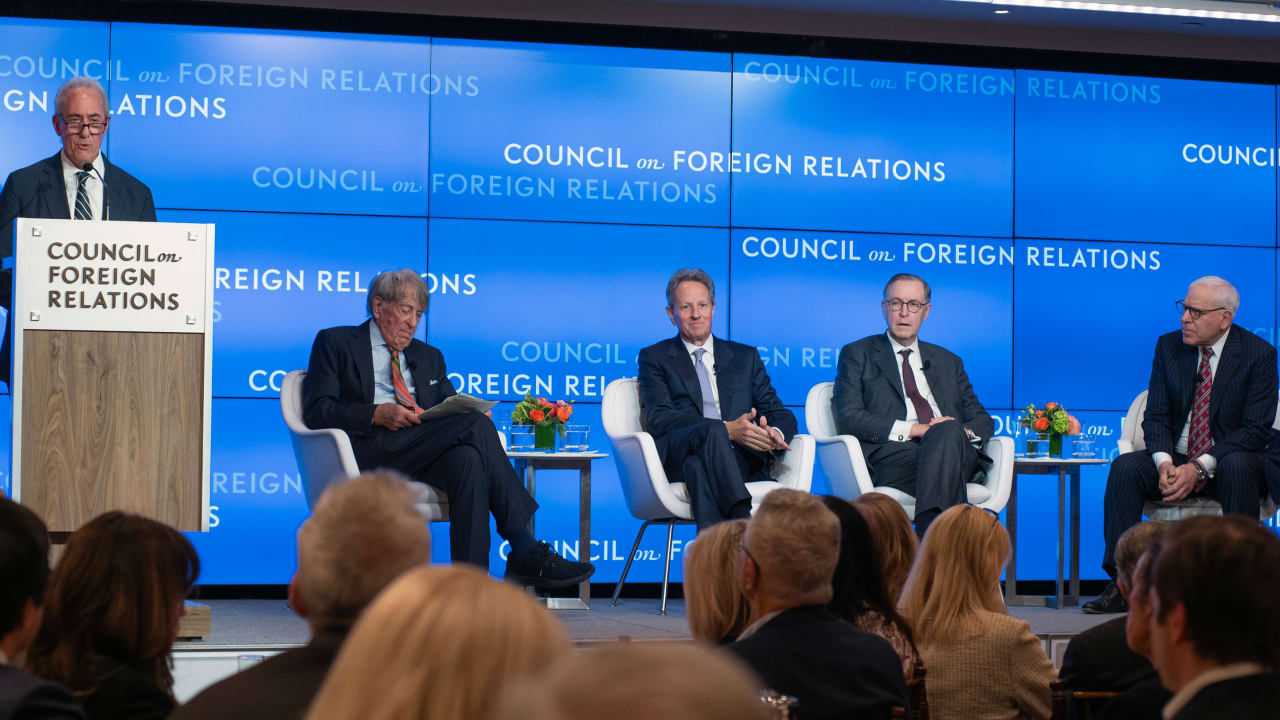
Event date
Speakers
- Chairman, Warburg Pincus; Former Secretary, U.S. Treasury (2009-13); Former President and Chief Executive Officer, Federal Reserve Bank of New York; CFR Member
- Founder and Senior Chairman, Evercore; Former Deputy Secretary, U.S. Treasury (1993-94); CFR Member
- Dean Emeritus; Russell L. Carson Professor of Finance and Economics, Columbia Business School; Chair of the U.S. Council of Economic Advisers (2001-03); CFR Member
Presider
- Cofounder and Co-chairman, The Carlyle Group; Chairman, Board of Directors, Council on Foreign Relations
Introductory Remarks
- Robert E. RubinCFR ExpertChairman Emeritus, Council on Foreign Relations; Former Secretary, U.S. Treasury (1995-99)
- Michael FromanCFR ExpertPresident, Council on Foreign Relations
Please join us for a meeting in memory of Alan Greenspan who passed away on June 22, 2026, at age one hundred. Alan Greenspan served five terms as chairman of the Federal Reserve, leading the central bank from 1987 to 2006. He joined CFR as a life member in 1978 and served as a board director from 1982 to 1988.
Panelists who worked alongside him discuss his legacy and contribution to the American economy and society.
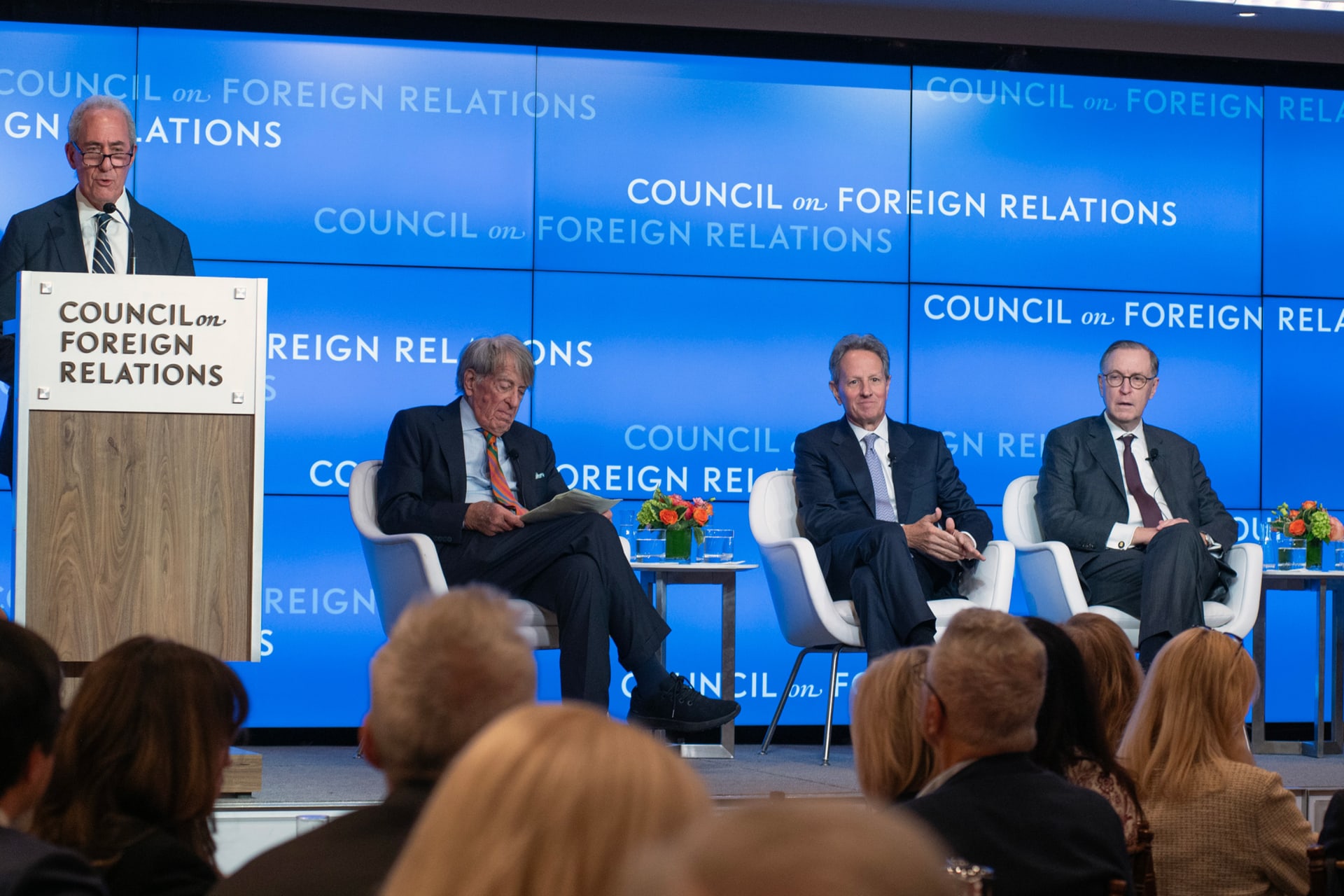
FROMAN: Good afternoon, everybody. Welcome. It’s a great pleasure to have you all here for this special event in honor of Alan Greenspan, and the 250 or so people who are dialing in online virtually as well. We’re particularly pleased to have Andrea Mitchell with us here today. There she is. She—(applause)—she’s not only been a constant and important presence at Alan’s side all these years, but here at the Council. And we’re honored that she allowed us to organize this event in his—in his memory.
Alan meant so much to so many people in this room, as a mentor to many and as a steady hand through countless crises. Just over twenty years ago, George Bush—President George Bush, awarded Alan the Presidential Medal of Freedom, our nation’s highest civilian honor. The president called him one of the most admired and influential economists in our nation’s history. That’s kind of a low bar, maybe, but—(laughter)—but he said he left—he left behind a standard that would always define a successful chairman. And I quote: “intellectual depth, analytical skill, and credibility beyond question.” His standing was such that CFR Fellow and Alan Greenspan biographer Sebastian Mallaby recounts that two normally sober economists observed that financial markets now view Chairman Greenspan’s infallibility more or less like the Chinese once viewed Chairman Mao’s.
Now, Alan was not infallible. And he was the first—OK, maybe among the first—to admit that. In the aftermath of the Great Financial Crisis, he asked, including here at an event at CFR, how he and others could have missed it. His willingness to be self-critical, to reexamine widely held assumptions, to adjust his perspective on policies are just some of the reasons he came to mean so much to economists, business leaders, and presidents.
He also meant a great deal to this room, to this building, and to the Council itself. Alan was a member of the Council for nearly half a century and a board member for five of those years. And throughout his time at the Federal Reserve and afterwards, he returned here time and again to this stage to share his insights on the global economy. He wrote repeatedly for Foreign Affairs magazine. And he helped shape our understanding of the complex and rapidly changing world.
It feels particularly auspicious to be hosting this memorial at a moment when Alan’s insights are most desperately needed. Having managed the U.S. economy through a series of boom-and-bust cycles, through the growth and pop of bubbles, we’d be lucky to have his perspective at this moment when corporate and sovereign debt is climbing higher with each month, and when it’s becoming harder and harder to reconcile value and valuations.
Alan represented what was best about the—represented the best of what the Council strives for: A steadfast public servant dedicated both to the stewardship of good policy and to the contest of ideas. And we’re privileged to have a panel with Roger Altman, Tim Geithner, Glenn Hubbard, led in conversation by David Rubenstein, to guide us through his legacy.
But before we invite them to the panel, I wanted to take a moment to remember that infamous Time magazine cover, “The Committee to Save the World,” published soon after the financial crisis in the 1990s that engulfed Mexico, Asia, Russia, Brazil. That photo encapsulated one of the most important, most sensitive relationships in the world, that between the chairman of the Federal Reserve and the secretary of the U.S. Treasury. And no one managed that relationship more adeptly than Alan Greenspan and Bob Rubin. So let me invite Bob to come and make a few remarks before our panel begins. (Applause.)
RUBIN: Thank you, Michael. I think he made those comments because he’s about to ask me for a contribution to their campaign. (Laughter.) But leaving that aside for the—and I must say, Michael, I never—I do—I did know Alan well, and I never thought of Alan as Mao. (Laughter.) But be that as it may, OK. (Laughs.)
Let me make a few comments about Alan, as Michael asked me to do and I’m honored to do. As we all know, Alan was a giant at the Fed, and much more broadly a giant with respect to economic policy; had an enormous effect on the way we all thought about what we were doing in the years that we were there. But he was also a great and valued friend to many of us.
During my four-and-a-half years at Treasury, Alan, Larry Summers, and I had breakfast every week at the Federal Reserve Board. And it was not, to say the least given the participants, an ego-free zone. But—(laughter)—but having said that, people put their egos aside, they never intruded, and we discussed everything under the sun: economic policy for sure, but politics, gossip, and all else that you can think of. The one thing we did not discuss was interest rates, out of respect for the independence of the Fed. This isn’t something you often hear about life in Washington, but in our case we really did get along. We had an ease that came naturally—an ease and a trust, a mutual trust—and that became enormously valuable as we faced the challenges of that time.
Alan always, as you know, was an adherent to Ayn Rand’s philosophy of individualism. But when we discussed economic policy, he always emphatically believed and said that economic policy must meet the needs of the people and that economies must work for all of our people. And that was deeply embedded in the way that he thought about economic policy.
Discussions that Alan and I had, both when he was at the Fed and afterwards, wandered over all kinds of subjects—economic to be sure, but many others. I remember saying once to Alan that, and in my view at least, there were no provable certainties and therefore all decisions were about probabilities. And he said, yes; but on the other hand, he said, that comment itself about all decisions being about probabilities and being no certainties is itself uncertain. (Laughter.) Well, nobody—I’d discussed it with a lot of people; nobody had ever made a comment like that to me before. But I think it captured something. It captured Alan’s intellectual thoughtfulness about everything that he engaged with.
Alan was a model, a model for public service and also a model for all of us who are involved in economic policy deliberations: his intellectual independence, his powerful intellect, his willingness to work with those who disagreed with him, and perhaps most importantly of all his humanity.
Andrea, I will miss Alan. I do miss Alan, and I will miss him for the rest of my days—our discussions of economics, of politics; our commiserations about the state of the world; and most importantly, our reflections on life as we experienced it. None of us, Andrea, will miss Alan as much as you do. He meant so much to so many, and he will live on in our heads and in our hearts. Thank you. (Applause.)
RUBENSTEIN: We have a very distinguished panel to talk about Alan, and I will just introduce them briefly. Everybody probably knows them, but I think they deserve an introduction. We’re doing it by—alphabetically.
So, Roger Altman. Roger was assistant secretary of treasury or domestic finance in the Carter administration and came back as deputy secretary of treasury in the Clinton administration; and, obviously, is the founder and chairman of Evercore.
Tim Geithner was the—worked at the Treasury under the Clinton—in the Clinton administration, but also later became the head of the New York Fed at a very young age when he looked even younger than he was, and then later became secretary of the treasury under President Obama.
And our special guest here, Glenn Hubbard. Glenn is a person who served as chairman of the Council of Economic Advisers. He is a person who’s been the dean for, I think, fifteen years of the Columbia Business School—now he’s a senior professor there—and really helped Columbia build its business school to great heights. And a graduate of Harvard, Ph.D. there, and knew Alan Greenspan when you were at the—at the Council of Economic Advisers.
HUBBARD: Yes.
RUBENSTEIN: So let’s go through. Roger, when did you first meet Alan? And what was your impression of him at the first time you met him?
ALTMAN: Well, I’d like to start by saying that, as a great admirer of Alan’s, I think his greatest achievement was his twenty-nine-year-old—twenty-nine-year marriage to Andrea. So—(applause)—very fond of Andrea.
I only got to know Alan well when I became deputy secretary of the treasury because he was chairman of the Fed then. I had known three previous Fed chairmen also moderately: Burns and Miller, who were there during the Carter years; and then Volcker, who of course succeeded Miller. I ended up knowing Volcker quite well. But I just saw Alan—I mostly observed Alan during my Treasury years because, as Bob said, he and Larry were really on point with Alan. I wasn’t. And I stayed in touch with Alan moderately after I left government. So I don’t know—I did not know Alan as well as Bob or Tim did, but I did have a high regard for him.
RUBENSTEIN: All right.
So you were a young Treasury staffer and you had to interact with Alan Greenspan. Did you call him “Alan” those days, or? (Laughter.)
GEITHNER: At some point. Yeah, he was—he was thirty years’ difference, more than a generation. Yeah. But I was a—yeah, I was a civil servant in the Treasury, and I think Bob and Mike both mentioned this, but there was that period in the—certainly in the mid-’90s/late ’90s, when Bob was secretary, where Treasury and the Fed were deeply involved in trying to deal with the risks to the United States of a series of emerging market financial crises. And Treasury and the Fed were, you know, co-combatants, worked really closely together, and I—that was the first time I got to spend some time with him and got to—got to see how he thought and be part of that process of decision-making that Bob described so well.
I mean, his—Bob and he exemplified something that is rare in decision-making, which is people with, you know, tremendous ability, able to see the gray—the gray and the complexity in all the things of consequence, and to think through them carefully. You can call it basing decision-making or risk management, whichever way you want to call it, but it’s the patience and the exacting discipline to sit with complexity/uncertainty, and think about the tradeoffs and the choices available to you, and how to make—how to make decisions in that context. And I was tremendously fortunate at that early stage in my life to get some exposure to him then. And then, of course, I worked together with him for quite a long time.
RUBENSTEIN: So did you ever play tennis with him?
GEITHNER: We did play—we did play tennis. He was pretty good tennis player.
RUBENSTEIN: Who won?
GEITHNER: Quite—but of course, I was somewhat younger. (Laughter.) And he was—yeah, he was very good tennis player. He could—he could hit many things back. He wasn’t as agile at that point, and fast and rapid and powerful, but he was very good.
RUBENSTEIN: Well, you had a(n) age gap with him.
GEITHNER: I had the age gap. (Laughter.)
RUBENSTEIN: OK.
Glenn, how did you get to know him and what was your relationship with him?
HUBBARD: Well, I became an economist because of Alan. Unlike Mike, I think that’s a noble thing. It’s a high bar.
I was an engineer. I saw Alan as the CEA champion at the time. I went to college in the 1970s. I first got to know him when I was at the Treasury Department in Bush I. I ran the tax part of the Treasury Department. First day I was on the job, Alan came over to audit the revenue estimating process. I was brand new from university. I didn’t even know what it was. But by lunchtime, I was ready for him. And that built a decadeslong friendship.
Over time, he became, for me, a mentor. He would refer to blinders for me, what I would call models, but he in turn taught me back getting out and talking to real people more; you know, trying to figure out from businesspeople what’s going on in the economy. So infinite respect for him.
RUBENSTEIN: So I would just—I should have added a few things at the beginning. Alan Greenspan served as chairman of the Fed for eighteen-and-a-half years; took over August 11, 1987, and finished on January 31, 2005. And during that period of time, the U.S. GDP went up on average 3.1 percent. No chairman of the Fed since that time has had a GDP go up at 3.1 percent on average. But he also left the Fed with a(n) inflation rate at 2 percent. So think about it: 2 percent inflation, 3.1 percent growth. Pretty impressive.
I got to know him later in life because I was working in the White House before he became chairman of the Fed. But when he left the Fed—some of you may not remember this—but he agreed to make some speeches around the world, and I engaged him to make some speeches for some of my clients. And I went to—we went to, I think, Europe and Asia a couple times, and you know, he was a rockstar of the likes of which I hadn’t seen. I’d been around some presidents and even secretaries of treasury, but even they weren’t the rockstars that Alan Greenspan were. (Laughter.) And there’s just no doubt that everybody just followed every word he had. And I think, Andrea, you were on some of those trips, I think, and it was amazing how he was so idolized by so many people around the world, and he was so meticulous and so thorough, and as I got to know him such a very nice, charming person, and very impressive in every respect.
And he also had one thing we forgot to mention: He was a member of the Council on Foreign Relations and a board member at one point. And this shows you that commitment to the Council lives—guarantees a long life. (Laughter.) There are many, many people—David Rockefeller, other people—have lived long lives because they’re committed to the Council. Just think about that when everybody is talking to you about your commitment to the Council.
GEITHNER: That’s great. (Laughs.) I like it.
RUBENSTEIN: So, Roger, what would you say is Alan Greenspan’s legacy? He served, you know, eighteen-and-a-half years. As you look at the world today, what would you say his legacy is?
ALTMAN: Well, I think you put your finger on the number-one aspect of his legacy, which was that while it’s impossible to isolate the impact of monetary policy on broad macroeconomic trends, you have to respect the remarkable record on growth, unemployment, and on inflation—just to name three—which took place under his Fed chairmanship. And it’s just—it’s just enormously impressive.
Secondly, as we all know, he had remarkable control over the way monetary policy was made. He controlled the FOMC very, very skillfully, but in in effect with an iron hand.
GEITHNER: Now—
RUBENSTEIN: Go ahead.
ALTMAN: And Alan was brilliant, I think, at generating and maintaining support for monetary policy for the Fed and for his own leadership. He was brilliant at it. He—I don’t think any Fed chairman ever spent more time responding and being available to members of Congress. We all know how skillful he was in terms of building relationships with the executive branch; after all, he was appointed or reappointed five times by four different presidents of both parties.
And if you think about the financial crises he faced, six of them—because he wasn’t in the job when the Great Financial Crisis erupted—and he handled those with great skill. Three of them required Fed intervention, direct Fed intervention: the 9/11 attacks, the Russian default, and the collapse of LTCM, and one other one. And three of them involved his leadership directly, but not direct Fed support. And all of them—and Bob was very involved in many of those—were handled with great skill. I mean, his record is just a record of just remarkable control and success.
RUBENSTEIN: Tim, when you were the head of the New York Fed, did you feel you were working for Alan Greenspan, or do you feel you were a peer of his? And how did that work?
GEITHNER: Of course not a peer. Can I tell a—can I tell a story?
RUBENSTEIN: Sure.
GEITHNER: This is not really about the New York Fed. But you know, I think Bob mentioned this. You know, he had a—he had a great sense of humor. And I remember—I can’t remember the context, but you know, Alan had testified a fair amount before the Congress, as did I, and as did Bob and many of you. And I remember him saying to me—we were talking about something, and he said—I said, well—I was asking him some question, but he said, well, you know, my approach is—in testimony is to think about lunch—(laughter)—and just to look forward to lunch. Yeah. It was—it was—
ALTMAN (?): (Laughs.) That’s great.
GEITHNER: I mean, I think—I think Alan, you know, he was, obviously, the master of his craft—of this craft. It’s not a—it’s not maybe the most complicated craft, but it’s a very complicated craft, and he was the master of the craft. But I think he was—he was partly the master of it because he had such a good feel for power and for politics, and how much the independence of the Fed depended not just on the quality of its decisions but in its accessibility, meaning the people’s understanding of why the Fed was choosing to do what it did, and how—and how to make sure you build and sustain that political capital that’s so, so critical to independence. I mean, obviously, he was deeply skilled at that, tremendously skilled, as Roger said.
But you know, he has—there’s a version of his legacy that gets reduced to two simple things, and they’re framed in opposition in some sense, which is: famously saw the productivity boom with the ’90s ahead of anyone else because of that that mix of feel for economics, and feel for the data, and for people; but that he was too much of a market fundamentalist to use the Fed’s powers effectively to help reduce the risk of the financial crisis. The former is obviously true, and I think the latter is—although he somewhat confessed to it, I think the latter is not quite right.
I mean, I mentioned this earlier. Alan was deep—had a deep understanding of market failures, not just the problems markets can’t solve on their own but how markets can be wrong, can be off. And he was deeply into and deeply supportive of a very important set of policy actions, not just in the financial crises of other countries but of course in our own country as example of that. And no pure market fundamentalist would have had such a feel for not just the frailty of markets and how they can be wrong and fragile, but also about what is the case for intervention for policy and what is the role of central banking. Of course, central banks’ role is not just in trying to sustain low and moderate inflation over time, but in trying to—trying to reduce the risk that financial panics or disasters come in—turn into something much more damaging.
So I just wanted to offer that small observation on his record of skill, and realism, and practical reality on things that are at the darker end of when markets don’t work.
ALTMAN: You know, Tim touched on something which is worth spending another minute on, which is you can argue that Alan was the most qualified person ever to assume the Fed chairmanship—possible exception of Paul Volcker—and among the reasons for that, he was the nation’s best economic forecaster beforehand. And as we all know, or anybody who was a student of Alan’s knows, he had a remarkable grasp and passion for the data. And I don’t think any Fed chair could have remotely competed with him on that, I know I personally couldn’t have. But it is a major reason why he was so effective as Fed chair. He understood the economic trends and what they implied better than probably anyone else at the Fed, let alone in the rest of Washington.
GEITHNER: Glenn, there was a rumor those—when he was chairman of the Fed that if he had brought to the Fed each morning his suitcase or his briefcase was filled with a lot of things, that meant something big was going to happen, and that it was thin meant nothing was going to happen. Is there any truth to that?
HUBBARD: I don’t think so. I think people think of Alan as the maestro for that kind of mystery, what he would do. Actually, to economists, Alan was imminently predictable. I mean, there are rules that sort of predict Fed actions.
The sense in which Greenspan was a maestro is not about that or how big his briefcase was, but really about the fact that he did integrate politics—the executive branch views, his own views of the economy, what businesspeople are thinking. That’s what made him a maestro. And I think there’s a little lesson for our new Fed leadership there: Be careful what you mean by maestro.
RUBENSTEIN: OK. So let me ask you: When you were dealing with him, you were the head of the CEA and he’s the chairman of the Fed. Did the president, and you, and the secretary of treasury meet regularly? And how—what kind of relationship did he have with the president?
HUBBARD: He had an excellent relationship with the president. He used to ask me at every lunch—we had lunch at least once a week—you know, how’s the president thinking of me? And I said, why do you care? He can fire me; he can’t fire you. (Laughs.) But he was very politically attuned. He was somewhat critical of some fiscal policy issues, but he stayed within the Fed’s lane. But he really knew what each sort of prominent member of Congress or the executive branch was thinking.
RUBENSTEIN: Now, after he served as chairman of the Council of Economic Advisers, he went back and got a Ph.D. at NYU. Did he really need that Ph.D.? And if he hadn’t had that, would he still have been a successful chairman of the Fed?
HUBBARD: Totally. You know, there’s an expression these days: You want economists on tap, not on top. It always hurts me to say it, but that’s prominent. But Greenspan was both. I mean, he was a real economist, economist with or without a Ph.D. And his constant—I remember having lunches with him where we would talk about 1950s investment data. You know, that’s the sort of burrowing into the real economy that he has. So I think the Ph.D. might have been a little wasted on his tail.
ALTMAN: Must’ve needed a lot of coffee at that one.
HUBBARD: No, I actually liked it. (Laughter.) Low bar for economists for—
RUBENSTEIN: So, Roger, how would you compare him to other chairs of the Fed? You’ve known a lot of the chairs of the Fed, Roger. How would you compare him in terms of his intellectual abilities, his ability to persuade people, his ability to get what he wanted accomplished?
ALTMAN: A little bit of a tough question, because many people would argue that the greatest Fed chairman ever was Paul Volcker because of the task he faced: the hyperinflation in the late ’70s, the economic stagnation. And we all know that he broke the back of that. And I have the high—I have the highest regard, and still do of course, for Paul Volcker and his legacy.
Absent that, I think Alan had no peer. And as we—as we said, he just—he was a master of all aspects of being Fed chair—not just the making of monetary policy; the controlling of the making of the policy, the support for the policy. And of course, he was actually, as somebody just said—I guess Glenn just said—he was a really skilled politician. Bob Rubin told me an anecdote I think it’s worth—or, it’s amusing to recall, that Bob Strauss, the famous Bob Strauss, who, you know, knew, and was one of the wisest observers who were watching and also one of the most powerful, once said to Bob—and Bob and Strauss were close—Alan was perhaps the best politician in all of Washington.
And if you think about some of the things he did apart from just being Fed chair, one of the strangest episodes that I can remember in observing government was the events at the 1980 Republican Convention, when Alan and Kissinger were negotiating with the Reagan team about a form of co-presidency for President Ford, whom Reagan initially wanted to be his running mate. And that was a really—Alan was going to be treasury secretary under that arrangement. That was an unusual, very unusual historically speaking, event, and Alan was right in the center of it. And anybody who gets appointed Fed chair five times by four different presidents is pretty good at understanding his market.
RUBENSTEIN: Bob Strauss, for those who don’t remember him, was the former chairman of the Democratic National Committee, became under Carter the special trade rep, and in the first week in Carter’s administration Carter said no more first-class air travel for anybody in the administration, and then an emergency arose and Bob Strauss had to go to Geneva. So Sam Donaldson asked him at a press conference: Are you going to fly over first class? And Strauss, without missing a beat, said: I’m going to go back to my office and check, and if there’s something better than first class I’ll fly that. (Laughter.) And if not, I’ll fly first class.
OK. So, Tim, today, if you were to advise the president of the United States on the ideal kind of person to be chairman of the Fed, what are the qualities you want in a Fed chairman? Assuming you can’t find another Alan Greenspan, what are the qualities that a great Fed chair should have?
GEITHNER: I mean, we’ve all—everyone’s said it. I mean, you need someone who has the shot at commanding credibility, as much—as much capacity—has as much claim to authority as is possible. And you—and that requires, of course, not just a good understanding about economics and markets, and a good sense of humility in the face of uncertainty, but it requires a good feel for politics. There’s no way to—you can’t be good at economic policy without understanding, even in an institution as independent as the Fed, with the Fed’s independence.
So, yeah, that’s those things I’d look at. But mostly you want what—mostly what you want is people who have the shot at credibility, because the—you know, you need someone who the markets will believe will do the right thing and can absorb the political costs of doing the right thing.
RUBENSTEIN: So some of you may know Alan Greenspan did not want to be an economist or a professional government official. What he wanted to be was a professional musician. And he went to Juilliard, and he later played in a band, and one of the band people with whom he played was Stan Getz. And when he played against him side by side, he realized that Stan Getz was ten times better—(laughter)—and he should get out of that. So the country is actually grateful for the fact that Stan Getz was so good, and Alan Greenspan got out of that business and became chairman of the Fed.
So, Glenn, today, if you were to advise a president of the United States what are the best ways to have a president relate to a chairman of the Fed, what is it—to meet regularly; have lunch from time to time; or just, you know, not have them communicate, only do it through the secretary of treasury? Or what’s the best way for the president of the United States to meet with the Fed chairman without making people think the president’s making all the decisions?
HUBBARD: Well, I don’t think there’s any problem with the president making his views known. Every president I’ve known has done that. But I think too much communication is not a good thing. The secretary of the Treasury or White House economist, that’s the right communication to have. The Fed’s independence is very treasured. Part of the Fed’s credibility comes from that independence, a large part. So I think, by and large, the president should leave it alone.
RUBENSTEIN: So did Alan Greenspan—any of you know—did Alan Greenspan ever risk not getting what he wanted out of his Fed board? In other words, the Fed chairman usually gets what he wants, but sometimes they may have to lobby for it. Was there ever a case where the Fed didn’t want to go along with what Alan Greenspan wanted?
ALTMAN: The answer—the answer is essentially, no. If you read Sebastian Mallaby’s wonderful book, Alan managed the FOMC like, you know, the best orchestra conductor in the world. And while there were times when there was initially some dissent going into the meetings, and maybe for a while before a decision was made, he had the support of the FOMC every time a decision had to be made throughout his entire chairmanship. Which, as you say, was almost nineteen years.
GEITHNER: I’m sure he had dissents, though I can’t remember them. But it doesn’t matter if you have dissents. Dissents should be part of the inherent complexity of these things. Yeah, I would say no, never—
ALTMAN: But there were very few dissents that were actually cast, actually recorded.
GEITHNER: Yeah, never any doubt of it. And he also—I mean, these are maybe not the most consequential things, but they matter a lot because if you think about institutional strength in our country today. And what is the root of that institutional strength? I mean, he inherited the Fed, a very competent institution with great respect. And the barons of the Fed at that time, who were really giants in their field, had tremendous respect for him. And he listened to them and relied on them, without being captured by them and subordinate to them in some sense. And, yeah, he had—he had great—even though he was such a commanding figure, and he took that job with commanding external credibility already, he had tremendous respect for the institution and what it required to sustain it.
ALTMAN: Don Kohn is a good—
GEITHNER: Don Kohn, and Mike Prell, and Ted Truman are the—
RUBENSTEIN: When you were—when you were the head of the New York Fed, did he ever call you and say, this is what I want. I want you to vote for me this way? Or he didn’t do it?
GEITHNER: The way monetary policy worked in that era is that the chairman of the Fed and the vice chairman of the board of governors, in that case who was Don Kohn, and the president of the New York Fed would have a series of conversations before the meeting to figure out what we thought, mostly what he thought, but really what we thought he should think. (Laughter.) And should be for. And then once we figured out what we were for, then there was a little bit of consensus building.
RUBENSTEIN: And you became head of the New York Fed, you how old? Forty-one?
GEITHNER: Forty-two, maybe, I think?
RUBENSTEIN: Forty-one, forty-two, you looked like you were younger. And was it intimidating to talk to the chairman of the Fed, who was so well respected and been around a while, and for you to tell him what you thought? And was that hard to do or easy?
GEITHNER: Well, I’d spent a lot of time with him before, and had some good other models in what is deference. So not hard. Yeah, he was—he was terrifically gracious to so many people around him, certainly to me. I mean, this is one example of him. It goes against his reputation as a market fundamentalist, I think, in some ways, and it goes to the heart of this debate about expectations, and how the Fed should define its relationship with markets, in some sense.
In ’04-’05, at that point the Fed was at the beginning of a long period of tightening coming out of the monetary policy after 9/11. And he called me one day and said—and, in fact, if you remember that point the Fed was raising interest rates, short-term interest rates, and long rates were not rising. In some cases, they fell a little bit because of what was happening in the world. But he said—he called me and said, you know, I’m worried about this one thing. Because the Fed had—he had signaled, and the Fed had signaled at that point they would gradually raise rates at a pace of twenty-five basis points a meeting. It seemed like sort of gently, gently. They had a ways to go.
And he said, you know, I’m worried if we make it seem too gradual and predictable a path that it’ll be less effective, that monetary conditions would ease in that context, and we won’t get the force that you need to help contain inflationary pressures and balance things. So he had this—he had such a good, smart feel about markets. And he was worried that people could, you know, put a lot of leverage on the expectation that the Fed was going to follow a completely predictable path, that might have—might have bad consequences. So I thought he—one great strength of his, like anybody who’s successful in these jobs, is he was relentless about talking to people, asking people what they thought, reaching out. Not just reading things, but talking to people in that sense. And I was a great beneficiary of that.
RUBENSTEIN: So he had a very close relationship with the Queen of England. How can you explain that? He’s from the Lower East Side, a nice poor Jewish boy, rises up. She’s the Queen of England. What was their connection? Does anybody know?
HUBBARD: The Taylor rule. (Laughter.) No, I think the—I think the—Alan Greenspan was larger than life in economic policymaking. It’s impossible to overstate that. I think even someone of the Queen’s background, who was probably more interested in horses and parties, I still think would have found him very intriguing.
ALTMAN: By the way, David, it definitely wasn’t that Alan was an equestrian. It wasn’t. (Laughter.)
RUBENSTEIN: Alan wasn’t a horseback person, right?
HUBBARD: No, I don’t think so.
RUBENSTEIN: So, today, if you were advising somebody on how to find the next Alan Greenspan, or be the next Alan Greenspan, let’s suppose you’re teaching people and you say to somebody, they want to be the chairman of the Fed one day, what would you tell them to do to prepare for to be the chairman of the Fed? What are the best background? Is it to be a private equity person first? (Laughter.) Is it to have a Ph.D. in economics? Be an investment banker? What’s the best skillset to be chairman of the Federal Reserve?
HUBBARD: The best advice I got as a student was from the late Marty Feldstein. Who told me, you want to be a great economist? Be about the economy, not about the economics profession. And I think what you want for a great Fed chair is somebody who understands the economy, is comfortable with businesspeople, builds credibility in politics. I think it’s kind of all of the above. You need the characteristics of all those jobs, whether you actually hold them or not.
RUBENSTEIN: OK. And Alan—do you have a view on that?
GEITHNER: I was just going to say, I mean, Andrea, you may know this although you met later in life, I think. How likely is it when Alan was twenty-one he wanted to be chairman of the Fed? Not that likely. I think it would be a bad sign at that age in life—(laughter)—to decide you wanted to be, and you could design your life to maximize the chance to be, chairman of the Fed. I think that’d be a bad sign. (Laughs.)
RUBENSTEIN: OK. So let me ask you, today, as you look at the economy generally, just tell us how is the economy doing? Would you say we’re in pretty good shape? You’re a master economist. Are we in good shape? Are we going into recession, or what?
HUBBARD: I would say the economy is in good shape, if you mean its innovative potential going forward. What worries me about the economy is less economics and more political economy. The fears about progress and technical change leading to division and the lack of management of that, I’m more worried about that if I have a worry. I don’t see the economy as in bad shape.
RUBENSTEIN: OK. Well, let me ask you, usually since World War II we’ve had recessions every seven years, on average. We haven’t had one for quite a while. Aren’t we kind of due for a recession or something?
HUBBARD: Well, you’re never really due for a recession. Usually the Fed kills the economy, or some other—
GEITHNER: Slows it. It doesn’t kill it. (Laughter.)
HUBBARD: Yeah. Former Fed official. But, no, I don’t see—geopolitical events are out there. But to me, political economy is the number-one concern.
RUBENSTEIN: OK. So would you all agree on that? That we’re not having—due for recession anytime soon, or we’re in pretty good shape economically?
ALTMAN: Well, as Glenn was saying, the basic—the basic data on the U.S. economy has been surprising on the upside, actually, in terms of growth, in terms of business investment, consumer spending. And so the U.S. economy is doing much better today than most people would have said a year ago or two years it would be doing right now. Now that’s a whole different question in terms of financial markets, because of the excessive—I mean, the extraordinary focus on artificial intelligence and the so-called AI trade.
RUBENSTEIN: None of you are worried about an AI bubble burst? You don’t think that’s a problem that some people should worry about, or we should all worry about?
HUBBARD: It could definitely happen. I think it’s—well, AI will be great for the economy. I’m less sure that any given firm, like Anthropic or OpenAI, makes it to the end. I think the market’s more competitive than those firms think. But I don’t see that as ending in cataclysm. The risk there is some of the debt obligations on some of these—if it’s just a loss of equity, then you’re looking at the dot-com bust, which is just an equity bust. So there is leverage there. And that’s the concern.
RUBENSTEIN: OK. So what is your favorite experience in government? You were in the government, Roger, in a couple administrations. What was the most enjoyable thing that happened to you in government?
ALTMAN: You’re going to groan at my answer, but I think service is its own reward. The best thing that happened for me in government was serving in government. In other words, you know, people say all the time about today’s Washington, oh, I would never go back there. You can’t get anything done. No. I mean, if you get the opportunity to serve, and I’ve been very fortunate at a lot of levels, especially medically—if you’ve been fortunate and you had an opportunity to serve, my two cents is you should serve. So that was the best part about it.
RUBENSTEIN: Tim, you served as head of the New York Fed, and secretary of treasury, and now you’re in private equity. What is the higher calling? (Laughter.)
GEITHNER: Another tribute to Alan. I mean, I joined at Treasury as a civil servant in 1988. And I got—my first exposure to government was in a(n) approach to thinking about problems and a quality of people that was—made you an idealist, an optimist about our country in some ways, because you had these people with tremendous integrity, terrifically talented and smart, who were trying to figure out what was the right thing to do, and how close could you get there given the political constraints we dealt with? And Alan, and Bob, of course, and Larry, and, of course, many, many other people across administrations, brought to that challenge this incredibly exacting approach of trying to patiently think through what the plausible choices were, what were the relative merits, what were the tradeoffs, and did it with just exacting standards for what was right in the long-term interests of the country.
And, as I said, I was so lucky, because it made me—it made me an idealist and an optimist about what was possible in this country. And I think that sustaining that requires not just good people willing to go there and spend part of their life there, but appreciating not just the complexity and uncertainty of the hardest problems we face, but knowing that to figure out what to do requires an appreciation, a humility about the world, and a—just a, you know, careful, patient effort to draw closer to the frontier what makes—what makes sense. And for me, Alan was the apogee of that.
RUBENSTEIN: So when Alan Greenspan was chairman of the Fed there was a lot of irrational exuberance about how good he was. But after he left the Fed, people criticized him saying that bad things happened and it was his fault. You think that was fair?
HUBBARD: I don’t think that it’s fair. I was actually there in that huge ballroom the night he did the irrational exuberance speech in the nineties. I don’t think that’s fair. Tim had teed this up earlier. I don’t think Alan was as absolutely market fundamentalist as he is portrayed. Certainly empirically that’s not—that’s not the case. The Fed did have tools that it could have used, but I don’t think Alan felt the situation warranted it early on. So I view it as more a technical mistake that you could look back at, rather than being, you know, fooled by blinders or a philosophy. So I think that criticism is unfair.
RUBENSTEIN: Do you both agree that the criticism after he left the Fed was unfair?
GEITHNER: Well, he—you know, he admitted to, confessed to, you know, had some reflections about that, in some sense. And Alan was very skeptical, appropriately so, of many types of regulation, and sort of some types of supervision. And that’s a healthy perspective to bring to a job where part of your responsibility is thinking about the incentives around the financial system. And I respect that. But as I said before, I think he had deep appreciation for not just the frailty of markets and their imperfections and the problems they can’t solve, but a deep appreciation for the role of policy. Not just—importantly, what central banks do, exist to do, can be designed to do. But not just the role of central banks. He was a big proponent of the use of fiscal policy in that context too. And that’s right—that’s the center of gravity of competence on these things. And he was very comfortable in that.
RUBENSTEIN: Now lots of times in government people lose their temper and they yell and scream. And I always had a picture of him being very calm. Did he ever lose his temper and throw anything at anybody that you know of?
HUBBARD: I never saw him lose his temper. There were times when I could tell he was less than happy with something I had just said. But, you know, a knowing look. He was always mad because I had a tuna melt and he had a salad. So the first ten minutes was on that. And then we’d talk about policy.
RUBENSTEIN: OK. So did you ever see—Roger, did he ever lose his temper?
ALTMAN: Not in my presence.
RUBENSTEIN: Wow. OK. So very calm. I guess he was—
ALTMAN: There was no drama—no drama from him.
RUBENSTEIN: Happily married, right?
GEITHNER: Yeah. (Laughs.)
RUBENSTEIN: So—
ALTMAN: Probably would have been different if he’d gone into private equity, but he didn’t see the light.
RUBENSTEIN: Right. Well, I encouraged him to get in there early, but he didn’t want to be in private equity. He should have done it. OK. So we have some time for questions. If you have a question, raise your hand and just identify yourself. And then speak up and get a mic. Right here. First person I see.
Q: Jeff Shafer.
You’ve talked about how Alan could kind of get people to accept him. Didn’t mention one thing that was much talked about, which was Greenspan-speak. He would talk in a way that was really very mysterious and hard to understand. I’d like your comments on that and the role that it played in his success.
GEITHNER: Yeah, like optimal fog. He could create an optimal level of fog around the Fed’s decisions. (Laughter.) But that was just—it was not a lack of capacity for oration or lucidity. It was just a choice about how to make sure you weren’t conveying too much certainty or clarity or knowledge about something that was uncertain, in that sense. So we were talking about this beforehand. You know, he’s in private, of course, terrifically clear and lucid. In public, he would often—he would often create a sense of vague fog to avoid committing to things he couldn’t commit.
ALTMAN: Agree with that.
RUBENSTEIN: OK. Back here.
Q: Hi. Robyn Meredith at Morgan Stanley.
As I remember, one of the weird statistics he looked at that was obscure at the time was the heavy truck sales every month. And I wonder, in today’s economy, when so many are trying to make sense of what we should look at to measure the true impact of AI, what would you guys recommend? What’s the equivalent of heavy truck sales for today?
HUBBARD: Well, it’s interesting because during the 2000-2001 recession, truck sales were very much a focus of Alan’s. He had me talk to business leaders around the country of the businesses of the day, out of concern that data are out of date. I think for AI, you want to look at the building blocks of AI, not at the Anthropics and OpenAIs of the world. I mean, it’s that second-level infrastructure. I mean, Alan was a master of, I guess, having his own input-output table in his head of how the economy worked and with whom he would—he would speak. It’s really quite amazing.
RUBENSTEIN: OK. Other questions back here? Get a mic, please.
Q: Thank you very much. Paul Sheard.
Just following on from Jeff’s question, you know, Alan Greenspan did engage in forward guidance. Tim, you mentioned the gradual twenty-five basis points forever kind of hiking cycle from the mid, early 2000s. But what do you think his advice to Kevin Warsh today would be about the role of forward guidance, given the current debate on that?
GEITHNER: I suspect he wouldn’t give Kevin Warsh much guidance about forward guidance. (Laughter.) I think he’d let him find his way, let him feel his way towards—which, of course, Kevin Warsh will do. He’ll feel his way to something that is a good balance of the credible.
RUBENSTEIN: Other questions here? Bob Hormats. Bob, did you work with Alan? I assume, Alan?
Q: Yes. Alan and I were on the third floor of OEOB, now the Eisenhower Office Building, for a number of years while I was in the NSC, and became very close, as with a number of you, worked very closely together. And I wanted just to underscore one point that several of you made, and ask you about the current environment. The point you made was that when we worked together amongst ourselves and with other countries, people who were doing the same kinds of things, dealing with the same crises, there was, and I think one of you used the word “confidence,” that the people you were working with were doing the right thing, or would do the right thing.
My question is, in the current environment if you had a financial crisis where you, in the past, would have to work together with the People’s Bank of China, the Bank of England, the Bank of Canada, Bundesbank, do you think today there is that level of confidence among other countries that the Americans that they would be working with to deal with the crisis would be doing the right thing? Or do we have an environment where there’s so much economic nationalism and so much America first, or other countries first, that it would impede the process of dealing with a major financial crisis, as we did, say, in 2008 and during other periods? Is that level of confidence there? And if it’s not, how do we restore it? Because if it’s not, it’s going to be a lot harder to deal with.
HUBBARD: Well, it’s a great question, Bob. I think it is there at the level of the Fed. For central bankers around the world, I think those relationships are still very cemented. Didn’t matter whether it was Alan, or Ben, or Janet, or Jay, or Kevin. I think those relationships are there. The government is a bit of another story. But at the level of financial crises, I think the Fed is in—has always been in better hands.
Q: Take it to the government part, then.
HUBBARD: I’ll defer to my colleagues to talk about the government. (Laughter.)
GEITHNER: I think we’ve done tremendous damage to people’s confidence in the quality of judgments coming out of Washington, and whether they can count on any commitment we make. And I think it’s not irreparable damage. I was just going to say, on the point about what matters in crisis, I mean, there are a bunch of things that matter. But one thing that matters a lot is—in terms of the U.S.—is about how confident are people in the quality of broader monetary policy and fiscal policy management. And I think we’ve done some damage to that too. Not critical damage still. We still have enviable degrees of freedom financially in many ways. And that’s very important.
Of course, do we use that authority, those strengths wisely in a crisis? You know, you’d have to see. We don’t have a good test of that. You know, a lot of what matters also in a crisis is just the quality of ideas that come out of the United States. You know, people don’t—if there’s this thing that requires international action together, it’s a function, in part of what is the quality of the idea and the initiative from the Americans? Is it perceived to be in the interests of the broader community of economies we operate with? Is it designed to be calibrated towards that broader interest, in some sense? Because the U.S. does not have the power unilaterally to impose its will in these things. It’s a mix of that credibility that comes with your own record of prudence and judgment, and also just the quality of your ideas. Both those things. And I said that I think that we would—the U.S. will enjoy, until we repair this, considerably less deference than we have in past financial crises.
RUBENSTEIN: So the way our economic policy is made, more or less, we have four entities, you could say, that are making it—Treasury—not counting Commerce—Treasury, the Fed, the CEA, and something that Bob Rubin invented, the NEC. So if you could restructure how we make economic policy, would any of you change any of these things? Or what would you do to make it better? Or it’s already pretty good?
HUBBARD: I think it’s a good arrangement. I give Bob a lot of credit for that. I mean, the right NEC chair is somebody like Bob. It’s not another professional economist. And I think that works well in the White House policymaking. Everything’s really about the president, honestly, at the end of the day. I mean, secretary of the Treasury is a big job. But at the end of the day the captain of the team is still the president. So it really is what kind of policy structure serves him.
GEITHNER: Could I offer one observation on this? I think that a lot of the hard things in the U.S. today are about things that don’t fall neatly within the broad authority of the Treasury, or the framework of decision making that the NEC is often the arbiter of, in some sense. I mean, the threats we face in technology and AI today are one example, but not the only example of that. And that part of the challenge for the U.S. is that in many of these areas policy is very—is very diffused and segmented, fragmented across the executive branch, with no obvious center of competence and authority with the ability to design or present to the president solutions for that. So I—and I don’t think—I think this is not just about the moment we’re in politically, in some sense. I think it’s a part of a structural problem.
And I think that there are a range of things like this, if you sat at a table and said, OK, what are the things we’re—what are the main things we’re worried about, where you think policy is sort of the frontier of what makes sense that feel new in some—I think there’s lots of areas like that, where that set of—that structures for cooperation, coordination are not quite up to it. And it’s not because you couldn’t have a competent NEC or White House to do it. It’s partly because the institutions that sort of are adjacent to those areas actually don’t have any knowledge, or much experience, or actually much power and authority in that area. And I think that’s a challenge. I would suggest—I would suspect if Bob was in his old job again, he’d want to figure out how to fix that.
RUBENSTEIN: So under our system the secretary of treasury has his signature on the dollar bill, as you all probably know. And one time, the secretary of treasury was Jim Baker, and his deputy was Dick Darman. When the secretary of treasury leaves the country, the deputy becomes the acting secretary of treasury. So Dick Darman went to Jim Baker and said, you’re leaving the country. Would you mind if I had some dollar bills printed up with the deputy secretary or acting secretary of treasury on the name, and my name is there? And Baker without missing a beat, said, if you do that, that’ll be the last thing you ever do as deputy secretary of treasury. (Laughter.) OK. So, look, one more question, then we’re done. OK. Go ahead.
Q: Mark Rosen.
You’ve alluded to Chairman Greenspan sticking away from fiscal policy, but he must have had private views on what was appropriate fiscal policy for the United States. Could you talk about those?
ALTMAN: Sure. He had lots of them. And Social Security, obviously, famously going back to his own leadership of the commission in the Reagan administration. Deficits were a long-time bugaboo of his. Tax reform. He had big concerns on each of those. But he rarely, other than at the 30,000-foot level, would have conversations in public about those things, to stay in the Fed’s—in the Fed’s lane. So he was very respectful.
HUBBARD: It’s worth adding that Alan—(coughs)—excuse me—benefited in the conduct of monetary policy and his overall job from the remarkable fiscal record that Bob and others are responsible for in the Clinton administration. I mean, we went, as you remember, from pretty serious deficits leading into President Clinton’s taking office, to, hard to believe now, but budget surpluses—substantial budget surpluses at the end of that period. That’s a pretty good recipe for success if you’re a Fed chairman.
RUBENSTEIN: Yes. I should have mentioned at the outset that under Alan Greenspan—the last three years of Alan Greenspan’s tenure as chairman of the Fed—or not the last three, but in three of the years—we had a budget surplus. And I have to remind younger people, a budget surplus is—(laughter)—when you bring in more money than you actually spend. And we haven’t seen that since Alan Greenspan left.
Look, I want to thank you all very much for an interesting conversation. Bob, thank you. Mike, anything else you want to say? (Applause.)
(END)
This is an uncorrected transcript.