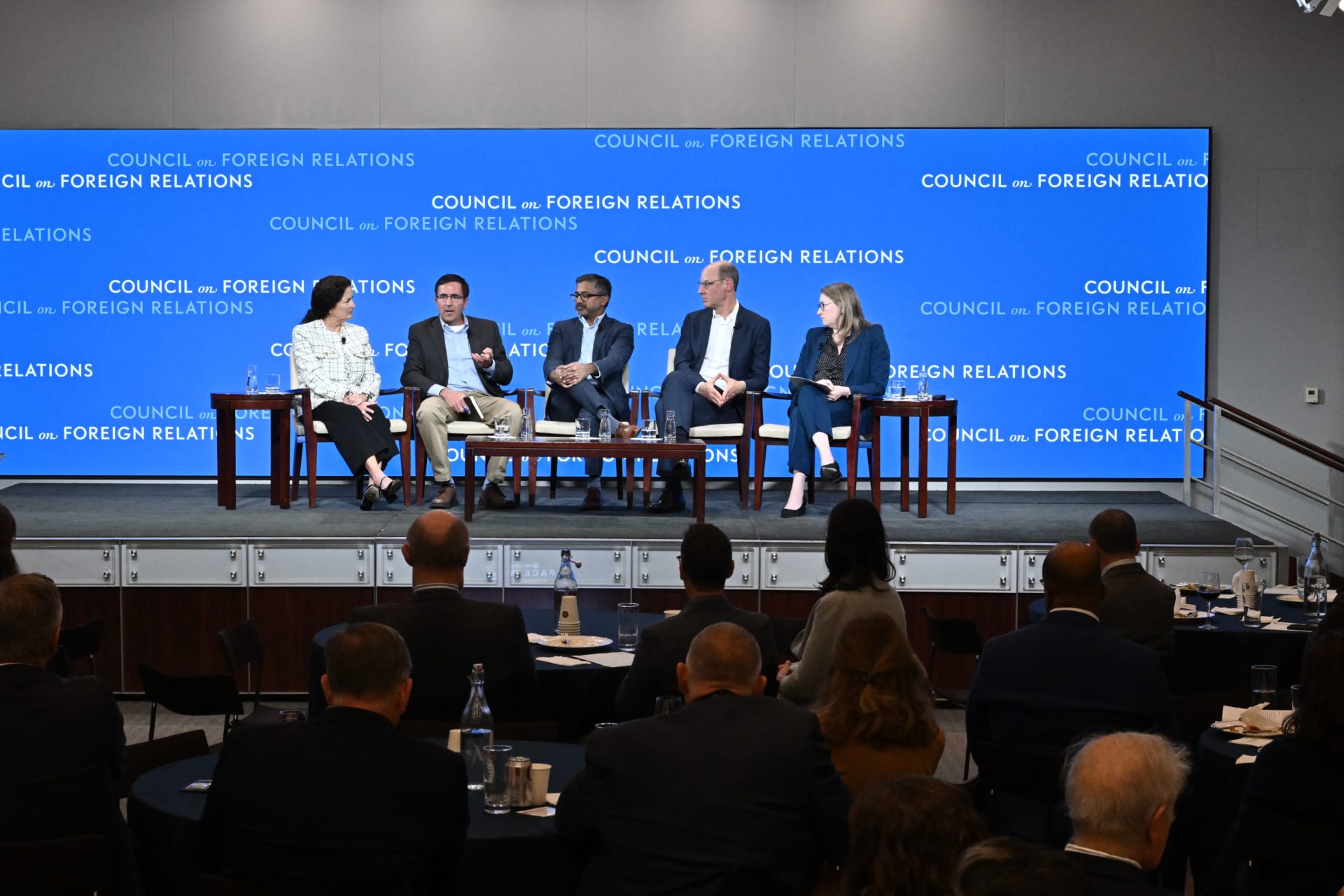
C. Peter McColough Series on International Economics With Daron Acemoglu

Event date
Speaker
- Institute Professor, Massachusetts Institute of Technology; Author, What Happened to Liberal Democracy?
Presider
- Senior Fellow, USC Annenberg School for Communication and Journalism; CFR Member
Nobel laureate economist Daron Acemoglu discusses his views on how liberal democracy flourished when it delivered on its promises of shared prosperity, widely-available public services, and self-government, and how the disruptions of digital technology and the social divisions of post-industrial society have strained those commitments and paved the way for our current crisis. He proposes “working-class liberalism” as a new governing philosophy for liberal democracy.
The C. Peter McColough Series on International Economics brings the world’s foremost economic policymakers and scholars to address members on current topics in international economics. This meeting series is presented by the Greenberg Center for Geoeconomics.
CHAN: Good afternoon, everyone. Can you hear me? Great, great. Welcome to today’s Council on Foreign Relations meeting with Daron Acemoglu, institute professor, Massachusetts Institute of Technology, author of the new book What Happened to Liberal Democracy? For visual effect, I’m just going to place it here.
ACEMOGLU: Thank you.
CHAN: And, of course, 2024 Nobel laureate in economic sciences. Welcome, Daron.
ACEMOGLU: Thank you, Sewell. Great being here.
CHAN: Thanks. This meeting is part of the C. Peter McColough Series on International Economics. I am Sewell Chan, senior fellow at the University of Southern California Annenberg Center on Communication, Leadership, and Policy. And I will be presiding over today’s discussion.
Daron, it is such a pleasure to meet you. You have become, in a very short space of time, the economist that perhaps the AI industry most loves to hate. (Laughter.) The Atlantic in 2024 called you the most controversial Nobel laureate in some time.
ACEMOGLU: I don’t remember that. But, OK, fine.
CHAN: And the Economist ran a rather extraordinary screed describing you as overrated, which we will—(laughter)—which we will get to in a moment. So I’m expecting a very free-ranging conversation, but let’s start with the basics. I, you know, read your book over the weekend. And I was really struck that this book, Daron, your fourth if I’m not mistaken, is a book in many ways about political theory and institutions. Why did you, an economist, someone steeped in quantitative and methodological matters, why did you see the need to write a political—a book of political theory?
ACEMOGLU: Well, I need to step back to explain why I wrote this book. I actually wrote it in much greater haste, with greater urgency, than anything else I have written. Because I think liberal democracy, one of humanity’s greatest inventions, so to speak, is in crisis. And that crisis is deep and is a big risk for our future. Because I think a world in which liberal democratic institutions either collapse or become toothless would be fundamentally different from things that we are used to, both in terms of our freedoms, our ability to participate in collective decisions and public affairs, but also in terms of the economic foundations of how our society works. And I don’t think the crisis is something you can just paper over. It requires a serious revitalization of the ideas of liberalism and institutions of liberal democracy. And a lot of that has to go back to questioning where we have partly gone wrong.
And that’s why it’s very important for us to go back and ask, which are sound foundations for liberal democracy? And what is it that’s actually missing in our current liberal democratic discourse and practice? And I think—my belief is that we need a more participatory liberal democracy, more bottom up. And part of my political theory, or political philosophy discussion is to provide justification and foundations for that. So how can we build a liberal democracy that’s both aspiring and inspiring, and bottom up, so that it’s not driven by some sort of cadre of leaders or activists who say, this is how liberalism should look like. It’s more participatory that we can find the means for reaching compromises within the framework created by liberal democracy.
CHAN: You put—anyone reading John Rawls’s A Theory of Justice, you know, in the late 1970s and on, in the twentieth century, you know, might be surprised at some of your reformulations. You don’t reject Rawls, but you do, you know, add on things that you think are essential to liberal thought now. For example, an emphasis on the community, humanitarian. Michael Sandel wrote a very praiseful review of your book. You also write about the essential role of economic growth in sustaining liberal democracy. How did you come at these ideas? And why ultimately did you choose to defend liberalism, as opposed to join the very popular attacks on it?
ACEMOGLU: Because I think that the core of liberalism—and, of course, one has to define what that core is, but the core, as I’ve defined it, is protection of individual freedoms of thought, speech, association, religion, and a commitment to improving the human lot, both for people who are benefiting from economic growth and those who are left behind, I think are foundational for our future. And those are also, I think, the more durable ideas of liberal theory, even though, you know, when you go back to history, you’ll see many thinkers deviate from them in some ways. So that’s why you need to have a discussion of what you mean by liberalism, or which parts of liberalism you want to sort of focus on. I think those are really important. And if you look at it from a historical perspective, as well as a quantitative perspective, a lot of the achievements that we have made over the last 250 years are related to these liberal ideas.
But it is also very important that we do not just take some already made, prepackaged view of what liberal duties and responsibilities should be. I think that should be a work in progress. And that’s the sense in which I actually do disagree with Rawls, even though I respect him more than many other thinkers of that era. I think there are many interesting ideas in him and the aspirations are worthy. But I ultimately don’t—sort of, don’t like the social contractarian views of liberalism, whereby somehow somebody, via philosophy or something else, tells us, this is the way that liberal democracy should be organized, from a top-down manner.
For Rawls, he worries a lot about some aspects of this, but at the end of the day he comes down to something like that with his difference principle, for example. But I think those kinds of things should be much more bottom-up, that different societies can agree different principles for furthering the human lot, within the confines of basic freedoms and this commitment to progress. And that commitment to progress is also the reason why economic growth is so important. I don’t think people are going to be happy, I don’t think they’re going to be satisfied if things were just stationary in their current state.
CHAN: In an earlier book, Why Nations Fail, you make the case that ultimately in the long run democratic and open societies and systems do better at economic growth. If that’s the case—and you’ve had some critics say it may not be—but if that’s the case, why do you think liberalism has had such a crisis of confidence?
ACEMOGLU: OK, that’s actually a very, very important point I want to talk about. I see no evidence whatsoever that any one of the ideas or movements that are challenging liberalism and liberal democracy in the West have any possibility of delivering what people want. From Trump to Bolsonaro, from Marine Le Pen to Nigel Farage, all of them are much, much worse. And they are worse because they don’t have a workable agenda of creating what I view, and I argue in the book, as the founding pledge of liberal democracy, shared prosperity and voice, people’s participation. Worse, their entire institutional nature makes them—and sort of their top-down nature of them—makes them very prone to veer into kleptocracy, corruption, mismanagement. So it’s like a triple whammy, not just a double whammy.
So there is really no better alternative in the West. We can talk about China, but even if we agree to disagree on what is good, what is bad about China, I think none of the things that the Chinese system is capable of doing can be replicated in the West. So that’s not a relevant comparison for the West. So we’re really—at the end, it comes down to some form of liberal democracy, either in its old form or in some revitalized form, versus all of the hard left, hard right, entire establishment alternatives to it. And then it is really clear that liberal democracy is where there is a better possibility.
But, on the other hand, despite that—and despite my work, this quantitative work that, in my mind at least, demonstrates quite convincingly that democracy has performed quite well, much better than non-democratic regimes in terms of economic growth, inequality, control of corruption, investment, health, education—liberal democracy has failed, relative to the standards that it set itself. It has not achieved over the last forty years shared prosperity. It has let its ability to provide public services and security to people slip. And it has done really badly in terms of its commitment to voice and self-government.
CHAN: That’s what I wanted to home in on. When you said a moment ago, there is no better alternative, I just couldn’t help but think of the times when politicians have said to the electorate, there is no alternative. 2016 Brexit, 2016 Trump, people like Orban and Kaczynski. Right now, the Alternative for Deutschland in Germany, which made huge gains in recent state elections. When you tell voters there’s no alternative to, you know, centrist liberal democracy, it seems to me that the—seems to me the voters are saying, hell yeah there, and I’m going to vote for it.
ACEMOGLU: Yes. Well, that’s—well, that’s because—and I think that’s very important. Thanks for calling me out on that. I do not mean that that should be a rallying cry for the voters, I’m using that as part of our intellectual discussion here. And in fact, my call for revitalization is exactly that if we don’t revitalize liberal democracy, voters are going to keep on doing that. And when—by revitalizing, I don’t mean making better promises. I mean really, structurally, making liberal democracy more responsive to people’s needs and getting rid of the big impediments that have emerged within liberal democracy, for both the participation and the flourishing of a significant fraction of the population who now feel left out.
CHAN: Are you confident that that can happen?
ACEMOGLU: Yes. I am confident that it can happen. I’m not confident that it will happen, but I’m confident that it can happen. (Laughter.)
CHAN: Look, I think your book will be and should be read by centrist parties across the world. But those parties aren’t doing so well right now. The CDU in Germany, traditionally center-right, perhaps the Democratic Party in the U.S., the Labour Party now has a little bit of breath of new fresh air with Prime Minister Burnham. But, you know, centrist parties are hanging on by a thread. So what should they be doing to actually deliver on the promise of better economic outcomes, more affordability?
ACEMOGLU: Well, it’s not just better economic outcomes, by the way. That’s part of it, but they have to definitely have workable plans to do better in terms of economic outcomes. You can call it affordability, cost of living, et cetera, but it’s really what—I think, fundamentally, what people expected from liberal democratic institutions for—have expected for the last 100 years, which is economic growth that becomes widely shared. So that’s shared prosperity, wage growth, job growth for workers with different skills. But that’s not enough. It also has to inspire. It also has to make sure that people of different skills and different ideological leanings still can feel comfortable within the broad liberal democratic tent. That’s what we’ve lost. And that’s why it’s both an economic effort, but it’s also a cultural, social effort as well.
And at the end of the book, the last chapter I devote to what I think is a workable alternative, which I call working class liberalism. And there are few pieces of it, but the most important one, given your question, is that I argue liberal democracy cannot stand unless it brings the working class, meaning people who still work with their hands in blue collar or white collar jobs and don’t necessarily share the same demographic as most people in this room—which is urbanite, well-off, college degree or post-college degree. Those people have to be at the center of center-left politics and at the center of liberal democratic institutions.
CHAN: And you’re actually quite critical in the book of progressive institutions, including some universities, for having put issues of identity above issues of economics and worker issues.
ACEMOGLU: Yes, absolutely. But my criticism is a little different than—it shares some aspects, but it is different than the standard complaints about cultural politics. Because I think what we are calling “cultural politics” is part of a broader whole which is related to the nature of what I call post-industrial society. And post-industrial society has changed both the nature of economic relations, in particular with the rise of digital technologies and globalization complicating the matter of creating shared prosperity, but at the same time it has also elevated managerial technical skills that college graduates have, while providing opportunities for college graduates to become much more influential in politics, much more segregated in the way that they live, in the way that they work, in the way that they befriend different people.
So at a time when the economic challenges of creating a shared agenda have become harder, it has also completely shifted to political balance. And you can see that, for example, as I argue and document in the book, most clearly in center-left parties—the Democratic Party in the United States, Labour Party, which you mentioned, in Europe, social democratic parties in Nordic countries and in Germany, or socialist countries like Spain or France. All of these countries got the majority of their votes from the working class, broadly construed as I’m defining. Now, they get the majority of their votes from college graduates that used to previously vote for center-right. But the college graduates have become much more ideologically aligned with these central-left parties, or the central-left parties have become much more ideologically aligned with that group, which now also dominates both the activists and the members of parliament or leaders of the party.
But at the same time, the working class has largely abandoned the center-left parties. And if it wasn’t for the union movement, they would have abandoned it even more powerfully. And that has created a real tension, because the center-left parties, which still are committed to fairness, equality, et cetera, don’t have the people who are the ones who are suffering economically. So that creates a real schizophrenic issue. And I think cultural politics, as well as other different aspects of political change that are quite different from the first half of the twentieth century or this first two, three decades of the post-war era, are related to this adjustment to post-industrial society. And now, before we can even contemplate that adjustment, now we have to adjust to a post-AI society. So all of that really requires this revitalization, together with new aspirations.
CHAN: So let’s pivot to technology. Your book talks actually about social media and algorithms. Has the algorithmic age made it harder for liberal democracies to sustain themselves?
ACEMOGLU: Absolutely. But I also reject in the book the view that all of our problems are due to social media. The problems I identify and document in the book all start at least two, three decades before social media. So it’s too cheap for us to say, oh, it’s just social media’s fault. That being said, exactly like you said, Sewell, social media really complicates the matter, because if you have a commitment to voice and self-government that has to function via people becoming informed and active, social media complicates both of those. And it’s also absolutely essential for democratic politics, at least the way that I’m defining it, that there should be means and efforts for compromise between different groups.
So that’s the big difference between, you know, a social contractarian view where, you know, you might say, we as the leaders of this party or that party know what the general will is, and we’re going to follow the general will. So I completely reject that. So you have to reach compromises. But again, social media complicates the problem of reaching compromises, both because of the way people interact, because of the way people don’t form the experiences that involve local associations, communities, and things like that. So that’s why I argue that we have to regulate social media while still fully protecting individual rights to dissent and individual liberty. So in some sense I am not against absolutism and free speech, but I don’t think absolutism and free speech require that we don’t regulate the algorithms of social media and the distorted realities that social media creates.
CHAN: Let’s turn our attention to AI. You have become known, fairly or not, as someone who’s more of a techno-pessimist.
ACEMOGLU: I would say I’m a techno-realist, but that’s a different—
CHAN: Yeah, well, and we’ll—I want to hear about that. But, in particular, you’ve been very critical of the notion that AI will deliver, A, unbridled prosperity, you know, make life a lot easier. But in particular, very, very critical of the notion that AI will yield huge increases in in labor productivity, which I think is one of the core, you know, preconceptions behind the AI boom that we’re seeing right now. Tell me how you arrived at your analysis, and how—and why has your analysis been so critical? Larry Summers, among others, the Economist, have kind of treated you as unduly pessimistic.
ACEMOGLU: I mean, I may be unduly pessimistic. I’m not—you know. I think nobody knows. There’s so much uncertainty. But here is where my sort of approach comes from, both philosophically and then I’ll explain it economically. Philosophically, it comes from the same place that drives me to be so keen on bringing people with different skills, different backgrounds, different leanings, back into the economic and social center of our society. Because I think human skills are very rich. And they’re rich in their diversity and in their interaction with the real world, in ways that are very, very difficult for algorithms or for even very sophisticated models to replicate.
Hence, I do not think that it’s going to be possible to fully automate even many simple occupations with very advanced models. And that’s why I believe we are seeing huge advances in some aspects of artificial intelligence models, but we’re seeing very slow spread of diffusion of these models. And when you look at the data—and I have some recent work on this as well—you’re also not seeing the productivity gains, either at the macro level or at the level of firms that invest in AI. It’s just a very difficult problem. So that doesn’t mean that we’re not going to have productivity gains. But it means they’re going to be slow in coming. They’re not going to be spectacular, like doubling of GDP every three years like some AI leaders are forecasting. And, third, it also means that the exact direction in which you develop AI and you apply AI is going to matter a lot. So those are the basic principles of what I’m saying, essentially.
One is, look at the data. You’ll see there are no productivity effects yet. There are much smaller employment effects than people were forecasting. This is going to be developing slowly. Be more realistic about what is it that we can do in the medium term, like a ten-year, fifteen-year horizon. And allow for the possibility that whatever is coming from a couple of leading AI labs and companies may not be the only direction in which we should think about AI being developed and being applied for the benefit of human society.
CHAN: Does that imply that the current frontier lab IPO valuations, the infrastructure build out, the datacenter boom, that it all amounts to a bit of a bubble?
ACEMOGLU: Well, let me answer two versions of that question—one you didn’t ask, and the other one you asked. The one that you didn’t ask, it certainly amounts to saying I completely reject the notion that a bunch of people, like, probably no more than twenty, know exactly how AI should be developed, with nobody else questioning where AI is going and whether this is the best direction. I cannot believe that we have lived with this kind of arrogance. I think AI is an amazing technology, but is this relentless pursuit of AGI, or actually, I would say, a distorted version of AGI, being the best thing, that’s just—like, perhaps they’re right. But that’s a debate we should have. That’s a much more informed debate we should have. That’s number one.
That’s quite distinct from your question, which is even if they are right in terms of direction of AGI, whether those companies are viable. There, I have my doubts. I wouldn’t say they are completely a bubble, there are advances here, but the amount of revenue they need to generate for their current investments to be profitable is just staggering. So a recent paper in Brookings, for example, estimates—and, I think, on the basis of sound and somewhat conservative assumptions—that given the current investments and the projected investment in the next three years, four years, by 2032 the AI frontier labs and leading companies need to generate revenues of the order of about $4 trillion, between $3.7 and $4 trillion. That means 10 percent of GDP.
So right now, they are less than one-twentieth of this number, or around that. So that means a growth rate of about doubling every year. It’s just, like, a phenomenal, phenomenal growth rate. And if you believe that there are going to be limits to the diffusion, if there are going to be certain bottlenecks, or if open-weight models are going to seriously restrict their ability to monetize the advances, whatever they are, you’re not going to think this is going to be possible. And if you think this is going to be possible—which, again, I’m not ruling out completely—but if you think it’s going to be possible, you should be really worried about what kind of inequality that implies, 10 percent of GDP going to AI companies.
CHAN: Regardless of which trajectory that ends up taking, what do you think should be the global—should there be a global governance framework for AI?
ACEMOGLU: Absolutely. So, you know, we’re talking about here about American workers and American voters having a say on AI. OK, fine. Imagine we did that. There are six billion people who are not in China, who are not in the U.S., or are not in Europe. What about them? Their lives are going to be shaped by AI. Should we not ask their opinions? Or even Europeans, perhaps we should ask their opinions too. So I think, yes, we do need some kind of global governance.
CHAN: At this time, I would like to invite members, both in person and on Zoom, to join our conversation with their questions. A reminder that this meeting is on the record. Yes, please, in the back.
Q: Thank you so much for this discussion. My name is Amy Larsen. I’m currently guest lecturing at Berkeley Law and Berkeley Engineering School on AI and geopolitics, having worked in law and politics and tech previously.
I wanted to follow up on your charge that one of the things that should be happening more is that democracy has kind of lost its ability to inspire. I wonder what suggestions you might give in order for this to, kind of, regain its footing. And also if you could shape the deployment of AI in a way that helped facilitate this goal, how would you do that? Thank you.
ACEMOGLU: Thank you very much for that question. And I think the two parts of your question are potentially related. The best way to inspire people is to have objectives based on shared moral values, objectives that are feasible, and the right way of bringing people around these objectives. Part of the reason why liberal democracy has alienated people and has failed to inspire is because we’ve lost that. We have set out either aspirations or objectives that don’t appeal to more than 50 percent of the population, or we have promised things that were unrealistic and have turned out to be completely groundless, such as freely trade and everybody will benefit, trust the financial system or trust digital technologies and everybody’s going to do fine. So that’s why realism is important. That’s why bringing people together is important.
And I believe that all of these things right now meet in the context of AI. So we have to set goals for AI around which a sufficient supermajority of people agree to some sort of a consensus, or sufficient majority. I didn’t—supermajority. Sufficient majority of people agree. And are consistent, in some inspiring way, about all of us benefiting from AI, and feasible. And that’s what I suggest in the book as steering AI in what I call a pro-worker direction. And that’s the kind of objective that, if we can convince people it’s feasible and achievable, and they can recognize through their own experience or through the mediation of good debate that actually would be much more beneficial for their lives, would be the kind of project that can bring people together. That obviously won’t be fun for some of the AI labs.
Q: Esther Dyson.
Following up on that, what about using AI more in government? One thing obviously is to tax—you know, just like we have fuel taxes, land-use taxes, taxing the profits made off AI, and then applying them to making the government more efficient. I mean, that’s the place—DOGE was not the answer, destroying it, but actually, genuinely making it more efficient so it can serve people better. It would give government a better reputation, and it would serve the working class much better if they could get their benefits on time, blah, blah, blah.
ACEMOGLU: So a couple of parts to your question. First of all, obviously, as AI advances we have to use it more and more in the government as well. There’s one big problem there, which is surveillance. So existing users of AI by governments around the world always starts going more and more in the surveillance direction. So we haven’t found a formula, other than civil society vigilance—which is not very active at the moment—whereby the government uses AI to make its services more efficient and more accessible, without then also using that data to suppress dissent. So that’s one bucket.
Second, I am definitely of the view that the U.S. needs more tax revenue, needs that tax revenue to be efficient. However, there are two aspects of your proposal that I’m not entirely sure about. One is that I think we should formulate the challenge of creating shared prosperity not as one of government redistributing, but creating jobs. Because I don’t think there is any historical precedent of sustained shared prosperity where the labor market outcomes themselves become very unequal. So unless we create jobs and wage growth for people with different skills, that’s not going to work. Safety net will help, but it won’t be a full solution. And second, I think the taxation of AI has to be placed within a broader framework of what it is that we’re trying to achieve and what are the effects of AI.
So generally if your objective is to raise tax revenue, which I think the U.S. needs to, taxing specific sectors or specific activities is not the right way. Always broader taxes, like income taxes, or, if we want to go there, wealth taxes, would be much more efficient than taxing specific sectors. Taxing specific sectors would be justified, and is justified, on what economists would call Pigouvian grounds, meaning on the grounds that those sectors create either negative or positive effects. So, in the case of AI, I don’t think the issue is that AI as a whole will always create negative effects. It’s the direction of AI.
And that’s why I put the emphasis in my book and in my other writings not on taxing AI, like token taxes, compute taxes, et cetera, but on getting the direction of AI right. And that’s where we need, going back to the previous question, first, a broad discussion and agreement on what that direction is. But what really worries me isn’t that AI is advancing in some abstract way. It’s that it’s actually driving towards a cliff. So I want that direction not to be towards that cliff. I don’t care as much about the speed of it. It’s the direction that worries me.
CHAN: We now have a question from a Zoom participant.
OPERATOR: We will take our next question from Tomicah Tillemann.
Q: Hi, Daron. This is Tomicah Tillemann with Project Liberty and the Pro-Human AI Coalition.
First, huge thanks for everything you’re doing on these issues. Second, one of the challenges that we have recognized is that the technology of democracy is not ready for the technology of AI. Generally, you would use the technology of democracy to reshape the incentives that are driving development of AI in a way that is going to deliver more pro-human, pro-worker outcomes. And, for a variety of reasons, that’s not happening in the moment that we’re living through right now. What mechanisms do you see we have access to that might help correct that deficiency and steer the trajectory of AI in a more pro-human direction going forward?
ACEMOGLU: Thank you, Tomicah. And I completely agree. I think part of it is an infrastructural problem. And I would like to steer that discussion both in a sort of philosophical direction and a more practical direction. So your question is more about the practical one, but let me start with the philosophical one. I think, philosophically, and this is—I discuss this most in the context of the regulation of social media but it applies to the regulation of AI—there is a big difference between regulating individual speech, for which I have very little sympathy, that I think individuals should always have the right to dissent however non-conventional or even dangerous their ideas are, versus algorithms. Algorithms have no freedom of speech. So when we’re worried about, say, misinformation via social media or via AI, the solution isn’t to silence people. The solution is prevent algorithm from exploiting that misinformation.
So in the context of social media, for example, a very simple proposal. And I know Project Liberty has more sophisticated infrastructural ideas as well. But a very simple one. If today we went back to the early days of social media, where you had no algorithmic feed and individuals used social media just to communicate with their chosen friends and read output from their chosen newspaper articles, a great majority of the problems that social media causes—from the mental health problems to political extremism to siloing of people according to echo chambers according to their leanings—many of those would be significantly ameliorated. So it’s a question of understanding what it is that these algorithms are doing, and deciding what is it that, as a society, we want the algorithm to do.
In the same way that, you know, individual rights are different from corporate rights, individual rights of free speech are very different from saying algorithms have a freedom of speech. In the United States, we’ve gone through a very strange legal philosophy somehow thinking algorithms have a freedom of speech and companies can do whatever they want with the information. And that’s very different from individual freedom of speech.
CHAN: A question in the third row.
Q: Thank you very much. Ramakrishna from Woods Hole Oceanographic.
Your point about the twenty individuals deciding what the future of AGI should be, and that should be more democratic and more broad-based globally, et cetera, I think is very well taken. Excepting that when they speak, I’m talking about the tech giants coming to the Congress to testify, and then they have to explain to the congressmen and the senators what the technology is, how to use it, and so on and so forth. So, in other words, what I’m saying that wouldn’t it always be a very small elite that is deciding, you know, even if you expand that from twenty to whatever number that you come up with?
You know, the second is the AI—you know, I’ve worked with the United Nations a great deal. And the delegates, particularly from the developing countries, find AI to be a great boon in terms of helping them understand the complex proposals that are being there and figuring out what their interests are, and so on and so forth. So from that point of view, it is actually helping them be more effective in terms of articulating their interests, and so on. So, you know, is that enough of a democracy or do we still need to think of our governance system in a different way than what we have? Thank you.
CHAN: Thank you.
ACEMOGLU: Yeah. So, I mean, I think, in response to your first question, of course, when an individual entrepreneur comes up with a new idea and introduces a new product, that is a solitary activity or an activity that an individual takes, and then the market decides how much that product is valuable and people will consume it or not. But in the case of AI, we have a technology that’s potentially affecting every aspect of our lives in which we are investing more than we have invested in any other technology. And it is being led by an unprecedentedly concentrated structure of people who have surprisingly aligned views about—ideologically, about what these key models should do, could do, et cetera.
And that creates a real problem. And many of the ways in which this technology then spreads into our lives is not through a market system, whereby people buy and sell. No, it’s just completely enters the way that, for example, it has entered K-12 education. Nobody planned that. Nobody first looked at whether it’s going to be beneficial for students’ learning or not. But it was just unleashed on the students in a huge social experiment with no guardrails. So that’s why I think AI is different and we should need to step back and decide whether the direction is actually going to be beneficial or not.
And in terms of the developing countries, I see absolutely no evidence that developing country companies, with a few exceptions, are ready for AI, or that they’re going to be able to use their comparative advantage, and especially the skills and talents of their own economy, with the current direction of AI. So whether they can prepare better reports with AI at the moment is a complete triviality relative to the tsunami that’s going to hit the developing countries.
CHAN: But the public—just to interject—the publics in developing countries, though, seem less anxious about job loss and more excited about the leveling up.
ACEMOGLU: They are. They are. But that’s partly because Americans are really worried about it. Americans are, by far, the most worried about it. And part of the reason is because we know in the United States that previous experiments with digital technologies have been very un-equalizing. We hear about the technology all the time. And we see it in our lives in a way that many people are not fully seeing it yet, except as chatbots. So, and, you know, I understand why the Chinese are somewhat less worried about it, because the Chinese have much more experience of AI or robotics being integrated into production processes, as opposed to our, you know, constant talk of AGI, for example.
CHAN: Yes.
Q: Hi. Juan Ocampo, alumnus of Court 14 (ph). Daron, thank you for being here.
ACEMOGLU: Thank you.
Q: As you make your rounds, because you’ve been interviewed many times, you’ve met with a number of people, many of the policy recommendations, which are actually quite tangible—algorithmic feeds, expanding the discussion of AGI towards maybe artificial useful intelligence, things like that—require—they’re pretty urgent in terms of timeframe, and they require some powerful people to act. Are there points of leverage among those who actually have an ability to move the ball forward that you have found, you know, more susceptible, more effective? And in order to frame this a little bit, sometimes it’s not the most obvious choice, and the example I would give was Michael Bloomberg, as mayor of New York, probably had a bigger impact in stopping the smoking all over the world, including Tokyo, places like that, as mayor, because he did it. And I wonder if there’s any groups like that that you have found that we can know about and help out on.
ACEMOGLU: Great question. So I think, no. The answer is, no. And I have not spoken as much to politicians, because this time is short. In the United States, politicians are, you know, more—sort of ,there is a sort of hierarchy that you have to go through, layers of staffers, et cetera. But when senators or Congresspeople reach out, I’m always happy to talk to them. I think there is a general openness, among at least a subset of lawmakers. But also, the next generation of staffers that they’re going to have are all going to be AI fluent. So I think we are already moving into an AI economy. So they’re going to be much better placed to understand what are the things that can be done and cannot be done with AI. So it is potentially going to change in the years to come.
But then there are other things that I think everybody can understand. And there is some, at least, recognition. So more concrete proposals, along the lines of you are suggesting—and I thank you for bringing them up—I think it’s very important that we fix our tax code so that it doesn’t favor capital income so heavily relative to labor income, which is not just unfair but it actually distorts the AI economy. It’s really important that we have new legislation about data protection, data ownership, because data is going to be a more and more important input. And right now, it’s both distorted and unfairly exploited. So those are kind of things that I think a lot of people can come around.
CHAN: Yes. The gentleman in the fourth row. You’ve been waiting. Yes.
Q: Albert Knapp, NYU School of Medicine. (Coughs.) Sorry.
My question is in reference to jobs. You mentioned earlier that AI is not impacted on jobs, in your experience so far. Then let me ask you, how would you reconcile the new generation factories in China and Tesla here, where you have maybe one-tenth the number of manpower, and everything is either automated through robotics and supercharged through AI?
ACEMOGLU: So thank you for that question. I should have been more careful in saying that. I should have said there are no aggregate employment effects. If you look at the composition, there are—in the last two years there is some evidence that a number of occupations and companies are reducing their junior hiring, but not always their overall hiring. In terms of potential sectors that are going to be impacted, obviously, drivers are going to be impacted. Customer service representatives. Coders are already being impacted. So there will be sectors of the economy that are impacted. It’s just slow. But a particular reason in the United States that is very slow is that the U.S. AI investment, and that, again, goes to the direction discussion that I was touching upon, is very, very slanted towards foundation model and large language model. There is actually relatively little investment in the United States in developing applications that can be integrated into the production process. And that’s one—
CHAN: Very different from China.
ACEMOGLU: That’s one big contrast with China, where the companies have done much more in terms of—and the government support, but it’s really the companies—have done much more in terms of integrating robotics and AI into the production process. And that’s why I really worry that actually when the push comes to shove, the U.S. doesn’t have a lead relative to China, because China is going to be the first one to benefit from some of the dividends. But that also cuts both ways. That’s why the U.S. has got a little bit more time in sort of thinking and worrying about the job effect.
CHAN: We’re running out of time. I want to get as many questions as possible. We’ll start with our colleague in the front here, and please keep questions brief.
Q: Nili Gilbert. I lead investments for the David Rockefeller Fund. Thank you so much for being here.
I’d love to layer into this conversation the research that you did on the competition for the allocation of tasks between labor and capital, with a focus on AI investment as a capital investment. Layering in this discussion about leaning into preferences for pro-humanism, shared prosperity, do you think that comparative advantage itself can shift, if it’s redefined through those lenses? In other words, can human agency, individual and community choice, actually shift the outcomes of the models that you designed? And what would you see there?
ACEMOGLU: Absolutely. I think that is exactly—and thank you for bringing it up—that’s exactly what I describe as pro-worker AI. So in particular, I argue, and I’ve argued in some of my work and I summarize that in the book, that AI has tremendous potential. In fact, compared to many previous technology waves, tremendous potential for creating human complementarities and new pathways for humans to be innovative using AI, both in terms of generating new tasks for humans and humans being able to be more innovative for coming up with new goods and services.
So, in fact, my assessment—and I’m not an AI scientist so take that with a grain of skepticism, obviously—but my assessment is that AI as a whole is a very powerful platform for human complementary work. And that’s why I am particularly bothered by the AGI agenda, because it completely ignores that part and says, what we should do with AI, both naturally and desirably, is to mimic human intelligence and then surpass human intelligence in every respect, so that humans can be sidelined. That’s both very dystopian, but also very unfair given the capabilities that AI has.
CHAN: Suzanne Nossel.
Q: I wanted to ask if you could talk a little bit—sorry—if you could talk a little bit about sort of the sequencing and the mechanism. You know, all of these changes that you think need to happen, bringing people from the ground up into the process, having broader dialogue, you know, regulating social media and AI, we seem so roadblocked. There’s so little momentum. There’s so many forces that just seem to have snowballed that work against all of this. How do you see that being reversed? Is this a matter of top leadership? Is it institutional reform? Is it people on the streets? Like, what comes first? What is the catalyst to give people a sense that the kind of changes that you’re talking about might be possible?
ACEMOGLU: I wish I knew. But I am convinced that what we need is demonstration effects. Meaning, people who do the right things, both in terms of being more inclusive and in terms of implementing some of the policies that we’re talking about and showing that it works so that additional confidence can be built on the feasibility of progress. So, for example, in terms of politics, I think it’s so important for Democrats to have—to break out of the current impasse of conflict between so-called centrists and so-called progressives, but come up with ideas that are radical enough for shared prosperity to be revived, but at the same time also reach to constituencies that are so left out of the Democratic Party. So what I want to see is radicalism in the Democratic Party that still maintains the aspirations of the Democratic Party for creating a fair society, but reaches, again, to more conservative, working-class communities that have been left out. That is, I think, the kind of leadership that we need to see.
So we see—we are seeing many charismatic leaders among the Democrats. But they’re not really taking that next step. So that—but that needs to be also combined with really feasible policies, because if you come to power, you promise a lot, and then it falters, that’s going to be more damaging. So that’s why I think a very big mistake on the part of pro-democracy forces all around the world, but especially in the United States, has been oh, all we need to do is defeat Trump. No. If you defeat Trump and you go back to policies that people don’t like and divisions that are very deep, and all of your—all of your promises turn out to be infeasible, that’s going to do more damage. And that’s what we’ve seen in the Biden presidency. So I think we need to come up with the coalitions and the policies that are going to work for those demonstration effects to be activated.
CHAN: One more question from a Zoom participant.
OPERATOR: We will take our next question from Andy Bodea.
Q: I’m Andy Bodea, the former CEO of Equifax, Inc.
How would you—thank you for joining us. How would you compare the current technology revolution in AI with the technology revolution prompted by the internet, and development of the browser? And what do you see as being the same? How is it different? And where does substitution of labor plays in, given many of these leading AI companies are capturing our knowledge, our experience, and forcing us to give to them that knowledge and experience in the process of us working, and therefore being substituting that way?
ACEMOGLU: So thank you very much for that question. In fact, let me give two different parts of—two different answers to different parts of the question. The first one is, the last part of your question, about our experience, that’s exactly why I put so much emphasis on new legislation we need on data, how we can trade data, how we can monetize data, how we can protect data. Because a lot of what you describe is through data.
But in terms of the internet comparison, I think the aspirations of AI are much more radical. And if, say, a quarter of them are realized, I think the effects could be deeper than the internet. But also, in the case of the internet, I think even though there was an internet boom, internet bust, and everything, from the beginning it was very clear what the economic uses of the internet platform would be. Everybody makes fun of Pets.com, but Pets.com’s business model was exactly the one that’s the same as Amazon.
And everybody understood that. That’s going to be more or less the business model. That you’re going to use the internet to create a platform for bringing people together, reduce some of the costs of transaction, and offer new goods and services, or expand your offering of goods and services. And that, and combining that with knowledge and communication, could generate a range of benefits. And I think, on the whole, some of those have come true, even though the internet has also become a cesspool of misinformation and things like that, inevitable.
So I think in the case of AI there is much more uncertainty about what direction is going to be monetized, what direction is going to be socially beneficial, what kinds of new goods and services are going to emerge. And that’s partly related to the ambition of AI, that it’s not confined to a limited set of activities, but, as some of the AI leaders never tire of saying, it’s to completely transform everything we do. So that also means there’s just much more for us to worry about how to regulate and how to think about creating broad-based benefits in an AI economy.
CHAN: On that note, I’d like to thank everyone in our audience and on Zoom for joining today’s meeting. And a warm thanks to Daron Acemoglu for speaking with us.
ACEMOGLU: Thank you so much. (Applause.) My pleasure.
(END)
This is an uncorrected transcript.