C. Peter McColough Series on International Economics With Neel Kashkari
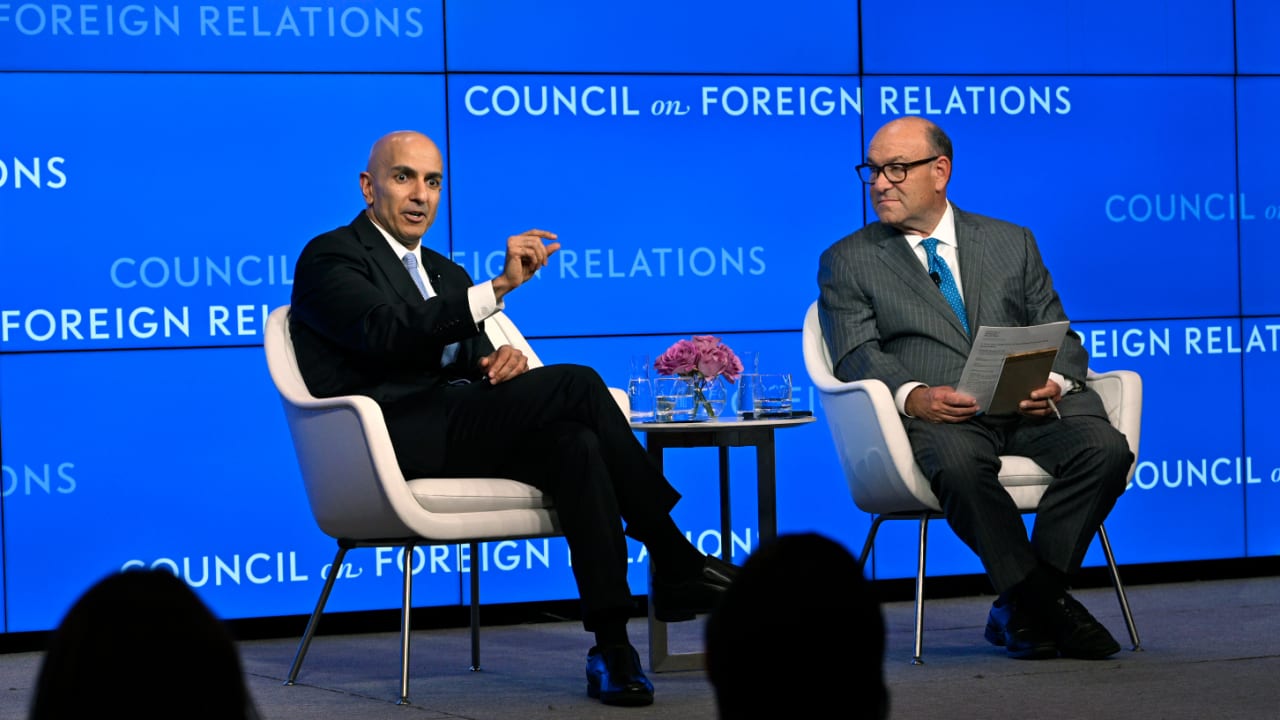
Event date
Speaker
- President and Chief Executive Officer, Federal Reserve Bank of Minneapolis
Presider
- Senior Economics Reporter, CNBC
Federal Reserve Bank of Minneapolis President Neel Kashkari discusses the U.S. economic outlook and monetary policy.
The C. Peter McColough Series on International Economics brings the world’s foremost economic policymakers and scholars to address members on current topics in international economics. This meeting series is presented by the Greenberg Center for Geoeconomics.
LIESMAN: Well, welcome, folks, to the C. Peter McColough Series on International Economics with Minneapolis Fed President Neel Kashkari.
KASHKARI: Good to see you, Steve.
LIESMAN: Thanks for being here, Neel. I think we should just kind of maybe get right into it.
KASHKARI: All right.
LIESMAN: So there was a boatload of data this morning on both sides of your mandate. You have full employment and stable prices. Start off for me, if you would, with your take on the PCE report this morning, which had some changes in methodology in it, and all kinds of other stuff. But what was your basic takeaway from it?
KASHKARI: My basic takeaway on the inflation data is that inflation is still too high. It’s running, you know, there are many different measures of inflation, but it’s running at around a 3 percent rate. It’s been elevated now for more than five years. I didn’t think the inflation data today really changed that story for me very much. But we also saw that consumers keep spending. The economy is resilient. The bigger surprise to me today was just some of the revisions, for example, in GDP, that suggests that the economic resilience is really there. It’s been remarkable the last several years—in the face of tariffs and trade war, in the face of the geopolitical conflict in the Middle East—it’s remarkable how resilient the U.S. economy has been.
LIESMAN: Does it surprise you? We keep seeing these numbers where oil prices are obviously high, but it doesn’t seem to dent sort of consumer spending on oil.
KASHKARI: It is surprising. I mean, I think people are feeling a lot of pressure from the high prices that have accumulated now over the last five-plus years. And yet people keep spending. The good news is the vast majority of Americans who want to work have jobs. The national unemployment rate is 4.1 percent. That is quite a low number relative to history. Most people have jobs. They’re not saving a lot, but they’re spending it and they’re making their way through it. And so consumers keep spending. You know, by the way, some of the big CEOs of the biggest banks have said that they’re seeing that their consumers, their high-income consumers, are spending and doing well, and their lower-income consumers are spending and doing well. That resilience continues to surprise me in a good way.
LIESMAN: Does it give you any information about where the Fed is relative to neutral?
KASHKARI: Yeah. It’s causing me—the longer this goes on, the longer the economy is proving to be resilient in the face of all these shocks, the more I am questioning how tight is monetary policy. So over the last few years I have slowly revised up my estimate of what we call the neutral federal funds rate. In September, I revised my estimate up to 3.25 percent as a neutral rate. But even that is a—it’s a curious number. That number is meant to be, what is the neutral federal funds rate when all the shocks have passed the economy. It’s this mythical state of the world when everything is perfectly in balance, a state of the world that we’ll never actually achieve because new shocks come along. But right now, it may well be that the neutral rate is temporarily elevated, even relative to that. So it gets quite complicated quite quickly.
LIESMAN: Well, that’s what I like, is the complicated stuff. So you’re suggesting that you have in your head a short-term neutral rate and a long-term one.
KASHKARI: Correct.
LIESMAN: There’s the kind of nirvana rate, and but there’s another rate that’s, like, this is the rate I need to get there. Where’s that?
KASHKARI: I’m not sure. I mean, I think I look at economic conditions. I look at the fact that so much massive investment, we all know, is going into the datacenter buildout, and power, and water, and all of the infrastructure that goes with it. That’s a new demand for investment capital. The neutral rate is ultimately set by the balance between demand for investment capital and supply of savings, and where do those two balance out? And if there’s a lot more demand for investment capital, all else equal, that’s going to push up the neutral rate. So I think the neutral rate is likely elevated temporarily, but how long is that going to persist? How long is the AI buildout going to persist? You know there are a lot of different factors that go into it, so it’s hard to know with confidence.
LIESMAN: The bond market seems to have an idea of where the neutral rate is. And it’s a lot higher than where you are right now. I have been using a metric, but you have a better one, I think. Just looking at the two-year over fed funds, and it’s 100 and change. I don’t remember it quite being there. I understand that two years from now you ought to demand a higher yield than tomorrow, but there’s a kind of normalcy to it that’s not—we’re not at right now. What signal do you take from the two-year yield and where the market is suggesting you ought to be, relative to where you think you ought to be?
KASHKARI: Well, it’s an interesting question that I’ve dug into with my staff. Today, I think the two-year ended around 4.88 (percent). And if you look at the Summary of Economic Projections, which is the dot plot that gets a lot of attention, you can compute an implied two-year rate from the expected path of interest rates in the dot plot. You look at the median dot. Our calculation is the median dot implies a two-year of a little over 4 (percent)—4.05-4.06 (percent). So 4.88 (percent) relative to 4.06 (percent) is the largest gap that it’s ever been between the two-year and the median implied two-year from the dot plot. So, you know, I take note of that. I try to understand what is the market likely saying. I don’t think that we should just be blindly following the market, because markets can move around for lots of different reasons. There’s a lot of volatility in markets. But I also don’t want to dismiss it.
Now, if I go back in time, you know, the dot plot was created after the financial crisis. And in the eight or so years after the financial crisis, the FOMC, through the dots, kept forecasting that interest rates are going to go up. And if you look at the two-year at the time, markets didn’t believe the Fed. They said, no, you’re going to end up being dovish for longer than you’re telling us. The truth was even more dovish than markets were. So markets were not right, but they were more right than the Fed. And so I don’t want to blindly dismiss what markets are signaling, because markets right now are signaling that policy may have to go even tighter than we expect. I want to pay attention to it, but I don’t want to blindly follow it either, because there are a lot of different factors can go into some of these market judgments.
LIESMAN: Neel, can you just walk us through what you jotted down in the last SEP when it came to rates and the outlook for the economy?
KASHKARI: Sure. I jotted down two hikes this year. And these are jotting down in pencil. This is as of September. I had jotted down two hikes for this year, one in September and then one later on this year.
LIESMAN: So, just to be clear, you’ve done one already.
KASHKARI: We’ve done one already.
LIESMAN: So one more left this year.
KASHKARI: That would suggest one more left this year. And then another one in 2027.
LIESMAN: Just one more.
KASHKARI: Just one more. But, again, this is—that is a snapshot in time based on information we had on that Wednesday of the meeting. And then we get all this new data, and there are all these new developments, including the GDP revisions that we’ve now seen, including the consumer spending data. All of this needs to go into my real-time assessment of where we go from here.
LIESMAN: All right. So riddle me this, because I’m absolutely haunted by this one line or one paragraph in a recent UBS report I read, which might be old news to you or everybody in this room. But what they did is they did an exercise of taking out the impact of AI on the economy. And they said, for the last year the ex-AI portion of the economy has been contracting. So when I say riddle me this, I mean, how do you set an interest rate for these two things that are going on? One that’s going absolute gangbusters and one that looks like it’s contracting?
KASHKARI: So I’m skeptical—
LIESMAN: And you’re about to slam the part that’s contracting.
KASHKARI: I’m skeptical that the rest of the economy is contracting. If you look at corporate profits, they’ve generally been up very strong across many sectors of the economy, not only those directly related to the AI buildout. And again, 4.1 percent unemployment rate, very low layoffs nationally, very low unemployment claims nationally. Most signs are the—I mean, housing is clearly under a lot of pressure, and housing-adjacent sectors are clearly under a lot of pressure. But many sectors of the economy, I think, are doing well. But AI is clearly the real engine of growth.
LIESMAN: I probably didn’t phrase it—well, I mean, that was—UBS said what they said. But still, there are different tracks and growth tracks for different parts of the economy. Do you set the rate for the marginal borrower, or do you set it for—you know, do you worry too much about, say, the housing sector, that’s going to really take it on the chin from further rate hikes?
KASHKARI: Well, I mean, unfortunately, you all know this, monetary policy—we always say—it is a blunt instrument. It affects the entire economy. We can’t target it on this sector or that sector. Ultimately, it will affect the economy.
Another factor that we haven’t talked about yet that’s been getting a lot of attention, of course, is diesel price. Diesel fuel goes into virtually everything. You know, it affects everything. And so on the margin I know monetary policy can work. It can help stabilize inflation expectations. It can tamp down on demand. It can help get us back solidly on a trajectory down to 2 percent inflation. And hopefully we can do it through modest adjustments rather than something more severe.
LIESMAN: Neel, walk us through your thinking. Was there a point in time you were on team look through supply shocks, and you’ve sort of left that team? Or did you—were you always skeptical of this idea of looking through supply shocks?
KASHKARI: No, I wasn’t. I mean, if you go back a little bit further than that, I was solidly on team transitory. When inflation first took off, and I looked at—we had supply chain disruptions from COVID. That was the first big supply shock, and all the COVID related. We also had a lot of fiscal spending. We had a lot of labor that was still available. There were good reasons to think that the COVID inflation would pass, and monetary policy would not have to respond. It ended up that inflation got much higher than we expected, and it was much more persistent than we had expected. Then you had Russia invading Ukraine, which sent a commodity shock wave all the way around the world, and then a series of these different supply shocks.
You know, coming into a year and a half ago, almost two years ago, it really looked like inflation was well down, going down to 2 percent. It was—like, there was a glide path for that soft landing. Then you have tariffs and trade war, which now sends goods prices up that we’re buying from all around the world. And then, of course, more recently the Iran conflict. And so I’m sensitive to the fact that for five years now—five-plus years—we’ve had these rolling supply shocks. And eventually this gets embedded in people’s decision making, and it becomes a self-fulfilling prophecy. It’s our job to make sure that that doesn’t happen.
LIESMAN: Neel, one of the things you’ve done is look back at the seventies. And obviously there are differences with the seventies. We’re not wearing bellbottom jeans and those sorts of things.
KASHKARI: The music was better in the seventies.
LIESMAN: Music was pretty good, yeah. All the best music from the sixties was done in the seventies, in my opinion. Anyway. But how does that inform the way you think now about monetary policy?
KASHKARI: Yeah. I went back, and I had different AI tools go back and read all of the transcripts from the seventies for me, and summarize them, and say what were policymakers looking at, what were the arguments for raising rates, against raising rates? And it’s fascinating some of the parallels. This is actually a great use of AI, because it could actually go through and read all the transcripts. They’re all public. It’s there for them. And it was fascinating, because so much of the diagnosis of the inflation of the 1970s was these are supply shocks. Monetary policy is not well suited to address inflation from a supply shock. These will pass, and then things will return back to normal.
Boy, when I read this I said, this sounds eerily familiar to deliberations that we have been having. Now it’s not all similar, as you said. There have been some important differences. In the seventies they were experiencing a wage price spiral. The labor market was part of the inflation story. The labor market is not part of the inflation story today. So that’s an important distinction from the 1970s. But it made me realize, you know, you can be fooled year, after year, after year. It’s now been five years. It’s now been five—if you’d asked me—I’ve been on the committee now—this is my eleventh year. If you’d asked me in my first five years, would we ever endure five years of elevated inflation, I would have said, not a chance. There’s no way that could happen. And yet, here we are. So, you know, the inflation episode of the seventies was around a decade. OK, we’re at the halfway point. And so at some point we have to just say, enough’s enough.
LIESMAN: I feel like my economist friends would feel I would be remiss if I didn’t push back on you. If you don’t have the conduit of labor to transmit the inflation, where does it come from and why does it persist?
KASHKARI: Well, it comes from many things. I mean, it’s coming from—as I—for example, I said, energy goes into virtually everything that we buy. Talk to companies. Shipping costs are going up all around the economy, both because of fuel prices and also for labor availability. There’s a confluence of events. You know, I’m on the board of a small nonprofit and—education-oriented nonprofit. And I sat through a presentation with their CFO doing a forecast for the next few years. In one of the footnotes of their budget for this nonprofit was an expectation of a 3 percent annual cost of living adjustment. Like, that was, like, a gut punch for me, that was just—it wasn’t—he wasn’t making a point. That was just embedded in their forecast, that 3 percent is what they need to start budgeting for because cost of living is going up by 3 percent a year. That’s the mechanism by which this stuff becomes embedded in the economy.
LIESMAN: I get it, but isn’t it true, or at least theoretically true, that without the wage price-ish spiral, it only—that’s only a one-time supply shock? That you take that former, that price increase, you pass it along, and you’re done. But it’s the ever-increasing demand of wages that keeps it going.
KASHKARI: Yeah, I mean, I hear you, and I’m sympathetic with that. But when we’ve had these series of rolling supply shocks, I think the risk becomes this becomes embedded. If it’s a one event, if it’s just Russia invading Ukraine, I’m with you. If it’s Russia invading Ukraine, it’s on—by the way, tariffs and trade wars, I mean, these things are going back and forth. Ongoing negotiations. There’s tit for tat. This stuff—what I’ve observed, this is taking longer to work its way through the economy and reach a new equilibrium than I would have guessed when these negotiations first started. The longer this goes on, the more risk we take.
LIESMAN: So, I have to ask you, did you push back against this guy? Did you tell him, no, that’s not going to be 3 percent, it’s going to be 2 (percent)?
KASHKARI: (Laughs.) That was not my role.
LIESMAN: You know—
KASHKARI: I said—I just took—I just quietly sat there and observed it.
LIESMAN: OK, you didn’t tell him he was wrong? (Laughter.)
I want to go back to this—that’s important, I think. You didn’t tell him he was wrong. I want to go back to this AI thing because I’m a little bit obsessed with it. What good does it do to raise rates on, you know, for people in AI? I got to tell you, today I was anchoring the 2:00 show. And we were interviewing a guest, an analyst about Micron. And it said 950 percent revenue growth and 350 percent earnings growth. And before we went on, I said to the producer, did you not put a decimal in there? I mean, 950 percent revenue growth? A quarter point is, like, I’m laughing at you. The entire AI industry is just going to laugh at that. And it will have absolutely no effect. So what good does it do? And then you say to somebody, your mortgage is going to be 7.5 or 7.75 (percent), and not 7 (percent), that matters a lot.
KASHKARI: I’m with you. It’s a combination of factors. One is, we have to use the tools that we have. And monetary policy is a blunt instrument, as I said. Second, higher interest rates are the mechanism by which capital gets reallocated in a market economy to its most productive use. So it’s not comforting to the person going out and getting a 7.5 percent mortgage. But what the economy is doing is taking capital that would have gone to build homes and apartment buildings, and it’s channeling it instead to build datacenters. That is not a great position for that first-time homebuyer who wants to get in, but that’s what’s happening in the economy. And it’s not the Fed’s job to stop that reallocation from happening. Our job is to recognize that that reallocation is happening, and set interest rates to achieve the dual mandate that Congress has assigned us.
LIESMAN: We’ll come back to that. I do want to do a bit of a sidetrack on something else that happened today. The inspector general of the Federal Reserve came out with a report about the building renovations. And it did find management deficiencies. I’m wondering what your response is to that report, have you had a chance to read it and react to it?
KASHKARI: Sorry, I haven’t read it. I’ve seen the coverage of it. I’m not surprised that the inspector general did not find any criminal liability, or violations, or any malfeasance, or whatnot that he said. But I don’t have any other insight into what went on in the building project, other than what’s been reported.
LIESMAN: Is it a bad look for the Fed to have a big cost overrun like that, do you think?
KASHKARI: Of course. I mean, one of the—one of the contributors in that report, plain as day, is inflation, right? (Laughter.)
LIESMAN: A little ironic, huh?
KASHKARI: A little ironic, right? (Laughter.) It’s our job to keep inflation down. So I would say, yes, the cost overrun is bad. But the inflation that was a big contributor to the cost overrun, use the term, that’s the original sin, so to speak.
LIESMAN: Do you have concern that President Trump might use this as an excuse to fire Jay Powell?
KASHKARI: I don’t have any insight into that.
LIESMAN: OK. I’m being quiet for a second to see if he wants to reconsider that answer. No?
KASHKARI: I don’t have any insight.
LIESMAN: Definitely not. OK. All right. Let’s move back to this—Chairman Kevin Warsh has talked about using financial conditions as a way to measure where the Fed is. I’m wondering about your take on that. He seems to have moved away from a more—well something that’s been used over the years—which is this idea of saying we’re modestly restrictive, we’re neutral, we’re slightly accommodative now. He doesn’t want to use that framework. I’m wondering if you could tell me, is this new framework something that we can figure out in terms of that’s where the Fed is going, and understand the reaction function through the financial conditions index? Or do you prefer the old framework?
KASHKARI: Well, I think each policymaker is going to look at this differently. I look at both. I try to assess—they’re related. So we think that monetary policy works through financial markets. So the idea that they’re completely distinct I don’t think is correct. But I look at both. I look at what’s happening in the real economy. Does that indicate to me that monetary policy is restraining the economy or supporting economic growth? Implied in that is a notion of, what is the neutral rate and are we accommodative or contractionary relative to neutral? Financial conditions are another factor. Looking at what’s happening in financial markets. Financial markets, by and large, have been booming. You know, whether it’s debt financings have been booming, AI companies raising huge issuances in the bond market, equities reaching new highs. None of that suggests that financial conditions are restraining the economy, or that monetary policy is tight. So for me, I have to look at all of these to try to get an assessment of what’s happening overall to the economy, writ large.
LIESMAN: Is there a danger of a feedback loop here, where financial conditions reflect what it is they think you’re going to do, and then you take a message from what they think you’re going to do, and do that?
KASHKARI: It is. It is somewhat of a looking in the mirror. But I also know at times markets can take a very different view from the Fed. And again, I go back to in the post-financial crisis era when the Fed kept forecasting that it’s going to raise rates, it’s going to liftoff from zero, and markets weren’t buying it. And markets did not have any trouble saying, we don’t believe you, we’re going to price it—price things our own way. So I give markets more credit than they are just blindly following the Fed. I do think we are looking at each other, but I also think we reach our own conclusions.
LIESMAN: Neel, I first got to know you when you were working at the Treasury, trying to keep the financial system from collapsing. Which I think you succeeded at. I mean—
KASHKARI: It was a big group of people.
LIESMAN: By the hair of your chinny-chin-chin you did, but it did—you know? But so I think you have some interesting thoughts, perhaps, on this idea of not regulating AI, or letting AI regulate itself. Does that bring you back to the days of the financial crisis?
KASHKARI: I’ve been seeing all the coverage about, you know, some people—some firms saying we should regulate ourselves, others saying no. And I just remember, I have this quote in my head, this—I think it’s an infamous quote, from then Citigroup CEO Chuck Prince, before the financial crisis. Where he basically said, regulators need to stop us because we can’t stop ourselves. If the music is playing, we have to keep dancing, and we’re still dancing. It was a damning comment about his own reflection of what they were doing and his willingness to continue doing it. And, of course, Citigroup blew up, and we also had the financial crisis. And so the notion that we’re just going to trust companies that they’re going to be able to—with the face of public shareholders, all of the competitive pressures—that they’re just going to do the right thing, it makes me skeptical.
LIESMAN: How much do you worry about it?
KASHKARI: I worry about it. I mean, I think there are a couple big risks from AI, at least two that I can think of. One is that AI gets out of control and does something terrible. And then, you know, it’s like a—think about, like, a nuclear reactor. If a nuclear reactor melts down, governments will spend unlimited resources to try to stabilize it. Not for the sake of the power company, but for all of our sakes, because we all suffer the consequences if that reactor melts down. And so the idea that well, no, don’t worry, the power company is going to be on the hook, they’re going to be liable for any of the costs, is just—that’s just laughable in a nuclear reactor scenario. So that’s a risk that I worry about.
The second risk that I worry about is this massive investment ends up not being as productive as we hope. You know, I’ve been talking to lots of CEOs in non-tech companies and asking them, how are you using it? And virtually every big company that I talk to is experimenting and experimenting and excited. And is it actually affecting your bottom line? No, not yet. A lot of it is, well, we hope it’s going to. We hope it’s going to improve productivity. But the fruits have not yet borne out. And so I hope it does come, but if this ends up being massive investment that is not nearly as productivity-enhancing as we assume, then this will have been malinvestment. And then there could be big economic consequences for the economy, writ large, given the scale of it.
LIESMAN: That’s one way to think about it. And the other way is perhaps the other side of it, if it’s massively successful. How does the Fed react in a world where AI increases unemployment, attenuates wages, especially at the bottom of the scale, and, still amid massive capital investment, where you would think you could react to the unemployment rate by cutting rates, but there’s still this tremendous demand for capital?
KASHKARI: Well, we have a—it’s a very difficult problem. We do have an assessment where we try to judge what is the natural rate of unemployment, the neutral unemployment rate. And that is a moving target. So in that scenario that you’re describing, my guess is what we would end up assessing is that the structural level of unemployment has now gone up because of these factors, and we might not actually have—therefore, have to respond to it, because we might realize there’s nothing we can do about it with monetary policy.
LIESMAN: Where do you put the probabilities? Is it more probable that all of this AI investment delivers game-changing productivity to the economy?
KASHKARI: I think my best guess right now, just looking at the history of massive fundamental productivity, new inventions, it just takes a lot longer than the optimists think. A lot longer. And it’ll show up, but it—you know, sometimes I hear these Silicon Valley types talk and they’re, like, oh, instead of 3 percent GDP growth we’re going to have 10 percent real GDP growth—I mean, absurd numbers that have not been experienced in the last—you know, the invention of electricity didn’t generate that. The invention of the engine didn’t generate that. And all of a sudden they’re talking about these pie-in-the-sky numbers. So I dismiss that. You know, a good scenario would be it just takes a lot longer, but it really does have transformative effects. That would be great. I hope so. I mean, I’m bullish on AI. Don’t get me wrong. But I’m also trying to think about what could go wrong.
LIESMAN: I mean, what people don’t understand is a good scenario is one that raises productivity from 1 ½ to 2 percent.
KASHKARI: That’d be a great scenario.
LIESMAN: You’d take that all day long.
KASHKARI: Absolutely. Absolutely. If it went to 2 ½ (percent), it would be a miracle.
LIESMAN: And then, of course, that half would simply replace existing labor—or, prior labor force growth.
KASHKARI: Well then, yeah. Then we’d have to—exactly.
LIESMAN: You’d still be at 2 percent.
KASHKARI: That’s true.
LIESMAN: So talk to me about when you look at the immigration numbers, the labor force numbers, what does that tell you about what’s the right run rate on the Friday jobs number? If I get zero, should I be happy?
KASHKARI: No. So this is—you know, we’re always trying to assess labor force growth, workforce growth, population growth, to figure out how many jobs does the U.S. economy need to produce just to keep up with working-age population growth? And as immigration numbers have come down, our assessment of that break-even rate has come down. Before, I’d say four or five years ago, the assessment was probably 100,000 a month, 125,000 a month, that the economy needed to create to keep up with population growth. I’ve seen estimates—I don’t think it’s zero, but maybe it’s 30,000, 50,000. It’s well below where it was before. But it’s probably above zero.
LIESMAN: I guess when I say zero, I mean within the 95 percent confidence level. It could be zero and it would be neutral as to the unemployment rate.
KASHKARI: It could be zero. Yeah. It could be. It could be.
LIESMAN: Yeah. Folks, just to understand, I’m just looking here, we’re going to—I’m going to ask one more question to Neel, and then we’re going to open it up to the audience, and then we’ll also do some virtual questions. But before we get to that, Neel, a lot of talk about the balance sheet, the $6.7 trillion balance sheet. And there’s a task force for that. Your take on whether or not the balance sheet ought to be a tool used more often as part of policy.
KASHKARI: I don’t think so. I think the balance sheet is best as a—it was originally used, once you got to the zero lower bound with the federal funds rate. The question was, is the Fed out of ammunition? And the answer is, no. In those moments it can be a tool to provide more stimulus by buying longer-dated securities and effectively pushing down the longer end of the yield curve. It also implicitly is a signaling device about the expected path of the federal funds rate, kind of a commitment device that if we’re buying up assets, we’re probably not going to be raising the federal funds rate at the same time. So I think in those zero lower bound moments, I think it’s still a useful policy tool to be considered. I think, away from the zero lower bound, we should stick to the federal funds rate.
LIESMAN: Do you think the balance sheet, in and of itself, the size of it, is something that should be reduced? Is there utility in that?
KASHKARI: You know, it’s a quite a complicated question because the demand for reserves, the banking system—based on its own needs for its customers and the growth of the economy and regulation—the banking system demands reserves from the Federal Reserve for their own functioning. So a few years ago when we were shrinking the balance sheet, maybe it was 2019—I’m going to blur my dates together; I’ve been doing this for a while—we were shrinking the balance sheet. And then we went a little bit too far. And we went below the level of what the banking sector needed for their own functioning. And you saw a spike in rates. So then the Fed had to step in. And so I do think shrinking the balance sheet, something to, like, an ample regime, makes sense. But I also think it’s appropriate for the Fed to step back periodically and reassess, do we have the optimal—this is an implementation framework, how we implement monetary policy. Do we have the optimal implementation framework? I think that’s a totally reasonable thing to revisit from time to time.
LIESMAN: Are you familiar with or persuaded by the work of Raghuram Rajan, who’s on the balance sheet task force, who wrote a paper—I think it was presented to Jackson Hole, I’m not 100 percent sure—where he sort of said, the Fed is responsible for that ever-increasing amount of reserves. And what he points out is, why is it that every time you increase the amount of reserves, the amount of reserves required by the banks increases? Do you think that that’s an argument that’s worth considering?
KASHKARI: I mean, it’s worth considering. I have a lot of respect for him. One of the reasons our balance sheet grows is that the other side of our balance sheet, one of the pieces, is demand for physical dollars. So physical dollars all around the world continue to be an increasing demand all around the world. So there are a lot of reasons why our balance sheet structurally has to grow over time. And we are—we were the first central bank to shrink our balance sheet after QE, and we’ve now done it again. And so we’re very willing to shrink our balance sheet.
LIESMAN: OK. I’m going to open it up to questions now, I still have more questions but I’m betting yours are better than mine. How about right here? Wait for the microphone, please, and identify yourself.
Q: Hi. Robyn Meredith, Morgan Stanley.
I wonder if you guys have looked at the capex expenditure that’s coming from AI datacenters. Because it strikes me as different from what we’ve seen in the past. That is, you know, more than half of U.S. GDP this year is coming from that. But by definition, those are not, like, putting in a car factory, right? Like, these are things that may generate employment for a year-ish, massive spending, but then after that they’re basically—they’re net negative jobs, not positive jobs, versus what we’re used to measuring, like a car factory made thousands of jobs, and then supplier factories, and things like that. So how has your measurement of the effect of the spending for those changed, compared to what we used to see GDP growth coming from?
KASHKARI: Yeah, thanks. I guess, for me, I don’t think about that spending as so much around job creation. I think you’re right. It is creating jobs. We hear a lot of anecdotes that anybody related to the electrical supply, installing electrical equipment, any of that, those type of skilled trades jobs, are in huge demand. And they’re drawing them from other sectors of the economy. And what’s going to happen to those jobs if the AI buildout slows? I think a related question though is, why would the AI buildout slow? Like, is it going to slow because we built all the datacenters that we need? Is it going to slow because the datacenters are not as useful as we hoped that they would be?
To me, that is a bigger question that’s going to affect the outlook for the U.S. economy than what’s going to happen to those electrician jobs, because there are many other sectors that say we can’t get electricians today because we’re getting priced out by the datacenters. So I think your observation is correct, but I’m—I guess, I’m more focused on what does it mean for the long-run economy than what does it mean for those pockets of the labor market.
LIESMAN: Just add quickly to that, which I’ll get to another question, but I was amazed to learn that some of these datacenters are being built only to train the models. I thought they’re building the datacenters to give me information. No, that’s the pre-process, which means they may have to build even bigger datacenters when they figure out the model, I don’t know. But that was, like, that—they’re building them just to train the models.
KASHKARI: Let me give you one little a silly anecdote, but it’s a true story. I do—I’ve got little kids, a five-year-old and a seven-year-old. I started late, in case you’re wondering. (Laughter.) So I take a picture of my kids. And I can tell AI, hey, take my kids and put them on a horse and have them eating strawberry ice cream. And it’ll do it. And it’ll create a little video for them. So it takes one minute of computation power to create a six-second video. Then I ask that same AI tool, how much electricity does this take? It takes as much electricity as running your dryer for an hour. One hour of dryer time, one minute of processing time, six seconds of video. Massively resource intensive for every six-second video that I create of my children. My point is, right now this is so funded I think that they’re throwing money at these problems in ways that are not at all efficient. And the industry is going to have to learn to become much more efficient. You know, building datacenters to train models, is that the most—you can do that when capital is cheap. If capital becomes more expensive, maybe they won’t be able to do that.
LIESMAN: OK. Neel Kashkari, single-handedly warming the planet with the superfluous videos of his kids. (Laughter.)
KASHKARI: They’re very clever. The kids laugh.
LIESMAN: OK. Thank you. Constance.
Q: Thank you, Steve. And thank you, Neel. Thank you for being here in New York. Constance Hunter. I’m the chief economist at Economist Intelligence Unit.
And, to go back to the earlier line of questioning, Steve was mentioning that oil prices are going to pass through if they don’t keep going up, so we—you know, economists would push back and say that’s going to fall out of the inflation. But I think what you’re getting to, because we cover both economics and geopolitics at EIU, is that there seems to be an endemic feature of geopolitics now that is putting upward pressure on prices.
LIESMAN: Hold on. We have a new mic coming.
STAFF: It’s working now.
Q: It’s coming from—it’s more endemic. There’s more—there’s increased conflicts around the world. We’re having a shifting geopolitical system, as you mentioned. Tariffs are not a one and done. It seems to be ongoing. And is it your framework that this is becoming more endogenous? Or has become a part of the landscape, rather than a one-off?
KASHKARI: It’s a very astute observation. And it certainly might be more persistent. I don’t feel like I’m qualified to know why it would be that now we live in a world of more supply shocks than we lived in five years ago or ten years ago. But it certainly seems to be an observation. And I don’t have any reason to think that that’s going to change. And so, you know, when—I’m not an economist—but when economists don’t know how to forecast something, they just assume it’s going to continue. And so my base case is this is the world that we live in right now, until we learn otherwise. And I want to start there and set monetary policy assuming that. And if it gets better, terrific, we can then take that on board and adjust.
LIESMAN: I want to follow up on that, which is, I mean, in a world that’s deglobalized with tariffs, maybe the ability of the world to respond to higher domestic prices is more limited than it used to be. In other words, I could go overseas and buy something cheap in China to replace something that was spiking here in the United States, and that would also attenuate the domestic price.
KASHKARI: True. No, that’s—but that doesn’t—that doesn’t absolve the Fed of needing to achieve our goals.
LIESMAN: Oh no, I’m not saying it does. I’m just saying that that’s maybe why—to Constance’s point, why some of these supply shocks seem to be a little bit more endemic. I think that’s an interesting point. There’s a virtual question here. I’ll get to you folks in a second here. Go ahead.
OPERATOR: We’ll take the next question from Jennifer Fondstad.
Q: Yes. Hi. Thanks so much.
My question’s about the balance sheet, but not the Fed’s balance sheet. It’s about the U.S. government balance sheet. And I’m curious what role—you know, we’ve had increasing deficits, and we’ve crossed some unfamiliar territory. What role does that play in your thinking and policymaking, and impact on the markets? Thank you.
KASHKARI: Yeah. It’s something we look at a lot to try to understand what’s driving treasury yields all across the curve. And normally, if you see a lot of concern about deficit spending, then you would see that show up in the thing we call the term premium, which is the residual, basically, of all the stuff we can’t explain. It’s a fancy term for a residual. People just want compensation for risk of bad things happening in the future. But I always go back to, what is the concern that an investor would have if the U.S. government were overly indebted? Ultimately, the concern is inflation. And one way it would show up would be it show up in inflation expectations. Another way it would show up is it would show up in something we call an inflation risk premium, which would be part of that term premium component.
And so I do think concern about debt and deficits—you know, we’re seeing this rise in yields all around the world, France, we’ve seen a very large rise in yields this year. I think there’ve been some political developments and real concern about France’s fiscal outlook that people say is part of the reason that French bond yields have gone up as much. And so I do think fiscal is part of the story, but disaggregating how much of it is just a growth story in the U.S., which is a better story, how much of it is fiscal concern—it’s hard to have confidence as you try to disaggregate it into those two fundamental—two of the fundamental components.
LIESMAN: How do you feel about the TIPS spreads, that suggest that there isn’t much concern about inflation inside of the bond yield?
KASHKARI: I mean, there still is a term premium when you go further out. There’s a real term premium. And is that real term premium—so when I think about, again, inflation expectations, so inflation expectations, as I think about them in financial markets, they’re still anchored at 2 percent. So the modal, the most likely outcome according to financial markets, is we’re going to get inflation back down to 2 percent over the next ten-year horizon. But if there’s an inflation risk premium that says, well, we believe you’re going to do it, but we’re nervous you might not, so we want a little extra compensation in case you don’t. And so, to me, an inflation risk premium is like the cousin of inflation. Like, we should not—I should not be comforted by investors demanding an inflation risk premium, the way anchored inflation expectations would otherwise comfort me. The two are related in my mind.
LIESMAN: OK. Next question here. Gentleman right there.
Q: Thank you. Niso Abuaf, Pace University.
I was wondering if you could elaborate a little bit more on the transmission mechanism. Clearly, you can affect the federal funds rate, but you cannot change the ten-year rate. And moreover, the hyperscalers depend on the ten-year rate, not on the federal funds rate. And those who do depend on the federal funds rate through the prime rate are usually the lower-quality borrowers. Thank you.
KASHKARI: Well, I do think that there’s some effect on the ten-year yield. I mean, I do agree that the ten-year yield is paramount importance to investment all across the economy. I do think the federal fund rate does have an effect on that. If people believe that the Fed is very focused on getting inflation down, and if we talk about our reaction function, and our reaction function is one that is committed to getting inflation down over a reasonable period of time, I think that will have some effect on the ten-year, and that will affect borrowing all across the economy. And, you’re right, hyperscalers may be the least sensitive to a marginal change in rates, but it will—it will show up in aggregate investment in the economy. And it may be sector specific, but it will show up. And so I guess I’m a little more optimistic than you are that monetary policy, even moving the federal funds rate, can have an effect on some of these longer-term investment decisions.
LIESMAN: This woman right here.
Q: Thank you, President Kashkari. Alexis Crow, chief economist at PwC.
Just have a question about swap lines. And I know these haven’t really always been the most popular. And you have some European regulators in this last eighteen months asking questions to their counterparts in Europe, and specifically to the banks. And saying, could you please revisit your funding model, because we don’t know if we’re going to be able to get dollar liquidity in a time of stress? I just wonder if there’s been kind of a discussion about reframing on swap lines.
KASHKARI: Not that I’ve been part of. I mean, to me, swap lines are just part of monetary policy implementation. They were done to make sure the dollar funding markets worked all around the world. Global institutions rely on the dollar and we want to make sure that our partner central banks had the dollar liquidity that they needed. And so I’m not aware of any deliberation at the Fed to revisit that.
LIESMAN: Gentleman right here.
Q: Thank you. Joe Gasparro, Royal Bank of Canada.
You spent 2008 successfully managing TARP. As you look across the financial system today, are there topics or risks that you think policymakers or investors are not paying close enough attention to? Is it AI infrastructure financing, or leverage in the treasury markets, or private credit? Thank you.
KASHKARI: I mean, I think a lot of the things you said people are paying attention to. Private credit’s obviously gotten a lot of attention. Generally speaking, private credit vehicles are less levered than banks. They generally have longer-term liquidity than banks. So if I just compare them apples to apples to bank funding models and bank leverage, private credit ought to be somewhat less risky than banks. But again, a lot of folks are focused on private credit for good reasons. The AI circular funding has gotten a lot of attention, appropriately so. I’m not signaling the all clear. I think it’s confusing and it’s hard for anybody to figure out exactly where the buck stops.
I think the thing that’s being—it was our earlier conversation, which is on one hand we’re very focused on the existential risks of AI doing bad things, and we’re worried about AI destroying jobs and being massively productive. You know, what if AI is just not as useful as we hope it is? This is a massive amount of investment going in, betting that this is all going to be transformational. What if it’s not? Again, that’s not my base case, but that is—that, to me, is getting less attention.
One other example. What if it just takes a lot longer? You know, five, six years ago, the best experts in Silicon Valley all told us that self-driving cars were right around the corner, and all the long-haul truck drivers were doomed. Five, six years later, they’ve made progress, but it’s going to take a lot, lot longer than the optimists thought. So what if AI just takes a lot, lot, lot longer to end up being useful in most of American production cycles? And then, does that have implications on the investment thesis? And then, what are the spillover effects from that?
LIESMAN: So, I’m sorry, I just have to ask this follow up. If that’s the risk, is there a role for the Fed or the federal government to reduce the possibility of that risk? Or we just let them go?
KASHKARI: Now, you’re really into the domain of fiscal policy and whatnot. And I don’t think that—I don’t know that the Fed—
LIESMAN: I don’t know that I am. And I don’t mean be argumentative, but what the hell.
KASHKARI: It’s OK. Be argumentative. (Laughs.)
LIESMAN: I mean, in the sense of you set the baseline borrowing rate. I mean, maybe it’s way too low, if they’re able to borrow all this money and build all this stuff that—
KASHKARI: I certainly don’t feel like I am in a position to second guess and say I know better that this is good investment or bad investment. Again, I go back to—I go back to the very famous expression from Alan Greenspan in 1996, when he declared “irrational exuberance” from the markets. All right, it went on for four more years before the tech bubble finally burst. And if the Fed had tried to stop the tech bubble from inflating using monetary policy, it would have done much more damage to the economy than the mild recession that followed the bursting of the tech bubble. So that’s an example where the regulator was wrong in his issue. Maybe he was right, but it would have been wrong for him to act. And so, I’m—the gentleman asked me a good question of what are some of the risks I think that are being under—are not being paid attention to enough. One is that AI just takes a lot longer to be useful. But I don’t think that suggests that the Fed should now do something about the fact that I’m speculating that AI might take a lot longer to be useful.
LIESMAN: Right. I would just suggest that the tent poles of this conversation are Alan Greenspan in ’96 and Chuck Prince in 2008.
KASHKARI: (Laughs.)
LIESMAN: I didn’t mean that in a funny way.
KASHKARI: I understand.
LIESMAN: OK. Right here. Oh, sorry. You’ll be next.
Q: Sorry. Glenn August, Oak Hill Advisors.
I have a two-part questions. First is, I’m trying to figure out how you think or how you thought in September that two more cuts in the next six—
KASHKARI: Hikes.
Q: Two more hikes. Two more—forgive me—two more hikes are going to basically cut inflation expectations, if we’re basically saying that demand for AI capex is insatiable and the big hyperscalers, whether it costs fifty or 100 basis points more, are still going to build. And the second part of the question is, we haven’t talked about the wealth effect and how that’s driven consumer demand. And obviously, to the extent rates would continue to go up materially more, that might have a dampening effect on the equity markets. And I’m curious how the Fed thinks about that.
KASHKARI: Well, one thing—to your to your former question, I mean, I take your point. What are up to three twenty-five-basis-point hikes going to do to slow the hyperscalers? Not much, you know, is the answer. It would have an effect on other parts of the economy that are already feeling the effects of the rate environment that we’re in, as you’re seeing this capital get reallocated to the AI sector. But I’ll also say, I—and you can criticize me for this, because people may disagree with me—I tend to move my dots somewhat slowly. Like I don’t—I don’t feel like it’s that useful for me to say, oh my gosh, now I think the datacenters are roaring, so I need to dramatically change my policy path. I actually think there’s some value in slow adjustments as we get more information on the economy.
Remember, less than a year ago there was a lot of indication that the labor market was slowing down pretty quickly. And the Fed did three, some people called them, insurance cuts to try to support the labor market. Since that happened, the labor market has shown signs of stabilizing and even strengthening. And so I take your point, but it’s not all been rosy in one direction. Wealth effect, again, sorry, something we definitely pay close attention to. That also gets into, has it been a K-shaped economy? Wealthy people are driving the spending. There’s some indication that lower-income folks are also spending. And so wealth effect is part of the story, but I don’t think it’s the whole story.
LIESMAN: This gentleman right here.
Q: Thank you. Thank you. David Ekizian, Mitsui.
Can you comment on the labor force participation rate being at historic lows relative to the unemployment rate? Seems like the job growth has been fairly narrow. When you put aside AI, it’s pretty much around healthcare and leisure and hospitality, which then you have to start to think that most of the consumer spending is coming from retirees, really, that really are probably going to be less impacted by rates.
KASHKARI: Well, so the labor force participation, you have to slice it a bunch of different ways. If you look at the aggregate labor force participation rate, you’re right, it is declining. Really being driven by the aging of our society as people age out of the workforce. If you slice it and look at prime age labor force participation, it looks quite good. Prime age employment to population ratio, it actually looks quite good. So it’s prime age are twenty-five to fifty-four year olds. That actually looks like it’s still a healthy labor market. So it is a complicated picture. You know, we look at the unemployment rate. We look at labor force participation, aggregate and prime age. We look at employment to population, aggregate and prime age. And we look at unemployment claims and we look at layoff notices. My big picture is the labor market looks pretty good right now. Not a great labor market, but pretty good. And not showing signs of deteriorating right now, which I’m happy about.
LIESMAN: Gentleman right here.
Q: Ian Murray, Peak Ten Capital.
I’d like to get back to this issue of malinvestment for AI and what impact it might have. Because let’s say, you know, as you say, it takes longer, or whatever. The spending has really been concentrated in hyperscalers. And they’re barely cash flow negative after spending 200 billion (dollars) a year. And if they stop spending, their cash flow will go up. And as a shareholder with Google, I might be temporarily unhappy. But what are the—you say you worry about its implications on the economy. And I’d just be curious to see what you think would happen if it took longer.
And a second question, do you think this extraordinary move in rates in the last few weeks, do you have a way of determining whether someone’s in trouble? Let’s say, a long-term capital—something out there, you know, today? Oil is going down a bit. Oil flows are increasing, yet the rates keep going up. Could it be that there’s a singular event that’s out there? And is there any way for you to know?
KASHKARI: Yeah. So what is a—how would the bad scenario of the investment ends up not being as high return as they expect, how would it show up? You’re right. Most of the hyperscalers could just turn off the investment and their cash flow returns positive because their underlying businesses are very healthy. So you’re totally right about that. But look at the economy as a whole. We would have taken whatever it is, a trillion dollars that we otherwise would have invested in other sectors of the economy, and we would have channeled them over here.
And while those companies might be OK, I’ve got to believe that there’s going to be some overhang from the U.S. economy from that—from having missed out on that otherwise productive investment. It’s not exactly the same thing as China investing massively in housing and apartment buildings and having this overhang, but it’s not entirely different from a country having a massive investment boom that ends up having been misguided. Again, that’s not my forecast. I want to be clear about that. But it is something that I—that I think about.
Remind me the second part of your question.
Q: An event.
KASHKARI: Oh, an event. So we do a lot of—because, obviously, we supervise banks, we supervise bank holding companies. We look at bank balance sheets. We try to mark to market their assets on their balance sheet to understand—you know, this is ultimately what got Silicon Valley Bank in trouble, is that they had a lot of duration risk, rates went up, the value of their bonds went down. That spooked a run, and that got them into a lot of trouble. So we do look at this all across the banking sector. But I think we have a lot less visibility into the non-bank parts of the financial sector that bears watching.
LIESMAN: Neel, I think that that question made me think that there’s two potential bad outcomes here. One, I think, as mentioned by the gentleman, is a systemic risk outcome. And I think that’s the one that seems like it’s less likely because of the equity being in the primary loss position here, right? There’s a lot of equity ahead of this debt that would not be—but there’s an economic shock, if you think about an economy right now that is fueled by the spending of the wealth, the wealth effect that’s out there now. So, do you agree that it’s not a systemic risk issue when it comes to AI?
KASHKARI: I don’t see the—for the reason that the gentleman said—I don’t see the immediate mechanism by which it would be a systemic risk. Obviously, you know, when ’08 happened, people didn’t know who owned the bonds, who owned the stuff. And that gets all packaged up and repackaged, and people were surprised that they had exposure. So could there be surprises on who has exposure to this that is not obvious today? That’s always a possibility, but that’s not my base case scenario. The more likely scenario is just the economic hangover that would result from this much investment that ended up being misguided.
LIESMAN: This gentleman right here, and then the one in the back. Oh, I thought you said there was somebody—no? Oh, back, yeah.
Q: Hi. My name is Hall Wang.
I’m just curious, being that you’re the president of Bank of Minneapolis, what unique and nuanced perspectives you have for—giving your coverage of the Upper Midwest—that you feel uniquely contribute to—your views that might be a little bit more nuanced differentiated from the other presidents.
KASHKARI: Well, I think we all bring—first of all, we’re all trying to make recommendations for the U.S. economy as a whole. I’m not advocating for monetary policy that’s just right for the ninth district. I’m doing my best to advocate for the right policy for the country as a whole. And that’s true for my eleven colleagues who are other reserve bank presidents, and the governors in Washington as well. But my recommendations are informed in part by conversations that I have with labor unions on the ground in in our region, with agricultural groups on the ground, with businesses, small businesses, labor—other types of labor representatives, big businesses, et cetera. So all of us, I think, are somewhat shaped by all of the conversations that we have. And so I don’t think it’s a unique Minnesota-only perspective or ninth district-only perspective, but it definitely is influenced by those conversations that I’m having.
I’ll give you a tangible example that I’ve spoken about before. I had a roundtable a few years ago of labor unions. And we were having this discussion about inflation versus the labor market, right? You raise rates to get inflation down, but then you might weaken the labor market and people lose their jobs. And how do those labor union reps think about that trade-off? And one labor representative said something very powerful. She said, for her members—and she represented low-income service workers—she said, for her members inflation is worse than a recession, right? That takes most economic thinking and turns it on its head. Most economists would say that’s crazy. A recession is worse than inflation.
And I said, well, help me understand, why do you say that? She said, because her members are used to dealing with recessions. People lose their jobs. And then you know what they do? They lean on their brother or their sister or their friend or their spouse or their mom or their dad to get through those lean times. But inflation is affecting every one of their network the same. And so there’s no one they can turn on—turn to for support, because they’re all under pressure at the same time. That was a remarkable comment for her to make, that I then took back to our team of Ph.D. economists. And I said, let’s examine this and let’s see if we’re missing something. So that—I don’t know if that’s a unique perspective that I’m getting about the ninth district, or that’s just a very powerful conversation I had with somebody in my district which then influenced how I thought about the trade-offs of inflation and employment.
LIESMAN: Kamala Harris could have told you that. (Laughter.)
KASHKARI: No comment.
LIESMAN: I mean, about the importance of inflation in the mind of the body politic. Maybe there’s one back here.
Q: Hi. My name is Elizabeth Blazey, Bank of America. Thank you for being here and speaking with us.
You briefly touched upon the global rate tightening that we’re seeing, I guess globally. I was curious if you could go into that a little bit further, and if that’s consistent with Fed thinking as well.
KASHKARI: Yeah. I mean, these markets tend to be linked, as you know. Sometimes they’re more linked than maybe they should be. Like, I don’t think the really optimistic growth outlook for the U.S. economy, I wouldn’t say that about many advanced economies. I do think more—there’s more of a strong growth story here in the U.S., driven by this datacenter buildout, much more so than we’re seeing in Europe, as an example. And yet, rates are going up in Europe. And, by the way, the stock market has done well in Europe as well over the past year. And so I mentioned the France example, where France yields have gone up more than other European economies. That seems to be more of a fiscal story, but it’s—you know it’s hard to disaggregate any of this.
And there’s also spillover from the U.S. So if people think, hey, the Fed is really on the mission to get inflation back down, and the Fed is likely on a tightening cycle, that can have some effects on currencies, as you know. Then that can have some spillover effects on foreign economies. And so I think all of these economies end up being linked. And what we do here actually has some spillover around the world. And so how much of it is just spillover from the U.S. into their rates market versus how much are those economies, their real economies, seeing something similar? It’s hard for me to know with confidence how to separate those two.
LIESMAN: We’re on the last question, and I want to just, I guess, use moderator’s prerogative here. Neel, you sat here and given us your views far and wide on the economy, given us your best guess on the outlook. The chair doesn’t want to do that. You submit a dot. He doesn’t submit a dot. I guess, you know, to each his own, each to his or her own. Does that situation have to resolve itself?
KASHKARI: Well, I don’t—as you said, you know, he’s created a bunch of task forces, one of which is on Fed communications. And I think we are all, I am, eager to see what recommendations come from the task force. Ultimately, the committee as a whole decides the communication policy of the committee. And so we will all have to take those recommendations on board, consider them, deliberate, and then decide what we’re going to do collectively going forward.
LIESMAN: But is it your belief, sitting here talking to us, that that leads to better monetary policy?
KASHKARI: I mean, it depends what changes we make, right?
LIESMAN: No, but, I mean, just the idea of you’re talking and giving us your views, is that a way of creating better monetary policy?
KASHKARI: I mean, I think what I’m trying to do implicitly in this conversation is share what we call my reaction function, which is these are the things that I’m looking at, this is how they are influencing where I think rates should go. And then as you study the economy, you look at the data, you look at developments, you can reach your own conclusions based on that. And so that’s what I’m trying to share. I’m not making a promise about what I think is going to happen to monetary policy. I’m just saying, these are the elements that I look at as one policymaker, which hopefully makes you better informed market participants.
LIESMAN: The Fed chair once turned to me and said, Steve, the only reason I’m talking to you is because I think it leads to better monetary policy. Otherwise, I’d kick you out.
KASHKARI: That’s a much more concise answer than I gave. (Laughs.)
LIESMAN: Blunt. Please join me in thanking Neel Kashkari.
KASHKARI: Thank you for having me. (Applause.)
(END)
This is an uncorrected transcript.