‘America First’ Meets the National Security and Defense Strategies
Will the two congressionally mandated documents provide some clarity about President Trump’s priorities and strategy?

Carla Anne Robbins is a senior fellow at the Council on Foreign Relations.
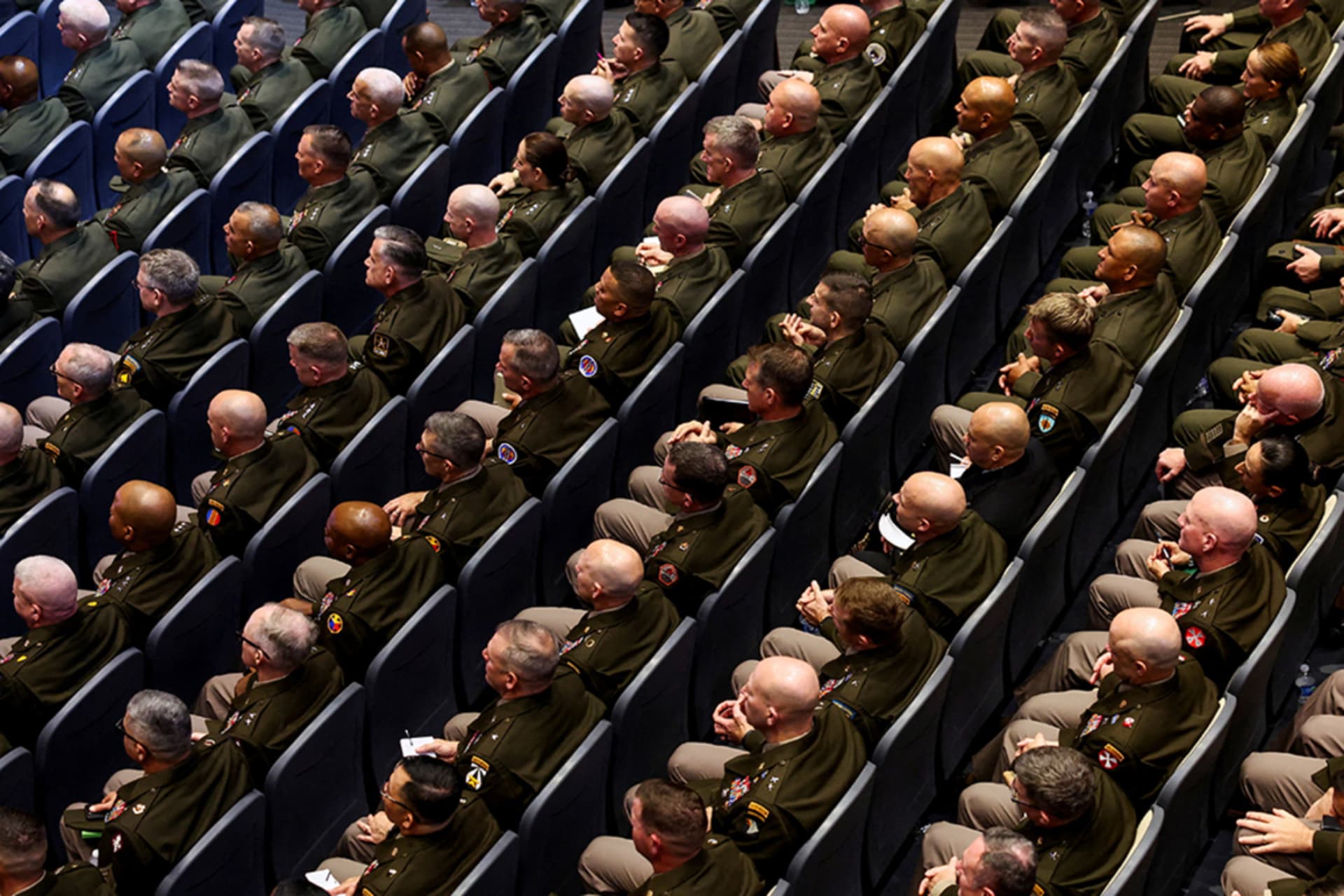
When President Donald Trump addressed the country’s top military officers in late September, he offered no insight into his plans for China, Iran, or Russia. North Korea and its fifty nuclear weapons didn’t come up. The president’s only apparent security concerns were alleged Venezuelan drug traffickers—whose boats, he promised to blow “out of existence”—and the need to fight the “enemy from within.”
Since then, Trump has announced and canceled a summit with Russian President Vladimir Putin, disclosed his authorization for covert action inside Venezuela, dispatched a carrier strike group to the Caribbean, and may or may not have ordered a resumption of nuclear testing. This uncertainty about his security intentions has raised the stakes—and the skepticism—surrounding the administration’s pending National Security Strategy (NSS) and National Defense Strategy (NDS). Both are mandated by Congress. The president articulates his vision of national threats, priorities, and strategy in the NSS. In the NDS, the Pentagon translates the NSS into military plans, force structures, and budgets.
This president doesn’t follow a playbook, even one with his name on it. But for the American public, the national security bureaucracy, and U.S. allies, any insight the NSS and NDS could provide would be an improvement over the non-stop roiling. They might, at least, clarify how his top advisers define and prioritize threats and the strategies to address them.
An America-first strategy?
Trump’s first-term NSS and NDS were guided by advisers—Defense Secretary Jim Mattis and National Security Adviser H.R. McMaster—who believed in the value of alliances and viewed authoritarian regimes like Putin’s anathema. This time, with few if any of those voices in the White House or Pentagon, they are more likely to channel the president’s own inward-looking, transactional views, codifying the sharp changes already underway in U.S. alliance politics and national security policy. Here are some issues to watch for with the release of the NSS and the unclassified summary of the NDS:
The new security threats. President Trump’s first NSS and NDS outlined a major shift from nearly twenty years of fighting terrorism to great power competition with a “revisionist” China seeking to supplant U.S. power and Russia seeking to dominate its neighbors and “shatter” NATO. President Joe Biden’s strategy went on to describe China as the “pacing” challenge and Russia as an “acute threat.” Trump’s new strategy is expected to significantly narrow U.S. focus to China and an inward-looking homeland defense—which of those will be given top priority is unclear.
On China, one of the key issues is how explicitly the strategy commits to defending Taiwan. Trump has sounded far less “all in” than his advisors, criticizing Taiwan’s government for not doing more to defend itself. And what, if anything, will it say about China’s growing nuclear arsenal? Will it call for a U.S.-China-Russia arms-control deal—an idea Trump floats episodically—or threaten a twenty-first-century arms race?
The definition of homeland defense. All U.S. presidents are sworn to defend the homeland, but Trump is breaking fundamental norms by charging the U.S. military with a growing number of domestic policing functions and describing a country at war with itself. In his speech to the military leaders, he said “straighten[ing] out” American cities run by “radical left Democrats” is “going to be a major part for some of the people in this room. That’s a war too.”
If either or both strategy documents include hyper-partisan language, it could undermine faith in the military with at least half of the country.
Who worries about Russia? How much can one downgrade a country that has thousands of nuclear weapons, is harassing NATO allies, and is fighting a brutal war in Ukraine with the support of a new set of unsavory allies (China, Iran, and North Korea)?
In March, the Washington Post reported on an internal Interim National Defense Strategic Guidance signed by Defense Secretary Pete Hegseth that said beyond China and the homeland, the United States is prepared to “assume risk in other theatres” and will press regional allies to shoulder the burden of defending against Iran, North Korea, and Russia. Trump—and Putin—have goaded the Europeans into investing more in their militaries. How much risk is the United States prepared to accept? And will allies on the front lines, who will be risking a lot more, be given time to prepare?
Security in the Western Hemisphere. In early October, the administration notified some members of Congress that it is now engaged in “armed conflict” with drug cartels and smugglers who are “unlawful combatants.” So far there has been no explanation for the massive U.S. military buildup ordered to the region. Politico is reporting that the NSS may cite the Monroe Doctrine, which is certain to provoke a sharp response from countries across Latin America.
A prolonged deployment or any loss of American life will lead to wider questions about legality and the realistic chance of success in a war on drugs or a decision to move against Venezuelan President Nicolás Maduro.
Retrenchment. As the U.S. turns inward, will the NDS outline a significant reduction in the number of U.S. troops deployed overseas? In late October, the Army announced that it is withdrawing some seven hundred troops deployed in Germany, Poland, and Romania, while insisting it “will not change the security environment in Europe.”
That decision provoked rare criticism from the chairs of the House and Senate Armed Services Committees, Representative Mike Rogers (R-AL) and Senator Roger Wicker (R-MS), who warned that the move, “just weeks after Russian drones violated Romanian airspace, undermines deterrence and risks inviting further Russian aggression.” Any wider pullbacks will need a much stronger argument.
Fear of commitment?
Trump was never comfortable with his first-term NSS and NDS. He immediately veered off message at the NSS rollout, enthusiastically recounting a phone call the previous day with Russia’s Putin. Driven by strategic realities of an increasingly powerful China and an increasingly malign Russia, great power competition became the new paradigm.
The real-world effects of the new strategy were still limited by bureaucratic inertia and, in the first Trump term, constant leadership churn—McMaster lasted just four months after the NSS was released, and Mattis resigned eleven months after the NDS.
The Brookings Institution’s Michael O’Hanlon told me over email that since 2018, there has been “a big overall increase in annual levels of investment,” especially in high-tech systems but “remarkably few changes in force structure or overseas posture.” He noted that the main changes—the U.S. withdrawal from Afghanistan and the addition of forces to eastern Europe after Russia’s invasion of Ukraine—were “measured in terms of +/- 15k to 20k,” out of an overall “foreign footprint of about 250,000 for the U.S. military.”
Mara Karlin, a former assistant secretary of defense who led the development of the 2022 Biden NDS, said that the last administration built capacity in Asia by “getting more deeply intertwined,” with regional partners. “I think the term we used in [a Defense Secretary Lloyd] Austin speech was ‘forward together,’” she added
Under the Biden-negotiated 2021 security pact between Australia, the United Kingdom (UK), and the United States—known as AUKUS—Washington committed to sell between three and five conventionally armed nuclear-powered attack subs to Australia early in the next decade. Starting in 2027, U.S. and UK attack subs based out of Western Australia will begin a regular rotation. The Biden administration also expanded a basing agreement with the Philippines and upgraded its military command in Japan to a joint operational headquarters.
Regional allies who felt these Biden administration commitments were less than they hoped for are now fearful they will be curtailed or abandoned by Trump.
For a while, it looked like the Trump administration might walk away from the AUKUS sub deal. Defense Under Secretary for Policy Elbridge Colby, who had already questioned why the United States was giving away “this crown jewel asset,” was put in charge of a review, provoking deep anxiety in Australia and dismay on Capitol Hill. Last month, after meeting with Australian Prime Minister Anthony Albanese, Trump declared that the United States is going “full steam ahead.”
Colby, who has the lead on shaping the new NDS, has become the focus of a host of frustrations with the administration’s high-handed dealings with allies and Congress. Republicans have noted that he is “the hardest guy to get a hold of in the Trump administration.” That could affect the reception for the new Trump defense strategy.
At a confirmation hearing in early November for three Defense Department nominees, Republican senators were vociferous in their complaints that Colby (who was not in the room) and his office had failed to inform them about critical policy decisions. This included a sudden pause last summer in the delivery of munitions to Ukraine, the AUKUS review, the recent order to pull U.S. troops from Romania, and the upcoming NDS.
Senator Dan Sullivan (R-AK) pointed out that the requirement for the NDS “comes from us. Don’t you think it would be smart to maybe preview it?” Senator Tom Cotton (R-AR) said “it just seems like there’s this pigpen-like mess coming out of [Colby’s] policy shop.”
There is a wide gap between policy, strategy, and the hard realities of budgets, politics, and implementation. With a mercurial president, the policy effect of an NSS—or even a more detailed NDS—is especially hard to predict. But, given Trump’s notorious aversion to introspection, a second term strategy could be the closest we will get to understanding his worldview.
This work represents the views and opinions solely of the authors. The Council on Foreign Relations is an independent, nonpartisan membership organization, think tank, and publisher, and takes no institutional position on matters of policy.