U.S. Supreme Court Rules Against Trump’s Tariffs
In a 6-3 decision, the U.S. Supreme Court struck down the government’s use of the International Emergency Economic Powers Act (IEEPA), holding that the statute does not authorize a president to impose sweeping tariffs. In this breaking news episode, host Rebecca Patterson is joined by Michael Froman, president of the Council on Foreign Relations and a former U.S. trade representative, to unpack the decision and discuss potential spillovers into financial and labor markets.

Published
Host
 Rebecca PattersonCFR ExpertSenior Fellow
Guest
 Michael FromanCFR ExpertPresident, Council on Foreign Relations
[Video: https://www.youtube.com/watch?v=j3dCmHNgNq4&list=PL4THPMjF2nCJThWvLnZkNd4Bcz7BJ5AH1&index=1&t=2s]
Transcript
PATTERSON:
Welcome to The Spillover, where we examine the ripples each week from the most important topics across economics, financial markets, policy, geopolitics, and technology in a clear and hopefully concise way. We have a special episode of The Spillover today in light of the Supreme Court’s decision around the United States emergency economic power or IEEPA tariffs. And then of course, President Trump’s subsequent press conference.
My normal Spillover co-host, Sebastian Mallaby, is somewhere in the air on an airplane. But I am absolutely thrilled today that I have someone, dare I say it, even better for this conversation. I’ve got Council on Foreign Relations President Mike Froman, and even more useful today, particularly for this conversation, U.S. Trade Representative from 2013 till 2017. So Mike, thanks so much for being here.
FROMAN:
Rebecca, thanks for having me on your new podcast.
PATTERSON:
I’m excited to be doing it. It’s a lot of fun. So I want to start with what we learned today, again, both from the Supreme Court decision and then from President Trump’s press conference a few minutes later. The decision it seems, from the financial market reaction at least, was partly or even largely expected. And it does sound like the White House is going to be levying some new tariffs, including a 10% Section 122 tariff broadly.
So it feels overall like there’s going to be some volatility, tariffs are going to take different shapes, different industries, different countries to a degree, but by and large, we’re still in a trade war landscape. I’m curious though, from your perspective, given your experience in trade for so many years, what did you take away from today’s events? What were your big takeaways?
FROMAN:
Well, I think first and foremost, the Supreme Court by six-three majority determined that IEEPA, that International Economic Emergency Powers Act, could not be used to impose tariffs. And the reason why the president liked to use IEEPA is that it really doesn’t require any process. He can just announce that it’s an emergency and he’s going to impose this. So it’s the easiest way for him to take action. But the Supreme Court made it clear that it doesn’t mention the word tariffs. It’s never been used for tariffs. And when Congress has delegated authority to the president, it’s taxing authority to the president to impose tariffs, it’s been under very specific language. And that is not in existence in the case of IEEPA.
So that’s very important because he’s used IEEPA not just for trade issues, but for whether it’s fentanyl or migration or political issues. Bolsonaro’s treatment in Brazil, India buying oil from Russia, Canada, signing a trade deal with China, that’s been the basis on which he’s taken action, and those tariffs are no longer going to be permitted.
On the other hand, as we’ve been talking about for some time, Rebecca, he’s got plenty of other authorities that Congress has delegated to him, and the court recognized that. And so he announced today he’s using one of those authorities, Section 122, which is intended to be used when there’s a balance of payments crisis. But that’s a subject to lots of interpretation. And that allows the president to impose terrorists for up to 15% for 150 days. And he decided to do it, he did it for 10%. And that gives him five months then to go under the various processes of the other laws without getting too wonky, Section 232, Section 301, maybe Section 338, and decide over time what more permanent tariffs he wants to impose.
So on one hand, IEEPA not appropriate for tariffs. On the other hand, reinforcing the president has plenty of other authorities that Congress has given him over the years.
PATTERSON:
Right. And I’ve been hearing now for months, investors, corporations, other academics, think tanks saying, “Well, once we get the Supreme Court decision, we’ve got clarity.” And I’m thinking, do we really?
FROMAN:
Clear as mud I’m afraid. I mean-
PATTERSON:
Yeah, exactly.
FROMAN:
… we know that for five months we’ll have this 10% tariff that substitutes for what was there before. So for example, the country faced, I think Vietnam that he’d mentioned in the press conference, I think they faced a 19% tariff. I believe it’s all IEEPA based. I could be wrong about that, but that 19 will now go down to 10, but in five months it could go back up to 19 or even higher, as the president said, based on these other authorities. So there isn’t a lot more clarity at the moment, and we’ll have to see how this pans out.
PATTERSON:
Right. And two of the big question marks on my mind are refunds, and then these agreements that aren’t exactly like historical trade deals that you might’ve worked on, but they’re what we call deals today. So the refunds in President Trump’s press conference, he was furious that the Supreme Court didn’t have any language in there to spell out how refunds would take place if they take place. And then he suggested in his press conference that companies could face years of litigation to get their refunds. That to me doesn’t spell certainty.
And then the other one, the deals, right? So he talked in the press conference about just finishing a discussion with Vietnam last week, I believe we had Commerce Secretary Lutnick discussing that Japan’s first installment of its trade deal will be a $36 billion investment from Japan into three different companies here in the United States. What happens to all of those? I mean, I can imagine some countries might be afraid to say, “Hey, we’re out,” because who knows what the response from the United States could be.
On the other hand, the tariff’s illegal then why do they have to play ball with us? So I feel like those are areas of uncertainty still that are going to be around for a while. I’m curious if you have any perspective on that, Mike.
FROMAN:
Look, I think that’s right. I could be wrong about this, but I think in the short run, countries are going to be reluctant to abrogate those agreements or to insist on renegotiating them because they don’t want to attract the ire of President Trump. And as I said, he’s got plenty of other authorities that he may choose to use against them in the future.
At a minimum, I think they’re going to want to wait the five months and see what the president does at the end of the day in terms of a more permanent set of tariffs going forward. By the way, the five-month deadline, that’s a tricky deadline because that takes us to August, about three months before the midterm elections.
We know from our own project with Morning Consult, a CFR-Morning Consult project that the American public, as you said, believes tariffs are associated with the affordability crisis, opposes tariffs and believes guardrails should be put around the president’s ability to impose tariffs unilaterally. So in five months to take a number of actions to raise tariffs right before the midterms could be politically quite unpopular.
My guess is countries and companies are going to want to wait and see what happens. Do they rush to make those investments right now or do they wait to see whether indeed they’re going to face the tariffs they thought they were going to face and kick that ball down the road? I think that is what remains to be seen.
PATTERSON:
Yeah, that Morning Consult poll that we did, and the research just went out in the last few days on our website. To me, the most interesting takeaway from that was the lack of dispersion in responses depending on party. So I thought Democrat voters or people who supported Harris, and we asked questions in both ways, would be very anti-tariff and Republicans or Trump supporters might be more pro-tariff.
Actually, the discrepancy between the two groups was very, very small, and it was really a plurality of respondents in some cases, absolute majority of respondents saying, “No, no, no. We tie tariffs to affordability concerns, to higher prices and things like food and grocery, healthcare, housing.” So it does seem to me like this is a big deal ahead of the midterm.
I go back to something you just said, Mike. He has the 10% tariff that I think is on top of non-IEEPA tariffs. Could he keep that? And then five months from now or whenever the Section 232 or 301 investigations are done, maybe slow walk those so we keep the tariff-related inflation at bay until the midterm? I mean, do you think they’re thinking that far or are they saying, “No, we need the revenue to fund the deficit”?
FROMAN:
Look, he may well decide that the Supreme Court has done them a favor. That he can look strong, he can fight and say he’s wanted to impose tariffs on countries that have treated us poorly in the past as he did this afternoon in his remarks, but the court hasn’t allowed him to it. And so he may get past the midterms and then decide to put more tariffs depending on the results in the midterms and go from there.
The revenue is a real issue. I mean, the IEEPA tariffs account for I think $180 billion of revenue that’s been collected over the last several months. So by law, that will have to be refunded. There’s a well-established case law that if tariffs have been collected inappropriately, by mistake, it has to be refunded. As the president said, it may take some time. There are processes, it may have to be petitions and suits filed, but that money will go away.
The new money will start coming in under the new 10% tariff. And then whatever tariffs are put in place on a more permanent basis after the 150 days … By the way, he doesn’t have to wait 150 days. He can start stacking up tariffs next week, the 10% now, and another 10% based on 301 or 232 for particular sectors. He could begin to rebuild the revenue base starting right now.
PATTERSON:
And how much is he focusing on his goals that he campaigned on? When he was campaigning for office, he talked about bringing back U.S. jobs, and we just got revised payroll data for the United States for 2025. It actually shows the revised data that 108,000 manufacturing jobs were lost last year after the tariffs went in place.
And then our trade deficit, we did bring it down with China. So that was a win significantly, but trade deficit went up even more with everyone else. So the U.S.‘s trade deficit with other countries last year actually increased somewhat. I would suspect that some of that was just transshipment out of China to other countries, but it was also technology. We imported a lot from Taiwan, from Japan, from South Korea, for example, towards AI infrastructure, if you will. Is it we have good goals, like helping create jobs in the United States, having resilient manufacturing in the United States, and we’re just taking the wrong approach to get there?
FROMAN:
Look, I think when we listen carefully to what the president and the administration says, they’ve moved slightly away from talking about the manufacturing goal as being about jobs and more about it being about the share of the economy that’s devoted to manufacturing. And there’s a big difference there because whatever factories are created may well end up to be more automated, may end up producing fewer new jobs. And meanwhile, the tariffs cause job loss in downstream manufacturing businesses that require these inputs that are coming in.
So we have data back from 2018 from the first Trump administration. They imposed a 25% tariff on steel as an example. And a couple years later, there were 1,000 more steel jobs. There were 75,000 fewer manufacturing jobs in downstream industries where steel and aluminum play a significant role.
And so the math is the math. I mean, those tariffs have to be paid by somebody. And it’s going to create a less efficient, more expensive, lower productivity, slower growth kind of economy in those sectors where the tariffs apply.
PATTERSON:
So I know today we’re focused on IEEPA and what can come after that, but there’s another really important tariff discussion taking place this spring right now. And that is the USMCA agreement, the Canada-U.S.-Mexico agreement that is up for, I guess we call it review renewal. I believe it’s July 1st this year. I’m starting to get more questions about that.
One on one hand, businesses are so integrated across these borders, especially in the auto sector, but across lots of sectors that it’s almost unthinkable that this deal won’t get renewed, even if there’s a lot of drama between now and then. But there isn’t a zero probability that for some reason it just ends. And I think in terms of uncertainty and how that flows through to business decisions to hire or to do capital expenditures, the USMCA talks are going to be a pretty big deal too. I’m curious, what are you hearing around USMCA or is everyone so focused on IEEPA, you think that’s still down the pipe?
FROMAN:
I think it’s beginning to come to the fore. I mean, because there are a range of outcomes. One is it could just be renewed. It could be renewed with certain changes. And I think one of the changes that at least for some time there had been expectation about is that there’d be an increased focus on the relations of those countries with China.
So that we would ask them, as we did with Malaysia, to adopt similar policies towards China, whether it’s a common external tariff towards China. If we impose a tariff on China, we want them to impose the same, so there can’t be that kinds of transshipment through Mexico or through Canada into the United States. Or a common approach to export controls or foreign investment.
You can see a situation where instead of there being a focus on what we used to call rules of origin, where’s the product coming from? Is it coming from Mexico or from someplace else? We look at rules of ownership. And if there’s a Chinese factory in Mexico that’s making electric vehicles, we may well want to keep those electric vehicles out of the United States even though they’re made in Mexico. And so we’ll go to saying, “Who’s the company that’s making it, and can they take advantage of the trade agreement with the United States?”
Recently, based on some of the concerns between the United States and Canada and some of the tensions there, there’s been conversation about renewing USMCA, amended or otherwise, with Mexico, but not with Canada. And it being a two-country agreement rather than a three-country agreement now, which would really be quite surprising and quite ironic. And when USMC was being negotiated, there was a moment there where it looked like Canada might cut a deal with the United States and leave Mexico out of it. And so now the shoe is on the other foot.
The other thing I would say about it is I think it’s a challenge in these other countries because trade agreements are always politically difficult. But you go through it, you go through the negotiation and you try and sell to your political system and to your public why it’s in your interest. One of the challenges we have is that this administration’s shown quite a bit of willingness just to ignore agreements that we have, take action that’s contrary to agreements.
And so if you’re a Mexican politician or a Canadian politician, how do you go and say, “We need to make these serious concessions, but we really have no guarantee that the United States is going to fulfill its side of the bargain”? And that issue of American credibility with regard to international agreements is a very serious concern now, not just in trade but in other areas as well.
PATTERSON:
I mean, I take away two things from what you just said there. Canada is a left-tail risk that definitely is not being priced into financial markets right now. As soon as you said that, I’m like, “Oh my gosh, I need to go price up some options,” because yes, president Trump and Carney have not been seeing eye to eye a lot recently. But actually having USMCA without Canada, which is so ironic since NAFTA, if I remember correctly, was really bolting on Mexico to a US-Canada bilateral deal that had existed before.
So that’s a huge takeaway to me what you just said, Mike. But the other one is if these questions around our institutions and trust in what we say as a country, if that continues, to me it feels like we’re going to keep moving down this road to opportunistic alliances and different partners on different topics. So Canada will keep looking to Europe or to Asia. And that’s a very different world system that I think we’re all still trying to figure out exactly what that’ll mean.
FROMAN:
Look, I agree with that. I think that’s happening anyway. I think there’s a great deal of concern, whether it’s on the security side or the economic side, countries trying to hedge their bets. I think with Canada, they are condemned by geography to be integrated with the United States. Something like 70% of their population lives within 100 miles of the U.S. border. A lot of their economy is organized north-south not east-west. And so while I think there may be an effort to de-risk from the United States to diversify their trading partners, my guess it’ll be largely at the margins.
PATTERSON:
Yeah, I’d agree with that. Listen, before we wrap up, I would love to leave on an optimistic note. So from everything you learned today, from the Supreme Court, from President Trump’s press conference, from everything else you’ve been reading today as you process this news, what makes you hopeful?
FROMAN:
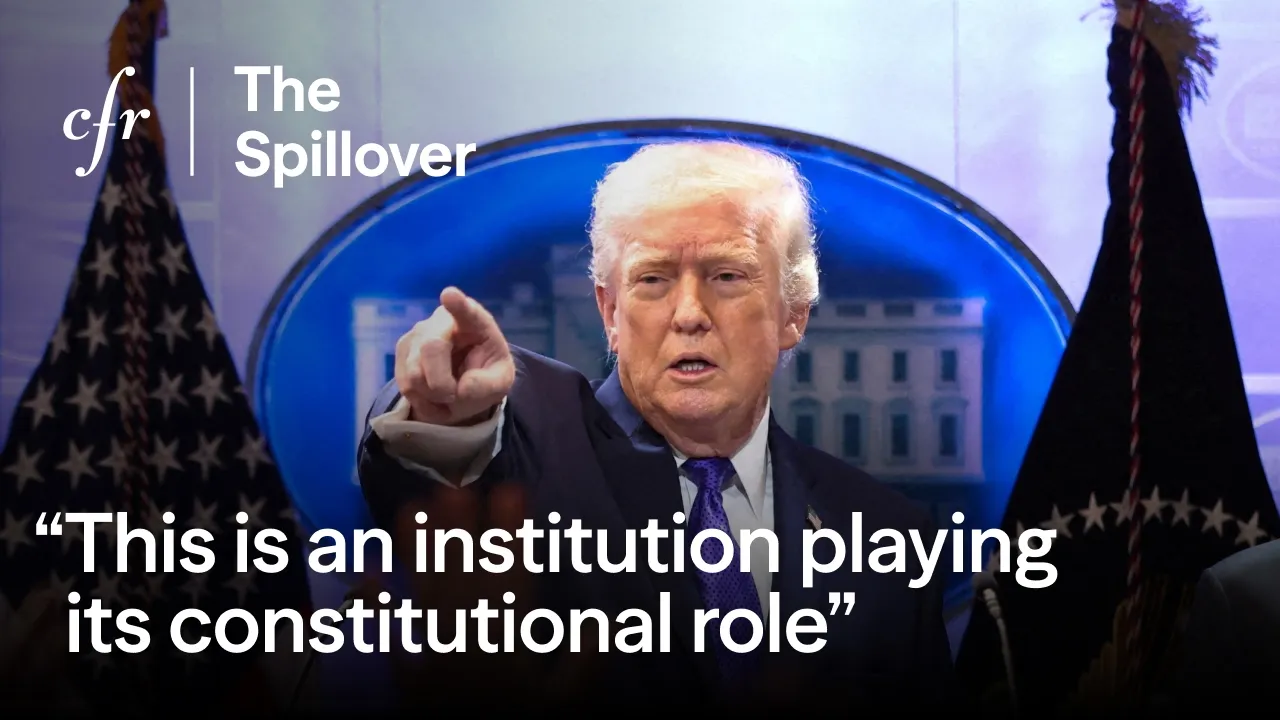
Well, I have to say, leaving just the substance aside, the fact that the Supreme Court by a six-three majority took an action to provide meaningful review of an administrative action, again, gives me hope and faith in the checks and balances that are in our system. That a lot of people have been raising questions about whether our institutions are broken. And I think, whether you like the outcome or not, this is an example of an institution playing its constitutional role and taking action that is very much appropriate in that context. And that gives me hope for the future.
PATTERSON:
Yeah, I agree with that completely. Well, listen, Mike, thank you so much-
FROMAN:
Thanks for having me.
PATTERSON:
… for joining The Spillover for our special edition today. And next week Sebastian’s going to be back and I’m going to be out in California. And we’re going to do a deep dive on artificial intelligence. So one day trade with Canada, the next day chips with Taiwan. Why not?
FROMAN:
Why not?
PATTERSON:
Listen, thanks so much for everything. Thanks, Mike.
FROMAN:
Thank you.
The Hook: The U.S. Supreme Court ruled that President Trump’s use of IEEPA to impose widespread tariffs was illegal. The decision comes as new data shows manufacturing job losses during Trump’s first year back in office.
The Spillovers: Tariffs aren’t going away entirely. The White House moved immediately to use Section 122, with Sections 301 and 232 likely to follow. Though the market reaction was muted, the administration’s moves could mean continued uncertainty for businesses, unresolved questions around tariff refunds, and hesitation in investment, hiring, and supply chains, even as manufacturing jobs and the overall trade deficit remain under pressure.
The Spillover is a production of the Council on Foreign Relations. The opinions expressed on the show are solely those of the hosts and guests, not of the Council, which takes no institutional positions on matters of policy.
Producer
- Producer, Podcasts
Supervising Producer
- Director, Podcasting
Supervising Producer
- Director of Video
Audio Producer
- Audio Producer & Sound Designer
More Episodes
 35:24Podcast
 48:01Podcast
 47:25Podcast
 50:17Podcast
 47:25Podcast
 52:31Podcast