Rahm Emanuel Talks Israel, Midterm Elections, and the Democratic Party
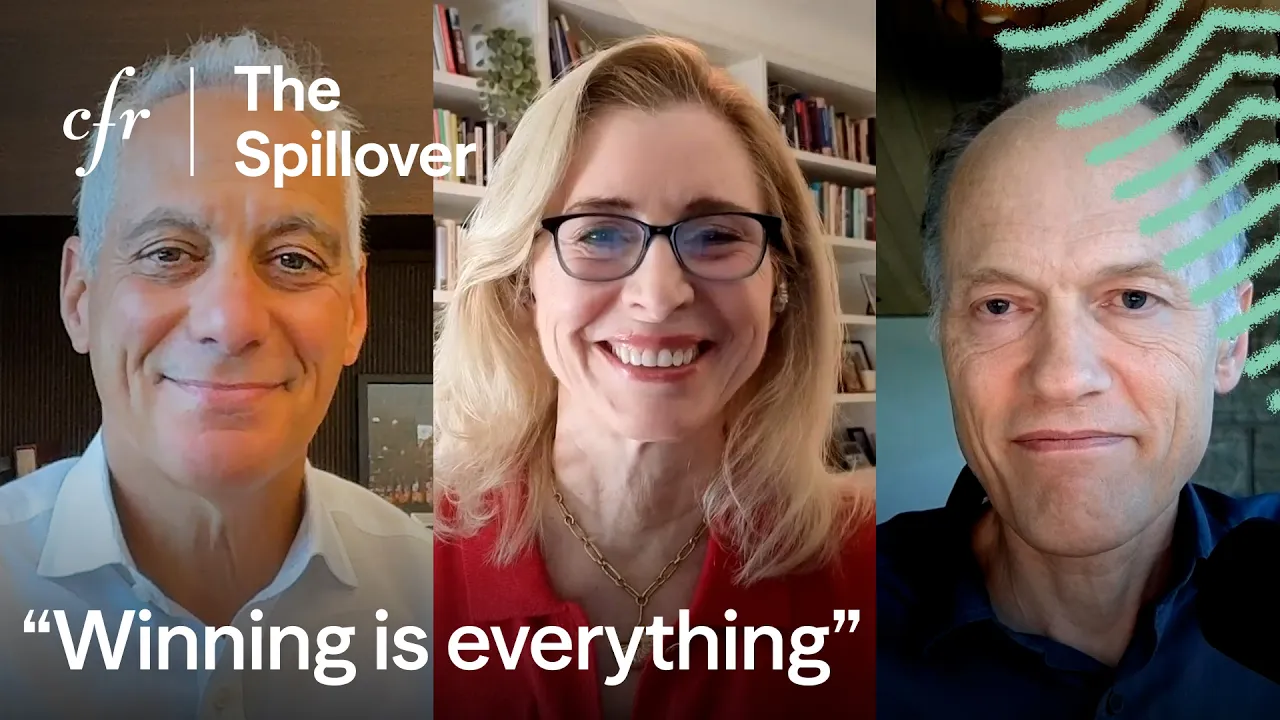
Rebecca Patterson and Sebastian Mallaby are joined by Rahm Emanuel, who served as President Bill Clinton’s political strategist, President Barack Obama’s first White House chief of staff, and President Joe Biden’s U.S. ambassador to Japan. The trio discuss Emanuel’s recent speech in Israel, the state of the U.S. Democratic Party, and the outlook for the upcoming midterm elections.

Published
Hosts
 Rebecca PattersonCFR ExpertSenior Fellow
 Sebastian MallabyCFR ExpertPaul A. Volcker Senior Fellow for International Economics
Guest
- Rahm EmanuelFormer U.S. Ambassador to Japan (2022–2025), Former Mayor of Chicago (2011–2019), Former White House Chief of Staff (2009–2010)
[Video: https://youtu.be/OkGotA4cf-I]
Transcript
This transcript was generated using AI and may contain errors.
MALLABY:
For decades, Rahm Emanuel was known by the singular title, the Enforcer. As Bill Clinton’s political strategist and Barack Obama’s first White House chief of staff, he was the ultimate centrist insider, a man who weaponized pragmatic, middle-of-the-road politics to lock down Democratic majorities.
PATTERSON:
But as the party looks towards this November’s midterms and the 2028 presidential cycle, the man who frequently says how much he likes to win is getting loud. And getting a policy conversation going to try to steer a Democratic party that is deeply, deeply divided. So, can a blunt-talking centrist rewrite the playbook on economics and global security so his party can win back the American middle?
Or will the fractures inside his own party pull him under before the 2028 primaries can begin?
MALLABY:
Right at the top of our conversation, we’re going to ask Rahm for his views on the upcoming midterm elections this year, including the question of whether fair midterm elections can even take place.
PATTERSON:
I’m Rebecca Patterson.
MALLABY:
And I’m Sebastian Mallaby.
PATTERSON:
Welcome to The Spillover. Ambassador Rahm Emanuel, welcome.
EMANUEL:
Thank you.
PATTERSON:
You are one of the Democratic Party’s most experienced leaders, and we are so excited and grateful to have you on The Spillover today. You’ve been White House chief of staff, ambassador of Japan, mayor of Chicago, and through all of that, you have been known as a smart political strategist. And that is a genuine compliment.
It’s not a jumbo shrimp kind of comment. And so, I want to get in right away to what the biggest political worry is, where I sit in New York City. I had a lunch with a bunch of investors today, and we were talking about what keeps us up at night.
And the thing that we think is underappreciated and needs more focus is the risk that the midterm elections in November are going to be contested. And as you know, there is some evidence out there that makes it a legitimate worry. And not talking about the conspiracy theories, I mean, we’ve got the additional FBI agents going into Georgia to comb through boxes of election materials.
We have the question around the Virginia ballot initiative on redistricting that President Trump, on Truth Social, has talked about as a crooked victory. You know, you’ve got Georgia and Virginia coming on top of an executive order and a raft of suits from the Department of Justice that seek to influence the conduct of elections, which is normally a state issue, as you know. So, you know, I think about this and the fact that with Bush Gore in 2000, you know, it went to the Supreme Court.
The Supreme Court made a decision and it was broadly respected and we moved on. But today, if something went to the Supreme Court, given the opinion polls towards the court, I’m not sure how respected it would be. So I’d love to kick off just by asking you, is this something that keeps you up at night, especially if we have some close races?
EMANUEL:
You know what, we all need to be a little paranoid, right? Paranoid people have enemies, too. So look, let’s start backwards a little, I mean, lay the field out.
There are three buckets to evaluate the election by. One is the House, one is the U.S. House, one is the U.S. Senate. Third bucket that never gets discussed, that I think is a very important bucket, is the state legislatures, the constitutional officers, the commissioners, the mayors, et cetera.
Democrats in this third bucket, which is what I call where your farm team gets built, we’re gonna have massive wins. I am sitting here today, there could be some different information that comes over July, August, September, but pretty confident about the House, based on the fact that when one party controls both sides of Pennsylvania Avenue, there’s a law of physics that kicked in. 94, 06, 2010, 2018, these law of physics kicked in.
Massive turnout by the voters out of power. We’re seeing that in every election since 2024, November. Independents break two to one for the party out of power.
We’re seeing that phenomenon play out. And a low turnout among party voters that are incumbent, seeing that. Democrats right now are 12 for 12 on their statewide elections, haven’t lost one.
We have flipped 26 out of 26 states’ House or state Senate seats, and Republicans are zero for 26. So that law of physics is there. Where your paranoia has legitimacy on the House side.
The Senate, it’s hard to have a discussion with Maine and Michigan upside down right now. And I’m being gentle using the word upside down, that’s a whole nother subject. I don’t know what the number is.
There’s a benchmark number. I kind of break it, if Democrats win nine seats or less. This is a hypothetical, I want to be very clear.
Not 12. If you look at every congressional cycle, there’s always two or three seats, usually three or four, that are in the 200, 300 vote separation. Some states, not every state has it.
If it’s less than 1%, it’s mandatory recount. Not every state has that. You and I do not know sitting here, nobody knows.
Where in the country those three or four seats are, that are just a few hundred votes apart. Is the Secretary of State a Democrat or Republican? There is an automatic recount.
And if it’s nine or less, I think when you look at how the Speaker of the House handled the Arizona election and not seating the member for months after her victory. And the Constitution, and I’m worried about Democrats because they’re gonna think like lawyers, the worst people when it comes to politics. The Constitution’s very clear that the Speaker controls the House and organizes the House.
And you don’t call the House back in with the new members because you’re saying these four seats, these three seats aren’t decided and we’re not gonna do that tonight. January 6th will not be on the steps of the Capitol, it will be inside the Capitol. Now, do I think that will happen?
I don’t, but given what the Speaker has done on the Arizona seat and how the President has acted both going back to 2020, redistricting, FBI and the list that you went through, you couldn’t say impossible. You just can’t. And so therefore, now, I’m usually one of about, you deal with what you can control, not what you can’t control today.
Everything Hakeem Jeffries and his team is doing is focused on making sure they win as many seats as you can. Let me break one other thing, the one other rule about midterms. When you think it’s bad, it’s worse, and when you think it’s good, it’s better.
I look at the phenomenon today, everybody’s saying, oh, and I’m with conventional wisdom, which is Democrats are gonna win the House. I happen to think if you’re thinking like that, it’s gonna be a better performance than what you think. Now remember, the Democrats, like, I don’t remember the exact number we started in 2006 when I did this to win the House after 14 years in the desert.
But the floor, I mean, Hakeem and the Democrats in the House are at 215, you gotta get to 218. So while there’s not a lot of real estate, the real estate you gotta cover is not a lot either. But you wanna get it to a place that the thing that you’re worried about can’t be played out, and the Democrats cannot focus on the law or the court.
They have to focus on the court of public opinion, because your first analogy, going to the Supreme Court, that is the last place I would wanna go, with this court. Every decision that the Roberts and Rehnquist courts made around politics, money, power, has been a disaster for democracy. And I’m not one for running on democracy.
There is nothing they have decided that does not focus on concentrating power. When you decide a corporation’s an individual, you’re about power. When you’ve decided that money can speak louder than a voter, you’re about power.
And so I would not wanna go to the Supreme Court, because if you look at the Constitution, and I am not a lawyer, it is quite clear the power of the speaker. So that’s not where you go.
MALLABY:
So in other words, the way to counteract this worry is if the Democrats win big enough, this fall, then- It’s a fait accompli. It’s, yeah, right, it doesn’t matter anymore.
EMANUEL:
Look, I know this is gonna come, but I’m gonna give you a little Chicago wisdom. Nothing like winning, okay, it’s that simple.
MALLABY:
I know that- Can I ask a follow-up on this?
EMANUEL:
I don’t think I’m gonna get to Harvard or the Kennedy School, and I don’t really wanna go, but winning is everything, okay?
MALLABY:
I heard that University of Chicago wasn’t that bad either, but anyway- Yeah, yeah, it better not be, my daughter’s going there. Well, what are you watching in the midterms that’s gonna be relevant to how people like you think about the 2028 contest? I mean, is there a couple of things, a couple of lessons, things going one way or the other?
EMANUEL:
Well, so if you’re asking me how do I project into 2028, look, in 2016 and 2020 and 2024, one phenomenon is consistent. Seven states, 500,000 voters spread across those seven states have decided who’s president. You have to assume based on that precedent, not just a one-off in 2024, not just a one-off in 2020, but three of the elections for president.
Now, Donald Trump has been on the ballot all three, so that may be slightly a spitball, but they’re all decided by Wisconsin, Michigan, Pennsylvania, North Carolina, Georgia, Arizona, and Nevada. That’s it. Depending on who they nominate, who we nominate, could another couple of states be in play?
Could be, but that will be it. So if I work with that assumption, now let’s back up. You have Ossoff in Georgia, Senate race, Cooper, North Carolina, Senate race, Arizona, governor running for re-election, a contested gubernatorial race in Nevada.
We don’t know the primary yet in Wisconsin, but you have a governor’s race in Wisconsin, Michigan, and Pennsylvania. And then what happens at the legislative level across those states, meaning in the top three of the industrial blue wall, and remember, and this also tells you something not going forward into 2032, it used to be just when those top three, it was game. Now you’ve added Georgia, North Carolina, Nevada, and Arizona.
By 2032, it’s gonna be 10 states, and Democrats gotta get focused here. We are, our ability in these states is getting narrower while there are more states because they’re not welcoming. Two, what did we do in the state house?
What did we do with the constitutional officer? Take the top three industrials. I mean, Governor Shapiro’s gonna win re-election unless some lightning strikes I don’t know about.
But what happens in the Michigan governor’s race, the Wisconsin governor’s race, the attorney general race, the secretary of state race? Does the house flip or not? Do we win the governor’s race but lose flipping the house?
That’s where I’m gonna be looking around. And then what are the trends like that? Did we pick up?
Now, if you stood back and didn’t look at 2026, I would say usually if you’re standing back and you’re up on the 10,000 feet and you’re looking in, Democrats do X in urban areas, Republicans do Y in rural areas, and then we fight it out in the suburbs. Now, by one example, in Wisconsin, we would have won the Senate race if Milwaukee had turned out like the rest of the state. Same percentage, from a percentage turnout.
Milwaukee dropped. That is also true in Detroit. That’s also true in Pittsburgh.
Urban areas have been dropping in performance. So I’ll be, you know, I’m a nerd. I got a degenerative gene and interest, but I’ll be looking at all that data and then projecting forward.
Some people, then you back out and then you look at themes, you look at the type of candidates, you look at other things, but those are the things that you look at and you kind of dissect it. And there’ll be, and ready, breaking news, there’ll be mixed messages. And if you wanna believe X, you’re gonna look at only things that support X.
If you wanna believe Y, you’re gonna only look at things that are Y.
PATTERSON:
Our algorithms will tell us what we wanna focus on the day after.
EMANUEL:
No, I mean, look, you know, well, I don’t wanna get into a tangent because I’ll start ripping somebody’s head off.
PATTERSON:
All right, don’t get into a tangent. We’ll stay focused.
MALLABY:
Yeah, mind you ripping people’s heads off there, just for the record.
EMANUEL:
Well, I will get into that when we get there, but so I’m biting my tongue until we get there and then I can let it rip.
PATTERSON:
Oh, no, no, no, you can rip all you want. And we’re all happy nerds together. So this is good.
You’re in good company. I wanna get to some of your kitchen table issues later because they’re something I do a lot of research on and I think a lot of us care about a lot. But first I wanna hit on foreign policy because, well, come on, Rahm, you just gave a very high profile, provocative address at Tel Aviv University.
And I mean, effectively you abandoned the standard US posture on Israel. You called Netanyahu a pariah. You essentially declared the truth.
Okay, okay, correct me, please.
EMANUEL:
I didn’t say Netanyahu was a pariah. I said he is making Israel a pariah.
PATTERSON:
Very big difference. Fair, fair, fair.
EMANUEL:
Very big difference.
PATTERSON:
No, thank you for correcting me.
EMANUEL:
Okay, number two, look, I worked in the Obama White House as chief of staff. I confronted in 2009, 18 years before all these Johnny come latelies, I told the prime minister to his face, if what you’re doing at the West Bank, which I think was a mistake, you’re gonna lead to the isolation of Israel and perpetual conflict. If there was a prediction Rahm Emanuel wanted to be wrong on, that was it.
I didn’t do what other people did is, you know, lip sync what they were saying for 18 years. I didn’t need a war. I said it, and I didn’t say it behind the prime minister’s back.
I said it to his face, which is why publicly in 09, he attacked me as a self-loathing Jew. A. B, I was also in the room, encouraging the president, which he did, to fund the Iron Dome.
I don’t think opposing settlements and funding the Iron Dome are in conflict. I actually think they’re complementary. One is about the physical security.
The other one is also about the political and diplomatic security of Israel. And I happen to believe, you know, a lot of people in what I think America, Democrat, Republican administrations, Congresses, et cetera, have made a mistake is that there should be no daylight between Israel and the United States. That has engendered A, the worst, as I said in the speech, the worst habits in Israel.
And B, it is actually, there are differences between America’s interests and Israel’s interests in a lot of places. And the third, I come at this, we have fought two wars as a country in that region in 20 years. We have lost 50,000 Americans, either dead or wounded.
The future of our country, our kids, a trillion plus, close to $2 trillion. We have interests. And I think, and I’m, look, when I was ambassador to Japan, China couldn’t be happier than when I left because I said it directly to China and they attacked me multiple times from the podium.
I didn’t say it behind the Prime Minister’s back. I didn’t need to warn Gaza to know there was gonna be a problem. I said it to his face and I said it in conflict.
I don’t think what I said about housing the West Bank and funding Iron Dome are in conflict. They’re actually complementary policies about the security of an important ally. Lastly, before you ask the question, look, NATO and countries have a plus 57% support in the United States, public.
Forget just Democrat, they just do. And Democrats, Republicans in the House and Senate reflect that 57%. I came from Japan, a lot of reasons, including soft power like baseball.
Japan’s in the 80s in America. And they’re our long pole in the Indo-Pacific. In the Middle East, our number one ally is Israel and they’re 32% support.
And among kids 30 or younger, they’re 21. That is an unsustainable place. You’ve lost Europe economically.
You lost your political patron at the United States politically. That is not a sustainable place for an ally. And we have to change it.
And doing more of the same and hoping for a change is ridiculous. And nothing I said, and I marked this, now I’m doing my therapy part, okay? Nothing I said in that speech in the analysis of the criticism has not been said by senior members of Israel’s defense forces and security.
100 generals on June 16th and Shin Bet leaders, generals in Shin Bet wrote an open letter that what’s going on in the West Bank, they called, I never said this, they called it Jewish terrorism, that it was destroying Israel’s security. I announced no more U.S. taxpayer support for buying U.S. weapons for Israel. Michael Oren, the Israeli ambassador in 2021, announced that policy.
The prime minister’s now for that policy. Now, I also said Israel would keep its qualitative edge. What does other people know that are critical of it that neither 100 Israeli generals and Shin Bet leaders, the former ambassador for the state of Israel, what do you know that they don’t know?
Now, I said it in the way Emanuel says it with certain flair and direction, but I want it to be honest and forthright and that’s what you do with friends. You’re honest about this is not sustainable.
MALLABY:
I think we get that the traditional policy was not sustainable, that you were early on it, that a lot of what you’re saying is echoed by people within Israel. But I got a question about the domestic politics in the U.S. because it seems to me that on the one hand, within the Democratic Party, you’ve got the younger voters, the progressives who want to basically total divestment from Israel. They’re really hard over on that.
On the other side, you’ve got people who want complete support of Israel, including whatever government happens to be there with almost no criticism allowed. And so I’m just wondering how you thread that needle, how you’ve waded into this really difficult subject. And the goal presumably is to forge a coalition within the Democratic Party that allows you to unite the party again.
And I’m not sure the party’s ready to be united.
EMANUEL:
Well, we’ll have a debate. I grew up in a Jewish home. We’ll have a debate.
And food will go flying everywhere at a meal, who cares? Okay, I mean, if you want that, I’m not so sure there was actually the unity you’re talking about before, but let me say one thing. One is, and I couldn’t be clearer in the speech, I am not for the river for the sea.
That is the destruction of the Jewish people and the Jewish homeland in a democratic society. I’m not for that. Nothing I said and nothing I’ve done in my entire life is about that.
Now, I happen to outline a position, which if you look at Hakeem Jeffries’ statement today that you and I are talking, where they’re dealing with the amendment on the funding, he basically echoed what I said. I actually believe, and given Brad Schneider, the head of the New Democrats, which is the largest caucus inside the Democratic Caucus, who supported what I said, I actually believe what I’d done is stake out a position that hadn’t ever yet been articulated between what I call the greater Israel policy or the river to the sea anti-Israel policy. One blindly leads it into a wall, which is where the prime minister led Israel.
And the other one doesn’t believe there will ever be a state. I’m not for that. But I’m definitely not for keeping the status quo.
Forget just the political support. I think it’s a strategic mistake, as does the 100 Israeli generals who said this was a mistake, what you’re doing on the West Bank. You have a government complicit in burning Palestinian farmland, pushing Palestinians out of their home.
You have not, they’re not like, oh, who knew it was happening? Or who knew gambling was happening here in Casablanca? They’re actually perpetuating it.
And the 100 Israeli generals and Shin Bet members wrote an open letter and said, this is a disaster for Israel. The head of Israel’s military on the West Bank said, this is a disaster. I didn’t say anything.
They called it Jewish terrorism. I didn’t even use that term.
MALLABY:
I look like- By the way, that’s a lot of generals for Israel. It’s a small country, a hundred seems quite a lot.
EMANUEL:
Do you want me to give you a clause? Well, let me say it. Jewish terrorism in Judea and Samaria, a strategic security threat, right here.
PATTERSON:
We’ll put it in our show notes for everyone to read.
EMANUEL:
Okay, but no, it’s number two. So they called it Jewish terrorism. I did not.
I said, you have a government that’s complicit and complacent with burning farmland, kicking Palestinians out, bringing violence to people. And you have a government official who’s head of the Israeli police, who’s facilitating this and not policing it. That is unacceptable to Israel’s security, which is what the general said, and it’s 100% unacceptable for a country when they can least afford their international isolation to double down on that isolation.
Nothing I said is not for Israel’s interest or for America’s interest. It wasn’t just to get them it so I could feel good at the end of the day. It was because I thought it was detrimental to their security.
Now, and look, I look at this and I look at the policy, I didn’t just criticize, and I didn’t just say dealing with the funding on weapons. I laid out a specific plan on economics and politics that integrates Israel back in, both diplomatically and economically, where it’s not a pariah, but it actually stands as a part of the Middle East rather than standing apart from the Middle East. Now, the one thing I know, unlike and I have no disrespect to both of you, I practice politics.
Jim Baker’s book, The Politics of Diplomacy. I know everybody wants to think that foreign policy is a bunch of people, a gray flannel suit, double-breasted with a pipe in a library with smoke around somebody’s head thinking big thoughts for their long memo. I don’t write long memos, but I do politics.
Now, the two-state has no politics. It’s over. The Arab League offered a 21-state Arab League recognition of Israel if they come to a security and sovereignty between them and the Palestinians.
The politics of 21 countries, which is Israel’s desire, one of the reasons for the start of October 7th was because Hamas was worried that Saudi Arabia was getting close to a deal, basically their own kind of version of the Abraham Accords with Israel. Now, I say to them, okay, we’re gonna deal with your desire, that is to the Arab League, for stability so you can grow economically, Israel’s desire for security, Palestinian desire for sovereignty, and use that in a single push because stability, sovereignty, and security actually work together if organized with American political capital. Now, the push or the leader for the Arab League’s offer in 2013 was Saudi Arabia.
They will not go back to the table right now and negotiate with Israel. So we’ll take Saudi Arabia up on the Arab League offer. Game on.
Your price, you don’t get to sit and offer something and sit on the sidelines. You gotta break a sweat. You gotta get here.
The lesson from Oslo is the Arab League, rather than helping, was basically a bystander with some popcorn and Coke and watch the game play out. Not happening. You want stability so your economies can grow and can be part of the global economy?
You want tourism, you wanna be a financial center? You got some sweat equity, brother. No more lip service to the Palestinian street.
Uh-uh, not anymore. You can’t afford it.
MALLABY:
Sounds like you’re proving that it’s not just Donald Trump who can tell allies that they need to get in and share the burden.
EMANUEL:
But don’t ever insult me that way, like Donald Trump. Don’t ever do that again, because this will be the shortest interview you ever had. What I’m saying is, you offered this, I accept.
It’s your idea, not mine. I accept it. You want America’s leadership to follow you?
Great. Here’s the price for our following. You have to get in the arena, not stand outside it.
I think, second is, and the first 20% of the speech, you know, we have a rule in America, three strikes, you’re out. Palestinians, you got offered out at Oslo courts. You then turned around and were blown up buses on Dizengoff.
2000, at Camp David, you got offered 98% of what you wanted. You said no, and you did the second Intifada. 2007, you got offered basically the same 98%, Abbas said no, and you went back to terrorism and violence, killing civilians on the streets.
I’m sorry. I know you feel oppressed. You’re 0 for three.
You’re lucky I’m coming back, because usually you go back to the dugout on that sucker. So we’re ready to do that, but this time you can’t mess around, and if you don’t get everything you want, your response is terrorism. Not happening.
And to everybody, and I said this at the speech, on October 7th, 1200 people were killed, raped, sexually abused, men and women, children were killed in front of their parents, parents were raped in front of their children, and to everybody who celebrated that on October 8th, you are morally bankrupt. You have no right, no standing. Now, I’m ready to roll up my sleeves.
We’re gonna take up the Arab League. Israel busts out of their isolation. You work towards peace.
That was one example, and then the economic IMEC, but I also offered, here, Syria, in the north, Galilee, you got a head of state that’s not Assad, called Iran your common enemy, said he wants to have a security agreement. You cut off weapons from Iran going to Hezbollah. Use my calling card.
Call him. You can use my AT&T calling card. You don’t have to pay for it.
I’ll pay for it. And he wants to be, there was an article I just read before we got on. There’s a discussion of an Iraqi oil pipeline going to the port in Syria.
He’s desperate to be part of the world economy. That means, if you were to work a security agreement that he offered to do, you’d have Syria secure, Jordan secure, Egypt South secure. Everybody that have conducted war in 67 would be either peace or security agreement, but the prime minister, every which way, has allowed the diplomatic, economic, and the cultural attraction of Israel, those three pieces of your security toolbox, to atrophy to the detriment of the state of Israel’s security.
PATTERSON:
I agree with you completely on how critical it is, not just for Israel and Gaza, but for the entire region. And listening to you, a lot of it, most of it, all of it sounds incredibly reasonable and pragmatic. I worry though, when you pull it back to politics, and you said earlier, I’m a politician, I’ve practiced politics.
Is there any risk that putting a folk, well, there’s always risk. Life is risk, I know that, I know that. But Bob Rubin taught me that.
So- Yes, there’s risk. But you’ve criticized the party for getting too focused on cultural issues that didn’t have enough appeal. Is there a risk that this is one of those, that right now, the American people don’t give a crud about foreign issues? They care about affording healthcare in school for their kids, et cetera. Are you worried that this could be almost a little bit of a trap for the party if they spend too much time on it?
Not saying it’s not important, it clearly is. But from a political point of view, is this the right focal point?
EMANUEL:
Well, first of all, look, the one thing I know, Rebecca, having spent eight years of my life in the Oval Office, a president has to be conversant with the classrooms of America, the boardrooms of America, the break rooms of America, the family room, the situation room. The problem for America is one party’s stuck in the bathroom, the other party’s stuck in the bedroom. That has nothing to do with it.
Now look, do I wanna focus on it? It comes with the job. As I told you, we fought two wars already in this region.
Do I happen to think my first real kind of foray of thinking about running for the big job? I went to Mississippi to highlight their reading successes, going from 49th to 9th. I spent my entire tenure as mayor working on education, moving our graduation rates from 56 to 84%, where Stanford called Chicago Public Schools the single best in America’s top 100.
That is my focus. I went up to New Hampshire to outline how to make college education affordable. The foreign policy comes with the job.
Being in the situation room is not new to me. It may be new to others, it ain’t new to me. Now do I think it’s everything?
No, but you gotta be conversant. You gotta also be conversant on how to have a growth strategy for the economy that’s not built on the corruption of the White House. You gotta have a growth strategy that doesn’t just mean we tax people without an idea how to create jobs and how to create jobs that give people a middle class life.
How to make sure that healthcare costs are not so out of control that every doctor and every nurse spends 50% of their time arguing with an insurance company that only knows one word in the English language, which is no. Or people who thought they were saving for their retirement but take money out of their 401k every month to make the paycheck work. So to me, that’s the core of it.
Laid it out. People wanna have a debate about it, great, but I will tell you this, the one difference between you two and me, when I went in New Hampshire and I did a bike trip from Portsmouth to Hanover, I did backyards, living rooms, barn, I did about seven meet and greets type of things with 700 people. Now, main issues with healthcare, home ownership, classrooms, middle class life, kind of families feeling under pressure that their kids aren’t gonna be better than they were.
But everywhere I went, in one of those forums, somebody asked about Israel. Somebody asked about the Middle East. Do I think it’s front and center?
No. Do I think you can ignore it? If I decide to do this, I’m not gonna ignore it.
Look, if you’re running for a Democratic nomination, Mississippi ain’t on your first on your list of visits, okay? If you’re running for the Democratic nomination, you wouldn’t do what I have done schedule-wise. You don’t go to Israel.
But I believe in telling people not what they wanna hear, but what they need to know. We are gonna have the first election that’s about the future, not about trying to restore a past that ain’t coming back. So I’m gonna tell you, and if you don’t like it, I get to go fly fishing, okay?
But I’m not gonna do this race and this point in my life, just telling people, Brahmanites, about what they would like to hear. We are at a crossroads as a country. My kids are gonna be okay.
They grew up in a loving home with a good education, great values. That’s just not true for everybody. The deck is stacked against them.
And if we don’t start doing certain things that I think are important for the future, then that future is exactly what people fear. It’s gonna be worse off. And I’m not ready to let that happen just on its own.
MALLABY:
Yeah, so since we’re talking about the nomination, the big job, I just wanna get something on the table and then we can move on. It’s the question that I hear people asking about you or the thing they say when you make the news yet again with one of your intervention statements.
EMANUEL:
Where’s this going, Sebastian?
MALLABY:
You’re probably gonna jump at this one. But anyway, the question is, can a Jewish candidate win the nomination for the Democratic Party? So let me just tell you this.
EMANUEL:
First, I think yes. And my faith is not your problem. The fact that the American people lost faith in America, that’s our problem.
That’s what we should be working on. Now, if my faith is your problem, don’t vote for me. My faith is what guided me to give 10 million kids healthcare.
My faith is what guided me to make sure that we had universal kindergarten, universal pre-K for every child in the city of Chicago, and that community college was the first city to offer it free, because I had some moral principles and the ethics that I raised with. So I do believe that. Now, the other thing is I got six elections to prove it.
You don’t know Chicago politics. It’s pretty ethnic tight. When I ran for Congress, the congressional seat I ran in, was known as the Polish seat.
Dan Rostenkowski, Roman Pucinski, Frank Annunzio, Rod Blagojevich, Mike Flanagan. I ran against a Polish woman, and it was some ugly things were said about my faith. I got over 50% of the vote in a five-way race.
Rahm is Rahm Emanuel, there was no hiding it. Two years later, when I become run for mayor, ugly things were done. Five-person race took 56% of the vote.
When I was ambassador to Japan, somebody on our fence sprayed some really ugly Nazi insignia. Next day, some neighbor cleaned it up. I’ve seen the worst, and I’ve seen the very best.
I’ve seen people, I don’t hide who I am, I don’t hide the faith, it’s not, I can’t do it, nor would I ever do it, it’s not worth it. I have all the confidence the American people will see me for my character, and will see that, in fact, my faith is important to me. It is a moral north star for me.
And, more importantly, I will challenge people to work on the fact that we have a generation of Americans who have lost faith in themselves and America, and that’s what we have to work on. But if my faith is your problem, you should go find somebody else, because your vote’s not that important to me. Got it.
And, Sebastian, you need some good friends.
PATTERSON:
He’s got lots of good friends.
MALLABY:
I got plenty of friends. I think they’re raising a question which is a political question, not a personal faith question.
EMANUEL:
Don’t you think, though, you know what I always find interesting? So let’s, that’s not the first time in, okay? I find it fascinating.
We can say this is a less-than-hospitable environment to Jews across America, forget the party. But for the first time, for sure there will be, and we’ve never had this in either party, you’re gonna have probably three Jews, more than you’ve ever had in a period of time in which people thought it’s less-than-hospitable. Sometimes not everything is just 100% one way.
It’s fascinating from a political, cultural standpoint.
MALLABY:
Do you think that the answer that Josh Shapiro or J.B. Pritzker would give is the same as the one you just gave?
EMANUEL:
I don’t know. That’s for them. We’ve all operate at different levels.
They gotta figure out what they’re comfortable saying, but I know what I’m, I really do believe that somebody’s talked about national service. I’ve laid out a plan for it. My faith is not your issue.
Let me back, Sebastian, in 2015, my second inaugural, so 11 years ago, I dedicated the entire speech to the unseen men and unheard men of Chicago. This is way before boys and men and the whole focus, but I had been around the city, and if you do go around, I had seen, we had a generation of young men that had internalized a self-loathing and a sense and a look in their eyes. I would never accept my own son.
I would never, I would never have accepted my two daughters. And I dedicated the whole speech to them, the men, laid out what we should be doing on mentoring, et cetera, and we built the largest mentoring program in the country, Becoming a Man program, that inspired President Obama’s My Brother’s Keeper. And I really do fundamentally believe one of the things that’s ailing America is the fact that people have lost faith in themselves, their future, and that this country has broke faith with them.
And if I was to run, the job of a president would, and I just came from Teddy Roosevelt’s library where I helped open it, is to restore that faith in themselves and restore that faith that while you may not be succeeding today, America hasn’t given up on you. And that to me, that spiritual kind of disconnect, that spiritual alienation is a chord that I would want to work on.
PATTERSON:
So I think you’re extraordinary, and I think that’s fair to say, communication skills would go a long way towards helping sentiment. I think about policies becoming reality, and you know this better than I do, you’ve lived it. When we talk about education, a lot of it’s state and local.
Federal can do some stuff, but they can’t do everything. Ditto with housing. And then with healthcare, it’s a Gordian knot.
I don’t even, I don’t know where you start, to be very honest with you. And I’ve spent time on all of these things, and I spend most of my free time running a nonprofit that focuses on financial literacy for students. So we’re aligned.
But then I think, how do you get it passed in a Congress that’s so polarized? And then if it’s a state issue, how do you coerce, encourage the states? And then finally, Rahm, how do you pay for any of this, right?
We have, I am a little surprised, and frankly, a tiny bit disappointed. I haven’t found a single speech of yours when I go into the AI ecosystem that mentions deficits, or debt, or unsustainable trajectory, and I worry you’re hiding from it a little.
EMANUEL:
Well, Ms. Vanguard, don’t worry so much then, okay?
PATTERSON:
Oh, I always worry, right?
EMANUEL:
You have a fiscal deficit.
PATTERSON:
Pay to be paranoid.
EMANUEL:
Well, you have a fiscal deficit. You ain’t gonna solve it with 50% of your kids not able to read a grade level.
PATTERSON:
100%, agreed.
EMANUEL:
So I’m gonna start with that deficit, okay? I don’t consider that a deficit to ignore, and I talk about it incessantly. So you and I are in two different deficit priorities.
Second is you aren’t wrong about state and local on education. Having been the person that negotiated President Obama’s race to the top, I actually think it incentivizes dollars. One of the big challenges of state and local is they don’t have money.
Property taxes aren’t keeping up with cost. Property tax revenue. No governor or mayor wants to be in a position turning down $300 million.
They’ll get killed politically. There’s a certain things, if I broke it down, elementary level, get back to the fundamentals. High school, fundamental change, difference.
We’re gonna say for these dollars, if you do these policy things, we’ll give you X on the race to the top. If you don’t, not a problem. Louisiana will get 50% of your money.
And no governor will sustain the politics of turning away X. Not a chance. There are things on phonics for reading that is key, which is what Mississippi, Louisiana, Alabama, and Tennessee have all done and shown all of them are taking the weather off the ball.
Also true about math. On high school, I happen to think what we did in Chicago to lay this out very specifically, you get a B average, we made community college free. We set a goal, 50% of our kids would graduate with college credit in high school.
We achieved it. I would make it 100% here for the United States. Community colleges have to align with high schools doing dual credit, dual enrollment, et cetera.
It actually keeps high school kids engaged in education. Third, which was most important, and I’d make this a national model as part of the race to the top money, pot of money you get. We’re the only school system where to get your high school diploma, you had to produce a letter of acceptance from either a college or community college or branch of the armed forces or vocational school.
Otherwise, no, you didn’t get it. 98% compliance in the city of Chicago with an 84% poverty rate. Everybody, we got a 67% college and community college attendance.
So those are the changes and you incentivize the right piece or you lose the money. Number two, the mayor in Chicago runs the second largest community college system in the country. We redeveloped our community college system.
Malcolm X was all healthcare. Olive Harvey, transportation, distribution, logistic. Richard J.
Daley was advanced manufacturing, blah, blah, blah, blah, blah, blah, and a board. I would take $8 billion that we were spending on detention centers that nobody wants and redirect it to the 1,200 community colleges and technical schools that everybody loves. That’s the backbone of your economy is that community college, not just the University of Illinois, but the Malcolm X Community College.
That’s where people work full-time and when they’re going a nurse to become a radiology nurse, that’s where they go. When they’re a paralegal and they wanna be the office manager, that community college is where they go. Modernize the community college system so everybody’s plussed up into a middle-class life and has the skills and capacities and then has not just two years, but 16-year credits, 16 weeks rather, where you can get your certificate so you can plus up on this or 32 weeks for that.
So you got a certificate type of program. To me, each of those allows the education system to better serve. If you look through American history, land-grant colleges, universal high school education, GI Bill, and space and technology, Apollo, Sputnik Challenge.
The one through line through every great period of American economic growth, the singular through line is educational gains, America makes. And if I run, everybody says to me, similar to the Jewish question, that’s the best of that. Well, people don’t care about education.
I do. When 50% of your kids can’t read and China’s three times our size, you think we can give up on 50% of this country? I don’t believe you can and I’m not gonna give up on those kids.
And we have examples all over this country. I’m gonna go soon in a couple of weeks from now to actually the last call before I go and do this other stuff. Louisiana is the only state in America right now that’s reading and math scores exceed pre-COVID period.
So I’m gonna go down there. What have they done that we can take to all 49 other states? That’s the model.
MALLABY:
So we’ve heard you out on the education deficit, the human deficit, and we get it. You make a powerful statement about that and your Chicago background gives you the right platform to be super authoritative on it. But you did duck the question.
You didn’t address Rebecca’s question about the budget deficit. And it is an issue. James Carville told us it’s an issue.
And I remember distinctly talking to members of the Clinton administration in the 1990s who told me the best way of uplifting Americans is to have a strong economy with growth. We delivered that in 1993 with a tax hike, which led to falling interest rates, economic growth, a budget surplus by the end of the 1990s. That was the vision for the Democratic Party and you were part of that Democratic Party.
Are you still believing the same thing or do you think we’ve moved on? We’re in a different time.
EMANUEL:
Well, yes, that’s the short headline, but let’s fill it out because it’s not just a headline or a comment. As somebody that actually brought a city’s budget under control and brought the healthcare costs under control of the city, which was the biggest factor, I actually believe, I don’t believe in just redistribution economics. I don’t think it has a growth strategy.
And I don’t believe in the corruption of crony capitalism. It distorts that. There are five components that I would focus on that would grow the economy, that help you deal actually with the fiscal deficit.
And that will, whether you want it or not, it will find you in the next six years. America cannot sustain this. First and foremost is education.
Second, doubling our R&D. I laid out a very specific plan, a 10% tax on all predictive markets and online sport gaming that goes into an innovation fund just for the National Institute of Health, National Science Foundation, and DARPA. Doesn’t replace the money, doubles it up so we don’t give away the future to China.
Third, I endorse the Dignity Act. 23 Republicans are on it, 23 Democrats. It finally resolves the immigration issue from being a nation of laws and a nation of immigrants, which is essential for our growth.
Fourth, I laid out a very specific plan, how to modernize and bring our energy and digital infrastructure to 21st century. Texas does show the way, and that was the whole column I wrote, whether Democrats want to hear it or not, what they’ve done on renewables, what they’ve done on battery, what they’ve done on distribution. They have a lower cost and their economy is booming.
And it’s a more predictable energy source. Fifth is a tax policy that goes away from what we have, which is a tax policy about preserving wealth into one that’s about creating wealth. And it’s going to have tax increases.
You’re not going to get the fiscal disc when you want without it. But the more important thing is changing the incentive clause of this tax code that is about preserving wealth. I saw a headline the other day, three weeks ago in the Wall Street Journal that nobody paid attention, I was shocked.
There’s a weekend retreat for nepo babies to help them figure out how to handle their inheritance. You’ve got a good education and a loving parents. Inheritance, that’s your inheritance.
And from a step up basis, and I’ll give you an example personally from us, Amy and I. Now that we’re empty nesters, we both like to fly fish. We built something for ourselves for the next chapter of our life in Montana.
I’m getting a mortgage deduction on a second home, on a vacation home, and you have young couples can’t start off like the family I met, young couple I met in New Hampshire. They can’t afford a home. He’s a plumber, she sells real estate.
I don’t deserve that. And I didn’t do that house for that. But throughout the tax code is a bunch of games and playing the corners that actually is about preserving wealth.
Well, you and I, we all three know people that actually with their equity, just borrow money against it, never pay any taxes on the debt, pass it on to another generation. They’re not being taxed. And I’m not just doing it for sport.
Because we got a fiscal problem. Now we got also a spending problem. And I’d put a cap overall on the top and no growth over five years while we get our revenue right.
And that would give, and that would be, wait a second before you said bingo. That would also give them, that would give the Federal Reserve the confidence to then finally deal with the interest rates. The trigger, if I may be, since I was a student of the 1993 or a participant, George Herbert Walker Bush doesn’t get credit for what he did in 1990.
That’s set up for what President Clinton did in 93, the fiscal discipline, and then prioritizing the right type of spending like on education. And then you had this thing on the internet happening. All Bush’s tax cut that cost him his job, Clinton’s tax, not tax cut, tax increase, Clinton’s fiscal discipline tax increase, and something else magical happening in the private sector called the internet economy.
And then opening up to the world, the US economy. That provided the leeway and the confidence for the Fed to act. That those four pieces created the, as I like to say to the left, which part of the peace and prosperity did you hate most in the 90s?
Because if you really hate Bill Clinton and his act, was it the 22 million jobs? Was it a shrinking wealth disparity between the rich and the poor for the first time in real terms? Was it the fact that America was a unipower?
Which part of peace and prosperity did you hate most? And I’ll deal with that. So I understand what has to be done, but the difference between all of us, and I know what you got to do is, but there’s a difference when you’re talking about plumbers and pipefitters and electricians building a new energy system, kids getting an education, innovation that cures cancer and it keeps America at the forefront of the life sciences cycle.
That actually rings a little more than, let me tell you how I can do root canal on the deficit.
PATTERSON:
I do think they’re all connected at the end of the day, right? That’s why they’re a growth strategy.
EMANUEL:
There’s a package.
PATTERSON:
If America succeeds at AI, it’s partly because we have enough plumbers and contractors and immigrants to do those jobs. And without a doubt, we have enough Americans who have read. So they develop critical thinking skills.
So they actually can put in good prompts to their model and see if the prompt output is garbage or not.
EMANUEL:
So let me just say this, wherever you turn, there’s a challenge in America right now, because we’ve been postponing dealing with the reckoning and it’s coming to a theater in their house.
PATTERSON:
Yeah, well, social security is gonna be the next president’s problem, most likely. That’s gonna be fun. Anyway, Sebastian, do you wanna touch on AI?
We haven’t touched enough on AI today.
MALLABY:
I guess if I had one question I could ask you about AI would be, where do you stand on data centers? Because that’s the big wedge issue in the Democratic Party right now, it seems to me. A good Democrat would want the growth in the data centers, but there are issues about the cost of electricity in the community and so forth.
EMANUEL:
I mean, I think without getting into, I wrote it out in the Wall Street Journal, what I would do on energy and modernizing the system. Look, on the data center, I just saw, as we’re talking today, New York says a moratorium. To me, I think you need a community bill of rights for a data center.
People that are in the area in the community that deal with a, and then it comes also with kind of a utilities or rate payers bill of rights. Because, and I laid out specifically in this proposal what I thought the big, the hyperscalers need to pay from both a rate payer subsidy, other types of things that they would do on training. Look, as a one example, I think I used, they’re spending $600 billion building out these data centers, maybe even more.
For somewhere between 40 to $50 billion investment in both the software and software technology, you can get 30% more efficiency out of our distribution system. That would be about $100 billion of saving. That goes right to the rate payer.
And it’s, let me say this, for the predictability for the hyperscalers, they would pay that 40 to 50 billion. It’s chump change for a $600 billion expense. They spend more money and lost time waiting for approval and then rejection.
So to me, those are examples of what I would do. It’s not just yes or no on moratorium. There has to be a change because you got rate payers paying for big users and they need to actually put their shoulder to the wheel to help solve this problem.
It’s in their interest.
MALLABY:
And- Yeah, I mean, maybe I phrased the question a bit loosely.
EMANUEL:
You would agree that it’s more complicated than a yes or no.
MALLABY:
Yeah, of course. But I mean, here’s the difficult dilemma, it seems to me. And you just said maybe the answer is, includes a community bill of rights.
Well, if we go back to the book, Abundance, published last year, which was sort of, in a way, a program for Democratic Party renewal. One of the points it makes, and you referenced Texas a moment ago yourself, is that if you want to build in Houston, there are almost no permitting restrictions. And so they build tons of new housing and they have a very low homeless rate as a result.
If you want to build in Democratic California, you’re stuck in kind of community reviews that go on for absolutely ever. You cannot build anything and then you have a very high homeless rate in San Francisco. So, yeah.
EMANUEL:
One thing is, no, as it related to this, I mean, I’m trying to avoid repeating my Wall Street Journal op-ed. I’m for a FERC 24-hour, 24-month shot clock. You have to approve, thumbs up or thumbs down.
You cannot leave all these new, we literally have doubling our energy production sitting in the queue waiting for approval. That’s just unacceptable if you’re going to have a modern economy. Now, one of the things we don’t look, Australia went hog wild, that’s an example, hog just went all out on solar.
They’re paying people today to use energy during the midday because they have so much power. China basically adopted Obama’s all the above. Only we decided to abandon a successful strategy that Australia and China and different models is using to go on a one-trick pony, and I’m for natural gas, but it’s only one.
So I’ve laid out, get ahead on geothermal. That’s a technology that we can dominate on and that’s a promising technology. Get ahead on the next generation battery.
Get ahead on SMR nuclear and standardize it so we can actually start producing it in real way with the six or seven companies. Every one of those would bring more types of diversity of energy on the system, get better efficiency out of the distribution system. The first down payment would be modernizing using better software.
You get 30% greater efficiency from existing system and get the regulatory process off its ass.
MALLABY:
That’s a good motto. I like the slogan.
EMANUEL:
Get it off its ass.
MALLABY:
We’ll buy you a very big billboard. It’ll be in a big intersection and you can put that slogan on it.
EMANUEL:
Let me just say this, as I’ve said before to all, if you’ve ever gone back to the Green New Deal, you know how many times the word ratepayer appears in it? I’ve Googled it. It’s very hard to communicate to people if you don’t talk to people.
Okay, number two, climate change cannot be an existential crisis that you leave in the hands of FERC to regulate. FERC has not approved a new distribution system or transmission system. Minimum is seven years.
It can’t be existential for seven years. So we’re gonna have to create a mandatory, you get 24 months up or down, get it in or out. And I, as a mayor doing stuff on mass transit systems and other type of things, dealing with the feds and state, it is a whack out system that has lost all meaning and purpose and common sense.
And I’ll give you a classic, but you can, down on the South side of Chicago, near South side of McCormick Place, I was gonna build a train station, an empty lot, elevated. We did an environmental review, call it 16, 18 months, sent it to the state. They did their own environmental review, found certain things, 16, 18 months.
Then both of us sent it to the fed. The feds come back to us with a set of questions. We go, it was for a train station.
It wasn’t a bird. There wasn’t an oil well we were drilling down on. We spent close to 36 months, I’m doing this by memory, it may have been 28 months, on environmental reviews for a train station that was on an empty lot that was standing above ground.
We were on some bird passage down from the North to the South or anything.
MALLABY:
We were a bunch of pigeons. Did the station ever get built?
EMANUEL:
Oh yeah, it got built.
MALLABY:
Do I look like a patient? Sometimes these things, they just never get built.
EMANUEL:
Sebastian, do I look like a patient person to you? Does this look like patient to you? Of course it got built.
MALLABY:
So I asked you a question kind of inviting the contrast between your view, your program, and the 1990s Clintonite Democrats. Let me try a question about the contrast between your program and the Biden Democrats. And you made a comment in passing, you don’t like crony capitalism.
I guess that’s a reference to the president that we have at the moment.
EMANUEL:
It’s not possibly a reference. It is a reference to the corruption of this administration. And I was the first person, when I got back from Japan, I did a thing with Ezra Klein.
He wasn’t even president yet, he was president-elect. I said, mark my words, corruption’s gonna be the most important identifying characteristic of this administration.
MALLABY:
Okay, good, good. Well, we cleared that up. It’s always good to get you ripping another head off because the blood on the floor is what we want to see.
But preferably not my blood, but I take that. Could be. So, but here’s the question.
So I think, you know, the Biden team clearly wanted to have a kitchen table policy. They framed the whole of foreign policy as a foreign policy for the middle class. And they did their industrial policy, big government spending on chips and so forth.
EMANUEL:
Chips, IRA, infrastructure.
MALLABY:
Yeah, yeah, and the upshot was that folks still voted for the other party at the next election. It didn’t seem to move the needle with the independence you need to move. And so, you know, when you talk about education and you talk about fixing the migration system and a whole different agenda, is that because you see that the Biden attempt to use industrial policy didn’t work?
EMANUEL:
No, look, first of all, if I had a critique at the Biden administration, I have some ways about the way they talked about it and the way they, and also what was in there. I think our party’s big mistake, and I’ve been unambiguous about this, is getting caught in what I call the cultural cul-de-sac. Whether it was defunding the police, Latinx, a budget document that refers to a person, a birthing person rather than a woman.
We come out of COVID, we have closed schools much longer than they needed to be, and we were the party of science, and the science was very clear very early on. It was bull, it was bull. And when the whole debate wasn’t about how we improve reading scores that we knew two years ago were a disaster because of COVID, but it’s about bathroom access.
Look, when people have their back against the wall, they expect Democrats to show up and help them. And we’re off hard charging on bathroom access, who gets to play in what sport, terms that people identify people as Latinx that don’t mean, other terms that birthing person, I’ve never heard of this. And I’ve been up front about it.
And the immigration policy that looked like we went, you know, people, breaking news, people like order, not disorder. And our border looked like disorder, and we look like the sponsors of it. Now, you’re looking at a guy under President Clinton who put in Operation Gatekeeper in San Diego, Operation Safeguard in Nogales, Arizona.
I’m firm about we’re gonna have a nation of laws. You don’t get rewarded for breaking them. And we’re also a nation of immigrants that would honor our history.
And we’re gonna find that, which is why I didn’t need to endorse the Dignity Act because it has 23 Democrats and 23 Republicans in the House. And it actually, it’s not the bill I would write, but it gets to where we gotta get going and get this issue behind us and get us moving on to other topics. I have also, I’m a firm believer on public safety.
You put more police on the street and get kids, guns, and drugs off the street. And you invest in that so we have progress on public safety. I don’t think we should run away from cultural issues, but I definitely don’t think we should be leading with a bunch of policies that block out everything else because you lose a major constituency.
Now, let me be clear about politics. Democrats represent 32% of this country. You wanna get to 51?
Find common ground with independents who are 48%. Now, you have a bunch of people running around in our party today that have zero interest in talking to independents and zero interest in persuading people and prefer to, I don’t know whether they prefer, but sticking around at 31%. I spent my whole life, I’ve never lost an election.
I like to win. I’ve worked for President Clinton, President Obama, and helped make Nancy Pelosi speaker. And the only way to do that is to persuade people who thought they were Republican to come home and be Democrats.
This blue to midnight blue, I ain’t into. I’m into red to blue. And the people I support, my new color is navy blue.
All these navy women who are running against Republicans, that’s my color, navy blue.
PATTERSON:
I think that’s a great note to end on.
MALLABY:
Okay.
PATTERSON:
Rahm, thank you very much.
MALLABY:
No, it’s been a great conversation. Thank you for doing it, Rahm.
EMANUEL:
Not a problem. Enjoyed it. Be good.
PATTERSON:
Want to stay up to date on the latest episode of The Spillover? Sign up to receive an email alert when new episodes drop at cfr.org slash newsletters or click on the link in our show notes. If you have an idea or just want to chat with us, please email podcast at cfr.org. Be sure to include The Spillover in the subject line.
This episode was produced by Molly McAnany and Gabrielle Sierra. Our video editor is Claire Seaton. Our sound designer and audio engineer is Markus Zakaria. Research for this episode was provided by Liza Jacob.
You can subscribe to the show on Apple Podcasts, Spotify, YouTube, or wherever you listen to podcasts.
On this episode of The Spillover, cohosts Rebecca Patterson and Sebastian Mallaby welcome Rahm Emanuel. Below are some takeaways from the conversation.
In the upcoming midterm elections, Emanuel is “pretty confident about the House” but warns of a razor-thin margin for Democrats. Emanuel’s worry isn’t about losing the House outright, but a result close enough to be contested. He notes there are always “three or four seats” decided by a few hundred votes, and that if the margin is “nine seats or less,” Democrats could be in dangerous territory where “January 6 will not be on the steps of the Capitol, it will be inside the Capitol.” His prescription: win big enough that the contested outcome “can’t be played out.”
On the domestic agenda, Emanuel argues both parties are distracted. In his characterization, “one party’s stuck in the bathroom, the other party’s stuck in the bedroom.” Emanuel emphasizes the education “deficit,” warning “you ain’t gonna solve it with fifty percent of your kids not able to read at grade level.” He lays out a growth-focused fiscal plan built on a tax code shift “away from...preserving wealth, into one that’s about creating wealth.” He also decries permitting delays, citing a Chicago train station that took nearly three years of environmental review over “a bunch of pigeons,” and pushes a 24-month approval clock to “get the regulatory process off its ass.” Separately, he defines what he sees as the Democratic Party’s core error: getting caught in “the cultural cul-de-sac” based on ideas like “defunding the police, Latinx, and a budget document that refers to . . . a ‘birthing person’ rather than a woman.” Emanuel is dismissive of a turnout-only strategy that pursues support among existing Democrats at the expense of winning over outsiders: “This blue-to-midnight blue, I ain’t into. I’m into red-to-blue.”
On Israel, Emanuel defends his previous assertion that Israeli leader Benjamin Netanyahu “is making Israel a pariah.” He notes that “one hundred generals and Shin Bet leaders wrote an open letter that what’s going on in the West Bank [is] Jewish terrorism—that it was destroying Israel’s security.” Emanuel frames the status quo as strategically fatal, noting that in the United States a recent poll indicated that Israel sits at “32 percent support, and among kids 30 or younger [it’s] 21 [percent].”
He’s also critical of Palestinian leadership, which he characterizes as squandering three opportunities for a peace agreement: the Oslo Accords in the 1990s, Camp David in 2000, and the 2007 Annapolis Conference. “We have a rule in America,” Emanuel says, “three strikes and you’re out.” Emanuel further characterizes those who would celebrate October 7 as “morally bankrupt” with “no right and no standing.” On the question of whether he believes a Jewish candidate can win the Democratic primaries, given strong anti-Israel sentiment among elements of the Democratic base, Emanuel responds “my faith is not your problem...if my faith is your problem, you should go find somebody else because your vote’s not that important to me.”
Mentioned on the Episode:
Emma Graham-Harrison, “Israeli Former Leaders and Security Chiefs Threaten Legal Action Over ‘Jewish Terrorism’,” The Guardian
The Spillover is a production of the Council on Foreign Relations. The opinions expressed on the show are solely those of the hosts and guests, not of the Council, which takes no institutional positions on matters of policy.
Producer
- Producer, Podcasts
Supervising Producer
- Director, Podcasting
Audio Producer
- Audio Producer & Sound Designer
Researcher
- Research Associate, Finance, Business, and Technology
More Episodes
 48:01Podcast
 47:25Podcast
 50:17Podcast
 47:25Podcast
 52:31Podcast
 48:40Podcast