Are We Ready? | The China Reckoning, With Rush Doshi
The episode unpacks how the United States is reckoning with the rise of China and a world of renewed geopolitical competition.
Published
Host
 James M. LindsayCFR ExpertMary and David Boies Distinguished Senior Fellow in U.S. Foreign Policy
Guest
 Rush DoshiCFR ExpertC.V. Starr Senior Fellow for Asia Studies and Director of the China Strategy Initiative
[Video: https://youtu.be/dK41zejaSNk?si=ocUuMiyVn-Bsmd4j]
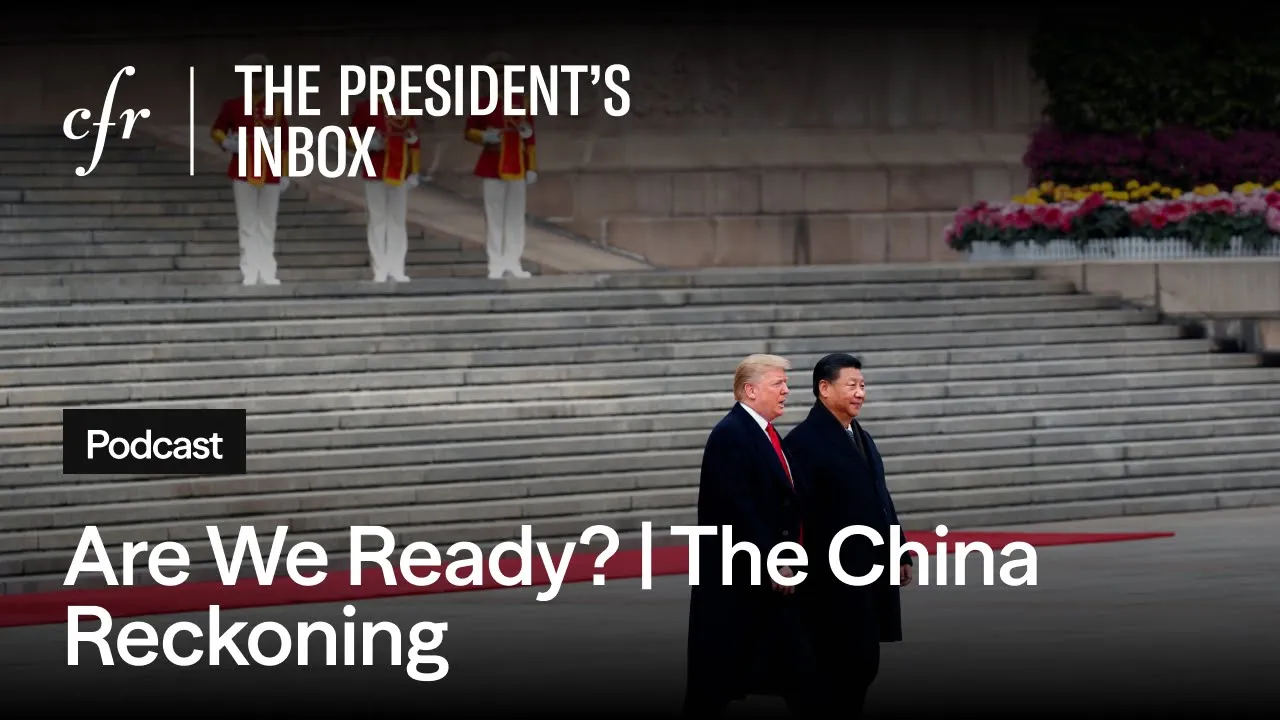
Rush Doshi, the C.V. Starr senior fellow for Asia Studies and director of the China Strategy Initiative at the Council, sits down with James M. Lindsay to discuss how the United States is reckoning with the rise of China and a world of renewed geopolitical competition.
This is the first episode in a special series from The President’s Inbox, bringing you conversations with Washington insiders to assess whether the United States is ready for a new, more dangerous world.
TRANSCRIPT
LINDSAY:
The world has turned dangerous. Russia wages, war on Ukraine, talk of a Chinese invasion of Taiwan grows. North Korea’s nuclear arsenal continues to expand. Iran clings to its nuclear ambitions. At the same time, America’s warfighting capacity is under pressure. A military that spent two decades combating terrorists and insurgents now contemplates fighting a major power war. The long neglected U.S. defense industrial base struggles to keep pace. Supply chains depend upon imports from potential foes. All the while cheap drones, autonomous weapons in AI-enhanced systems are rapidly reshaping warfare. Is the United States prepared to meet the new challenges it might face? In this special series from the President’s Inbox, we’re bringing you conversations with Washington insiders to assess whether the United States is ready for a new, more dangerous world.
CNN:
Soviet President Mikhail Gorbachev has been removed from power and there are tanks now in the streets of Moscow.
LINDSAY:
The collapse of the Soviet Union in 1991 left the United States as the world’s unchallenged superpower. Believing that its victory in the Cold War had closed the book on great power rivalry, Washington sought to remake the world in its image.
ABC News:
How do you measure such an astonishing moment in history?
LINDSAY:
But the so-called unipolar moment proved to be just that, a moment. Other major powers began to balk at Washington’s policies and to chart their own course. The result has been the return of great power rivalry. Now, for the first time in three decades, the United States faces a peer competitor that threatens its position at the top of the global order, China. Today, Chinese economic strength, military modernization and technological advances are challenging U.S. leadership in ways that even the Soviet Union did not.
Across trade, defense, and diplomacy, Beijing is contesting Washington’s policies, seeking to rewrite the global rules and institutions that have long reflected U.S. interests. China’s assertiveness has many people asking, “Does the United States have a strategy that will enable it to triumph over a true peer competitor?”
From the Council on Foreign Relations, welcome to the President’s Inbox. I’m Jim Lindsay. Joining me today is Rush Doshi, a senior fellow in Asia studies and director of the China Strategy Initiative here at the Council. Rush, thank you for joining me.
DOSHI:
Thanks, Jim.
LINDSAY:
I want to dive right in, Rush, and I want to ask you to lay out for me how you see the nature of this U.S.-China competition.
DOSHI:
Yeah, it’s an interesting and fundamental question we don’t often take a step back and think about. I think that the competition is really over a few things. Fundamentally, it’s about order. The order seems to be shifting and what is order? Order is sort of a combination of coercion and consent and legitimacy that allows you to say, “Here’s how things are going to be,” and maybe even to get your way over others. It’s about hierarchy and order is built on foundations. Each one of those foundations of American order is being tested by China, and so you see China essentially blunting the foundations of American order and building the foundations of its own. But beyond that abstract sort of international relations answer to your question, there are hard bread and butter issues in this competition too.
LINDSAY:
Good. Let’s talk to, because I sort of feel like I’m a graduate seminar. What are those?
DOSHI:
Well, I think there’s four that I put on the table. One question for Americans is do we want to be able to deter China from taking military action in Asia? That would be catastrophic for American interest and people talk a lot about Taiwan, given its role in supply chains. Bloomberg estimates $10 trillion of global disruption if that happens. Obviously that’s where all the chips are made for AI. So that’s one question and related to that is can you imagine a truly global Chinese military operating in the Atlantic off our coast, et cetera? A second fundamental question is what is the business model of America going to be or are we going to stay prosperous? A big reason the small country in a sense of 330 million people is so prosperous is because we do well in international markets. Not as well as we used to perhaps, but we do well.
The question is, is America going to be competitive in all those fields that undergird American prosperity? And China is a full spectrum competitor in international markets in the areas that we rely on. So that’s the economic question. Are we going to end up becoming dependent on China? With China in turn less dependent on us? Then there’s technology and technology. The big question is who’s going to lead the next industrial revolution in tech? And you go back historically. Steam power, Great Britain led that. Electrification, Thomas Edison, right? Mass manufacturing, Henry Ford. Second and third Revolutions, America led those, and now there’s a fourth industrial revolution. We’re seeing it. AI, quantum computing, AI-driven manufacturing, biotechnology, robotics, and so on, and China wants to lead in all those areas. That’ll be the first time really that America is behind in the technology curve. And then the final part that we care about is, what is the international system’s view of liberal values? Is the system going to be one that’s default setting is conducive to democracy—
LINDSAY:
What do you mean by liberal values? I think it’s a term that we use in our conversation. I don’t think it’s a term that Americans walk down the street using.
DOSHI:
Let’s make it practical. I mean, are there going to be elections in foreign countries? Do a handful of people who control the wealth and the surveillance technology that matters, as well as the military and domestic security forces behind it, do they control what happens in other countries? We’re talking about is what is the role of the individual in the country they live in over their own future, and to what degree politically is that at the control of others? I think you could argue that China’s export of surveillance tech, its export of security service training and its, let’s say, friendliness with autocratic forms of government creates an authoritarian winter for those who want to see a world in which individuals are empowered and can flourish.
LINDSAY:
I think you’ve already hinted to the answer to this question, but let me ask you it anyway. I’m older than you. I lived through the time of U.S.-Soviet rivalry, where everyone was concerned that the Soviet Union was going to catch up and surpass the United States. What if anything is different about the Chinese rivalry with the United States?
DOSHI:
Yeah. I mean, I think the biggest difference is scale, that China basically can out-scale the United States.
LINDSAY:
What do you mean by scale?
DOSHI:
Well, you could basically break it up into a few different dimensions. On the one hand, you’ve got the size of China, right? But size alone isn’t the issue. I mean, India is also quite large. They’re not about to overtake the United States in the next twenty years or ten years or five years. Scale is the ability to convert that size into outcomes that matter. When we talk about an industry scaling up, that doesn’t mean that they’re big. It means that they’re able to be efficient as well. And so, when you talk about China’s scale, you’re talking about the ability to sustain a massive industrial economic, technological, and military ecosystem at the leading edge and doing that with a 1.4 billion person economy. And so, look at the statistics that come down to the wire here. China is twice America’s manufacturing capability, value add.
LINDSAY:
Thirty-one percent world’s manufacturing output.
DOSHI:
Right, and we’re like half of that. Now, we used to be much more than China, but in twenty years we went down dramatically to the point we’re now half of China. If you look at other metrics, China’s power generation is two times America’s. Car production is three times America’s. You look at steel and cement production, eleven, twenty times America’s. And then you could say, “Well, those are conventional metrics. They’re a big country. Of course they’re going to be doing well there.” But let’s look at a different metric. What percentage of really advanced tech is being built in China? And there you see, China makes more than two thirds of the world’s electric vehicles, more than two thirds of the world’s advanced batteries, which are critical to the new industrial revolution in electrification. They are building a hundred nuclear reactors. They’re planning to build a thousand small modular reactors.
For your listeners, the nuclear reactors are clear. That’s a lot of power generation. Small modular means you can do it at scale much faster, much cheaper and much more deployable. That’s a lot of power. They’re also dominating as we are finding out right now, the supply of rare earths and rare earth magnets. That’s a little bit older tech. To dominate the supply of antibiotics and other pharmaceutical ingredients, but solar panels too, other newer tech, cheaper solar panels. So you look across the spectrum, which you see isn’t just that they out-scale us, it’s that they dominate the global production of what the world is going to rely on for this next phase of the industrial revolution.
LINDSAY:
So they control choke points in the modern manufacturing era.
DOSHI:
Yeah, it’s two things. People talk about them as choke points, and that’s true rare earth magnets are certainly choke points, but they also control enablers. Batteries aren’t just choke points. Batteries are the enabler of the electrification revolution. The movement from the internal combustion engine to a battery system, movement from power, that’s something that you would move across a grid geographically, to now something you can move across time. So these are the basic inputs of the next industrial revolution. And I think, Jim, the reason I don’t like choke points as the only frame, is imagine if we thought of steam engines as a choke point. They weren’t just a choke point, they were a general purpose technology. And right now the general purpose technologies are increasingly built in China.
LINDSAY:
What about the argument that I often hear that we’re exaggerating China’s successes in underestimating China’s challenges, that China has too much debt, has extremely high levels of youth unemployment, its economic growth is slow—
DOSHI:
Demographics.
LINDSAY:
… demographics, perhaps its political system is strong but brittle.
DOSHI:
Absolutely.
LINDSAY:
How does that factor in?
DOSHI:
I think all those arguments are right and they matter, because I think China’s long-term, and remember in the long-term we’re all dead to quote Keynes. So fifty years from now when the demographics really hurt them, I’m not sure how valuable that is to us today, but I make the argument that those weaknesses are serious and they could bring the system down. But let’s assume for the sake of argument for a moment that you can’t count on your competitor tripping up. And let’s also assume for the sake of the argument, and I can sustain this one, that their weaknesses may not matter in the areas most relevant for strategic competition and the timeframe most relevant for strategic competition. That’s a different assessment and it’s not the assessment the financial markets think about. They say, “Hey, their demographics are bad.”
I say, “Yes, but their industrial production is what matters in wartime and that could happen in the next decade.”
LINDSAY:
So in essence, China can have problems, but still pose a critical strategic challenge to the United States.
DOSHI:
That’s how I square the circle. It is possible for two things to be true, that they’ve got enormous weaknesses, but they’ve also got enormous strengths and the timeframe in which those matter isn’t the same.
LINDSAY:
I would imagine if we were having this conversation in Beijing, in Mandarin you can make the same point about the United States.
DOSHI:
Right. I think the United States has enormous strengths and enormous weaknesses too. No country is perfect. And to some degree no one really knows how two countries are going to interact at this level of complexity. It’s sort of like a game of poker, where you’re not even sure your opponent’s cards and your own cards. Both are sort of a question, but you’re still betting against each other. You’re still gambling. That’s a little bit of what the dynamic right now is between the U.S. and China in this trade war. Nobody’s exactly sure who has the high card, but in a way it doesn’t matter. It’s sort of if you believe the opponent has the high card and they believe they have the high card, they have the high card.
LINDSAY:
So let’s talk about the issue that I think has gripped a lot of Washington D.C. in recent years, and that’s the potential military confrontation between the United States and China. Often the talk is about Taiwan flashpoint. How do you assess sort of the balance of military forces? Because there’s a lot of talk about China potentially wanting to have the capacity by 2027 to invade Taiwan. I don’t know what you make of those arguments.
DOSHI:
Well, it’s true that they want the capacity to be able to take Taiwan with military force.
LINDSAY:
That’s the conclusion of U.S. intelligence.
DOSHI:
Yeah, that is a position put out by the U.S. government at the highest levels. It’s also true that what they would have to do to combat the amphibious invasion of Taiwan would probably be the most complicated and challenging military operation undertaken by a great power, even more challenging perhaps than the Normandy landings. It’s really hard. That said, China also brings to this really complicated problem some advantages and that includes a few things. First, incredible defense production. We’re halfway through 2025 and in the next five years you’re supposed to build sixty-five new surface combatants. We’re halfway through this year, so it’s really more like four and a half years. And those sixty-five combatants are going to put real capability into the PLA and they’re going to be 60% larger than the U.S. Navy by then.
LINDSAY:
I’ll just put on that score. I think in the last year the United States Navy has commissioned five new surface vessels.
DOSHI:
Yeah. And if you look at what the Chinese are building, they’re building not just destroyers, but also cruisers, which have significant firepower advantages, as well as a variety of lift platforms to actually transport troops across the strait. And that’s just, Jim, the military side of their investment. We should also talk about the civilian side. Right now at China’s car companies of all, car companies, BYD are building their own car carriers. You could call them car carriers. There’s a technical term of our, but it doesn’t matter what it is, they transport cars across the water. What’s great with the car carriers, it can also transport troops across the water.
LINDSAY:
Dual purposes.
DOSHI:
They say they’re absolutely 100% dual use and they are thought about as dual use. They are even involved in exercises, as if they’re dual use. The Chinese have at times for signaling purposes sent out what we call these roll on, roll off vessels, which you could use to invade Taiwan into the strait to make a point. So when you add that civilian shipbuilding capability to the military, it’s significant. Now, again, what I would say and others who are going to be a part of this series can be more precise, I think the biggest trends in warfare, and Steve Biddle and others have made this point, are greater range, greater precision, greater lethality, and greater autonomy.
Again, range, precision, lethality, and autonomy. What that basically means is defense has some advantages against an opponent that’s trying to project power over the water, right? Range means they got to go, our weapons can strike further out. Precision means they can hit the target. Lethality means they can kill the target, and autonomy means they can work even if they’re not talking essentially back to their home base, to put it in kind of crude and somewhat inaccurate terms. Those trends favor Taiwan and the United States potentially in some manifestations. But the question now is which side can better exploit those trends?
LINDSAY:
Well, let me ask you a little bit more on that point, because partly it depends upon what it is that Taiwan invests in.
DOSHI:
Exactly.
LINDSAY:
But it’s also partly a function of what kind of war the Chinese might wage. And you brought up the reference to D-Day and think a lot of people when they’re talking about this have visions of Chinese troop carriers coming across the strait—
DOSHI:
Yeah, but there are other ways.
LINDSAY:
… but there’s a lot of talk about so-called gray area of activities, the boa constrictor. Help me think about that.
DOSHI:
Yeah, you raise a great point, Jim, and we talk about invasion as the high-end contingency, but what I actually focus a lot more on when I was working at the White House, what I think about now, what we did contingency planning work on back when I was at the NSC was also on these gray zone scenarios. So just to walk you through from the low end to the high end. On the low end, you can imagine China just occupying what we call Taiwan’s claimed territorial waters or claimed contiguous zone. Historically, China hasn’t done that, right? It barely ever in the past would even cross that center line between China and Taiwan. Now it’s obliterated that line and it could go even further closer to Taiwan shores. That’s dangerous, because it creates a real risk of escalation. The other stuff they can do, they could take an offshore island, for example.
The island of Kinmen is just right off the shore of Fujian province and it also has 120,000 people living on it. There’s uninhabited islands that they could take as well to send a signal. They could overfly Taiwan. That’s all on the lower end. Then you get to the higher end. They could do what we call law enforcement activity, send the Coast Guard or the Fujian maritime vessels out to basically stop shipping to Taiwan, saying they have legitimate law enforcement rights to inspect that cargo or stop that ship. That is now a declaration of control over what goes in and out of Taiwan.
LINDSAY:
Why would that be a problem for the White House?
DOSHI:
Well, I think it creates the real risk, especially if it becomes routinized that you’re going to see that anaconda, to use your word earlier, constrict Taiwan. Let me just add one other scenario and then I’ll go back to your question, which is a blockade, right? You start with law enforcement, but you might end with a blockade and say no ships can come in and out, right? And the goal would be to force Taiwan to capitulate, because its stores of energy and food and critical parts for its supply chains would run out. And if that happens, Taiwan may decide to fold and just become part of China. And we could say, “Well, there was no war. So is it consequential?” And given Taiwan’s role in the global semiconductor supply chain, given that the entire AI buildout of the United States of America, which is supporting the future of American industry and present GDP growth depends on those chips from Taiwan. Yeah, it’s a big deal.
LINDSAY:
So in that circumstance, wouldn’t it put the pressure on the United States to make the first so-called kinetic move?
DOSHI:
Yeah—
LINDSAY:
Because you have to break a blockade?
DOSHI:
So you raise a great point. A conventional trope that many in Washington believe that I do not agree with, is that China prefers an invasion over a blockade, because a blockade could be challenged, an invasion could be a fait accompli. So you invade, you do it quick, Taiwan fold, it’s over before anybody.
LINDSAY:
If you can do it very quickly.
DOSHI:
Yeah, that’s the goal to do it.
LINDSAY:
That’s what the Russians thought that we were going to do in Ukraine.
DOSHI:
It turns out war can be more complicated than that, but if you’re able to pull it off, then great. That’s the view in China. But I’m not sure that invasion is the first choice, because it’s also highly risky. And blockade or quarantine could also be very effective at bringing about Taiwan capitulation. Now, people say in Washington that they wouldn’t do it, because America could respond. They could run the blockade and then all of a sudden China looks sort of impotent in the face of American political will. But there are many ways a quarantine or a blockade could be sequenced over time. You could do it every month for a week and then for two weeks. You can make it difficult.
LINDSAY:
This is the frog and boiling water.
DOSHI:
Exactly. And that’s the anaconda constricting more—
LINDSAY:
Get a lot of animal metaphors here today.
DOSHI:
… over time. We’re going to have a lot of metaphors before this is done. We’ve used a few already. I got a few more up my sleeve, but I think that the story here is that the Chinese can play this many different ways. And the strategy, Jim, for handling a quarantine and blockade could be very different from handling an invasion. But one thing is probably true, that the investments that Taiwan should make are in the capability to take out amphibious capabilities, because that is what’s going to effectuate the blockade and the invasion.
LINDSAY:
But make it hard for the Chinese to carry out an invasion.
DOSHI:
Yeah, it’s funny, the Chinese really studied the Falkland Islands war way back, and they saw that a French Exocet missile took out the British vessel, the Sheffield, and the Argentinians were able to take out a major surface combatant and a lot of people died. And the Argentinians success in that inspired not just the Chinese, but also the Soviets to think, “Look, investing in cruise missiles and now in drones is very effective against these expensive, slow, heavy ships that have to float on water.”
LINDSAY:
Otherwise known as targets.
DOSHI:
As sitting targets in some cases, because as fast as they can go, they can’t go faster than a missile. And so, they’re not particularly mobile. These targets are American if we’re coming to Taiwan’s defense and those targets are Chinese, if China’s trying to cross the water to Taiwan. So from Taiwan’s perspective, the answer is very simple. Be what we call a porcupine. A porcupine with long quills, the quills being long range strike capabilities, either via aircraft or via uncrewed systems, via drones, for example, or via submarines or underwater vehicles, or missiles, and use those to keep the Chinese out.
LINDSAY:
Let me talk a little bit in terms of this Taiwan scenario. Why is Taiwan important to the United States? There’s certain group of people here in Washington, D.C. like to call themselves the restrainers would say that Taiwan is an important interest in the United States, but it’s not a vital interest and because it’s not a vital interest, the United States shouldn’t risk war over Taiwan. How do you assess that argument?
DOSHI:
Yeah, I’m always curious what the definition of vital interest is for a restrainer, because the argument principally turns on that question. I mean, you could have argued in the past that Pearl Harbor or Hawaii wasn’t a vital interest of the United States, that it was not necessary to defend American territory against the Japanese, because gosh, it was so far away and is it really a state? Is it a territory? And yes, it was U.S. personnel, but that restrainer argument without concrete logic about vitality of interest doesn’t have much water with me. The Taiwan case is interesting. I’m sympathetic to the argument that America has overstretched itself. I don’t think the invasion of Iraq was particularly sound. I don’t think it was necessary to spend so much time in Afghanistan. I have questions about the use of military force in Libya and in Syria and in other places, but Taiwan is different.
And the reason Taiwan is different, and I’m not saying America should necessarily commit to using military force to defend China. We can talk more about what America’s posture should be, but the reason Taiwan is different is threefold. First, most obviously for your listeners is the chips. Taiwan is at the center of the technology that might revolutionize everything. Now AI could be a bubble and we could all laugh at decent centrality of AI chips to the American economy, but odds are, even if it is a bubble, Taiwan’s AI chips still matter for American prosperity and they make the only AI chips at scale that anyone can make. For that capability to fall into the hands of China or be lost in a conflict would be disastrous for the world.
LINDSAY:
Do you think the Chinese would refuse to allow the export of such technology?
DOSHI:
Well, they’re already refusing to allow the export of rare earth magnets and minerals, in part because of their own concerns about domestic supply shortage. We should talk more about China’s industrial strategy and what that means for America in a moment. But yeah, I think there’s a real risk of that, but more likely is these plants would be destroyed in the strikes.
LINDSAY:
Or get blown up. I mean, I’ve heard people argue that the way to deter the Chinese is by threatening to blow up those fabs.
DOSHI:
I’m skeptical of that argument, because I don’t think China’s principally motivated by control of the fabs. We might be principally motivated by that. But what they are motivated by is ending the civil war between China, China’s Communist party and its former nationalist party which fled to Taiwan. This is the last vestige of that civil war, and frankly, it’s a legacy item for any Chinese leader, and it’s important to the Chinese people. Chinese nationalists care about Taiwan, and so we have a different set of interests that motivate this question, which can be useful at times and not irreconcilable.
I think the second issue here is that if Taiwan were basically to become a part of China through military force or through capitulation in which we did nothing, if you’re an Asian economy, let’s say you’re Japan or even India, do you really put much stock in your security ties to the United States or do you say, “It’s not worth it, we should bandwagon?”
I will say my restrainer friends, who I’m not always opposed to, I agree with them on many things, I don’t agree with them on this. They often say, “No, Asia will balance against China even if Taiwan folds, they won’t bandwagon.” Bandwagon means joining the powerful state of course, and balancing means working with the weaker states to ensure equilibrium. I don’t think Asia is going to balance a China that has taken Taiwan.
LINDSAY:
Well, in history we can find examples in which weaker powers bandwagon and we can find them when they balance.
DOSHI:
Yeah, but you know what’s interesting is that when there’s such a decisive asymmetry in power, like let’s say in North America between the U.S., Canada, and Mexico, bandwagoning happens. If Mexico and Canada had different political institutions, if America were more threatening, it could be different. But I think power is a big part of the story here. China is more than half of Asia’s military spending. It probably is close to 75%. It is the leading economy within Asia. Every Asian economy relies on China. Why wouldn’t they bandwagon? And the third point—
LINDSAY:
Well, plus balancing also requires confidence that other countries—
DOSHI:
Are going to be with you.
LINDSAY:
… are going to be with you. And if you doubt them, then there’s incentives to defect.
DOSHI:
Balancing is a really weird thing, right? Balancing is a collective action effort, right? It requires everybody, assuming the other guy’s not going to defect, and you’ve got massive incentives to defect when your entire economy is also dependent on a country that has the weapons.
LINDSAY:
When you add in historical rivalries and enmities. I can say it could fall apart pretty quickly.
DOSHI:
The balancing coalition.
LINDSAY:
Yeah.
DOSHI:
Yeah, I mean, Japan and Korea have to hold together. That’s not easy. Of course, Japan and China have their own challenges. And China has a unique ability to alienate the countries that might otherwise be inclined to work with it. So right now you’ve got massive American tariffs on India, and yet the Chinese have not been able to mount a charm offensive with the Indians. You had in the past, Japanese administrations under Hathayama that were very pro, they were more about equal distance between the United States and China, and yet the Chinese escalated territorial disputes against Japan.
So the Chinese can always get in their own way, but gravity matters in politics. And I guess the third factor very quickly is the question of what it means for a liberal democracy to be extinguished in such a fashion for a democracy around the world. But if I am honest with you, Jim, the first two questions, economic and even the second is really economic as well are decisive. An Asia which bandwagons with China is an Asia that might be separate from the U.S. in a way that makes us the Galapagos Islands of the global economy, and that’s not where we want to be.
LINDSAY:
Okay. Let’s talk about industrial strategies. You were going to tell me why that’s important?
DOSHI:
Yeah, it’s interesting. I mean, if you read Chinese economists who worked at key industrial planning institutions within China, like the NDRC, what they often I think sort of acknowledge is that the United States basically enabled the rise of China as a manufacturing power. They were already a good manufacturer before WTO accession. But if you look at the change in American and Chinese share of global manufacturing after China joined the WTO, it’s not even close. What the WTO did, and I write about this in my book, The Long Game, is it also created for China the ability to tie America’s hands behind its own back on economic coercion. It meant that we weren’t going to use 301 investigations, at least for a while against China—
LINDSAY:
Because a provision in trade law that allows the government to impose tariffs.
DOSHI:
Yes. In fact, in the 1980s when we were Cold War buddies with China against the Soviets, we still launched trade investigations into China and put tariffs on Chinese exports many times, even under President Reagan. After WTO accession, we have to use the WTO process to adjudicate all this, that gives China a great deal of stability. It gives investors in America confidence that when they invest in China, they’re going to get a return on their investment. Investors always want stability, predictability, and WTO accession more than anything, gave them that. And that’s why American companies, for many reasons, flocked to China, built China’s manufacturing ecosystem. And now twenty-five years later, the bill has come due, America wants to re-industrialize, India wants to industrialize. Latin American countries want to industrialize. Is China going to allow them to do that? Is it going to invest in other countries and build their manufacturing ecosystems or will it do what we call final assembly?
All the parts come from China like an IKEA production kit, and you turn the screw at the end. That right now is the model of what China is doing around the world, but what the world needs is its own productive capacity. Now, is China going to let that productive capacity flow out? I think the answer is no. Look at these exports—
LINDSAY:
I can’t imagine the answer would be yes.
DOSHI:
Well, but some people would say that it is. Some people say, “Look at all this Chinese investment in green technology. They’re building all these plants in Europe.”
But remember, they’re building these plants on a Chinese supply chain with Chinese parts, with final assembly in other countries. It keeps all the value basically in China, and you’re not learning how to build this stuff. Now, when America did its sort of industrial transfer to China, we were doing it from soup to nuts in many cases vertically in the end. So I guess I’d put it to you this way too since we’re on the hunt for metaphors. We put a ladder down, China climbed that ladder up. We fell down and China won’t put the ladder down for us. They’re pulling the ladder up. They won’t put the ladder down for anybody else.
And look at India. India wants to make phones. China is throttling the supply of individuals who know how to do this work from Foxconn Factories. They’re throttling the machine equipment that’d be necessary for India to manufacture this stuff. Indian government’s very open about this, because China’s worried about India becoming a dominant manufacturer at China’s expense. Now, look at the export controls that China just put on the U.S. two weeks ago. They don’t just control the flow of rare earths, Jim. They control the flow of the equipment used to do the refining. They don’t just control the flow of batteries, Jim. They control the flow of the equipment used to make the batteries and—
LINDSAY:
But, Rush, the Chinese would say, this is—
DOSHI:
Smart.
LINDSAY:
… the goose imitating the gander, because the United States has done this in terms of high-tech semiconductors.
DOSHI:
They would say it, but they would be wrong, because the truth is America has not, generally speaking across the industrial sectors, limited the flow of capital equipment to China. In fact, let me give you several examples of how the exact opposite happened. Take rare earth magnets since that’s in the moment, and we’ll talk more about the semiconductors. Right Now, china is saying the flow of magnets and minerals to the United States is really up to China. And without those magnets and minerals, the U.S. economy can’t produce things at scale. Can’t produce things, period. And so, it’s a big deal.
Now, America had a magnet manufacturer and we sold it to the Chinese in the 1990s. There was a deal that the Chinese would promise not to shut down the production facilities in the United States. They would keep them open. But what they did instead when nobody was looking or more accurately nobody cared, is they shut down those plants. They moved that capital equipment to China. They moved some sophisticated computer equipment that was regulating the process of making those magnets. They even got some of the engineers to train China on how to do this work. They basically completely moved that capability to China, and all they had to do was pay a premium over the value of the company. And they’ve done that in industry after industry after industry. The reason we don’t know about it is because nobody was paying attention.
LINDSAY:
I take that, Rush, I know that David Lynch, the Washington Post reporter has a new book out called, I think it’s The World’s Worst Bet, which look back at the assumptions that undergirded several administrations development of economic relations with China and the rise of globalization. But I want to look forward now, and that is what sort of strategy should the United States pursue, given where we find ourselves right now, which seems to me that the United States is not just sensitive, but vulnerable to Chinese economic coercion, that it will take time to turn that vulnerability into a sensitivity or to eliminate it altogether. How do you proceed?
DOSHI:
Well, it’s a good question. Why don’t we start with semiconductors for just a minute, because I think one of the questions you raised was didn’t the United States do export controls to China, so isn’t this just fair play? It’s true. The United States did restrict the flow of what we call highly sophisticated EUV machinery. Now, EUV is the gold tier machines that you use to make chips, but there’s a silver tier called DUV. And the U.S. did not restrict the supply of the silver tier to China, which they have used to make a lot of really sophisticated chips. And American companies are profited from some of that production. And even the U.S. export controls we’re not going to affect 99% of chips that were going to China. And even the advanced AI chips, many of them China could still acquire, just not the very, very best.
LINDSAY:
Well, this is the whole argument of the Biden administration. Small yard, high fence.
DOSHI:
Yeah, and as our CFR president, Mike Froman has basically said, what we’re looking at with China is sort of like a great square and a great wall, or a big square and a great wall. They have widened the area around which they put up protection and they have also increased the height of that protection. So their approach on rare earths is not at all comparable to what the United States did on chips. Let me paint that for you with an evocative example. If the United States did what China is doing on rare earths, here’s what it would look like.
It would basically mean that no chips period anywhere in the world, no matter the quality, good, bad, ugly, any chip made at any point with any American technology would require a license to go to China. Any chip, even chips from the 1990s. That is not the U.S. approach. That would be a crazy approach. There’s also a further element of the Chinese approach, which would suggest that any product involving rare earths may also require license. The equivalent would be if we said any chips at all, no matter how unsophisticated with American technology, any product involving them would require license to go to China.
LINDSAY:
I’ll accept the argument—
DOSHI:
It’s not even remotely comparable, and that’s why this is the most important escalatory action that China has ever undertaken, period. And I think people are not paying enough close attention to it. This is a loaded gun pointed at the head of the American economy, unlike any that America has ever cocked itself and pointed at the head of the Chinese economy. And what happens now in the next few weeks before U.S. President Trump and Chinese President Xi meet in South Korea will determine a lot about the nature of U.S.-China interaction in the period ahead. I think there’s a real risk that what is now an activity that they’re using, they claim in response to U.S. action, becomes a tool they use to dictate American policy. What do we do?
LINDSAY:
So again, how does the United States respond?
DOSHI:
There’s not an easy answer on rare earths. I will say—
LINDSAY:
Well, just give me the forty-thousand foot level.
DOSHI:
Yeah, the big picture is simple, Jim. Scale. America needs to scale, right? It needs to do more investment at home to mitigate its critical dependencies. It needs to do more investment at home to dominate the future of technology. The market is not going to get there on its own. The market is why we’re in the position that we’re in. And you’re going to also need to find a way to create abroad a coalition. Not a coalition to contain China. We’re not talking about containment, that ship left port thirty years ago. What we’re talking about is balance, equilibrium.
The real risk of the future, and this goes back to your first question, isn’t that the United States and China can’t find some terms of coexistence. I think we can find those terms. The question is what are the terms of that coexistence? And right now, I think the real challenge we have is that China might be able to dictate those terms, because of its superior industrial capability, its technological innovation, its military power. And so, what we are looking for, Jim, is balance. And if you combine the United States with its allies and partners, you can begin to get after some of China’s advantages. And I can give you the stats. They’re quite interesting on how the United States plus its allies out-scales China.
LINDSAY:
But that means you have to be willing to work with your allies—
DOSHI:
Yeah, you do.
LINDSAY:
… and not view them as countries that have stolen from the United States. That’s a very different mindset than I think President Trump has.
DOSHI:
It’s a good point. If you combine the U.S. and its allies, let’s just say you take manufacturing capacity, value add, we totally outscale China. We’re like 50% more than them. GDP terms, purchasing power, We’re more than them. Nominal, we’re more than them. You look at scientific research, patents, top-cited publications. Chinese have more of both than us, active patents and top publications. Well, you combine us with our allies, it’s not even close, it’s just we completely dominate.
LINDSAY:
So there’s strength in numbers.
DOSHI:
There’s strength in numbers. And what China has is scale, right? If a Chinese company can find a market in its 1.4 billion person economy with its significant purchasing power, then that company is going to be very competitive abroad. And look at history, Jim. The rise and fall of grade powers is about a lot of things. One of the things it’s often about is scale. Great Britain, when they were winning the industrial race with the steam engine, they won that First Industrial Revolution. There was a British author, this guy named Lord John Seeley.
In 1883 he wrote a book which was a bestseller about the rise of Great Britain. People wanted to know how they became so amazing. But he left a cautionary tale in the last two chapters. And what he said was, if Britain’s rivals that are bigger in size, were able to scale up. And he uses the word scale, Jim, he wasn’t a venture capitalist and he also talked about scale. He basically said if they can scale up and be as productive as we are with that much bigger population, much bigger territory, much bigger resource base, Great Britain was going to have a problem. And the only hope for Great Britain was going to be to unite with its other, in his case, white settler colonies.
Now, America is not going to do that, because we don’t believe in that. And also, we have something better called allies. And our alliance system is way better than Britain’s empire ever was for a million different reasons. And so, that’s the thing we have to do. And let me be concrete. What that looks like, Jim, in practice, is we give our allies and partners better terms to each other than China gets. We buy first from our allies and partners, and second from China.
LINDSAY:
You form a club.
DOSHI:
It’s a cartel, even if you want to call it that. And that’s actually how free trade began, as a club of market economies. China is not a market economy, and it’s big. A non-market economy that’s big is going to warp the system. Let me give you one example.
LINDSAY:
It can be the last one, then we got to wrap up.
DOSHI:
Take antibiotics. Well, this is one that counts for everybody. We talked about bread and butter issues. Most fermentation for antibiotics is done in China, and that is in part because it was no longer economically efficient to do it in the United States and China could do it, but our allies like Japan are investing in this capability. If all the allies agree to buy from Japan, Japan gets economies of scale, and all of a sudden those drugs are still cheap. Now imagine we get together and collectively farm out each of our dependencies across an allied system. It’s not managed trade. We don’t want to go back to that, but it’s trade that thinks about security and resilience. That can work to make Americans more prosperous, can make our supply chains more secure.
LINDSAY:
… trusted suppliers, trusted supply chains.
DOSHI:
With one big asterisk, which is that this approach builds scale. An allied market that has preferential terms to each other can allow companies to achieve skill that they can’t accomplish on their own in competition with China. So you asked me what we should do. We should invest in our foundations of industrial and technological strength, and we should work those efforts with our allies to create scale in numbers.
LINDSAY:
On that note, I’ll close up this episode of the President’s Inbox. My guest has been Rush Doshi, the senior fellow for Asia Studies and Director of the China Strategy Initiative here at the Council. Rush, as always, thank you for joining me.
DOSHI:
Thank you, Jim.
LINDSAY:
Today’s episode was produced by Justin Schuster, Molly McAnany, Markus Zakaria, and Director of Video, Jeremy Sherlick. Production assistance was provided by Antonio Antonelli, Oscar Berry, Elijah Gonzalez, and Kaleah Haddock.
Mentioned on the Episode:
Rush Doshi, The Long Game: China’s Grand Strategy to Displace American Order, Oxford University Press
David J. Lynch, The World’s Worst Bet: How the Globalization Gamble Went Wrong (And What Would Make It Right), PublicAffairs
Opinions expressed on The President’s Inbox are solely those of the host or our guests, not of CFR, which takes no institutional positions on matters of policy.
Associate Podcast Producer
- Associate Producer, Video and Audio
Editorial Director and Producer
- Director, Podcasting
Director of Video
- Director of Video
More Episodes
 33:42Podcast
 36:05Podcast
 41:07Podcast
 39:26Podcast
 35:04Podcast
 31:46Podcast