Are We Ready? | The U.S.-China Chip War, With Chris McGuire
This episode unpacks U.S. efforts to deny China advanced semiconductor chips and its consequences for Chinese innovation.

Published
Host
 James M. LindsayCFR ExpertMary and David Boies Distinguished Senior Fellow in U.S. Foreign Policy
Guest
 Chris McGuireCFR ExpertSenior Fellow for China and Emerging Technologies
[Video: https://youtu.be/I0W53oz-f50?si=AGHFUWE_VtnVL7I6]
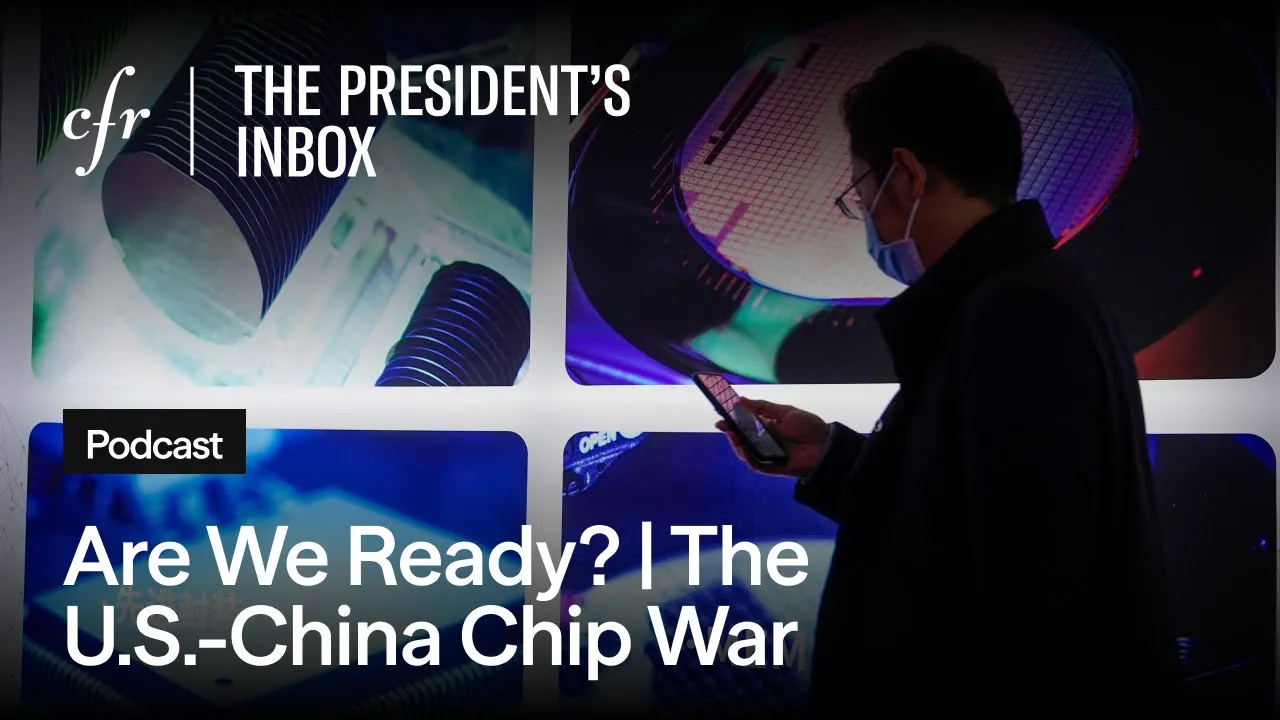
Chris McGuire, senior fellow for China and emerging technologies at the Council, sits down with James M. Lindsay to discuss whether U.S. efforts to deny China advanced semiconductor chips will sustain the U.S. lead in artificial intelligence or unintentionally accelerate Chinese innovation.
This is the fifth episode in a special series from The President’s Inbox, bringing you conversations with Washington insiders to assess whether the United States is ready for a new, more dangerous world.
TRANSCRIPT
LINDSAY:
The world has turned dangerous. Is the United States prepared to meet the new challenges it might face? In this special series from the President’s inbox, we’re bringing you conversations with Washington insiders to assess whether the United States is ready for a new more dangerous world.
For decades, the United States was the world’s technological powerhouse. American universities and firms led the globe in scientific breakthroughs that revolutionized the way we live and work. However, Chinese firms and universities now rival, if not surpass their American counterparts in many areas. One recent study concluded that China leads in fifty-seven of sixty-four critical new technologies. As China’s dominance of critical minerals shows, Beijing can potentially weaponize its technological advantages against the United States and its allies. Washington has responded to the China challenge in part by imposing export controls, licensing restrictions and technology sanctions, especially when it comes to the advanced semiconductor chips needed to power the AI revolution.
The goal of these moves is to slow Chinese innovation, particularly innovation that would enable the Chinese military to close the gap with the United States. But are U.S. restrictions working or just forcing China to innovate even more? Would other policies do more to sustain America’s technological prowess. And will escalating tensions over technology further inflame tensions between Washington and Beijing?
From the Council on Foreign Relations? Welcome to the President’s Inbox. I’m Jim Lindsay. Joining me for today’s discussion is Chris McGuire, a senior fellow for China and emerging technologies here at the council and a former deputy senior director for technology and national security on the staff of the National Security Council. Chris, thank you very much for joining me.
MCGUIRE:
Thanks so much for having me, Jim.
LINDSAY:
Chris, I want to begin really at the 40,000 foot level and I’d like you to give me a sense of the overall nature of the U.S.-China technology competition. I wrote a spate of reports in recent months, which argue that again, China has either caught up or passed the United States on a number of critical technology dimensions. Is that a fair reading of where we are?
MCGUIRE:
Yeah, I think with everything it’s complicated, but what I would say is the Chinese have absolutely shown the ability to commoditize products and to innovate themselves and to catch up in technologies where people previously thought they could not. And I think the U.S. leadership edge on technology as a whole has certainly eroded. That said, there are discrete and also very important areas of the technology stack where the United States not only maintains superiority but potentially even dominance. And that’s very important for the nature of the overall competition.
LINDSAY:
Okay, so why don’t we lay out what those areas are where you see the United States as still in the lead or having the ability to in essence cement its dominance?
MCGUIRE:
Yeah, so I think really the area that people traditionally focus on is semiconductors, and it is because that is the area of the greatest strategic advantage of the United States and its allies and also it forms the foundation of so many other technologies that fundamentally advanced chips are the single hardest thing in the world to make. They require the most complicated machines that humans have ever devised that rely on the most complicated supply chains on earth. They are very, very difficult to indigenize and that’s an area where the Chinese indigenization has not shown those as successful. That said, there are many other areas where they have shown much more success recently, take for instance, electric vehicles where I think that is an area where there’s traditionally been dominance in the United States and its allies in Europe and Asia, and that is a product that the Chinese have been able to commoditize and then with that flood the international market and really upend the dynamics around the whole vehicle supply chain.
I think the Chinese are trying to do, there’s a clear effort to do this on as many technologies as possible. The Chinese are very clear that their goal is to indigenize technology development. They do not want to be reliant on the United States or the west.
LINDSAY:
They want to de-risk or decouple.
MCGUIRE:
Precisely, in the same way that we do. And they’ve shown in many areas we have to give them credit. In many areas they have shown remarkable success at that. There are also some areas where they have shown much more difficulties. I think the primary one that is the biggest hurdle is semiconductors, and that’s why it’s the big outlier in the overall landscape.
LINDSAY:
What other areas do the Chinese lead in terms particularly a basic technology?
MCGUIRE:
Yeah, I think it’s many things in the adoption and implementation of technology. So look, we talked about EVs, robotics. I think there’s big concerns that they’re way out ahead. I think on biotech even that’s an area where the United States has traditionally been very dominant, but if you look at the prevalence of Wuxi biologics and BGI in these instances, people frequently say, well, we have to make sure they don’t become the next Huawei. And actually they probably already are. U.S. firms are very, very reliant on Chinese biotech industry, and I think it’s really getting to be neck and neck with the United States, which is very, very concerning From a strategic perspective. You could look down the line. I think on quantum it’s probably a little bit so reliant on computing and the advanced chip fabrication that it falls more in the semiconductor bucket. But really I think the advanced computing is a different bucket, but in anything where they can commoditize the hardware. Drones, for instance, Chinese have 90% of the global drone market, it doesn’t look like that’s going to slow down anytime soon.
So that has demanded a fundamentally different policy approach from Washington, both to address challenges of the Chinese using advanced technology to undercut security interests and also to make sure that we still have industries in areas that we’ve determined are strategically important.
LINDSAY:
There seems to be an important distinction what you just laid out that I don’t want to gloss over. One is the ability to sort of lead the world in, I’ll call it bench signs, technological scientific breakthroughs. There’s a separate issue about your ability to translate what you can do in a lab into the commercial space. Is that a fair summary?
MCGUIRE:
Yeah, that’s right. And the Chinese have traditionally been very good at fast following and they’ve definitely closed the gap.
LINDSAY:
What is a fast following? Sounds like a buzzword.
MCGUIRE:
Yeah, it’s the word people use. I mean it is basically taking the innovations that happen elsewhere, but then being able to use their large economy at scale to commoditize it, commercialize it, and actually get the products out as fast as possible. I think that we have to give credit to the Chinese that have tremendous technological talent and for us to say that this is something where the United States has forever superiority probably is not the case. I do think that on the very top end of talent, the U.S. University system probably does keep us as the talent magnet of the world. So even if the Chinese do publish more papers, I think some of the studies you cited, there’s many studies like this, but some of them frequently just look at things like number of paper citations, which actually probably is not the best.
LINDSAY:
Number of patents.
MCGUIRE:
Exactly.
LINDSAY:
Who’s the lead author, those sort of things.
MCGUIRE:
Which isn’t always the best metric because actually the top 1 percent of papers frequently have much more impact than the bottom 99 or 98 percent. So in terms of high quality research output, I think we still lead, but there’s no doubt that the Chinese are catching up and their ability to quickly commoditize, commercialize and scale is something that poses fundamental challenges to U.S. technological supremacy.
LINDSAY:
Your points remind me of an old saying, at least it’s the dominant saying, which is the United States innovates, China imitates, Europe regulates. But as I hear you speaking, what I hear you saying is no, China has gotten really good at innovation. Why is that? Because it was only thirty years ago where China would’ve been viewed as being way behind on the technology curve. I can’t think of many other instances in world history where one country caught up so quickly.
MCGUIRE:
Yeah, there’s been a massive prioritization from the government on technology. I mean every single five-year plan has emphasized this more and more that made in China in 2025 initiative has made technology indigenization a major component. We have seen for many years that the push from the top down in China to indigenize the most advanced technologies from the central government then proliferating down has been substantial and it has had some impact is something it’s given enormous resourcing effectively unlimited resourcing, and it matters. There are areas where they face other structural challenges, but anywhere where they can break through, they’re doing their best to.
LINDSAY:
So why does this matter? And I ask because a lot of the stuff I read about technology sort of posits it as a race, who is going to win? And as I look back over history, I’m not sure there was ever a point in which somebody won the technology race and it was over. And I think of things like some countries got first mover advantages. Britain benefited enormously from being the first to go to industrial production. Obviously, for the United States at the end of the 18th, early part of the 19th century, the advent of electricity and other things revolutionized the way business was done, how society operated, what others caught up and did well in prospered. So is there something particular about technology today that makes it different that we can really talk about winning or are claims that in essence what’s happening today will make a generational difference? Really just a lot of hype?
MCGUIRE:
I think both things are correct. So number one, I think that technology has always been the source of U.S. economic and military dominance. Since the entire post World War II period, the United States has been the kind of unquestioned world technological superpower. Obviously there were niche areas where the Soviet Union was good, but certainly across the board they were not rivaling the United States. And you saw that from everything from our economy where our labs and our companies were the ones that were leading the world to our military tactics and strategy, right? We are, for instance, even on the nuclear deterrence front, our missiles were actually, we were able to have much more precise targeting and therefore we could have lower yields on the warheads and the Soviets couldn’t have the same precise targeting than they compensated for that with much higher throw weight, much bigger warheads, et cetera. But the U.S. technological advantage is the source of that, and it has proliferated throughout the U.S. ability to project power and the U.S. approach to the world and the world’s approach to America because everyone knows that the United States is the technological superpower That is something that filters into everything. So that’s number one.
And I think that’s generally, if you look further back in history, technological supremacy just is core to the ability of a superpower to project power.
LINDSAY:
Let me ask you about that because you raised the issue of the nuclear age and the United States was very worried about falling behind the Soviets. We managed to stay ahead, as you point out, the Soviets developed all kinds of technology. But even in terms of power projection, it didn’t seem that at any point, even when the United States clearly had the technological advantage that it gave the United States any meaningful purchase in world politics. In essence, both sides had the ultimate weapon and they deterred each other.
MCGUIRE:
I would say that probably was true vis a vis the Soviet Union in terms of mutually assured destruction at that ultimate level. But the U.S. ability especially to put forces on the ground anywhere in the world very quickly to deliver munitions on target, especially as you got later into the Cold War in the post-cold war period.
LINDSAY:
Certainly gets the Gulf War with the revolution military fears precision.
MCGUIRE:
Precisely, completely changes the military dynamic. And I think as you have seen particularly advances in sensing and computing technologies and the way those have been leveraged, that has manifested differently. That gets to the second point that you made actually, which I think we actually are at a bit of an inflection point as well, specifically because of massive advances in computing and in artificial intelligence and the ability of that to transform both our economy and our military operations and give you massive economic efficiencies and untold amounts of growth potentially, and also revolutionary new military capabilities. At the same time, there’s a chance that we are at a point where the country that really is able to capitalize on this new technology and put it through their economy and military is going to have kind of untold power projection advantages. So even though the technological advantages have always been the case right now, we are probably at a heightened point and therefore it’s particularly important obviously in the U.S.-China competition.
LINDSAY:
Well, let me play devil’s advocate just on that point, and again, I want to keep in mind there’s the issue of who gets there first in terms of setting the technological standard, but there’s really the question of who’s able to translate into some meaningful product, weapon, what have you. But I’m left wondering if it really will be that important to be on the cutting edge to have the best system. And I ask it in the sense of will you really get a meaningful advantage or is it simply sufficient to have a technology that is good enough. If China has an AI system, for instance, that doesn’t meet the technological benchmark of other American systems, but nonetheless it’s still good enough to enable the Chinese to take all kinds of data and locate where American submarines are or it allows them to penetrate American cyber networks, being behind isn’t a detriment. Am I missing something here?
MCGUIRE:
I think it’s a function of both where the frontier is and where our ability to apply it is. I think when some of those instances, especially when you’re talking about AI systems versus AI systems in the future, there is a real chance that the better system will just win. If it’s a kind of cyber offense versus cyber defense and you have one system that is substantially better than the other one, it might just dominate that engagement. Similarly, for autonomous systems, the smarter system assume there’s some going to be some differences in actually capabilities to the platform, but the smarter system might just have such significant advantages that there’s a chance that just having the better system will win. But having the better system, like you said, is a function of both what your best technology is and what your ability to apply that technology is.
So I think this is a general concern that the United States retains in AI retains a lead over China in the frontier, but also DOD procurement is not our forte. And if we are not able to rapidly integrate that into systems, and meanwhile the Chinese are if we have a one-year lead in AI, but it takes us a year to actually apply in the systems and meanwhile it takes them, they can do it basically instantaneously, then it’s a tie. These are hypothetical numbers, but it’s a function of both. And that I think is where our Achilles heel could be if we don’t rapidly resolve things.
LINDSAY:
And I imagine, just to complexify things further, if I can put it that way. A lot of what matters is what people believe they have accomplished or not accomplished. I mean, if the Chinese become convinced that they have somehow managed to crack the code and they have a system that allows them to defang the United States, they could be very likely to act on it regardless of whether that is true or not.
MCGUIRE:
Yeah, certainly. I mean, just as a general conception, I think deterrence is the perception of your adversary of your capabilities. Your capabilities is actually not the most important thing is how your adversary perceives your capabilities.
LINDSAY:
And I also want to stress that particularly when we talk about military affairs, the goal is deterrence. It’s not to get into war to find out whose strategy worked best or whose technology excelled or not. In essence, you’re trying to keep the other guy from going to war. So we have to keep that in the background as we talk. I want to focus now if we can, Chris, on AI, partly because I know you’ve worked on this in the White House, but also because I think it is sort of the focal point of the U.S.-China technology competition over the last several years. The United States has sort of looked around, surveyed things and said, we have to make it a priority to deny technology to the Chinese, particularly advanced semiconductors. Walk me through what the United States government actually has done and what the logic is driving those decisions.
MCGUIRE:
So if I can start with the logic, if that’s okay. I think if you take as a premise that AI has the potential to be a transformative technology and because of the concerns I was laying out earlier in terms of both the ability to be at the frontier and apply, the goal really should be to maintain as large of a lead as possible in AI in order to maximize our advantages. And the technology is also moving very, very quickly. So the larger your lead is, the more of the benefits that you get. So therefore the policy of both administrations, both this administration and the previous one has really been to both do as much as possible to make sure that the United States moves as fast and to slow the Chinese down as much as they can.
And the reason why that we focused on hardware and on semiconductors and on chips is if you look at the inputs into the AI stack, right, the inputs into AI, I would say it’s hardware, algorithms, data, talent, and applications. And if you look at each of those, I would say on talent, we have good people, but they have four times as many. They have great engineers. I don’t think that either side has a huge advantage on algorithms. Similarly, their engineers are great, DeepSeek has great engineers that are doing great things. They would get hired at all of our labs data. They have as much as we do if not more because they have everything inside the free firewall as well as what’s outside and applications. We’ve already been saying.
LINDSAY:
When you say the firewall you mean what’s happening inside of China versus
MCGUIRE:
Precisely.
LINDSAY:
What they get outside of China.
MCGUIRE:
Precisely. And on applications, they are traditionally better accustomed to moving fast and breaking things on this. And I think we’re a little more slower and safety conscious. So that is a concerning dynamic if you’re trying to maintain the lead. But the one area where either side has a really big edge is hardware. The Chinese do not have the ability to make chips that are anywhere near as good as ours in either the quality or the quantity that is necessary. And the other important thing is that the amount of computing power that you feed into an AI model that you use to train it and also use to run it is highly, highly correlated with the model’s capabilities. And this is a trend that has hold held very for best years.
LINDSAY:
What does that specifically, I’m not sure I follow.
MCGUIRE:
So in essence, the more computing power you use to develop the model and then also to in what they call inference to when you actually put a query in, the more time it thinks the better it will be at developing responses. So the amount of computing power used to train the most advanced model is increasing exponentially and has been for a long time. And we’re also now seeing that actually large amounts of computing power are necessary to run advanced models even once you train them. So this is why we’re seeing-
LINDSAY:
And just to be clear here, what matters for compute power is the quality of the chip as well as the quantity.
MCGUIRE:
That’s right. So effectively it is a combination of how many chips you have and how good they are. And if you get very large numbers of mediocre chips or small numbers of very good chips or really what the AI community is using is very large numbers of very good chips that you multiply those two numbers and you’ll get the total amount of computing power. There are some other factors, memory, bandwidth, some other things, but fundamentally that’s what it is. And that’s why you’re seeing these massive data center build-outs because companies just need more and more chips in order to develop and train the models. And as the demand is going up, they need to do that.
LINDSAY:
I should be careful here. There’s an assumption that there is no technological shortcut in the offing that is going to solve that problem of needing both quantity in quality.
MCGUIRE:
That’s right. And I think there’s anything’s possible, but there’s good reasons to believe that’s the case.
LINDSAY:
But certainly one possibility or weakness vulnerability would be if somebody figures out a shortcut.
MCGUIRE:
Sure, just like anything, that’s the case.
LINDSAY:
But I think my sense is the Chinese are working on shortcuts to see what they can get.
MCGUIRE:
They are, of course, inherently. The assumptions that underpin this strategy is that this is the hardest thing. Not only does the United States have a big edge, but also this is the hardest thing in the world for the Chinese to indigenize because they don’t have the machines to make them. And there is no real shortcut, at least as of right now, to develop these advanced chips without-
LINDSAY:
And we’re really talking the equipment made by ASML out of the Netherlands, and we’re talking about the ability of TSMC in Taiwan to manufacture these.
MCGUIRE:
ASML is certainly, they’re the best of the lithography machines, which are the most sophisticated, but also there are five companies in the world that make all the semiconductor manufacturing equipment, three in the United States, one in Japan, and ASML in the Netherlands, the vast majority of the most advanced equipment.nnnn There are other companies. And all of those companies make tremendously sophisticated devices. Applied materials, KLA and LAM, the three American companies make unbelievably sophisticated equipment as well. Everything that goes into the fab is extremely complicated. The lithography machines are the creme.
LINDSAY:
This is not 1970 Silicon Valley where a couple guys in the garage are going to revolutionize everything.
MCGUIRE:
That’s right. And I mean even if you look at it compared to well, other countries were eventually able to develop nuclear programs, nuclear technology hasn’t actually changed that much from the forties and fifties in some ways. But this is actually, it is much more sophisticated, much more complicated to make a two nanometer chip than it is.
LINDSAY:
It requires vast amounts of investment.
MCGUIRE:
Precisely, hundreds of billions of dollars, and also access to the tools. The Chinese have unlimited supplies of capital. They’ll have unlimited supplies of capital and on energy, but if they don’t have access to the key equipment that they need, then that is something that is very hard for them to walk around.
LINDSAY:
Unless they can steal it, they’ve been very good at intellectual property theft over the years.
MCGUIRE:
They have, but they haven’t been able to reverse engineer these machines. I mean, they’re just unbelievably complicated. They’re 20,000 parts all from different supply chains around the world. I mean, no one should underestimate the China’s ability to indigenize equipment, but it is also logically consistent to think that they can actually indigenize everything except this.
LINDSAY:
So you’ve laid out the logic. What have successive administrations done on this score?
MCGUIRE:
So I think this approach really started with the first Trump administration, which realized that export controls with respect to semiconductors were a big weakness for the Chinese and specifically on Huawei. Huawei was cut off from TSMC by the first Trump administration, and there was innovations in export controls. They used something that’s called the foreign produce direct product rule to basically regulate products that are made in Taiwan, but with U.S. technology as opposed to export controls as traditionally just export direct exports from the United States. And this has given the United States the ability to basically regulate the entire advanced semiconductor supply chain globally because it is impossible to make an advanced chip without U.S. technology and equipment and because it is next to impossible to design that out. It gives the U.S. government the ability to regulate anyone making these chips for anybody in the world.
And then that was initially done just for Huawei, and the Biden administration took that approach and said, okay, we’re not only going to ban all chips to Huawei in order to hobble this company that poses very significant national security risks, but also for the types of chips that we think are the most important to U.S. national security, we’re going to ban them countrywide to China.
And that is where the AI chip export controls came from. The corollary to that is also substantial controls on the equipment that’s used to make them. So you’re denying China the ability to make the chips themselves and also to buy the chips from Taiwan or elsewhere, and that then makes it very difficult for them to kind of build a domestic AI ecosystem.
LINDSAY:
And obviously you need the cooperation of allied governments because some of this equipment is made elsewhere and you can apply U.S. law extraterritorially to go after them, but it helps if your allies stand by you.
MCGUIRE:
That’s right. So the Biden administration had a lot of conversations, quiet conversations with our, especially Japanese and Dutch allies on this, and certainly-
LINDSAY:
My sense is talking to Japanese and Dutch diplomats. They would’ve preferred a lot more conversation a lot earlier, but be that as it may.
MCGUIRE:
I think that there was a lot of conversation over a long time. I think that this is something that actually went back to the first Trump administration and as was throughout the Biden administration, what I would say is, look, this is really, really hard for allies to do. It’s really big business. The number one export from the EU to China was semiconductor in 2024, was semiconductor manufacturing equipment. The number two export of Japan to China in 2024 with semiconductor manufacturing equipment behind only semiconductors. These are massive exports to China. Their allies are very sensitive to the business concerns. The argument that we made to our companies as well is there’s the national security risk, but also these companies are also doing very well too because of the massive proliferation of advanced fabs around the world and everyone wants as many chips as possible. There’s a lot of opportunity for them.
But fundamentally, this is a national security issue, and it’s something that if we actually believe that AI is the most important technology potentially that we’ve seen in decades or generations, then it’s something that we have to take seriously and this is the foundation of it.
LINDSAY:
So let’s bring the U.S. policy up to date. My sense is that the China Hawks in the administration are big backers of continuing export controls, making as hard as possible for China to get chips. I’m not sure though that the President of the United States is necessarily in the same place. We had the deal that was supposedly inked back in August in which Nvidia would be allowed to sell, not its cutting edge chips, but something, I guess it’s the H20 to China and the United States would get a 15 percent cut on the revenue of sales to China. I’m not sure whether that actually really went forward. But more recently before President Trump met with President Xi Jinping in Busan, South Korea, there were news reports that the president wanted to discuss with Xi Jinping about allowing Nvidia to sell its cutting edge chips, Blackwell chips to China, but only at the last moment with a lot of pushback from Marco Rubio and others. Did the president relent on that? Give me some sense of where this policy really stands with the Trump administration.
MCGUIRE:
Yeah, I mean, I think this is a very live debate inside the administration, inside Capitol Hill. You have to look at first, actually the H20 chip that you mentioned actually was something that the Biden administration did not control, and there were many of us in the Biden administration who thought that it should be controlled, but fundamentally it didn’t happen. It got controlled by the Trump administration that actually tightened the export controls on China initially and then subsequently reversed that in allowing the chip to go. I think the president has actually been very clear following the Busan meeting that Blackwells or something that only go to U.S. companies. And I think the White House has repeated with quite a bit of clarity over the last week or so that this is something that’s not on the table right now. Obviously there’s Secretary Besson is said publicly, we’re going to see where this goes in the future. But my takeaway from the Busan meeting was certainly right now, this is something that’s not an active debate, but that is a must.
LINDSAY:
And my sense is that Nvidia could not produce enough Blackwell chips for market demand anyway. So if you’re selling them to China, you’re not selling them to United States or firms in allied countries.
MCGUIRE:
That’s correct. There’s so much demand for these chips in the United States. And actually that is what’s prompted on the hill. There’s a piece of the NDAA, the National Defense Authorization Act that’s being debated right now called the GAIN-AI Act that’s sponsored by Senator Banks from Indiana that basically would say U.S. companies get right of first refusal for controlled AI chips because of this concern that there’s more demand than there is supply, and therefore you don’t want to be selling to China if that would all be bought by the United States, then that’s kind of doubly bad. We will see if that gets included in the NDAA. But the point there is substantial concern in a lot of parts, Washington that actually exporting AI chips to China could also not only help embolden their capabilities, but also potentially slow our AI build out as well. Look, with everything with these types of things, the Trump administration has gone back and forth multiple times. So I don’t all mean to apply this as a settled issue and I think-
LINDSAY:
And it’s not the first administration to go back and forth on an issue.
MCGUIRE:
Not at all, not at all. And I think, look, Trump’s going to go to President. Trump’s going to go to China in April. I imagine this will be discussed again around then the Biden administration’s policy was pretty clear that a line that’s going to draw in the sand and we will not export anything over that line. And the idea behind that was to maintain as large lead as possible. The Trump administration has shown some willingness to say, well, actually maybe we’ll keep some generational gap. We’ll see how that evolves in the coming weeks and months.
LINDSAY:
Well, Chris, at least to the question of how effective this strategy of denial can be over time. I take your point that it’s very, very hard for China to close the gap on making these ships, but I don’t think we can rule out their ability to do so. We also can’t rule out the potential that necessity is the mother of invention. In Chinese engineers who are very good, many of whom were trained in the United States, who will figure out shortcuts that may be good enough. So that raises the question of can we rely solely on this strategy of denial or are there other things the United States really needs to be doing specifically on AI, but maybe in terms of preserving America’s technological advantages overall?
MCGUIRE:
So absolutely, the strategy I think needs to be two pronged. It is trying to slow China down as much as possible, but it is also running faster. And it means, from the AI perspective, it means solving the permitting issues on data centers and trying to expedite that. It is getting as much energy into the grid as possible. It is giving firms access to as many chips as possible. I really see those three as the three main things that are-
LINDSAY:
Well, but getting more electricity is going to be a big issue because if you look at recent elections, what was one of the big concerns of voters. Electricity prices are going up in part, not solely, but in part because of the huge demand for electricity from these AI data centers, which require vast amounts of electricity.
MCGUIRE:
That’s right.
LINDSAY:
But rebuilding the electrical infrastructure of the United States is, A, expensive, and B, gets you into a jurisdictional nightmare because states, counties, towns all get a say.
MCGUIRE:
That’s right. This is hard. And this is something that I think is a challenge that we face that the Chinese don’t, they’re not going to have electricity or permitting issues, but they are going to have chips issues, but we are going to have to solve that. And I think there are potential solutions. I think that moving more does, for instance, behind the meter solutions.
LINDSAY:
What is the behind the meter?
MCGUIRE:
So basically instead of a power plant contributing to the grid as a whole, and then if there’s a data center there, they get that allocated percentage, but it also contributes to all the houses in the area. You could have private development of power plants exclusively for data centers, which also would have the benefit of taking them off the grid. It is a challenge because also electricity is a public utility, and then you have to make sure that you’re actually providing for people as well. But some combination here is there are ways to get more power into the grid. I think most companies are confident we can generally get there. And also many of our allies and partners are focused on this too. We’re talking about the AI infrastructure build out. Certainly we want as much of that to be as possible to be in the United States, but our Canadian partners have massive hydro solutions. Australia has big solar solutions, the UK’s building out big data centers, and then you kind of go down the line, there’s a lot of partners that we could use and lean on to develop expansive AI infrastructure.
LINDSAY:
What about maintaining the talent pipeline?
MCGUIRE:
Absolutely. So that’s also incredibly important, I think.
LINDSAY:
Are we doing it?
MCGUIRE:
Our university system has historically been the main feeder of that, and I think there is a concern that the damage that’s being done there in terms of cutting R&D funding for universities will have a negative downstream impact on our talent. Outflows going to come. Are we going to be the magnet for international talent that we always have been? I certainly hope so.
LINDSAY:
We don’t seem to be the beacon that we once were for Chinese students, in part because we’re ambivalent now about whether it makes sense to have Chinese students here in STEM fields.
MCGUIRE:
And I think the Chinese students is always going to be a little bit of a stickier topic, but at the same time, in my opinion, we should be trying to take their top talent away to the best degree we can. And actually that is the use of one of America’s great superpowers. This does require extensive immigration reform and really giving people a path to staying, giving very, very talented people a path to staying here in the longer term, which the Biden administration has did focus on quite a bit, gets into very tricky politics right now, obviously. But it’s something where I think when you talk with folks on the hill, especially behind closed doors, people on both sides of the aisle will say, absolutely, we want to find a way immigration’s political issues aside. We want to make sure that the top technical talent in the world can and does stay and come and stay in America, but then when the rubber actually meets the road, when you’re talking about actual legislation, the politics kind of always seeps in.
So hopefully we can find a way to break through that logjam at some point. But it’s hard.
LINDSAY:
Chris, one of the things I hear often in this debate, not just about ai, but technology writ large or certainly digital technology is the concern that we are seeing the evolution of essentially two different technology ecosystems. There’ll be one dominated by the Chinese, one dominated by the United States. I can imagine some people saying that sounds good. You got a problem, get a loaf of bread, cut it in half, both are happy. Is there a downside to having different tech ecosystems develop?
MCGUIRE:
I think it depends on your longer-term view of U.S.-China relations fundamentally. But I think in my personal opinion, as we are moving into a more and more competitive environment, what do you want to say, competitive or confrontational environment vis-a-vis the Chinese, and as they remain a significant military competitor to the United States, it becomes very difficult to see the advantages of a deeply integrated technological ecosystem. I think certainly there are advantage on supply chains for lower quality goods and things like that where they don’t pose either cybersecurity risks or IP theft or big concerns on that front. But the Chinese are very, very clear that they want to indigenize everything and they want to take what we will give them and exploit our open market system to further their own development and then ultimately use it to scale their own production and then make the world reliant on China instead of the rest of the world. And as long as that remains their strategy, it becomes very difficult to have deeply integrated ecosystems, especially on these technologies that are so, so important to our core national security interests.
LINDSAY:
On that note, I’ll close up the president’s inbox for this week. My guest has been Chris McGuire, a senior fellow for China and Emerging Technologies here at the council. Chris, thank you very much for joining me.
MCGUIRE:
Thanks a lot, Jim. Enjoyed it.
LINDSAY:
Today’s episode was produced by Justin Schuster, Molly McAnany, Markus Zakaria, director of video, Jeremy Sherlick, and with director of podcasting, Gabrielle Sierra. Production assistance was provided by Oscar Berry, Jorge Flores and Kaleah Haddock.
Mentioned on the Episode:
Bethany Allen and Jenny Wong Leung, “Trump’s Crackdown on Chinese Students Ignores a Startling New Reality,” New York Times
Raffaele Huang, “Chinese Officials Urge Firms to Shun Nvidia AI Chip,” Wall Street Journal
Opinions expressed on The President’s Inbox are solely those of the host or our guests, not of CFR, which takes no institutional positions on matters of policy.
Associate Podcast Producer
- Associate Producer, Video and Audio
Editorial Director and Producer
- Director, Podcasting
Director of Video
- Director of Video
More Episodes
 33:42Podcast
 36:05Podcast
 41:07Podcast
 39:26Podcast
 35:04Podcast
 31:46Podcast