Defending Europe if Russia Steps Out of the Gray Zone
Europe needs to prepare to manage low-level Russian aggression without the help of the United States.
By experts and staff
- Published
 Liana FixCFR ExpertSenior Fellow for Europe
- Benjamin HarrisResearch Associate, Europe and U.S. Foreign Policy
Liana Fix is a senior fellow for Europe at the Council on Foreign Relations (CFR). Benjamin Harris is a research associate for Europe and foreign policy at CFR.
This Ukraine Policy Brief is part of the Council Special Initiative on Securing Ukraine’s Future and the Wachenheim Center for Peace and Security.
Executive Summary
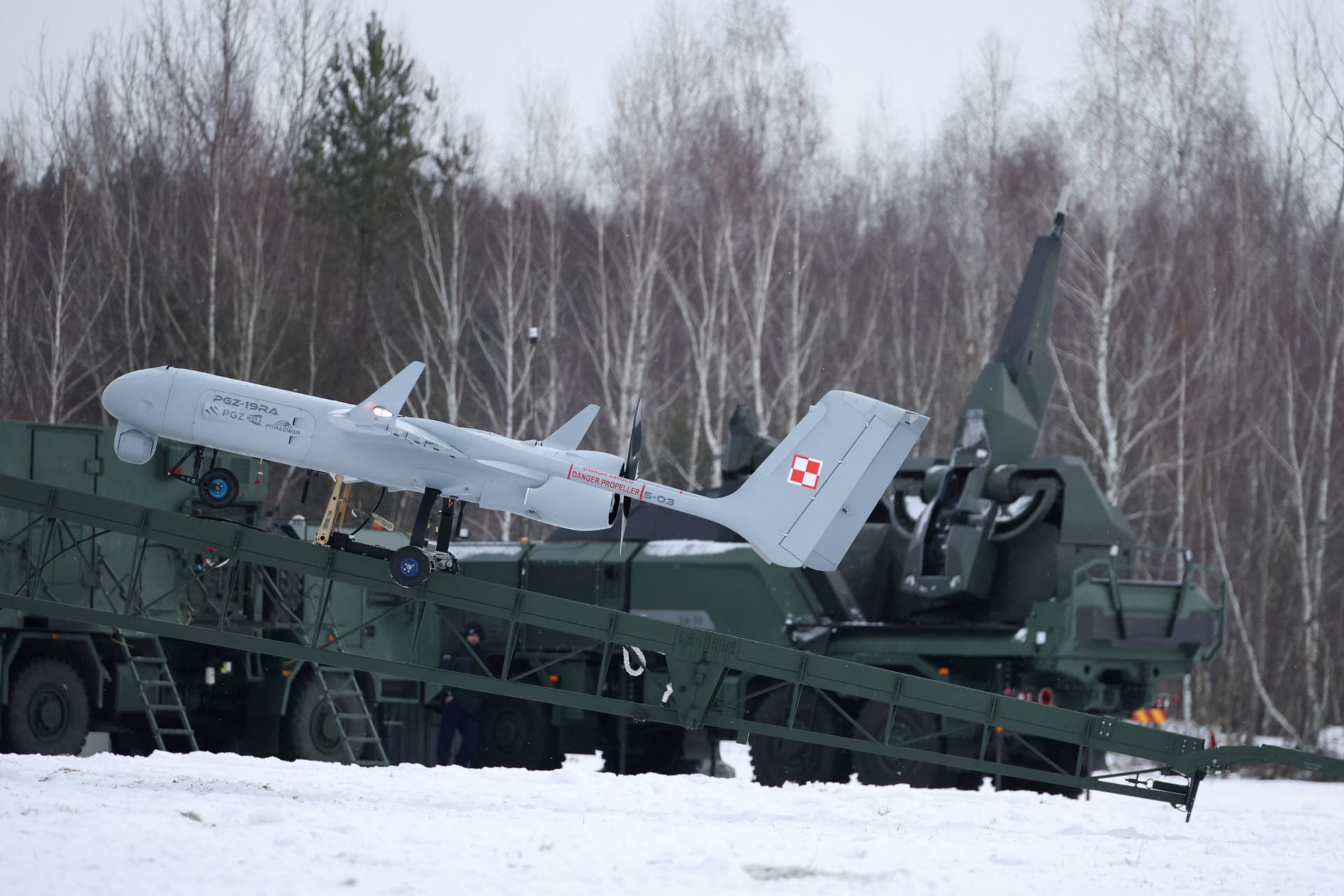
As peace negotiations continue between Russia and Ukraine, Europe should prepare for Russia to step out of the “gray zone” of hybrid warfare activities toward more overt attacks as part of a pressure strategy on Europeans. With transatlantic trust at a historic low, Russia could use the window of opportunity and decide to conduct low-level conventional provocations against European states, for example by using military drones against civilian targets, to further undermine the alliance. Europe needs to prepare to manage such a crisis on its own, without (or with less of) its traditional U.S. backing.
A Window of Opportunity
Russia intensified its use of gray-zone tactics—using hybrid, nonconventional measures just below the threshold of open warfare—in in the last years across Europe to destabilize the West. The loss of trust in the transatlantic relationship raises the risk that Russia could step out of the so-called gray zone and cross the line to low-level conventional attacks against European countries, with the hope that a lackluster response would fatally wound the NATO alliance. At the minimum, such actions would add further pressure on the Europeans during ongoing Ukraine peace negotiations. The United States has already proven useful to Russia in that regard. The transatlantic crisis over Greenland has damaged the credibility of the United States as the traditional security guarantor in Europe and of NATO. Across Canada, France, Germany, and the United Kingdom, more people said the United States was unreliable than reliable. German Chancellor Friedrich Merz echoed popular sentiment at the Munich Security Conference in February 2026 when he spoke about a deep divide that has opened between the United States and Europe.
Low-level Russian conventional attacks do not necessarily have to involve a sizable Russian military contingent. Instead, Russia could use military drones and other, cheaper means to achieve the same desired political effect: demonstrating to Europeans that the U.S. security guarantee is essentially hollow. Given the resource constraints imposed on Russia since its full-scale invasion of Ukraine, a limited attack could be more feasible for Russia than a major landgrab in the Baltic states, for example.
Consider another Russian drone incursion deep into NATO territory, even further than its push into Poland in fall 2025. This time, swarms could replace individual drones. Carrying explosive payloads, they could swerve into an airport or a commercial center, killing European citizens. Russia could once again claim that it was an accident, a narrative that could well find traction in Washington where policymakers are eager to win a peace agreement for Donald Trump in Ukraine. The United States could call for deescalation and mediation, rather than responding with condemnation or committing U.S. forces to respond militarily. A minimal incursion could have maximal effect, shattering the trust that gives NATO meaning. It could also embolden Russia to go further in the future.
Stepping out of the gray zone with low-level attacks could be strategically beneficial for Russia: Low-level attacks raise the chance the United States is unwilling to engage, set meaningful precedent, and wreak havoc on NATO without significant military investment. The victory would be political, not military, demonstrating to Europeans that the United States will only deliver a subpar or delayed response, thereby putting NATO and its deterrence value into question.
Stepping Out of the Gray Zone
Russia has significantly stepped up its hybrid warfare and sabotage activities throughout the last year. The most prominent examples took place in September 2025, when Russian drones crossed into Poland and a Russian fighter jet violated Estonian airspace. Some incidents could have been accidental, caused by recklessness, but some could have been intentional. Regardless, they were political success for Russia because they triggered a mixed NATO response.
Although NATO’s military response was well coordinated and executed (the drones were tracked and intercepted), the political response was muted. European leaders differed on the possibility of shooting down Russian aircraft: Polish Prime Minister Donald Tusk said that Poland would not hesitate to shoot down aircraft violating its airspace, while German Defense Minister Boris Pistorius called for prudence and not playing into Vladimir Putin’s “escalation trap.” The U.S. response was also ambiguous and did not reaffirm U.S. support as strongly as it was needed. Overall, the response may have encouraged, rather than discouraged, Russia regarding any future attempts to step out of the gray zone.
Some European officials believe that ongoing Ukraine negotiations are important enough to Russian President Putin to present a ceiling on escalatory maneuvers he may take. According to their thinking, Putin does not want to risk his relationship with Trump and miss the chance of a peace deal on Russian terms. But that argument also works in reverse: Trump wants a deal on Ukraine more than Putin wants it, and so Trump does not want to put a possible peace deal at risk (especially ahead of this year’s midterm elections) just to respond to a low-level attack.
Regardless of the outcome of current peace negotiations, Europe should brace for an escalation of Russian low-level attacks against European NATO members, before or after a ceasefire deal is reached. With the United States in retreat and Europe only beginning to rearm, it presents a window of opportunity for Russia. Instead of waiting for Europeans to bolster their defenses and deterrence without the United States, Russia has both the tools and the opportunity to step out of the gray zone without risking full-blown conventional war.
Other potential Russian steps, apart from drone incursions at land or at sea, include: an escalation of Russia’s ongoing sabotage campaign in NATO countries, such as downing an civilian airplane over NATO territory through sabotage; the assassination of senior European politicians; an escalation at the Poland-Belarus border, where Russia says it would come to the help of its ally, resulting in fighting; and many more scenarios imaginable that demonstrate Russia’s willingness to use force to pressure Europe.
Russia will hope to minimize, delay, and confuse any U.S. response to such a crisis. This move will leave Europeans on their own, at least initially, to manage such a scenario.
Europe on Its Own
Europe can take steps to prepare for any low-level conventional attacks Russia may launch against Europe, even with the potential of limited, delayed, or subpar U.S. support.
The following recommendations should guide Europe’s preparation and response.
- European governments should demonstrate unity and resolve among each other without waiting for a U.S. response. Even if the first European response takes place in ad hoc or small groupings, rapid responses by the most important European actors would deny Russia the period of confusion and waiting that normally follows its provocations, and which enables Russia to sow chaos and discord. Internal debates about the appropriate levels of response, and the pathways to control escalation, should take place in strictly confidential settings outside of the media discussion. Rhetoric and action need to align among key European NATO member states, for example, with joint and coordinated statements and announcements.
- European governments should prepare a menu of independent defensive and offensive responses that would aim to reestablish deterrence with Russia even with a lackluster U.S. response. Europe, at present, lacks credible planning to respond to Russian aggression at various escalation levels on its own, much less in a timely, unified manner. Offensive measures should be closely coordinated with Ukraine, which has tools available for such scenarios, for example, by using long-range precision strikes on Russian drone factories to signal support on behalf of the Europeans. Ukraine could even preemptively shoot down Russian aircraft or drones over its western territory before they reach NATO member states. Defensive measures should include efforts at drone protection at a justifiable cost-to-effect ratio, as well as further strengthening European NATO member states’ presences in the east, such as deploying more German troops in the Baltics.
- European governments should update the software—the structures and the formats within which Europeans communicate and coordinate—used to manage Russian aggression. Europeans need to establish and train mechanisms of communication, coordination, and escalation control that do not rely on the United States. The Coalition of the Willing, established as a military command structure for a European contingent in Ukraine, can serve as a format for communication, coordination, and escalation management. Points of contact in each European capital should facilitate quick decision-making protocols. Europeans also need to train how to coordinate not only horizontally, but also vertically on the escalation ladder: such as, what is the order of signaling toward Russia, and when do nuclear-capable European states signal their nuclear arsenals in case it is necessary to respond to Russia.
- At the same time, European governments also need to update the hardware (drone capabilities, air defenses) with which it would defend against low-level attacks such as airspace incursions, without necessarily relying on the United States for coordination or communications support. Beyond the obvious gaps in European protection against drones—such as sensors, anti-drone weapons, and electronic warfare capabilities—the lack of air defenses among member states has been a long-recognized problem. Efforts such as the European Sky Shield Initiative alone will not be sufficient to deter Russia, as it relies mostly on the acquisition of individual, rather than integrated, European capabilities. Europeans will also have to consider establishing European-only military command structures to be used outside of NATO, if necessary. The same applies to better European intelligence-sharing as well as the declassification of intelligence for European partners and the public. European states should invest in independent intelligence, surveillance, and reconnaissance capabilities plus communication structures (such as acting in the absence of U.S. early-warning and control capabilities)
- Lastly, European governments should consider establishing their own political and military-to-military channels with Russia. Given that U.S. political and military channels with Russia are likely to be unreliable in a crisis, European governments should have their own such channels available to enhance stability and avoid miscalculation. The risk of discord among Europeans (given that those close to the Russian border fear that such channels would enable rapprochement with Russia) can be minimized by choosing credible political and military interlocutors that are respected by all sides. They would likely come from northern Europe; Finnish representatives have a long tradition of deterrence and dialogue with Russia, for example.
Conclusion: Darker Than Gray
As Dutch Defense Minister Ruben Brekelmans warned in early 2026, “There is a gray area, and as Russia is taking additional steps, the gray zone is becoming darker.” European governments need to prepare to manage a Russia that steps out of the gray zone without the help of the United States. It needs to take precautionary steps to advance Europe’s objectives and update its instruments, as well as the software and hardware of communication, coordination, and capabilities. Deterring and defending against Russian low-level attacks during this period of transatlantic discord poses increased risks to European security; the time to prepare is now.
This work represents the views and opinions solely of the author. The Council on Foreign Relations is an independent, nonpartisan membership organization, think tank, and publisher, and takes no institutional positions on matters of policy.