Task Force Report No. #30
U.S.-Cuban Relations in the 21st Century
A Follow-On Chairman’s Report
- William RogersCochair
- Bernard W. AronsonCochair
- Walter MeadDirector
- Julia E. SweigDirector
What are Task Force Reports?
CFR sponsors Task Forces to assess issues of critical importance to U.S. foreign policy to reach bipartisan consensus on policy recommendations.
Who makes them?
Task Force members aim to reach a meaningful consensus on policy and are solely responsible for the content of their report.
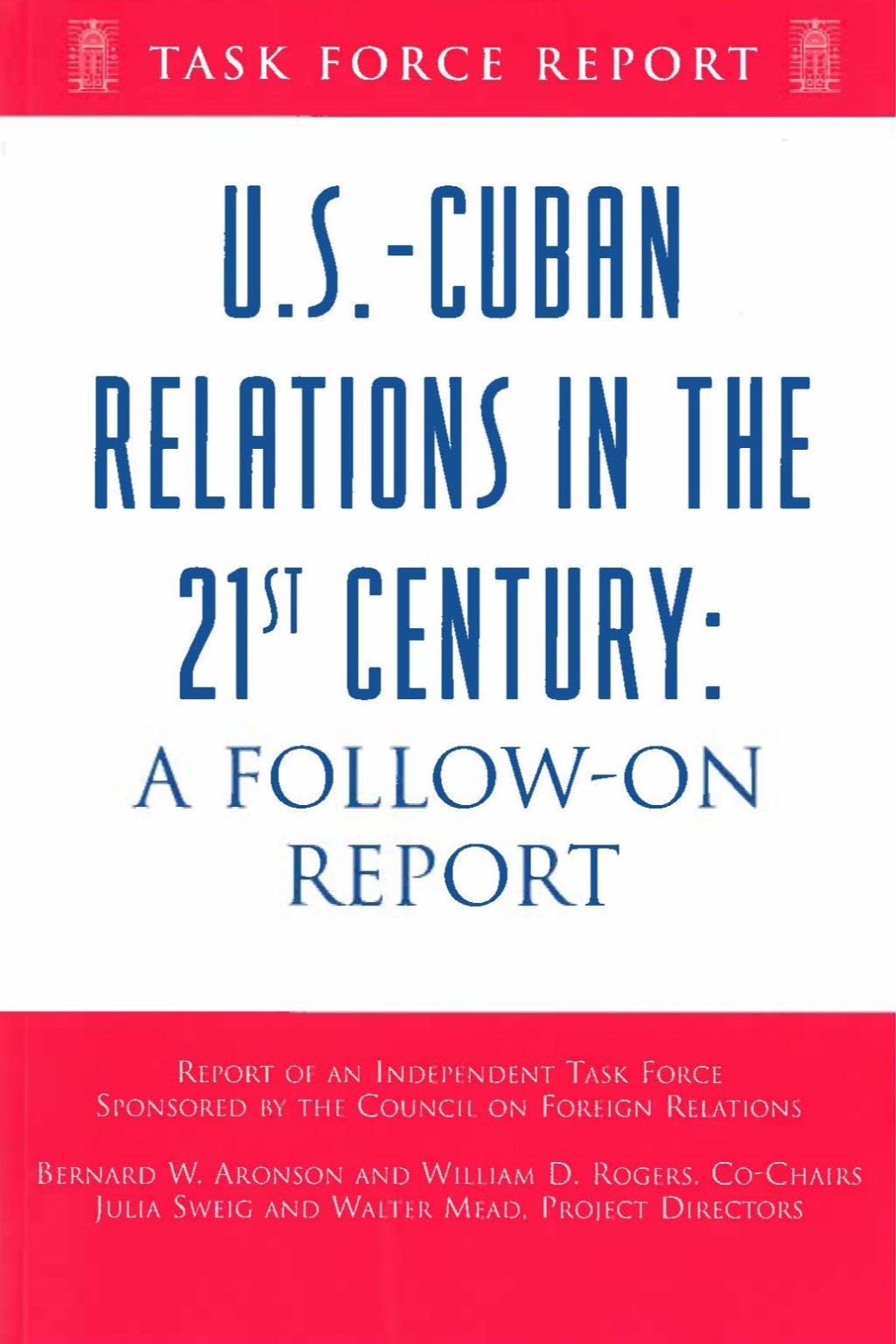
This Independent Task Force report represents a significant step forward in deepening a bipartisan consensus for a new U.S. policy toward Cuba. While avoiding the highly politicized debate over whether to lift the U.S. embargo on Cuba, the report touches on the terms for American investment in Cuba in its recommendation for the settlement of Cuban expropriation claims. The report seeks to stimulate a discussion among those interested in crafting a creative and dynamic policy toward Cuba.
Building on an earlier Council report, Task Force Report U.S.-Cuban Relations in the 21st Century (1999), this report offers four areas of recommendations: family reunification and migration; the free flow of ideas to speed the dynamic currently under way; security proposals to develop relationships and deepen counter-narcotics cooperation, and military-to-military exchanges; and trade, investment, property, and labor rights.
Task Force Members
BERNARD W. ARONSON served as assistant secretary of state for inter-American affairs from 1989-93.
WILLIAM D. RODGERS was formerly assistant secretary of state for inter-American affairs and undersecretary of state for international economic affairs.
WALTER RUSSELL MEAD is the Henry A. Kissinger senior fellow in U.S. foreign policy at the Council on Foreign Relations.
JULIA E. SWEIG is a senior fellow in the Latin America program at the Council on Foreign Relations.
 Task Force Report
 Task Force Report
 Task Force Report
 Task Force Report
 Task Force Report
 Task Force Report