How I Got My Career in Foreign Policy: Steven A. Cook
Steven Cook knew from an early age that he wanted to study international affairs. The longtime CFR Middle East fellow discusses how he found his path and all the places it’s taken him.
By experts and staff
- Published
- Writer/Editor
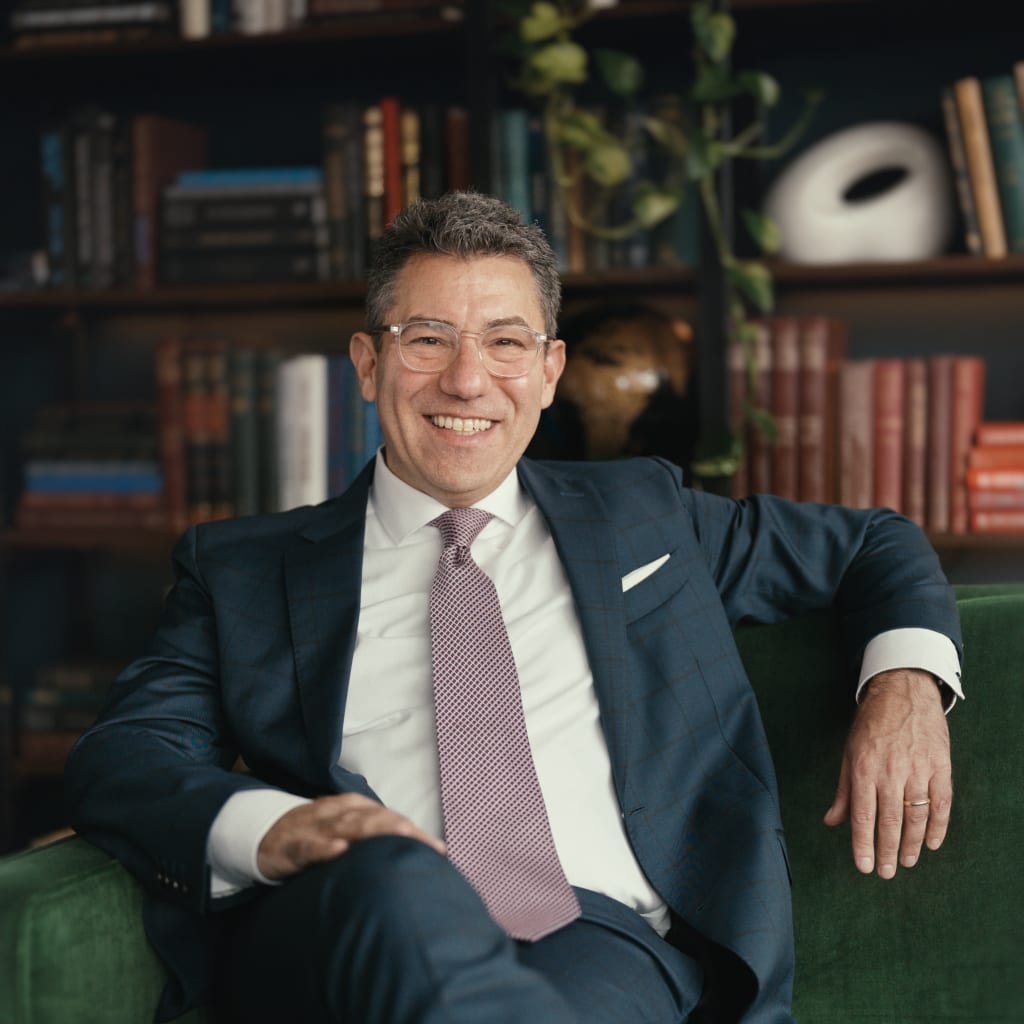 Steven A. CookCFR ExpertEni Enrico Mattei Senior Fellow for Middle East and Africa Studies
Steven Cook’s interest in the Middle East began while sitting in front of the television in sixth grade. Watching the coverage of the U.S. hostages in Iran from his all-American home on Long Island, Cook wondered what made parts of the region hostile to the United States. He studied these questions through three degrees and while traveling the region. Along the way, he discovered that while the world may be vast, the Washington think tank world is surprisingly small—his path to CFR started at Brookings with the Council’s very own Jim Lindsay. Read on for more about how they met, how Cook’s travels involved multiple passports and occasional meals with extremists, and what it takes to write about such a dynamic region.
Here’s how Steven Cook got his career in foreign policy. If you’re interested in this series, check out more editions here.
What did you want to be when you were a kid?
From the moment I could toddle up to around eleven years old, I wanted to be an architect. Every summer, my parents took my sister and me on vacation to Montauk Point. I didn’t come from a wealthy family, and this was back in the 1970s, when Montauk was just a fishing village with a few motels. On the way there, we would pass through these very fancy towns in the Hamptons, and I thought the houses were the coolest things I’d ever seen. I started leafing through books on Frank Lloyd Wright and drawing my own sketches.
I was pretty good at math, but as it turns out, you have to be really good at math and spatial relationships to be an architect. I still can’t even get the dishes in the dishwasher. So from an early age, it was clear that I was not going to be an architect.
But I was always interested in the world. My friends would talk about how they’d always read the sports section of the paper first, and I’d stay quiet. I read the world news first. I kept it a deep, dark secret that my favorite television program was the evening news, because I didn’t want to be ridiculed by my friends.
I’m guessing if you knew your CFR colleagues in their youth, you’d have found some like-minded kids. When did your interest in the Middle East specifically begin to grow?
I was in sixth grade when the fifty-two U.S. hostages were taken in Iran in 1979. My dad was born just before World War II and my mom was born just at the beginning. They loved John F. Kennedy and Lyndon B. Johnson, and that whole idea of the positive use of American power at home and abroad. So it was very odd to me to see millions of people in the streets of Iran, a country I had never heard of, screaming “Death to America.” It didn’t make sense. Weren’t we the good guys? I was fascinated by it, and followed the story very closely.
Another part of this origin story is that my mother’s older sister married an Iraqi Jew. He was studying in the United States when the Nationalist Revolution happened, and then the creation of Israel and the dispossession of the Iraqi Jewish community. He was granted political asylum in the United States, and growing up around him, I’d hear him speaking Arabic. That was really interesting to hear, living on Long Island, which was not the most diverse community in the world.
By the time I went to college, I knew I wanted to be an international studies major.
An international studies major several times over, it seems: you have a bachelor’s, master’s, and a PhD in the field. Were you always drawn to academia, or was that something you discovered along the way?
Simply put, no. When I earned my PhD, my parents threw this lovely party for me. My mom opened a speech with, “to say that Michael”—my late father—“and I are surprised by this outcome is an understatement.”
That’s quite the lede, as we say in the business.
In my freshman and sophomore years of high school, I was a straight–A student. Let’s just say somewhere around junior year, my friends and I started to drive, and that gave us freedom to do all kinds of fun things. I was no longer the model student. I was the kid in the back asking, “Are we responsible for this on the test?” I only picked up a book if I had to write a paper about it.
That changed in college. I found I wanted to throw myself into the interesting intellectual environment there. I was planning on going to Jerusalem for a semester, but then the first intifada broke out, and it felt too dangerous, so I didn’t go. After college, I worked in Washington for two years as a research assistant at the Center for Strategic and International Studies. I experimented in the business world in New York, and discovered I hated it. I still really wanted to go abroad, so in August 1992, I lived in Jerusalem for a year studying Arabic and Hebrew.
I was older than most of the American kids running around on their semesters abroad, so I did things I never would have done in college. I was able to score a second U.S. passport while in Israel. I spent some time in Egypt. From there, I hid one passport, pulled out the other one, and traveled through Syria. Then I went back through Jordan.
After I returned home, I did my master’s degree at the Johns Hopkins School of Advanced International Studies, and later, my PhD, which brought me back to Egypt and to Turkey for my dissertation field research.
How did you get to the Council?
After I did my dissertation research, I came back to the United States on a research fellowship at the Brookings Institution. They gave me a tiny office and a small stipend—no one was dining out on it, to say the least—and my job was to sit there and write my dissertation. But my first day at Brookings was September 4, 2001, one week before the attacks on 9/11.
When 9/11 happened, I got more involved in the Brookings work than a research fellow normally would because of my developing expertise in the Middle East. And who was the senior fellow overseeing the fellowship there but none other than Jim Lindsay. I guess that impressed Jim. It took several more months to finish and defend my dissertation—I swear it’s easier to schedule the G7 summit than to get a dissertation committee together. By then, September 2003, Jim was CFR’s vice president and director of studies under President Richard Haass.
When you’ve been in grad school for years, you go kind of crazy. In the depths of my writing, I declared to my wife that I would not get a new pair of sneakers until I successfully defended my dissertation. I was walking around with sneakers that basically had no sole, saying “ow” all the time because I could feel every pebble on the sidewalk. The day after I defended, she was taking me to buy new sneakers when the cell phone rang. I picked it up and heard, “It’s Jim Lindsay. How’d it go?” I told him about my defense.
He invited me to do a talk at CFR and meet the staff. I got really nervous, I spoke too fast, and was a little more combative with my future colleagues’ questions than I should have been. But I think Jim and Richard saw that they could mentor me. I started at the Council on January 20, 2004, and here we are—four books, hundreds of articles, two children, and twenty-two years later.
What did living in the region teach you that all your time in the classroom couldn’t?
I’m never going to tell you that book learning isn’t important. People need to read history and political science, but there’s nothing like being on the ground. Throughout my career, I’ve never said no to an opportunity like that. When I was around twenty-three, I got connected with someone at the United Nations who took me to a Palestinian refugee camp in the West Bank. I was always curious and talking to people to learn more about their lives.
I also think the ability to learn the language provides extraordinary cultural grounding. It’s limited, because you’re still a foreigner, but it helps a lot. When I lived in Ankara, where very little English is spoken, you either used Turkish or nothing—which made my Turkish quite good.
Egypt and Turkey have long been your major areas of interest, but of course, world events require you to also focus on places like Israel and Iran. How do you balance keeping up with each country’s distinct politics?
Egypt and Turkey will always be my bread and butter, but—with unbelievable respect to my friends and colleagues who work on one country—I’m too curious about too many things. I’ve become increasingly drawn to other issues in the Gulf. I wrote for the Council’s Future of American Strategy initiative about this clear power shift from older countries in the Middle East—like Egypt, Iraq, Syria—to the Gulf states—Saudi Arabia, Qatar, and the United Arab Emirates—which is super fascinating to me. I wrote a book about the Arab uprisings, and that led to a deep desire to write another book and learn about the U.S. role in the region. So I have a lot of different interests.
As for how I keep up with it all, I have talented research associates and interns. At the end of every week, they hand me a reading folder of the important issues in the region that I typically read on Sunday evenings. It’s an opportunity to catch up on what happened in Algeria or Jordan, for example, or things that I’m interested in but don’t have enough hours in the day to be watching.
You mentioned your books—did the process of researching and writing any of them change your mind about the thesis you had going into them?
No book is the same. There’s always been things that surprised me, and the arguments change as you’re writing. I didn’t really know what the big idea in The Struggle for Egypt: From Nasser to Tahrir Square was until I was almost done with it. I was piecing it together as I researched, but the writing was really the problem-solving exercise for me.
The conventional wisdom on Egypt has always been that it’s quite stable. “Egyptians are the people of the Nile, they want stability,” I’ve heard plenty of diplomats say. It sounds very deep, but I don’t know what that means.
If you look at the political history, Egyptians have been in open revolt against their rulers since 1882. As I finished The Struggle For Egypt, the uprising against Hosni Mubarak happened. The book became this perfect arc because I started it in 1882, arguing that this country is not as stable as it’s portrayed. I was making the point that Egyptians want better governance, and then the uprising happened. People called me an Egypt expert before I wrote The Struggle for Egypt. After I finished, I realized I thought I knew a lot about the Arab uprisings before, but I didn’t know what I didn’t know until I took the deep dive.
Other than getting to write books, what appeals to you about the think tank world?
I get to pursue my intellectual interest and be part of a conversation in the policy world. I believe very strongly in the production of knowledge, but at the same time I like to think about how I can bring it to policy decision-makers. I probably would have been a very happy academic at a small liberal arts college, spinning out books and having fun teaching. But there’s something unappealing to me about these big research universities. I didn’t want to spend my career fighting over methodological differences and approaches to certain things.
I get a lot of independence by being at the Council, and the fun of being in Washington, briefing members of Congress, and meeting with people at the White House. I wouldn’t necessarily be able to do those things if I was in a traditional political science department.
Has the role of think tanks changed since you entered the profession?
Think tanks used to be a little more staid. Now I think they’re a lot more proactive in seeking to influence the policy process in interesting ways. There’s some dangers to that. We want to be doing the best possible rigorous work, and very often in Washington, everybody’s chasing news cycles. You see this with the Iran war; the president will say we’re close to a deal, and then everybody spins like a top. There is a risk in trying to be influential because you end up chasing the news cycle, rather than stepping back and providing superior context and analysis. I think the Council handles it quite well.
What advice would you give to young people today who are interested in working on Mideast politics or policy?
My advice is probably the same that I would’ve given twenty years ago: sharpen your writing skills, study languages, and learn something about economics. I would also say, you have your entire adult life to be in an office in Washington. DC is a weird place. Spend some time not just in other parts of the United States, but in other parts of the world. It was formative for me when I did it at twenty-three, and again when I was doing my dissertation field research.
I always say to my research associates that if they came into my office one day and said, “Boss, it’s been great, but I’m gonna go and walk the face of the earth for a year,” I’d say, “Go for it.” In your twenties, you can sell your furniture and be gone in twenty-four hours. You can’t do that when you’re older. I miss the days when I could live in another part of the world for a long period of time.
If I asked for a story that we’d never know from reading your bio, what comes to mind?
I have so many stories. My wife calls them “Council stories,” as in, this could only happen because you’re at CFR. Once I had lunch with the Houthis in Oman. They brought this banner that read “Death to America, death to Israel, curse upon the Jews, victory for Islam.” We’re sitting there, and I asked, “Do you actually believe what’s on your flag?” I found out it wasn’t for dramatic effect, they were true believers in this stuff.
Another time I was with Palestinian citizens of Israel in a town that was a stronghold of the Islamist movement within Israel. I’m having this amazing lunch with these guys, and as we’re talking, I’m realizing, “Oh my god, these guys are basically Hamas. I’m having lunch with Hamas.”
I can’t imagine what was going through your head during those conversations.
Well, the dinner I actually want to tell you happened in Manhattan. Music fans will know Ahmet Ertegun as the founder of Atlantic Records. He was a CFR member, and Ahmet took a liking to me. I would go to his office, which was full of pictures of him with the Rolling Stones and Led Zeppelin, and I thought it was the coolest thing ever. He’s originally Turkish, and only wanted to talk about Turkey, while I wanted to talk about music. But I always felt like I couldn’t waste his time asking, “What’s Mick Jagger really like?”
Ahmet invited me to a private dinner with Turkish Prime Minister Recep Tayyip Erdoğan, who is now president, when he was visiting New York. For Ahmet, a private dinner meant seventy-five people in his unbelievable home.
When I got there, I didn’t look at my table assignment until they called everyone to sit down. I flipped over my card: table one. It’s got to be a mistake, I thought, but I’ll go see if there’s a matching card for my name. I go over, and there is a card for Mr. Steven Cook. Sitting to my right is Senator Chuck Schumer, across from me is Charlie Rose. Next to him is Ronald Lauder, head of the World Jewish Congress and heir to the Estée Lauder company. Then it’s the wife of UN Secretary-General Kofi Annan, Henry Kissinger, Erdoğan, his interpreter, and the wife of a Turkish financier. And me. This was 2005. I’d just started working for the council in 2004 with my newly minted PhD.
Ahmet saw you as a VIP early on!
I kept wondering why I was at this table. It was clear that Kissinger was also wondering why I was at this table. Everybody else was really nice, asking Schumer questions, Rose and Lauder were holding court, and Mrs. Annan was lovely. The prime minister spoke no English, but this was when he still said he was a reformer, so it was fascinating to speak with him. It was quite the table. And me and Kissinger were both thinking, “Someone here doesn’t belong.”
I’m officially convinced that you’ve had a meal with just about everyone. Hopefully you proved yourself to Kissinger, and maybe one day you can get the chance to sit down with Mick Jagger, too.