Iran’s Protests and the Internet Blackout That Followed
The regime is facing one of its largest protest movements in years. Tehran has shut down internet and telephone communications as the demonstrations grow more violent.
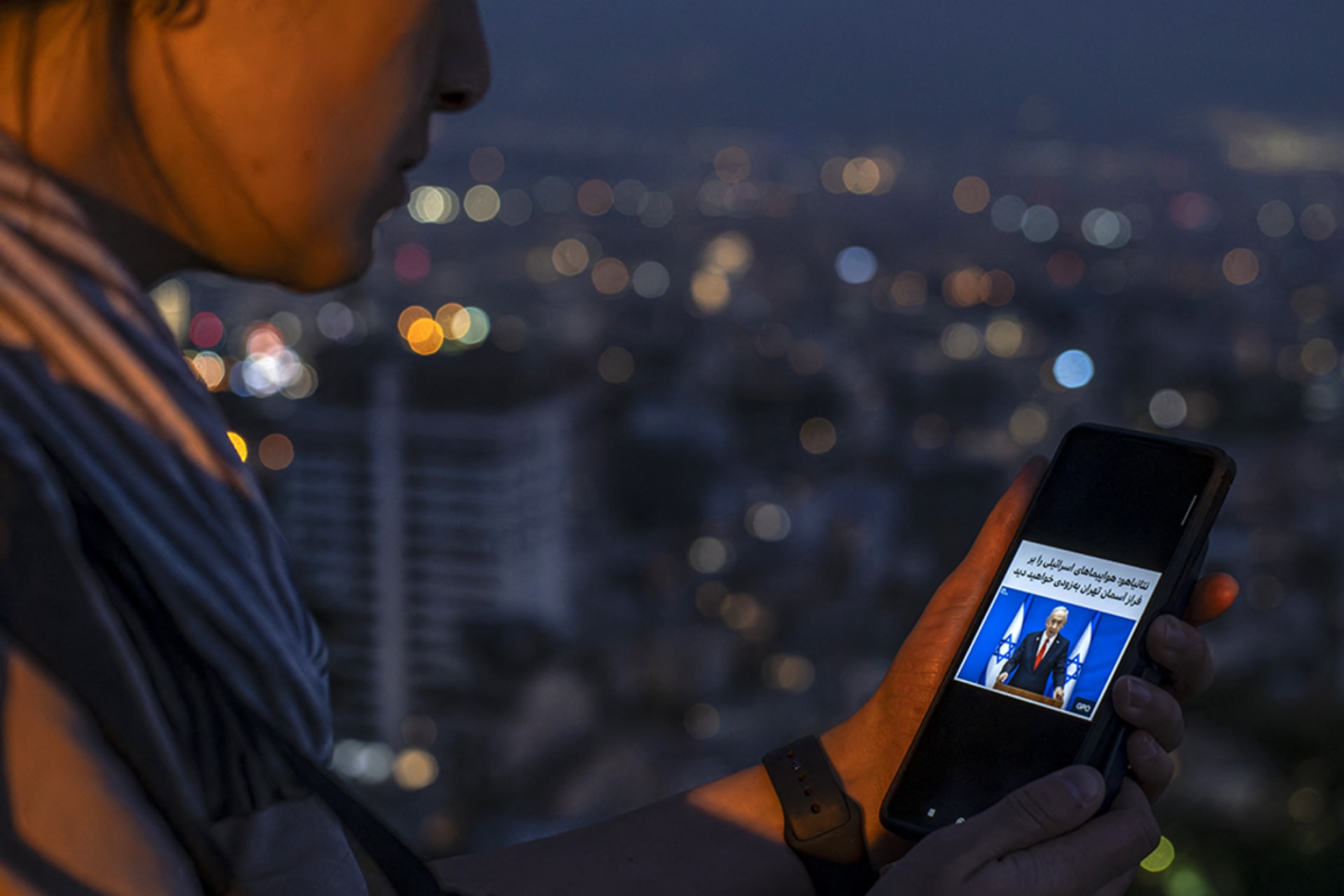
After nationwide protests broke out in December against the Iranian government, the regime decided it would try to quash the turmoil by leaving Iranians—quite literally—in the dark.
Iran’s authoritarian regime cut internet and phone services in response to nearly two weeks of antigovernment demonstrations that have overtaken the country. The blackout left Iranians without the ability to obtain vital information, such as safety warnings and the whereabouts of their family members. It also attempted to obscure the picture inside Iran from global onlookers.
Iranians have been posting footage of the protests that have since been verified by Western news outlets. Videos coming out of Iran show large groups of people demonstrating and chanting in the streets. In others, viewers can see Iranians fleeing gunshots as fires billowed out from government buildings, cars, and other items on the roads.
Death toll reports vary widely, partly as a consequence of the clouded information landscape. The U.S.-based Human Rights Activists News Agency (HRANA) reported that as of January 15, at least 2,615 people have been killed in the demonstrations so far, 2,435 of them protesters and 153 of them security forces, with another 882 death reports under investigation. The group says that 18,470 individuals have been detained.
It is common for information to be restricted in Iran, and the regime also closely monitors what narratives leave its borders. “The internet shutdown causes economic damage, which is why it has been done sparingly. This time, it seems [to be] a more significant cutback,” CFR Iran expert Ray Takeyh told CFR. Despite the government’s efforts, the public has still found ways to share information with the world, experts say.
Iran’s Latest Protests
On December 28, Iranians began taking to the streets due to increasing economic hardship, as the country’s currency collapsed. With large swaths of Iranians under financial strain and upset at the government’s response, many are now openly calling for regime change.
Protests were initially limited to merchants and students in urban areas in response to growing economic challenges. But the demonstrations have begun to spread across the country and developed into the largest antigovernment movement that Iran has seen in several years. Slogans reportedly adopted by the protesters indicate expanding demands and growing dissatisfaction with the regime’s leadership.
Residents in Tehran told the New York Times that crowds are chanting “Death to Khamenei”—in reference to Iran’s Supreme Leader Ayatollah Ali Khamenei—and “freedom, freedom.” By mid-January, HRANA had recorded protests in more than 187 cities across all of Iran’s provinces.
Earlier that month, Khamenei said on state television that the government would “not back down” and accused protesters of attempting to “please” U.S. President Donald Trump, who had threatened military action if more protesters are killed. Iran’s Supreme National Security Council said that “no leniency” would be given to “saboteurs.” Tehran’s public prosecutor, Ali Salehi, has threatened the use of the death penalty as part of the government’s response. Both the United States and Iran have said their communication lines are open for negotiation, though Iran’s foreign minister also indicated the country was prepared for war.
The Regime’s Blackout and Response
While protests began peacefully, they had grown violent by early January. Amnesty International called out the Islamic Revolutionary Guard Corps (a branch of Iran’s military) and Iranian police for “unlawful use of force and firearms and mass arbitrary arrests,” with authorities reportedly using “shotguns loaded with metal pellets, water cannon, tear gas and beatings to disperse, intimidate and punish largely peaceful protesters.” The group also accused authorities of trying to cover up recent deaths. Controversy has also swirled over the regime’s denial of plans to allegedly execute imprisoned protesters.
As protests swelled, the country plunged into an internet blackout on January 8, which has persisted for several days. Data from NetBlocks, an internet monitoring group, revealed a sudden, near-total drop in connectivity in Iran. The group said that this indicated Iran was “now in the midst of a nationwide internet blackout,” adding that this “follows a series of escalating digital censorship measures targeting protests across the country and hinders the public’s right to communicate at a critical moment.”
“The lack of internet is designed to prevent protest leaders, if there are any, from contacting each other,” Takeyh explained. “It is a means of isolating individual marches and thus having them peter out.”
However, the attempts to suffocate organizing seem to have only further provoked protesters, according to several news outlets. Since January 9, reports of more gatherings have grown. At the same time, the regime’s response has also hardened. The authorities are now using “the most brutal amount of force” and intensifying their language by categorizing protesters as terrorists, Sanam Vakil, Middle East expert at Chatham House, said at a CFR event. “We’re only going to begin to hear about the wide-scale death and destruction in the coming weeks—if not longer—and I think it’s going to be much higher than anything we’ve seen before,” she said.
The Information Landscape Under the Regime
By some metrics, life in Iran is more modern than many outside the country might expect. Life expectancy is seventy-eight years, equal to that of the United States. The literacy rate is pushing 90 percent, there’s universal access to electricity (when the government keeps the power on), and the UN Human Development Index ranks Iran higher than the global average.
But strict government rule casts a long shadow over Iranians’ lives and access to information. Leading watchdogs including Freedom House and Amnesty International highlight the lack of personal freedoms, as the regime has stifled expression and demonstration—including public singing and dancing—restricted women’s rights, and imposed a ban on LGBTQ+ activities.
The majority of the country’s news comes from Farsi-language outlets based outside Iran. “There’s no free media,” said Takeyh. “The landscape has become much more barren over the last twenty years as the regime clamped down more.” Any outside reporter that crosses Iran’s borders is saddled with a government minder, limiting the places they can go and whom they can talk to.
As the current protests unfold, getting a clear picture from the outside is challenging, too, Vakil said. ”We don’t have regular, reliable information…and journalists are scrambling to verify videos.” A particular feature of these protests, she added, is “a lot of misinformation and disinformation that is adding layers of confusion to the scene…and that makes it all the more challenging to reliably assess what’s happening or have evidence as to what’s happening.”
Many international outlets do not have reporters stationed in Iran for safety reasons, but the regime can attempt to deter or influence the journalists covering Iran even when they are outside the country.
“They can’t reach us, so they go after our families,” Bahman Kalbasi, reporter for BBC Persian, told CFR in June. The regime has arrested and harassed his family members and taken away their passports. This has happened to many other Iranian journalists’ families as more foreign outlets seek to cover Iran.
The government initially imposed a strict ban on foreign outlets as digital media grew more popular around the rest of the world. It deployed satellite jammers to intercept the signals of those who had illegally set up television dishes. But the dishes have become so ubiquitous across rooftops—at least 70 percent of houses have them as of 2024—the regime has struggled to keep up, experts said.
Social media is another avenue Iranians get their information. News accounts on platforms like Instagram are banned in Iran, but many Iranians use virtual private networks (VPNs) to stay connected—the BBC Persian’s twenty-two million followers among them. Traffic to Radio Farda’s Instagram shot up 344 percent, and web traffic 77 percent, in the days following Israel’s June strikes. (Typically, Radio Farda sees about 6.5 million Iranians, about 10 percent of the population, visit its website in a year.)
Telegram channels and other alternatives are also a substantial source of news. In the aftermath of the Israeli strikes, data from Google Trends showed soaring interest for these messaging apps, as well as traffic for VPNs and the banned satellite service Starlink. Starlink has begun offering free services, providing a line of communication to the outside world amid the current outage in response to protests.
“Iran is not a country where you could cut people off from what’s going on outside,” Kalbasi said. “People find out everything. Information arrives in one way or another.”
A Closer Look at Dissent
Information flows out, too, largely due to the Iranian public. The government is known for holding information close, whether about nuclear activities or human rights. But its people are widely uploading their own accounts of what’s happening in Iran, and their footage often winds up in external reporting, regardless of whether it was sent to outlets directly or posted publicly.
The Iranian people have long been vocal about dissent in their country, dating back to those who ignited global attention with the Green Movement protests in 2009. The “Woman, Life, Freedom” protests in 2022 also made headlines around the world, triggered by the death of twenty-two-year-old Mahsa Amini, who died in police custody for refusing to wear her hijab. Videos of mass protests and personal accounts of life during these demonstrations helped document those movements.
Iranians are largely opposed to the regime, Takeyh said, a trend in part driven by how young the country’s population of ninety million skews—more than 60 percent of its people are under thirty years old. Many in this generation are outspoken about their hostility toward the regime, risking their safety to defy the rules. But the bite of Western sanctions has changed the stakes of their defiance. When it comes to U.S. involvement, Iranians are frustrated and stuck by the haranguing U.S. sanctions on their country.
“The youth are sacrificing and endangering everything they have because they don’t have much left to lose and because they just don’t want to deal with it anymore,” Kalbasi said. “They want to express themselves.”
Many of them are doing so—most visibly, in recent years, by removing their hijabs. Now it is commonplace to see women without them in public spaces, which was nearly unheard of before the Woman, Life, Freedom movement. “Women just decided, slowly but suddenly, en masse, to take off their hijabs,” Kalbasi said.
Culture and the arts are also major avenues for Iranians to express themselves, whether that be musicians who perform as an act of defiance or everyday youth who upload their own creative content. Iranians are ultimately trying to live life and stay connected with the world by consuming and creating culture just the same. “Everything that you see in the United States, if it’s fashion or comedy—all kinds of content creation—you’ll find the equivalent in Iran,” Kalbasi said.