Orbán’s Fall in Hungary Opens a Door for Europe — and Closes One for Russia
Longtime Hungarian Prime Minister Viktor Orbán suffered a massive defeat in his country’s elections, with the opposition party claiming a supermajority. The country’s new leader, Péter Magyar, now has the chance to unwind sixteen years of illiberalism and play an important role in the future of NATO and European integration.
By experts and staff
- Published
Experts
![]() By Liana FixSenior Fellow for Europe
By Liana FixSenior Fellow for Europe- By Benjamin HarrisResearch Associate, Europe and U.S. Foreign Policy

Liana Fix is a senior fellow for Europe at the Council on Foreign Relations (CFR). Benjamin Harris is a research associate for Europe and foreign policy at CFR.
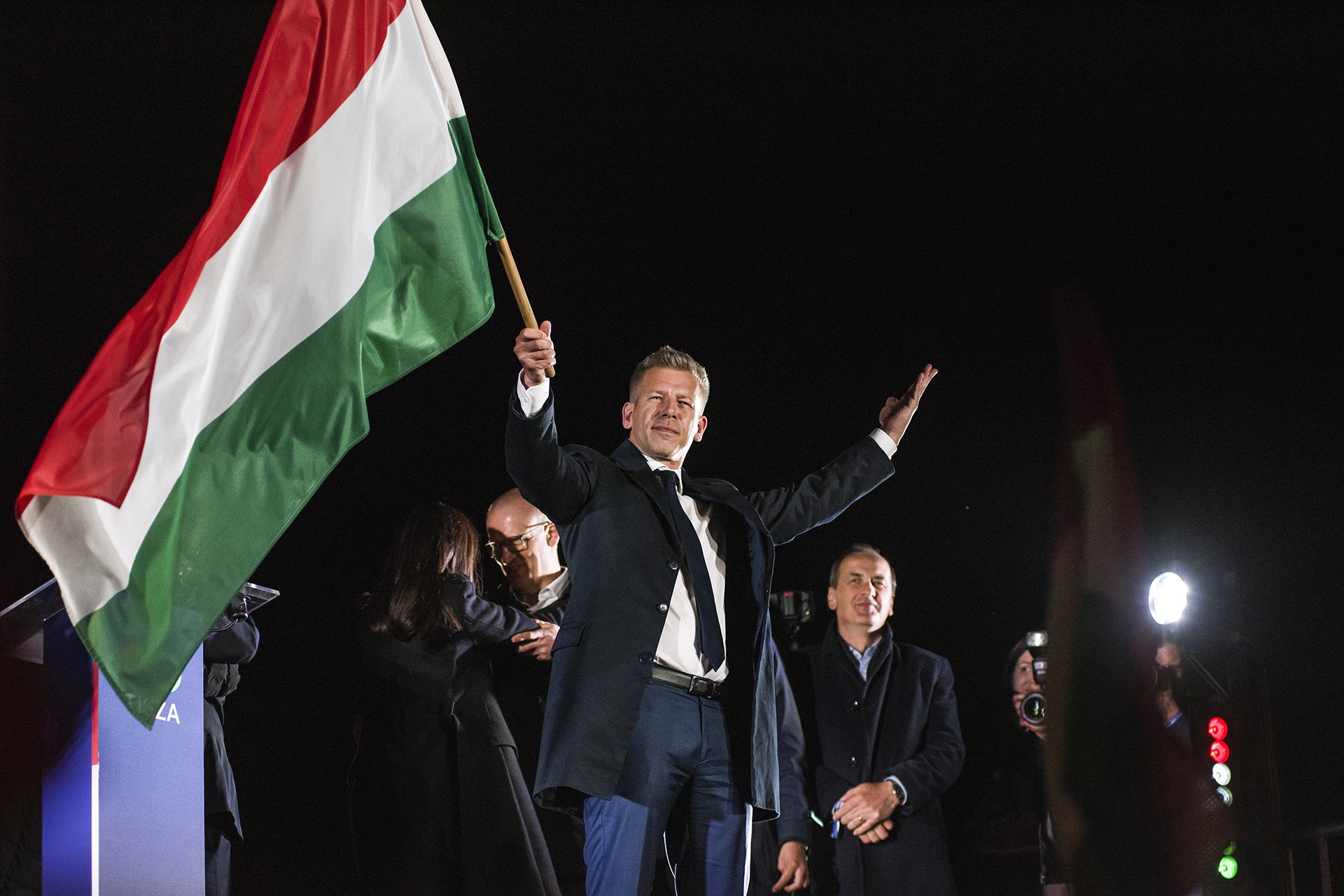
Péter Magyar’s Respect and Freedom Party (Tisza) defied expectations by securing a two-thirds supermajority of seats in the Hungarian parliament after the country’s elections on Sunday. This gives the new ruling party the opportunity to change Hungary’s constitution and unwind outgoing Prime Minister Viktor Orbán’s efforts to rewrite election rules and consolidate power in the media, judiciary, budget council, and across the public life.
These changes are what ultimately backfired on Orbán. His strategy of transforming Hungary’s electoral system through gerrymandering and supermajorities helped Tisza take home just over 53 percent (of the preliminary count, as vote counting is not yet complete) and two-thirds of the seats in parliament. Voters appeared unconvinced by the claims made by Orbán and his party, Fidesz–Hungarian Civic Alliance (Fidesz), that Ukraine and the European Union (EU) were Hungary’s greatest threats. After sixteen years under Orbán’s leadership, it seems that Hungarian voters were primarily concerned about the economy and corruption.
With Tisza’s commanding lead in an election that saw 80 percent turnout of the voting-eligible population—the highest rate since the fall of communism—Magyar now has the mandate to gradually liberalize the country and pursue deep reform. This massive defeat of Orbán, the most vocal and influential voice in Europe’s far right, will have important implications for Ukraine, NATO, European integration, the far right in Europe, and Hungarian relations with the United States.
Consequences for Ukraine and NATO
Orbán’s loss clears the way for greater European support for Ukraine, although the Tisza party is expected to oppose sending weapons or troops to Ukraine. Orbán recently blocked a 90 billion euro package loan for Ukraine, leaving it in limbo for weeks, while Magyar had explicitly campaigned on freeing that loan to fund Ukraine’s defense effort. Magyar’s win could also clear the way for a new sanctions package on Russia, which Orbán had also vetoed. The incoming prime minister has promised to put an end to Russian influence in Hungary, which would boost momentum for European efforts to place more pressure on Russia (as it will be difficult for Slovakia’s Prime Minister Robert Fico to maintain the opposition to harsher sanctions alone).
Together with Magyar’s promise of restoring relations with NATO allies and greater defense spending to meet NATO’s 5 percent spending goal, Hungary’s new leaders could help build a more unified NATO–EU front. The one question that could linger surrounds energy: Hungary has remained a major consumer of Russian hydrocarbons. However, Magyar could gradually wean the country off that dependence by diversifying and pursuing alternative energy routes, especially if the EU is willing to provide support to help Hungary transition.
European integration and Ukraine’s accession
For the European Union itself, the election victory will prove a much-needed boost as Orbán has opposed deeper EU integration—especially on foreign policy matters. European Commission President Ursula von der Leyen has called for an end to the national veto, whereby any national government can, on its own, block EU decision-making in foreign policy. Orbán, in part, inspired the change that he has long opposed.
This would be a significant step towards reform for a more efficient EU foreign policy. However, Magyar has opposed fast-tracking Ukraine’s EU integration and has tied Ukraine’s chances of eventual accession to the EU to a referendum (in a Ukraine-skeptical population).
A stumble for the far right
Orbán’s defeat is a major loss for the far right in Europe. Orbán was, in many ways, the pioneer of the current form of European illiberalism and championed populist anti-EU and anti-migration messaging long before others adopted it. Orbán also hosted the global Conservative Political Action Conference (CPAC) and has enjoyed the support of the Trump administration. The week before the elections, Vice President JD Vance visited Hungary to rally others in support of the Hungarian strongman.
This also indicates that European politics remain somewhat insulated from outside influence attempts, as voters primarily focus on domestic issues. For the Trump administration, it demonstrated that support for a “Make Europe Great Again” movement might be weaker than anticipated, although Magyar will likely try to maintain close ties with Washington.
Orbán’s loss also adds to a trend in far-right politics in Europe, wherein parties close to Moscow perform worse than far-right parties more critical of Russia—as seen in Italy. This trend will likely further trouble far-right parties in France and Germany, which have consistently struggled to productively position their views on Russia and their relationship with the Trump administration in a way that appeals to voters.
This work represents the views and opinions solely of the author. The Council on Foreign Relations is an independent, nonpartisan membership organization, think tank, and publisher, and takes no institutional positions on matters of policy.