The World Should Not Ignore China’s Undervalued Currency
A weak renminbi directly led to China’s latest export boom, and a stronger renminbi is the only realistic cure.

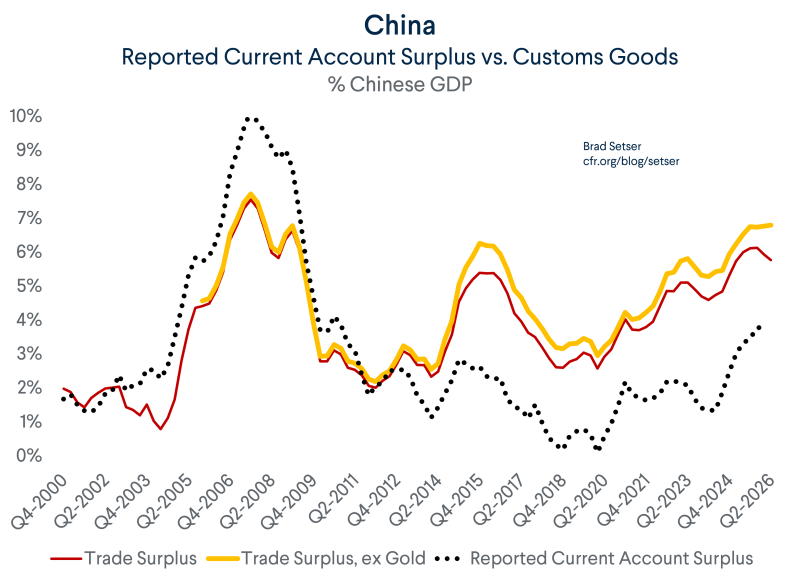
China’s current account surplus is now reported to be around 4 percent of GDP—or 3 percentage points higher than what the IMF estimates it should be. That works out, using the IMF’s own calculations, to an undervaluation of roughly 20 percent.
If adjustments are made for China’s surging gold imports (1.5 percent of GDP in Q2) and its obviously misreported investment income balance (China reports a deficit of $125 billion on $4 trillion in net assets, something that no one—the IMF included—can explain) the current account surplus would rise to around 6 percent of GDP and the estimated undervaluation would increase to between 30 and 35 percent. The upward adjustment to China’s surplus should not be controversial: the customs surplus excluding gold is now an incredible 7 percent of China’s GDP, the services deficit is only 1 percent of GDP, and a long history of surpluses should lead to a positive net foreign asset position and thus external investment income (as in Korea, Taiwan, and Japan).
China not only runs a large surplus. Its government, rather obviously, controls the movement of its currency. The People’s Bank of China (PBOC) sets the daily midpoint for market trading and the state commercial banks (perhaps acting on behalf of the PBOC) buy and sell foreign exchange to keep the yuan within that band. Recently they have been buying foreign currency in size (something like $2 billion per trading day, $50 billion a month) to keep the yuan from strengthening toward the upper edge of the band. The yuan, in other words, goes where the PBOC wants it to go.
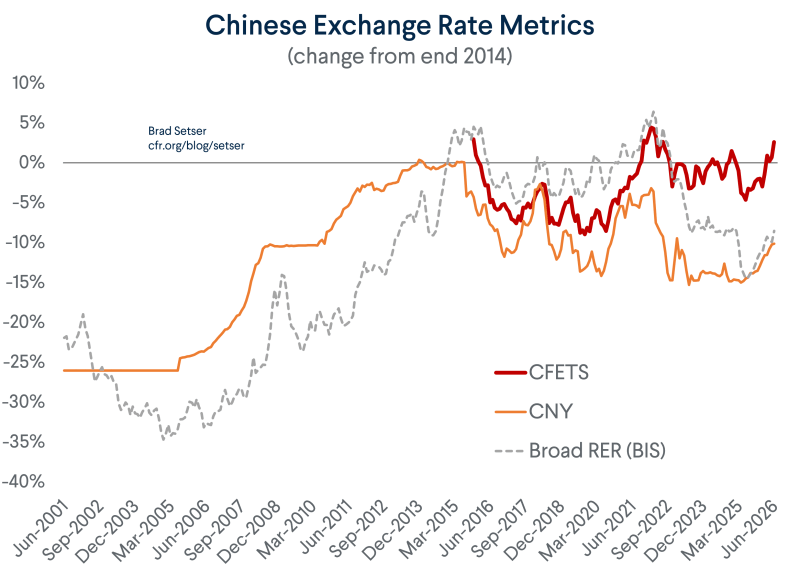
That has been obvious for some time—and is particularly obvious in the last few years. The PBOC kept the “fix” (the midpoint for trading, notionally) more or less constant from mid-2023 to mid-2025, and since then, the renminbi has been on a slow, controlled, move upward—though it still has a ways to go to get back to its 2021 or early 2022 levels.
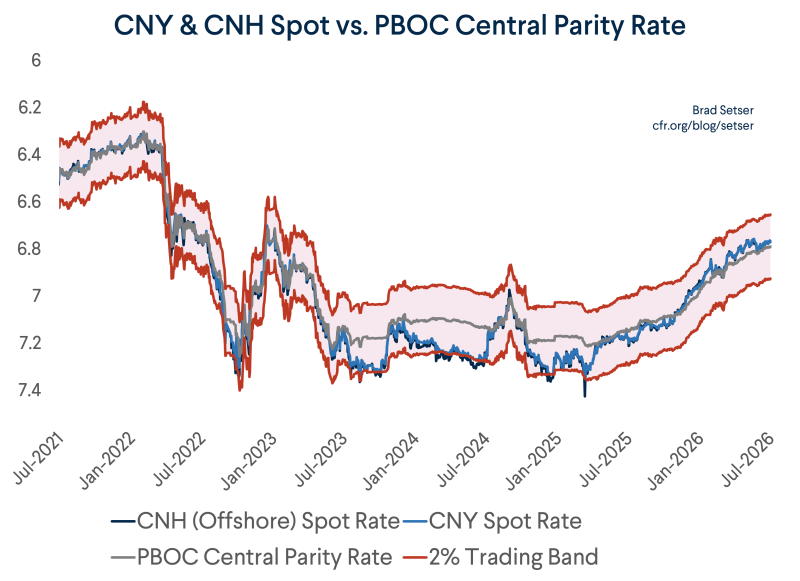
Moreover, China still has a largely closed financial account. It effectively has chosen to limit financial flows so as to allow both a stable (or controlled) currency and domestic monetary policy autonomy. The exchange rate isn’t set by interest rate differentials and unconstrained financial flows, but rather by the signals sent by China’s central bank and the exporters’ incentive to convert the current account surplus back into yuan.
That too has been obvious to close observers this past year.* It explains why “settlement” (the net purchase of foreign currency by the state financial system) surged as the PBOC started to set stronger “fixes” and the renminbi started to appreciate.
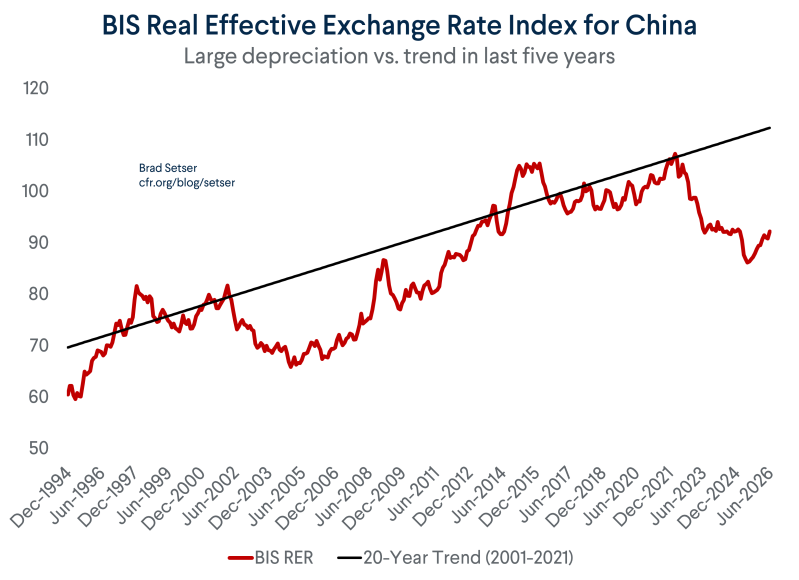
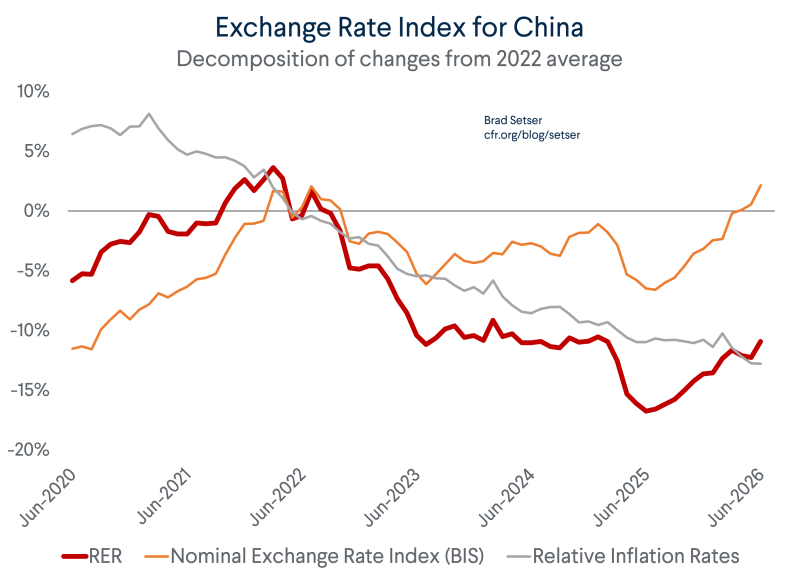
Given the extent of the undervaluation of the renminbi and the scale of China’s surplus both relative to its own economy and relative to the economies of its trading partners, the most obvious way China could bring its trade accounts into a bit better balance would be to allow the renminbi to strengthen. It currently is roughly were it was against the dollar in 2008—and in inflation adjusted terms against a basket of its trading partners, it is something like 10 percent weaker than it was ten years ago—and China’s currency should have a trend appreciation so the gap between its current level and where it should be has become quite large.
Yet a collection of the world’s most distinguished international economists—the former deputy managing director of the IMF, the former chief economist of the IMF, and the incoming chief economist of the Bank for International Settlements—argue that the world shouldn’t press China to change how it manages its currency.
They argue a mix of two things: one, that exchange rate moves don’t have all that much of an impact, and two, that pressure for a stronger RMB wouldn’t really work even if China moved the exchange rate a bit, because any nominal appreciation of the currency would result in more deflation and thus no change to the inflated-adjusted value of the yuan. The correct policy, they argue, is to wait for China to conclude on its own that it needs to do more to support domestic demand, as stronger domestic demand growth will eventually reflate the Chinese economy and generate a real appreciation of the yuan.
That could mean waiting for an awfully long time.
The cost of waiting is not something these prominent voices explicitly discuss, but it could be large.**
The status quo isn’t defined by a large but static Chinese surplus. No, the status quo is one where China relies on an increasing surplus to make up for the ongoing weakness of its own internal economy.
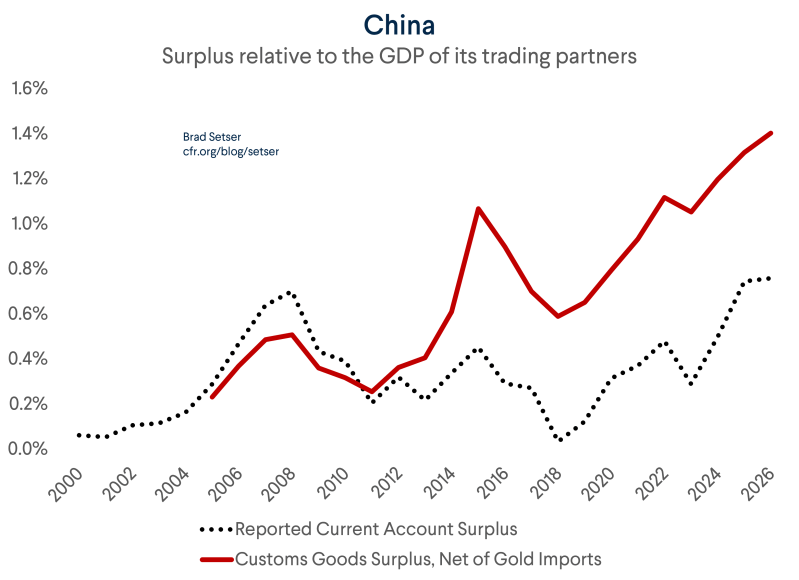
Waiting for China to change thus means accepting more Chinese exports, less production of traded goods in the U.S., Europe, Japan, and India, and an increased concentration of global industrial production in China, with all the dependencies that generates.
I offer five points in rebuttal of the arguments put forward by Gopinath, Gourinchas, and Rey.
1. China’s currency management actually matters; it isn’t secondary to other fundamentals
Back in 2022 and 2023, the renminbi depreciated by 10-15 percent against the dollar and by roughly half as much against the basket.*** That nominal move would not have happened without the tacit support of the PBOC.
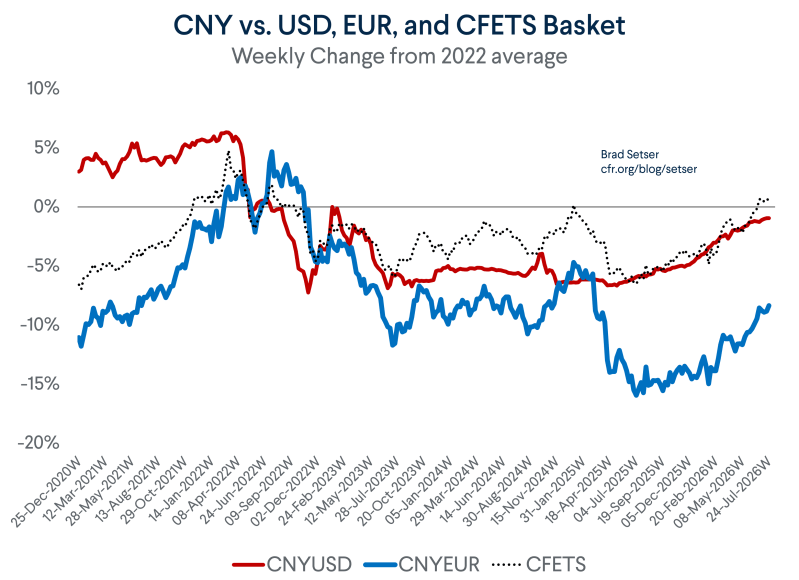
We know this because, once China wanted the move to stop and the renminbi to stabilize, they held the fix constant and the weak edge of the band constrained the yuan’s movement (this is the period when the banks were also net sellers of foreign currency, though on a more modest scale than they are now net buyers).
At the time, China was experiencing deflation as a consequence of its unresolved property crisis and Xi’s unwillingness to stimulate household spending (he preferred direct lending to support investment in manufactures), and the U.S. and Europe were experiencing significant inflationary pressures, so the change in the real exchange rate was close to the change in the nominal dollar-yuan exchange rate.
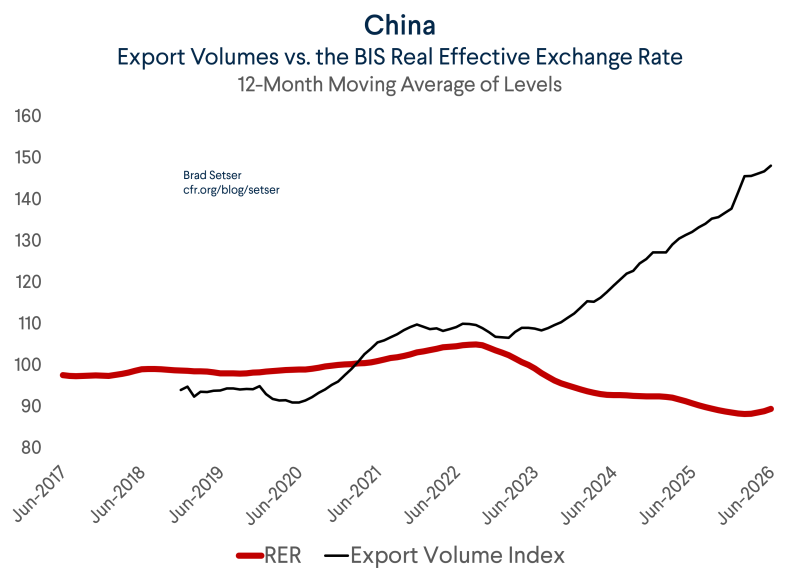
That depreciation should be assessed relative to an appreciating trend, as Dr. Krugman has pointed out. China’s convergence in manufacturing productivity with the advanced economies should result in a real appreciation. So, depreciating rather than appreciating has a large impact: the IMF’s standard exchange rate model suggests a 10 percent move in China’s currency should lead to a 1.5 percentage point increase in net exports—and a closer to 15 percent move relative to trend should result in an increase in the contribution of net exports of more like 2 percentage points.
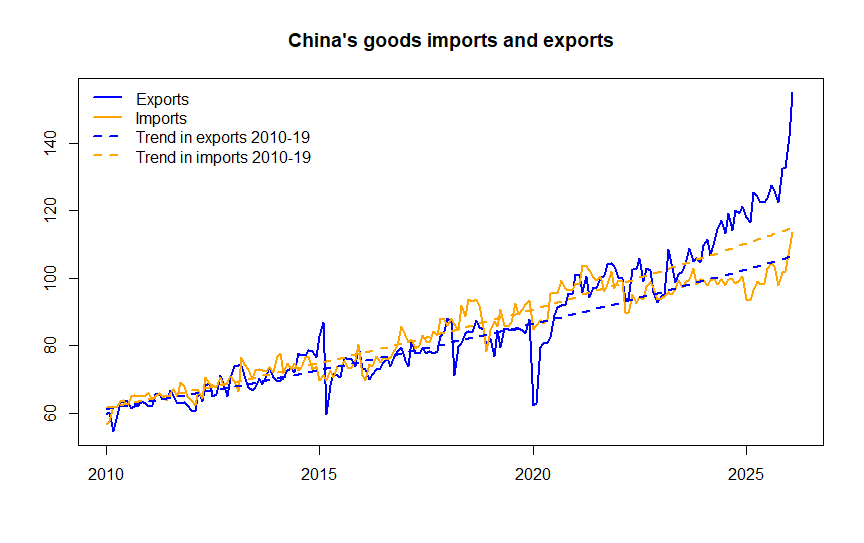
That simple forecast was more or less right. By the end of 2023, 4-5 quarters after the big move in the renminbi, Chinese export growth accelerated. That acceleration then shows up as 1.5 pp contribution from net exports to China’s growth in both 2024 and 2025.
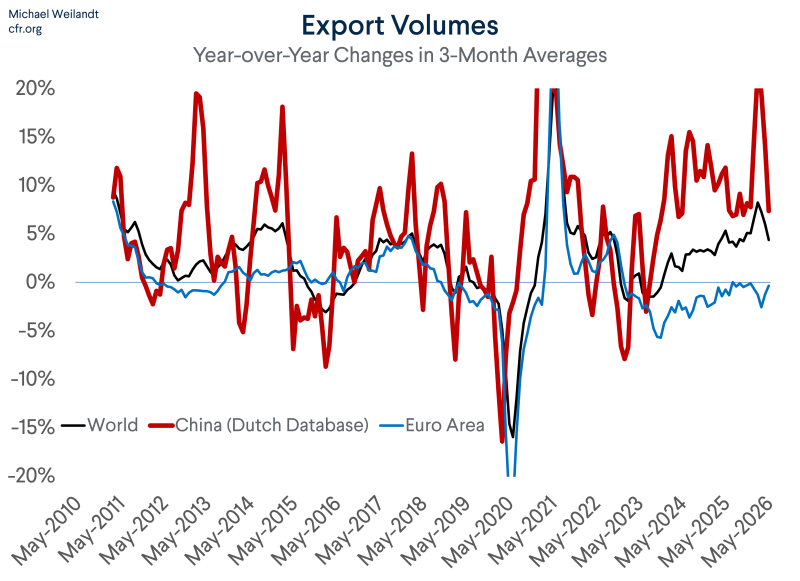
This pattern, by the way, is entirely consistent with a standard model where exchange rate changes do matter, and they have their biggest impact with a lag.
Now, the modern IMF does at times seem to ignore its own long-standing institutional wisdom on balance of payments questions, for reasons that I don’t fully understand. In 2022, 2023, and again in 2024, the IMF’s official forecast for China showed that China’s external surplus would shrink, not rise, over time—basically ignoring the real depreciation.
I will note that these forecasts have not been borne out.
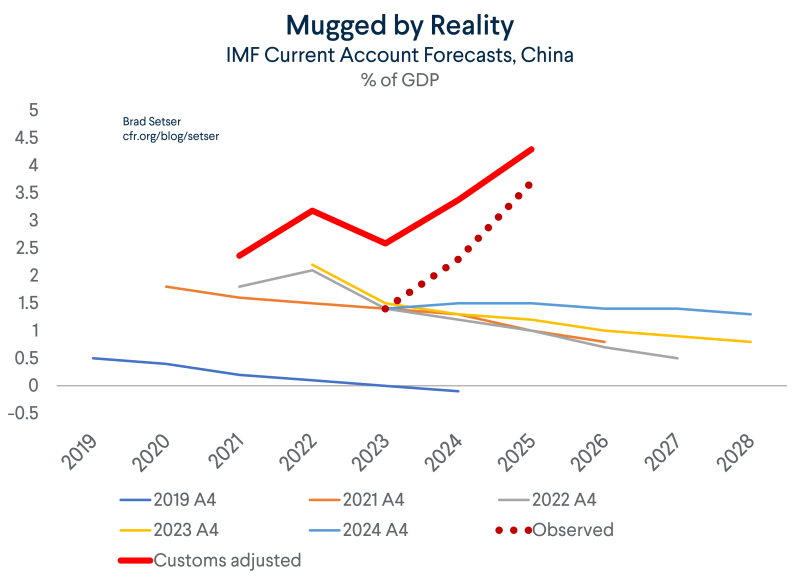
Based on the recent acceleration in China’s export growth—and the similar export outperformance during period of renminbi weakness after China joined the WTO—it sure seems like a weakening currency leads China’s exports to outperform global trade. And there is every reason to think that a stronger currency would lead China’s export growth to decelerate to a pace that its trading partners can more easily absorb.
Is “currency” the entire story of the last few years? No, of course not. The weak currency worked off a bigger manufacturing base thanks to China’s industrial policies, which effectively raised the reward for “macro” industrial policies. China has also long rigged its domestic market against imports, and as China’s indigenous technological base converged toward the global frontier, those policies started to impact a broader range of sectors.
At the same time, it is very hard to understand the enormous acceleration in China’s export growth in late 2023 and 2024 and the sustained outperformance of China’s exports in 2025 without some reference to moves in the renminbi (assessed with standard lags).
2. Nominal exchange rate moves usually result in real exchange rate moves
When inflation pushes up the real exchange rate of a deficit country with a more or less fixed exchange rate (gulp, Argentina; gulp, Egypt in the past), the IMF doesn’t generally advocate keeping the currency stable and deflating the economy to restore external competitiveness.
Rather, it generally advises a depreciation of the currency, because inflation doesn’t offset the full impact of a nominal move and the effect of depreciation on domestic prices can be offset with other policies.
There is equally no strong basis for thinking deflation would quickly offset the full impact of a nominal appreciation in a country with a large and rising surplus. Exchange rates can move quickly; domestic prices adjust partially and with a long lag. There isn’t an immediate offset.
Given global concerns about the immediate impact of China’s export expansion, a nominal appreciation thus offers immediate relief.
And if the nominal appreciation leads China to, well, clean up its property sector (as the IMF has long advised) and spend more on consumption (as the IMF has only recently started to recommend) the nominal appreciation need not be offset by future deflation either.
This isn’t just theory. Solid (if old) empirical work has long found that nominal exchange rate moves do result in real exchange rate moves. Krugman highlighted this back in 2011.
And there is no evidence that the nominal depreciation of 2022-23 materially reduced the pace of deflation in China, and also zero evidence that the modest nominal appreciation of the last year led to a faster pace of deflation. If anything the pace of deflation has moderated, though I fully accept that higher oil prices have had something to do with that.
3. Xi won’t change without a bit of external pressure
Gopinath, Gourinchas, and Rey write:
“What China needs to do—and what is in its own long-term interest, given its ageing population and an investment model overly reliant on the tradable sector—is to raise the share of household income in GDP, expand social insurance so that families feel able to spend, and stop financing tradable-sector expansion at the expense of consumption. Do those things, and a real appreciation of the yuan will follow”
No disagreement from me. I would add that China also needs to change its very regressive system of taxation. See this blog.
I also don’t dispute that China’s unresolved property crisis has an impact on the current account (even if it didn’t show up immediately in the Chinese data because of the misguided 2022 balance of payments revisions) and falling property prices still weigh on consumption.
But the property bubble burst in 2021. We are now well into 2026. At some point, China needs to resume growing off its own demand.
Net exports have already added six percentage points to China’s growth and are on track to add a seventh point in 2027. That is well over a percentage of world GDP. In other words, the bursting of the bubble has been a shock to the entire global economy, not just to China. Ask Germany.
There is no sign that waiting for President Xi to see the light will lead China to start writing big checks to households any time soon. I also would not hold my breath and wait for President Trump to recognize the need to reduce the fiscal deficit. Waiting for a U.S.-China deal on the “fundamentals” likely means waiting for a long time. And that isn’t something that Europe can really afford. Ask Chancellor Merz.
By contrast, what likely would happen if the renminbi appreciated and China stopped getting 1 to 1.5 pp of its annual growth from net exports?
My bet is that Xi would be forced to make a few hard choices. He might need to reconsider his reported belief that stimulating households directly is wasteful. He might need to put a bit of pressure on the Finance Ministry to run bigger fiscal deficits to support upfront reform to raise demand. My guess is that Chinese policymakers would end up doing a bit of needed household stimulus—to their own benefit and to that of the world. The Gopinath, Gourinchas, and Rey recommendation, by contrast, risks being a recipe for continued inaction.
4. Exchange rate diplomacy has a better record than is commonly assumed
The Plaza Accords, contrary to the arguments made by the G7 economists, did actually bring down the overall U.S. trade deficit as well as Japan’s surplus. It took a couple of years, but that is because exchange rates have an impact with a lag. The adjustment in the Deutsche Mark, incidentally, also brought down Germany’s surplus.
And the common belief (especially in China) that the Plaza Accords led to Japan’s bubble economy doesn’t stand up to scrutiny. Germany let its currency appreciate too, and didn’t have a property bubble. And we have learned in the years since that there are many paths to a bubble economy that don’t involve a currency appreciation: the U.S. in the naughty aughties, Spain before 2009, China 2015-2020.
Moreover, China has responded to currency pressure in the past. It took way too long, but China did let the yuan move in 2007 and 2008. And after repegging in the crisis and getting stuck at 6.28 for a couple of years during the global financial crisis, China opted for renewed appreciation in 2011 rather than risk legislation that would result in across the board tariffs (Schumer-Graham).
Putting a bit of pressure on China to end its current reliance on net exports for an acceptable pace of growth thus seems like an acceptable risk, and far better (at least from Europe’s point of view), than continuing to pay a price for remaining mostly open to China at a time when the yuan is clearly deeply undervalued. Chinese cars seem very cheap, just as pizzas in Argentina now seem expensive (see the big Mac index—though ignore the Economist’s leader!)
Gopinath, Gourinchas, and Rey are reluctant to prioritize pressing China to make policy choices that would move China towards external balance (a smaller surplus) if they put China’s internal balance in question. And they—like the IMF itself—are reluctant to call on China to do a big sustained fiscal expansion, which is the one policy that classic Keynesian analysis would say moves China toward both external and internal balance.
In fact, for most of the last five years, the IMF encouraged China to combine fiscal tightening with monetary easing—a policy that would have (maybe) addressed deflation (fiscal tightening doesn’t help there, and there is a debate about the effectiveness of monetary policy without fiscal support) while clearly pushing China towards an even larger external surplus.
5. Addressing China’s imbalances without a stronger nominal RMB would take a massive reflation, one far bigger than anything the IMF now supports
China’s surplus is no longer small. The goods surplus is 7 percent of GDP if gold imports (effectively an import of a financial asset) are excluded. Honestly measured, without adjustments from an internal survey that cannot be independently assessed, the goods and services surplus is now 6 percent of GDP. The current account should be similar or bigger given China’s net foreign asset position (don’t trust me? Look at the coefficient on net foreign assets in the IMF’s own model and apply it to China’s 20 percent of GDP net foreign asset position). Even using China’s reported 4 percent of GDP surplus (give or take, with a forecast for Q2 2026), the undervaluation is now more than 20 percent—and since China’s real exchange rate needs to appreciate to offset ongoing technological catch up, the need over time is even bigger.
Getting that kind of adjustment through domestic policy shifts alone, without an assist from a stronger set of fixes from the PBOC, would take a massive swing in policy.
Yet the IMF’s actual recommendations for China are incredibly timid. The proposed 0.5 pp of GDP, “temporary” fiscal expansion to support consumption might knock 0.2 pp of GDP off the external account in a standard model. The Fund wants China to scale back the subsidies that have pumped up industrial investment. In a simple model that would actually increase the external surplus not reduce, as any reduction in investment relative to savings implies a larger surplus (the steel that has gone into building factories would need to be exported). The Fund argues that this would not happen because China’s households would recognize that inefficient investment reduces their future wealth and thus would anticipate higher future income from a more efficient and start spending those gains today.
Maybe, but I personally wouldn’t bet on it. Cutting inefficient property investment didn’t magically spur household consumption over the last five years.
A true reflation of China’s economy would take a much more aggressive fiscal expansion financed by the central government (which doesn’t have much net debt actually) than the Fund has been willing to call for. And of course, what really matters is what Xi actually does, not what the Fund recommends.**** I am all for expanding social insurance, but if expanded benefits are financed only by expanding the already very regressive set of social contributions the immediate impact on consumption won’t be large. There needs to be a fiscal bridge, and I would say a big one, to a more generous system of benefits that is financed much more heavily out of income tax receipts.*****
If Gopinath, Gourinchas, and Rey don’t believe exchange rate moves have much of an impact and should not be a priority now, the scale of the needed shift to other policies needs to be ramped up to be commensurate with the true size of China’s surplus.
The former Deputy Governor of the Banque de France, Jean-Pierre Landau, and a member of France’s Council of Economic Analysis, Sébastian Jean, have noted that a weak real exchange rate is a core feature of Xi’s China, and not just a by-product of the current cyclical downturn. It supports the industrial and technological upgrading that Xi wants, helps subsidized industrial sectors gain the global scale they need, creates incentives for the import substitution Xi wants and allows Xi to get the growth he needs without sending out the checks to households that he believes to be inefficient.
When lots of money wants to leave China, the desired real exchange rate emerges naturally—and when the inflow from the trade surplus exceeds the allowed outflows (as is the case now), China has no problem asking the state banks to warehouse the extra foreign exchange. A close examination of the pattern of settlement shows that it sure still acts like an intervention variable even if the proceeds from settlement no longer all appear on the PBOC’s balance sheet.
Convincing Xi to change his current policy settings won’t be easy—that applies as much to changing China’s system of social insurance and welfare payments as to changing China’s currency preferences. Progress on either front may well take a bit of real pressure, which probably now needs to come from Europe rather than a distracted United States.
But there is a growing sense that something does need to change. It isn’t just that China’s $1.4 trillion goods surplus (without gold imports), which is almost three times bigger than China’s pre-global financial crisis surplus when scaled to the GDP of China’s trading partners. Now, it is that China is set to export 10 million plus vehicle exports a year. It is that China’s current model is based on an ever-rising surplus. Growing by net exports requires an expanding trade surplus. China has already gotten 6 percentage points of growth from net exports over the last 6 years, a total that will rise to 7 percentage points at the end of this year. That implies an ever bigger China shock, and ever more dependence on China for key industrial inputs. China is now on a trajectory that would lead it to export 20 million cars (roughly 1 in 3 of all cars sold outside China) in as few as three more years. Similarly shifts are possible in a range of other strategic industries.
Is inaction really still an option? And if not exchange rate adjustment—a policy change that is known to work—then what?
* The IMF has not invested heavily in close observation of China’s exchange rate management; look at the discussions of China’s currency and the PBOC’s activities in the last few staff reports (in the 2025 staff report, paragraph 36 and figure 3) and compare them to my blogs on the issue. In the past few years, I have not seen any serious discussion of state bank flows, FX settlement, the diversified use of China’s foreign exchange reserves (see Box 6 of SAFE’s 2020 annual report), SAFE’s co-investment funds, SAFE’s entrusted loans, or the PBOC balance sheet’s missing external interest income.
*** If I understand Dr. Gopinath’s past work correctly, the move against the dollar (“dominant currency pricing”) may matter more than the move against the basket.
**** I do have some sympathy for the IMF here. China is both big, and extremely unbalanced. The IMF’s standard play book isn’t designed for a country that saves over 40 percent of its GDP—or for a country that combines ruthless competition and state guidance in new ways. Look at China’s fiscal numbers, and a standard model would forecast that the country would be running a current account deficit and face inflationary pressures. Conversely, the standard medicine for a country with deflation and an “excessive” current account surplus is a fiscal expansion, especially if monetary transmission is gummed by a weak banking system. No wonder the actual policy recommendations have often been confused.
***** My only significant point of disagreement with Michael Pettis is that he emphasizes the growth China’s overall debt and I would emphasize the debt of China’s central government, which remains exceptionally low compared to other large economies. Indeed, an important 2023 IMF working paper has shown the central government doesn’t actually have any net debt, given its substantial financial assets (the domestic side of Huijin, SASAC, etc). I do agree with Pettis that any realistic adjustment requires China accepting a period of slower headline growth, the central government’s fiscal space just needs to be used offset the loss of the impetus to growth from net exports and the drag from slower investment during a period of adjustment.
This work represents the views solely of the author(s). The Council on Foreign Relations is an independent, nonpartisan membership organization, think tank, and publisher, and takes no institutional positions on matters of policy.