China and the U.S. Agreed to ‘Strategic Stability’ in Beijing. They Don’t Define It the Same Way.
The Beijing summit did not resolve U.S.-China competition. Instead, it gave the rest of the world reason to worry about a new uncertainty: whether U.S.-China “strategic stability” will restrain rivalry, conceal it, or turn it into a bilateral bargain over their heads.
By experts and staff
- Published
 Zongyuan Zoe LiuCFR ExpertMaurice R. Greenberg Senior Fellow for China Studies
Zongyuan Zoe Liu is Maurice R. Greenberg senior fellow for China studies at the Council on Foreign Relations
The Beijing summit between U.S. President Donald Trump and Chinese President Xi Jinping produced something rarer than a breakthrough: a mutually useful ambiguity. Washington came away advertising deals. Beijing came away advertising a doctrine. Both sides claimed stability. But a close comparison of the two readouts shows they did not mean the same thing.
The White House framed the summit as a package of practical wins. Its fact sheet emphasized a “constructive relationship of strategic stability” based on “fairness and reciprocity,” a fall visit by Xi to Washington, and understandings on Iran, the Strait of Hormuz, and North Korea. It also packaged the summit’s commercial deliverables around rare earths and critical mineral supply chains concerns, Boeing aircraft purchases, agricultural purchases, beef market access, and poultry imports.
Most strikingly, it called the formation of the new U.S.-China Board of Trade and Board of Investment the “cornerstone” of the agreement—not the Boeing order or farm purchases, but the institutional mechanism through which future trade and investment disputes are supposed to be managed.
China’s readout did not reject the White House’s language of “strategic stability,” but rather claimed and elaborated on it. Both sides used the phrase “a constructive relationship of strategic stability,” but Beijing gave it a more expansive political content. In Foreign Minister Wang Yi’s telling, stability meant not only keeping communication open or reducing risk, but also keeping competition within “proper limits,” managing differences, respecting China’s “core interests,” recognizing each side’s development path, and grounding the relationship in the three U.S.-China joint communiqués.
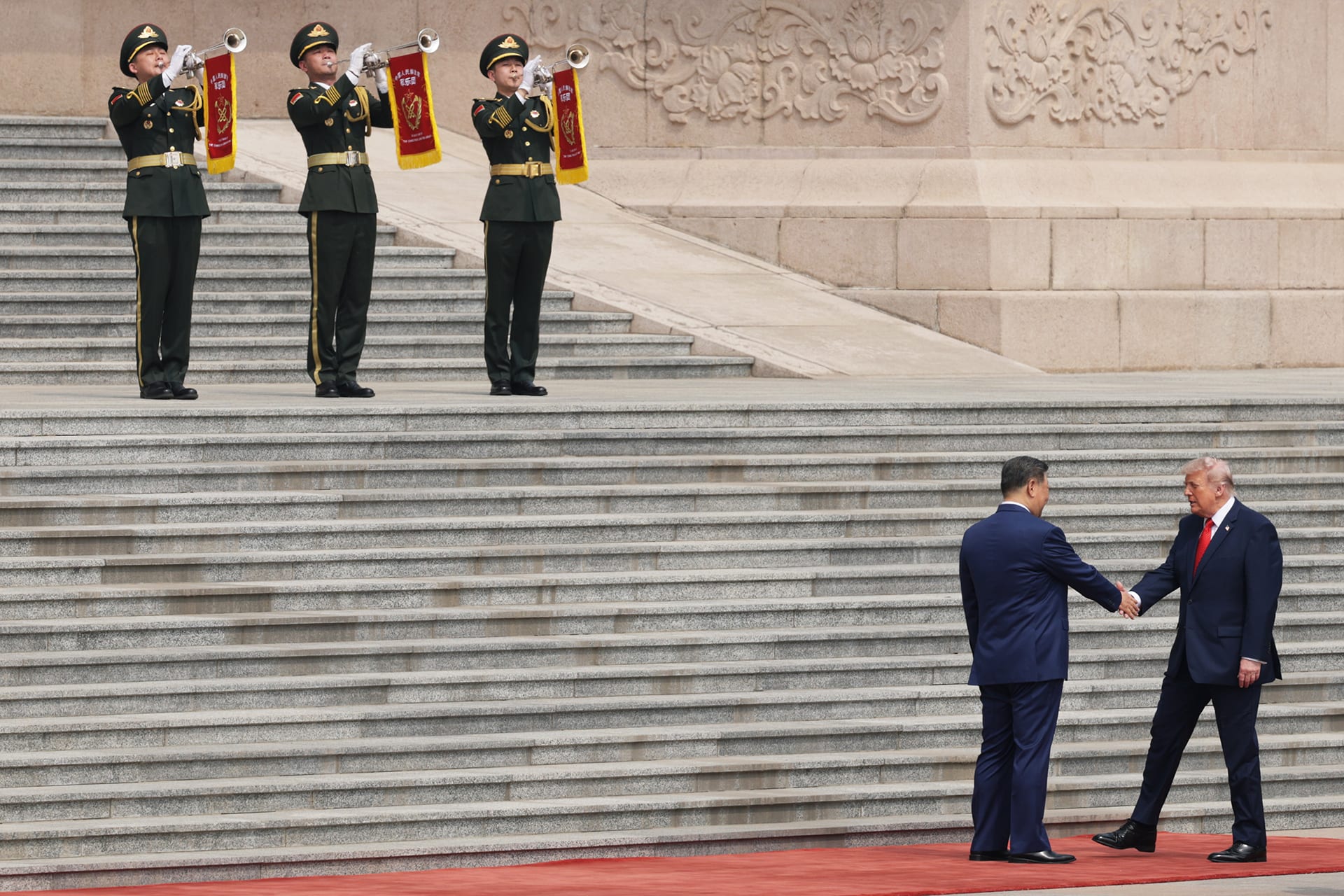
That difference matters. For Washington, the summit was about making competition manageable enough to deliver economic and political dividends. For Beijing, it was about changing the vocabulary of the relationship. The United States emphasized transactions; China emphasized hierarchy, status, and rules of conduct. The same photo op served different objectives—precisely the asymmetry I flagged before the summit, when I argued that Trump was seeking visible deliverables ahead of the midterms while Xi was playing a longer game of strategic patience.
Boards of change
The boards are the clearest sign of what actually changed. They resemble earlier U.S.-China dialogue structures, including the Strategic and Economic Dialogue and the Joint Commission on Commerce and Trade, but appear narrower and more transactional. The old mechanisms aspired, however imperfectly, to manage a broad relationship that included macroeconomic coordination, market access, climate factors, financial reform, and strategic concerns. The new boards seem designed for a more modest purpose: to keep trade and investment disputes from becoming crises.
That is why the White House’s use of the word “cornerstone” is revealing. The administration did not call agricultural purchases or aircraft orders the foundation of the summit because those are politically useful but temporary. China may buy planes. It may purchase more soybeans, sorghum, wheat, beef, or poultry. But purchases can be delayed, reclassified, routed through commercial entities, or quietly revised. A standing mechanism is more valuable because it creates a repeatable bargaining table.
This does not mean the boards are meaningless. In a relationship as large, adversarial, and economically entangled as that of the United States and China, channels matter. Regular contact can reduce miscalculation, give firms some visibility, and create a place for both governments to register complaints before they escalate. But the boards also reveal the limits of the summit. They are not a strategic settlement. They are a management device.
The Board of Trade appears to be aimed at “non-sensitive goods,” a phrase that does a lot of work. It suggests that Washington and Beijing are carving out a space for bargaining over agriculture, energy, consumer goods, selected industrial goods, and other politically salient products while leaving the hardest questions—advanced semiconductors, artificial intelligence (AI), military technology, Taiwan, export controls, industrial overcapacity, and critical infrastructure—outside the room. Rare earths sit awkwardly between these categories: the White House fact sheet mentioned them explicitly as a supply-chain and critical-minerals concern, but China’s main diplomatic readout did not name them, folding the economic results into broader language about market access, reciprocal tariff reductions, and continued consultation.
The Board of Investment is even less defined. The White House describes it only as a government-to-government forum for investment-related issues, while China’s Commerce Ministry has characterized the broader trade and investment results as preliminary, with details still under negotiation.
A serious investment framework would need to answer basic questions that the readouts leave open: Which Chinese investments are welcome? Which are restricted? What counts as control? What counts as access to sensitive data or technology? How will greenfield investments be treated? How will state-linked capital, private equity, sovereign wealth funds, venture capital, and passive stakes be distinguished?
The Trump administration’s existing investment policy, laid out in its February 2025 “America First Investment Policy” memorandum, already draws a broad line: the United States will continue to welcome passive non-controlling foreign investment, but it also directs the Committee on Foreign Investment in the United States (CFIUS) and other tools to restrict Chinese government-affiliated investment in technology, critical infrastructure, health care, agriculture, energy, raw materials, farmland, and other strategic sectors. This policy is not a blanket ban on Chinese capital. It is a risk-based doctrine.
That is a doctrine in principle, but is not yet a settlement in practice. It says Chinese capital may be welcome when it is passive, non-controlling, and distant from national-security risk. It posits that Chinese capital is suspect when it touches strategic sectors, sensitive technology, infrastructure, data, food security, or coercive leverage. But because those categories are broad, the line will still be drawn deal by deal. The Board of Investment may become a clearinghouse for politically acceptable projects. It could also become a venue for Beijing to press Washington to loosen restrictions in exchange for purchases or other concessions.
No return to Chimerica
This is why the summit should not be mistaken for a return to engagement as usual. It is not the old Chimerica, in which Chinese production and American consumption were treated as mutually reinforcing pillars of globalization. Nor is it the Biden-era formulation of strategic competition with guardrails. It is something more transactional and potentially more unstable: managed rivalry through bilateral bargaining.
For Trump, that bargain has obvious appeal. It allows him to claim that pressure produced results: aircraft sales, agricultural purchases, restored market access, tariff discussions, and Chinese cooperation on selected global issues. The White House says China will purchase at least $17 billion in U.S. agricultural products annually in 2026, 2027, and 2028—in addition to earlier soybean commitments—and that China approved an initial purchase of two hundred Boeing aircraft. Reuters has noted, however, that China’s commerce ministry did not provide timelines, values, or volumes for many of the arrangements and described key outcomes as still pending finalization. This is an important reminder that the summit produced a framework for bargaining, not a fully specified settlement.
For Xi, the bargain is more strategic. Beijing can absorb some commercial concessions if the larger result is time, predictability, and recognition. Buying American goods is not the same as changing China’s industrial model. Restoring some market access is not the same as accepting U.S. demands on overcapacity, subsidies, technology policy, or state capitalism. In Chinese terms, the summit’s most important result was not the trade list. It was the U.S. president’s apparent acceptance—at least rhetorically—of a new framework of “strategic stability.”
Changing the framework on Taiwan?
That phrase deserves scrutiny. In Washington, “strategic stability” often implies risk reduction between rival powers. In Beijing’s usage, it carries broader political content: the United States should respect China’s core interests, refrain from defining the relationship primarily as strategic competition, and manage disputes within limits acceptable to Beijing. Foreign Minister Wang’s explanation explicitly linked stability to the three joint communiqués, respect for each side’s system and development path, and China’s “core interests and major concerns.”
Taiwan is therefore not peripheral to China’s interpretation of the summit: it is central to it. In Beijing’s readout, Xi stated that Taiwan is the “most important issue” in U.S.-China relations and warned that mishandling it could lead to “clashes and even conflicts.” Wang later reinforced that point, stating that Taiwan was an important topic at the summit and that it affects the entire relationship. The White House fact sheet, by contrast, omitted Taiwan entirely. That omission may be diplomatically useful, but it also illustrates the gap between the two sides’ definitions of stability: Washington wants economic calm; Beijing wants political caution.
This gap also explains why the summit looks like G-2 choreography but not G-2 architecture. Trump has repeatedly shown interest in great-power bargaining and Xi welcomes being treated as Washington’s principal counterpart. But Beijing does not necessarily want the responsibilities that would come with genuine co-management of global order. The Iran war is instructive. As I argued in Foreign Affairs, China fears American volatility more than American power: instability in the Middle East threatens China’s energy security, trade flows, and global growth prospects, but Beijing has limited appetite, experience, and capacity to replace the United States as a security provider.
That is the paradox of China’s preferred order. Beijing wants status without overextension, influence without alliance burdens, and stability without assuming the costs of enforcement. On Iran, the White House said both leaders agreed that Tehran cannot have a nuclear weapon and called for reopening the Strait of Hormuz. China’s statement was more cautious, emphasizing dialogue, a ceasefire, and its continued role in promoting peace talks. The difference is subtle but important: Washington wants China to help solve a crisis; Beijing wants to avoid being trapped inside one.
For allies and partners, the summit’s message is mixed. Reduced U.S.-China tension is welcome. A less volatile trade war, fewer supply shocks, and renewed leader-level contact are all better than unmanaged escalation. But the mechanism emerging from Beijing is bilateral, leader-centric, and transactional. Allies may be briefed afterward rather than conferred with beforehand. They may welcome stability while worrying that decisions affecting technology controls, Taiwan, supply chains, energy flows, and regional security are being negotiated over their heads.
The rest of the world should therefore resist easy interpretations. The summit was not a grand bargain in which Washington and Beijing agreed to govern the world together. Nor was it merely empty theater. It was more consequential than theater because it created a mechanism, a vocabulary, and a political rhythm for managing rivalry. It was less than a bargain because the core sources of rivalry remain untouched.
The summit’s meaning is thus not that U.S.-China competition is ending, but rather that both sides are experimenting with a new way to conduct it. Washington wants managed trade. Beijing wants managed competition. Trump wants visible wins. Xi wants time to strengthen his position and recognition. The rest of the world wants predictability but may get something more ambiguous: a great-power relationship stable enough to reduce immediate risk, yet flexible enough for both sides to keep contesting the rules.
That may be the real outcome of the Beijing summit. The United States and China did not bridge their differences. They agreed to manage them—and to call that management stability.
This work represents the views and opinions solely of the author. The Council on Foreign Relations is an independent, nonpartisan membership organization, think tank, and publisher, and takes no institutional positions on matters of policy.