China and Climate: China Restricts Fuel Exports, Solar Exports Surge
April’s edition of China and Climate provides an update on China’s response to the Iran war and unpacks recent climate governance measures, the Spanish prime minister’s trip to Beijing, Chinese battery manufacturing strengths, and the anticipation of extreme flooding in 2026.
By experts and staff
- Published
- Research Associate, Climate and Energy
- Research Associate, Climate Change Policy
The China and Climate primer series tracks and breaks down China’s engagement with energy and climate issues around the world.
Iran Response: China Restricts Fuel Exports
In March, China instructed its top diesel and gasoline exporters to halt all fuel exports, seeking to prioritize its domestic oil needs during the energy shock caused by the war in Iran. That focus has continued into April. Following the destruction of two Qatari liquefaction production units, China’s liquefied natural gas (LNG) imports continued to fall too. Until that point, China had received close to a quarter of its LNG imports from Qatar.
To reduce domestic harm, China’s National Development and Reform Commission instructed its leading private refiners to produce crude oil and gasoline at levels at least equal to 2025 production no matter the cost. If the independent refiners fail to meet those output levels, they could face reduced crude import quotas. The private refiners account for nearly 25 percent of China’s refining capacity.
China’s Solar Exports Surge in March
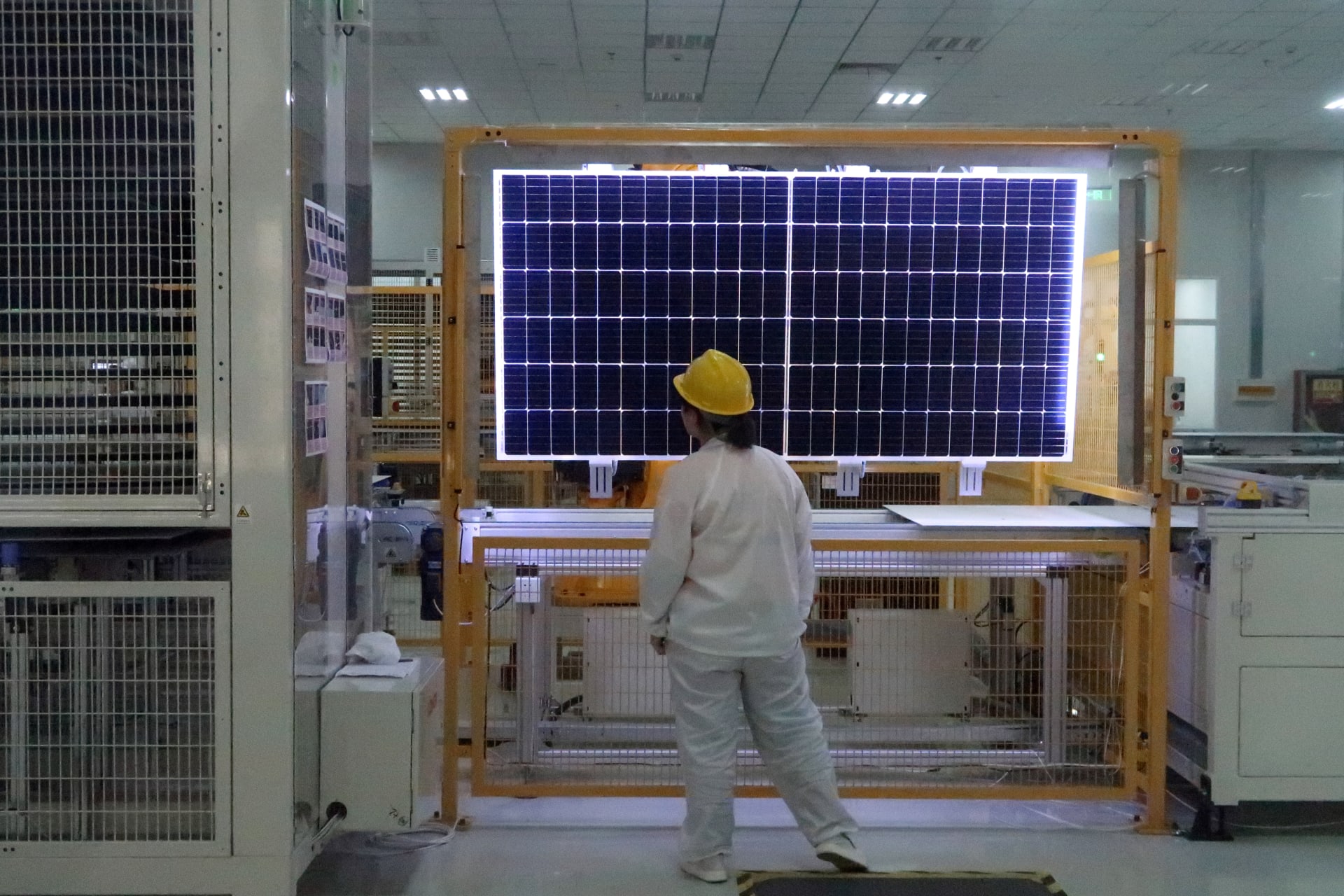
Researchers argue that China could be a major beneficiary of the conflict in Iran as countries seek to reduce energy dependence on the Middle East. One significant example of China’s gains is record-high exports of Chinese solar in March, following the closure of the Strait of Hormuz. Clean-energy think tank Ember reported that China exported sixty-eight gigawatts of solar capacity—equal to Spain’s entire installed solar capacity.
March was also a record-setting month for countries importing Chinese solar. Fifty countries set new import records; some notable rapid growth included India, up 141 percent; Malysia, up by 384 percent; and Ethiopia, up by 391 percent. To be sure, the closure of Hormuz is not the only factor driving solar exports. China had previously announced it would be removing solar photovoltaic export tax rebates on April 1, creating an export rush before the deadline.
More broadly, Chinese officials have spoken publicly on the importance and value of accelerating the transition to renewable energy. Speaking at the International Vienna Energy and Climate Forum, China’s climate envoy Liu Zhenmin emphasized the importance of renewables to boost energy security and resilience. Zhenmin also argued that shifting to renewables will require an economic transition crucial to reducing future overreliance on one energy source.
China Releases Climate Governance Measures
In late April, China released two documents that offer insight into how it might achieve its climate goals. The first document, an opinion approved by the Central Committee of the Chinese Communist Party and State Council that is nonbinding, covers energy conservation and carbon-reduction efforts. Included in the opinion is a call to “strictly control fossil fuel consumption,” and it lays out various aspirations for improving energy savings and reducing carbon across China’s economy. The document prescribes regular monitoring and evaluation of progress toward climate targets through assorted mechanisms, including “alerts for lagging progress.”
The second document outlines binding measures for evaluating progress on climate targets. Provincial governments will develop “carbon peaking action plans” and additional targets that help achieve overarching goals such as “achieving the carbon peaking target before 2030” and “reducing carbon emission intensity by more than 65% by 2030 compared to 2005,” among others. The document includes fourteen indicators that will be used in the evaluations, including five “control” indicators, which are total carbon emissions, carbon intensity reductions, total coal consumption, total oil consumption, and the share of non–fossil fuel energy consumption, according to reporting from Carbon Brief.
Those measures will be administered by China’s National Development Reform Commission, which, alongside other agencies, will assess the carbon reduction progress of local governments. As with sweeping national frameworks, how the measures are implemented will prove as important in assessing their merit, if not more so, than the language they contain. Yet together, the documents could strengthen the bureaucratic machinery for turning national climate aspirations into action.
Spanish Prime Minister Travels to Beijing for Talks
In mid-April, Spanish Prime Minister Pedro Sánchez traveled to Beijing for bilateral talks. It was his fourth visit in four years and followed trips made by several of his fellow European leaders earlier in 2026. The two countries announced several agreements, and Sánchez urged China to take a larger role on the international stage, including on climate change. Spain is heavily dependent on Chinese imports for its solar power, with China accounting for around 80 percent of Spanish photovoltaic module imports. The country is less dependent than Europe as a whole, however, which imports around 98 percent of its solar panels from China.
U.S. Battery Start-Up Relocates to China
Battery infrastructure company Ener Venue’s $300 million funding raise will be used to invest in a factory build-out in Changzhou, China.
EnerVenue, which uses technology similar to NASA nickel-hydrogen battery technology, originally raised $12 million in seed funding in 2020, followed by $100 million in series A. In 2023, the company announced a $264 million investment to open a factory in Kentucky. Following technological delays and significant costs, however, it withdrew from its planned investment in Kentucky in 2024. Taking advantage of the robust manufacturing ecosystem in China, EnerVenue shifted its manufacturing focus to China, where it intends to continue to scale its technology. That change happens as the United States has continued to develop its own grid battery installations in 2025 and 2026.
China Expects Significant Flooding in 2026
Intense flooding after heavy rainfall befell southern China in late April. It followed on the heels of an announcement by Chinese state media on April 1 that the country will likely experience significant flood and drought events in 2026. Already, China has seen nearly ten inches fall within one day, the highest amount ever recorded in Qinzhou in late April, according to reporting by the Associated Press. Authorities had issued warnings for heavy rainfall several days earlier.
Chinese meteorologists forecast that El Niño conditions could emerge in May and last through the end of 2026. The announcement is based on findings from the Ministry of Water Resources, indicating torrential rains and the possibility of typhoons hitting the mainland and damaging inland areas. The ministry also indicated that drought could occur along the Yangtze River and in northern Xinjiang.
Researchers have indicated a growing possibility that this could be the strongest El Niño in a century. During strong El Niños of the past, China experienced heavy flooding and torrential rainfall.