China and Climate: February 2026
The China and Climate primer series tracks and breaks down China’s engagement with energy and climate issues around the world. February coverage focused on China’s complaints about domestic manufacturing practices in India, how China is updating its grid, a revised set of air quality standards, and German Chancellor Friedrich Merz’s trip to Beijing.
By experts and staff
- Published
- Research Associate, Climate and Energy
- Research Associate, Climate Change Policy
More Challenges to Domestic Manufacturing Incentives
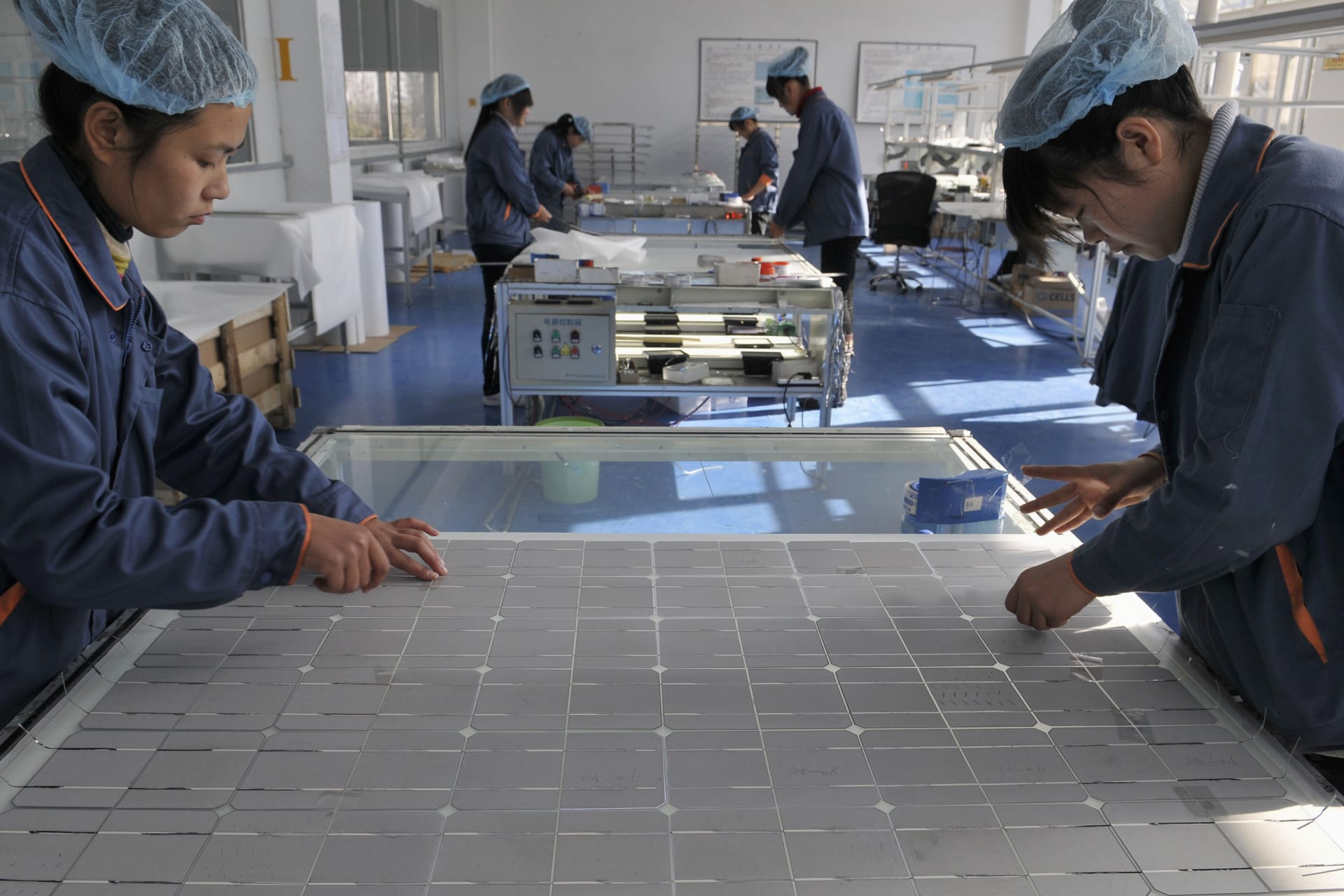
As governments around the world ramp up subsidies for domestic clean energy manufacturing, disputes over how those measures fit with international trade rules are growing. Although China has faced scrutiny in the past from major economies, including the European Union, over its own support for domestic electric vehicle and solar manufacturing, the country has recently lodged complaints challenging subsidy programs in the United States and India.
On February 24, the World Trade Organization (WTO) agreed to establish a panel to investigate China’s complaint that India’s domestic incentives for automobiles and energy technologies place China at a disadvantage. The complaint centers on India’s production-linked incentive scheme, which seeks to boost domestic manufacturing across fourteen different sectors, including solar manufacturing. The program was established in 2020 and has led to significant growth in India’s domestic solar production.
Strikingly, the United States, has also placed pressure on India’s domestic solar manufacturing, setting a new 126 percent tariff on solar imports from India in February. Although tariffs place a different form of pressure on India’s manufacturing industry, experts expect those duties to effectively block all Indian solar manufacturers from the U.S. market.
Though the United States and China are aligned in pressuring India’s manufacturing industry, China has also been raising complaints challenging U.S. clean energy manufacturing. In an earlier dispute, the WTO ruled in favor of China that several clean energy tax credits in the United States violated international trade rules.
Those recent disputes illustrate growing tensions and contradictions within the global trade system. As more countries gravitate toward energy sovereignty, major economies are increasingly relying on subsidies and tariffs to secure domestic manufacturing advantages while challenging those same tactics when other countries apply them.
Updates to China’s Grid
Leading up to the release of China’s fifteenth five-year plan, the National Energy Administration (NEA) held a video conference discussing a set of five priorities for improving renewable-energy construction and development. In recent years, due to rapid wind and solar expansion, China’s grid has faced significant problems related to curtailment: renewable power that is generated but not used because the grid cannot absorb it, reliability and power shortages, and lack of overall flexibility to manage large volumes of variable generation.
The priorities that the NEA set out to address some of those issues include increasing investment in renewable deployment and infrastructure, resolving grid and industry development challenges, and overhauling a strategy for renewable energy in the next five-year plan.
Beyond the NEA’s released goals, Beijing has also established several new policies geared at improving its grid infrastructure and electricity system. In the last year, China’s investments into the grid increased by 5 percent, reaching about $92 billion in annual investments. That number will continue to climb steadily through 2030. In addition, to help further propel the nation’s growth in battery technologies, China expanded subsidies to energy storage and told provinces to include batteries in its payment program, which is geared toward improving electricity reliability.
China Announces Revised Air Quality Standards
Images of smoggy cities were synonymous with China as it rapidly developed its industrial capacity. Although problems persist, particularly in the west and south of the country, China’s “war against pollution” has had some success.ChinChinese offici report that, between 2013 and 2025, the country’s average annual concentration of fine particulate matter, or particles with a diameter of 2.5 microns or less (PM2.5), fell from 68 to 28 micrograms per cubic meter of air (μg/m³). New updated released in February set new targets for the annual average concentration of PM2.5; particulate matter, or particles with a diameter of 10 microns or less (PM10); sulfur dioxide; and nitrogen dioxide. For PM2.5, the primary target will set the average annual concentration at 10 μg/m³, but a likely more achievable secondary target was set at 25 μg/m³.Ambient Air Quality Standards released in February set new targets for the annual average concentration of PM2.5; particulate matter, or particles with a diameter of 10 microns or less (PM10); sulfur dioxide; and nitrogen dioxide. For PM2.5, the primary target will set the average annual concentration at 10 μg/m³, but a likely more achievable secondary target was set at 25 μg/m³.
In 2025, an estimated 60 percent of Chinese cities had PM2.5 concentrations above 25 μg/m³, which an official acknowledged fell below the standard for “building a beautiful China.” The new standards for those pollutants will take full effect in 2031 and will involve a transitional phase of implementation with intermediate limits leading up to 2030. They will help motivate Chinese cities to improve their efforts to tackle air pollution, according to reporting from Bloomberg.
Merz Makes the Trip to Beijing
Following the January flurry of European leaders traveling to China, Germany’s Friedrich Merz was the latest European leader to travel to Beijing. The German chancellor formalized five agreements, including engagement on climate change and clean energy. The two countries agreed to continue dialogue and cooperation on climate change and the green transition. China and Germany had previously signed a cooperation mechanism on climate change and the green transition in 2023. And in 2025, China was Germany’s largest trading partner, with Germany serving as the top destination for Chinese lithium-ion batteries through September of 2025.