Concerns About Tinubu’s Health
As the next presidential election looms, anxiety about the Nigerian president’s physical condition is growing.
By experts and staff
- Published
 Ebenezer ObadareCFR ExpertDouglas Dillon Senior Fellow for Africa Studies
Two different conversations about the country’s highest political office are currently ongoing in Nigeria. One—arguably the less important of the two—concerns a matter of basic protocol that flared up after an Independence Day address during which Atiku Abubakar, former vice president and currently standard-bearer of the African Democratic Congress in the January 2027 presidential election, repeatedly referred to President Bola Ahmed Tinubu as simply “Bola.” Whether or not Mr. Abubakar intended to put a former political associate who he can correctly boast of having brought into politics in his place, political commentators did not take kindly to the perceived insult to the office. Akin Osuntokun, director general of Peter Obi’s presidential campaign during the 2023 election and someone who can scarcely be described as an ally of President Tinubu, decried Mr. Abubakar’s action as “objectionable” and “needlessly disrespectful” of Nigeria’s highest office. In the same vein, popular journalist and social commentator Simon Kolawole adjudged it “contemptuous” and “ungentlemanly.”
If Nigerian politicians and commentators, regardless of party affiliation, agree about the importance of preserving the aura of the country’s highest office no matter its occupant, they are less sure about the physical fitness of the incumbent whose health has been the subject of animated discussions since he left the country on August 30 for what his handlers had described at the time as a “working vacation.” Although President Tinubu is now back in the country (he returned to Lagos on September 29 after spending four weeks in the UK and France, more on which shortly), it has not been enough to douse the controversy.
While Tinubu was away, much of the criticism by the opposition centered on speculation that he failed to transmit a written declaration to the Senate President and Speaker of House of Representatives, as required by law. Chapter 6, part 1, section 145 of the 1999 Constitution of the Federal Republic of Nigeria states: “Whenever the President transmits to the President of the Senate and the Speaker of the House of Representatives a written declaration that he is proceeding on vacation or that he is otherwise unable to discharge the functions of his office, until he transmits to them a written declaration to the contrary such functions shall be discharged by the Vice-President as Acting President.”
President Umaru Musa Yar’Adua’s apparent violation of this requirement when he left Nigeria in November 2009 to seek medical treatment for a heart condition at a Saudi Arabia clinic was the trigger for a constitutional crisis that did not end until his passing in May of the following year.
Ever since, Nigerian politicians have seemed determined not to allow a repeat, and as uncertainty grew following Vice President Kashim Shettima’s departure for New York to attend the eighty-first session of the UN General Assembly, at which point both the president and his vice were out of the country at the same time, it came as no surprise that a political party—the African Action Congress, led by human rights activist Omoyele Sowore—would ask a Federal High Court to look into the matter. Since the president is now back in the country, the legal question is moot. What has refused to go away are the rumors about the health of President Tinubu.
This is not the first time that Tinubu has had to contend with such rumors. During the 2023 campaign, his frail appearance, coupled with occasionally slurred speech, had raised eyebrows among the public, which members of the opposition were quick to seize upon to suggest that he, Tinubu, was not physically fit to run for office. Those speculations dogged the soon-to-be president throughout the campaign and would persist even after his campaign released a video of him riding an exercise bike at an undisclosed location and saying: “Many have said I have died... Well… Nope. This is the reality: I am strong, I am healthy.”
Nor is it the first time that the country itself would be in this kind of situation. As mentioned earlier, the Yar’Adua presidency (2007–2010) was cut short by his transition, and while Nigerians still rue the way it all ended, they also recall that concerns had been expressed on the campaign trail about Yar’Adua’s health only by his supporters, including his main backer at the time President Olusegun Obasanjo, to dismiss those concerns as unfounded and frivolous. When rumors that Yar’Adua had died in a German hospital would not go away, Obasanjo sought to reassure a skeptical public by calling Yar’Adua live on speakerphone at a campaign event. Their brief conversation went in part: Obasanjo: “Umoru, are you dead?” Yar’Adua: “I am not dead, I am alive.”
President Muhammadu Buhari (2015–2023) too had his fair share of health issues and associated public speculation. Buhari spent a fair chunk of his first term (about eight months in total) outside the country on various medical trips. In 2017, he spent three months receiving treatment for an undisclosed ailment in a London hospital, prompting King Charles to tease him during a state visit in November 2022 as to whether he, Buhari, owned a house in the UK. Like most things, the joke sailed over the late president’s head.
In a sense, we are now back to square one, with another election looming and anxiety growing about the health of the president, in this case the incumbent. Tinubu has dismissed those concerns as politically motivated. Upon his arrival in Lagos last week, he quickly assured journalists, “I’m ready to kick, ready to work. There is nothing wrong. Well, rumor will always be emanating from politics, but the fact remains I’m here, healthy and sound, and ready to go.” As is to be expected, his aides have echoed him. His special advisor on information and strategy, Bayo Onanuga, dismissed speculations about Tinubu’s alleged ill health as “entirely false.”
What is difficult to hide, and to that extent incontestable, is data from President Tinubu’s physical appearance. Alighting from the plane at the Presidential Wing of Murtala Muhammed International Airport last week, he looked distinctly unbalanced, and in his subsequent public appearances, he seemed to need the help of people around him to keep his balance. As president, he has slipped and fallen on at least two occasions, the first while climbing into a vehicle during the Democracy Day commemoration in Abuja in June 2024 and the second in January 2026 while inspecting a guard of honor during a state reception in Ankara, Turkey.
Senior U.S. State Department officials have shared with me their worries about Tinubu’s health and its likely political impact.
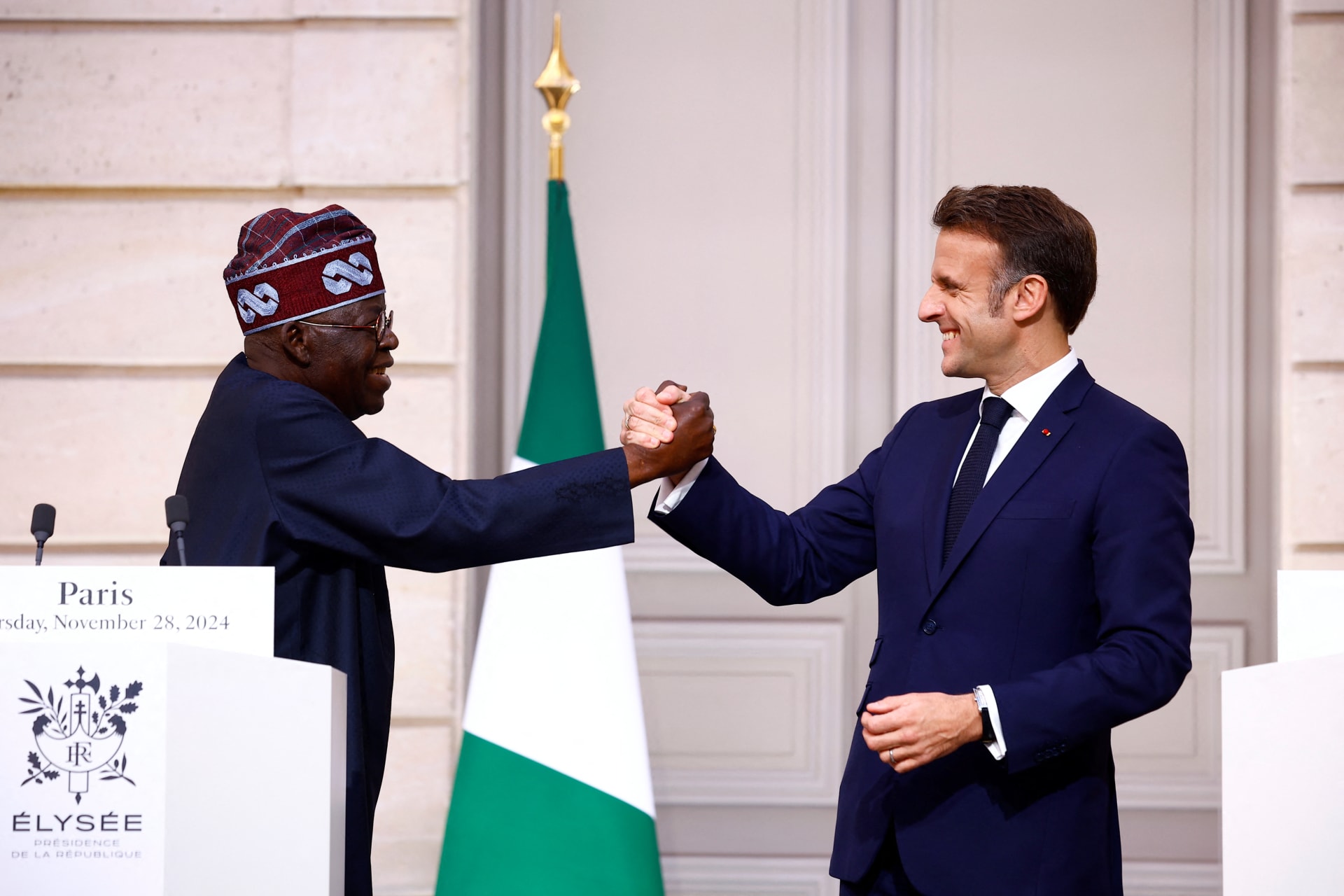
Another thing that his aides have not been able to explain is his international itinerary, particularly the frequency of his trips to France. Shortly before his inauguration in 2023, Tinubu reportedly traveled to the American Hospital of Paris in Neuilly-sur-Seine for a medical checkup. Between May 2023, when he was sworn in, and April 2025, Tinubu undertook five separate visits to France. Over the course of his presidency, he has visited France nine times under various auspices: “private trip,” working visit,” and “private visit.” The frequency of Tinubu’s trips to France is puzzling for two reasons. One, even when his visit is to other countries, he invariably manages to find room for a quick dash to France, as was indeed the case with his most recent trip where he started in London only to end up in, you guessed right, France. Second, there is scant evidence of a shift in diplomatic focus or a significant strengthening of ties with France such as to justify repeated visits to the country. Such solidarity, as it were, would be uniquely one-sided considering that French President Emmanuel Macron has never reciprocated with a visit to Abuja since Tinubu assumed office. Macron’s last visit to Nigeria was back in July 2018.
It is difficult to gauge the effect, if any, all this will have on the presidential race. The health of the country’s first citizen is an issue of paramount importance, but it is far from clear that the opposition, divided as it is, has the discipline to capitalize on it.
For the moment, Tinubu seems to have things under control, but the debate over his fitness for the office is bound to flare up again the next time he slips, or tries to slip out of town.
This work represents the views solely of the author(s). The Council on Foreign Relations is an independent, nonpartisan membership organization, think tank, and publisher, and takes no institutional positions on matters of policy.