Could Flávio Bolsonaro Deliver on His Fiscal Promises?
Investors are betting that the Brazilian presidential candidate will rein in public debt. But structural and political hurdles make austerity easier to promise than to enact.
By experts and staff
- Published
 Rebecca PattersonCFR ExpertSenior Fellow
- Research Associate, Geoeconomics
In any election, what investors care about does not always align with what matters to voters—and Brazil is no exception. While opinion polls heading into this month’s presidential runoff suggest violence, health and the economy (notably the cost of living) top the list of voter concerns, investors appear focused on just one issue: fiscal policy.
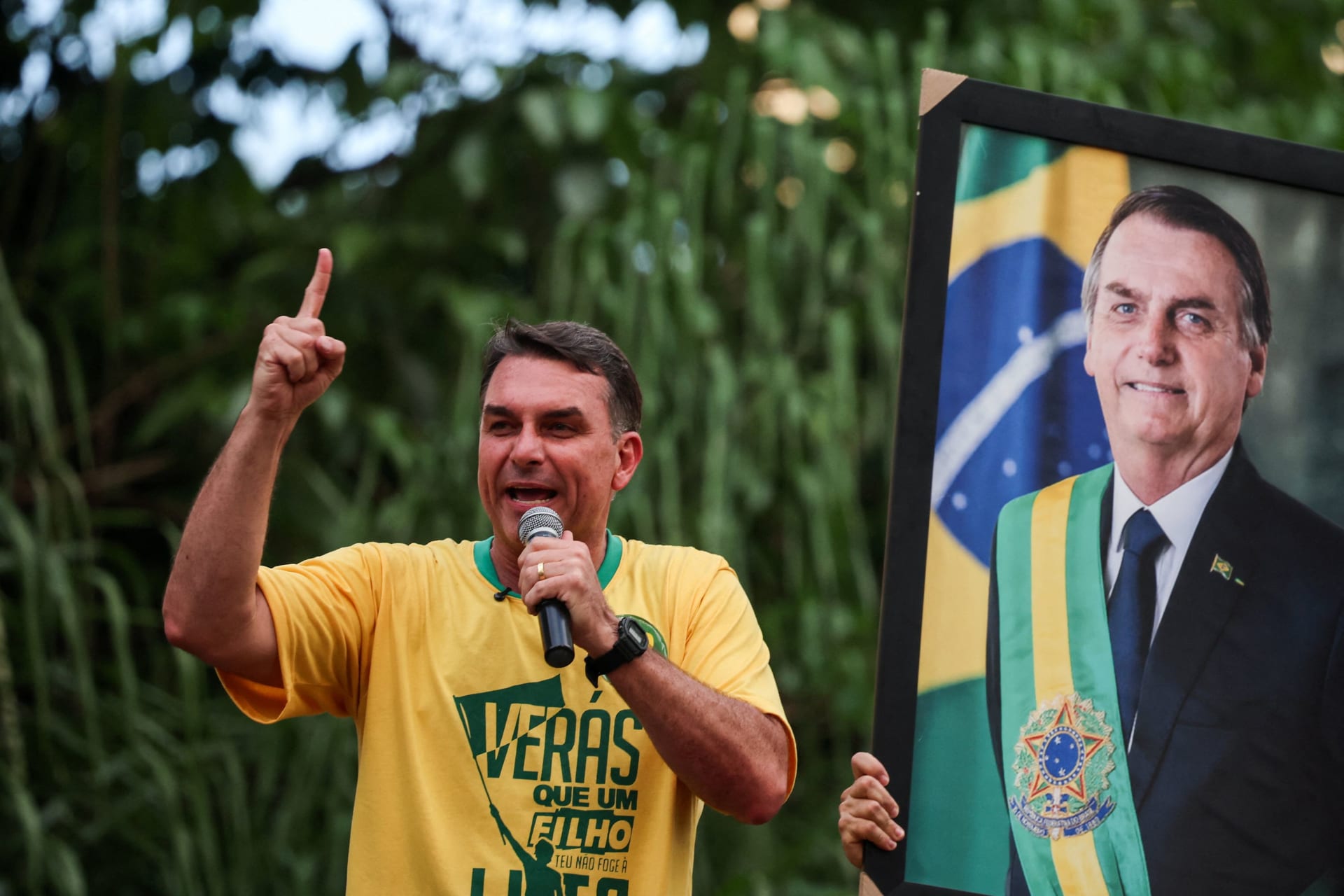
Senator Flávio Bolsonaro, the eldest son of former President Jair Bolsonaro, has pledged to use “big scissors” to cut spending and improve the country’s debt trajectory (although he also recently rejected cuts to social spending), and the performance of local asset prices suggests a belief that he would deliver. Since the October 4 runoff, increases in Bolsonaro’s lead over incumbent President Luiz Inácio Lula da Silva have tended to occur alongside lower government bond yields, a stronger Brazilian real, and tighter credit default swap (CDS) spreads (that is, a relatively smaller chance of government default). Those trends have consistently reversed whenever the race has tightened.
But it is easy to pledge austerity during campaigns and much harder—for both political and logistical reasons—to deliver on such promises once in office. Any initial gains in Brazilian assets following a Bolsonaro win should therefore be viewed with a healthy dose of skepticism.
In the first round, Bolsonaro overcame a three-point polling deficit to take the lead over Lula, helped by his tough-on-crime rhetoric. Financial markets followed suit. The day after the first round, the benchmark Bovespa stock index surged 7.7 percent, while Brazil’s currency, the real, gained over 4 percent against the U.S. dollar. Five-year CDS spreads fell 22 basis points (one basis point is 0.01 percent) on the day, hitting six-year lows. Long-term bond yields dropped as well, with ten-year bonds rallying about 100 basis points in the week after the first round of the election. In short, investors were optimistic that Bolsonaro would have the chance to follow through on his fiscal pledges.
These recent market trends are particularly notable in a world where government debts are rising to multidecade highs across many countries, increasing borrowing costs and challenging central banks facing uncomfortably high inflation rates.
In Brazil’s case, gross government debt is just under 83 percent of GDP, the highest level outside of the COVID-19 pandemic in more than twenty years, and almost double that of regional peer Mexico. Meanwhile, interest payments on the country’s government debt now account for 8.8 percent of GDP, leaving limited room to spend on other policy priorities such as crime, health care and the economy.
A continuation of current populist fiscal policy would increase the risk that Brazil’s government debt could be downgraded further by major rating agencies, making the bonds less attractive to investors and potentially pushing up interest rates even further. Weaker foreign demand for local assets could also weigh on the currency, which in turn would help sustain inflation. That would make it more difficult for the central bank to ease policy rates to support growth and help households manage their personal debts.
Could Bolsonaro actually deliver on his fiscal promises? He has pledged a nearly $40 billion fiscal adjustment to the federal budget, almost entirely through spending cuts, a reduction in the size of the government (he says he would eliminate at least ten ministries), and privatization. However, Bolsonaro’s official governance plan offers few details on how much these measures would save, or how much they would boost growth. Additionally, most of Brazil’s government spending is mandatory, which leaves little scope for major cuts.
Bolsonaro’s fiscal plan would also be challenged by other campaign pledges to boost growth. Among his proposals, Bolsonaro’s campaign has said the new government would review Lula-era tax reform, including reducing the value-added tax rate and exempting exports and investments, invest $178 billion (R$900 billion) in infrastructure over four years through concessions and public-private partnerships, and have the state, possibly through state-owned lender Caixa, buy and refinance household and corporate debt.
Public pressure and Brazil’s political economy could further complicate the candidate’s fiscal goals. In recent weeks, he has agreed to maintain some social spending levels, including continuing to raise pensions above the rate of inflation (just under 4.6 percent over the past year), and dismissed reports that he planned to halt real minimum wage increases.
Further, the senator has reportedly received endorsements from center-right parties and former adversaries. While this could provide a tailwind for his legislative agenda, a diverse ruling coalition also means that Bolsonaro may have to make concessions to these allies, which could include offering important cabinet posts, as Lula himself did in 2023, as well as policy trade-offs. In addition to fiscal reform, he is keen to reshape Brazil’s Supreme Court with right-wing justices and to free his father, who is currently under house arrest after being convicted for his role in trying to undermine the 2022 election.
Ultimately, like many other populists, Bolsonaro faces a tricky balancing act between living up to his promises of serious long-term reform and satisfying voters in the short term through higher social spending.
History suggests that populists tend to choose austerity only when they have no other option. Lula did so in 2003 amid a confidence crisis, when he froze spending and raised the primary surplus target above a level agreed upon with the International Monetary Fund. Turkish President Recep Tayyip Erdogan turned to orthodox economic policies and austerity following his 2023 reelection, but only after a currency crisis. Even then, fiscal discipline eroded as elections approached. Former Mexican President Andres Manuel Lopez Obrador started with austerity but ended with the largest deficit since 1988, while Jair Bolsonaro pushed R$41 billion in spending outside of a constitutional cap just before the 2022 election.
Brazil does not face a financial crisis today. But a scenario in which Bolsonaro wins yet does not follow through on fiscal promises could well translate into one, as higher yields and a weaker currency slow growth while lifting inflation.
This work represents the views solely of the author(s). The Council on Foreign Relations is an independent, nonpartisan membership organization, think tank, and publisher, and takes no institutional positions on matters of policy.