Japan’s 2026 Election: National Security
The outcome of this Sunday’s election will have significant consequences for Japan’s national security policy.
By experts and staff
- Published
 Sheila A. SmithCFR ExpertJohn E. Merow Senior Fellow for Asia-Pacific Studies
- Research Associate, Asia-Pacific Studies
The outcome of this Sunday’s election will have significant consequences for Japan’s national security policy. Yet unlike the other issues shaping party alignments, it is the absence of contention over Japan’s defense policy that is striking. For much of the postwar era, political parties have staked out positions on national security that revolved around interpretations of Article 9 or contention over U.S. military bases and other issues related to the alliance.
In 2026, a consensus seems to be forming around Japan’s national security needs. The government has already doubled its security spending, and Prime Minister Takaichi has hastened to complete the five-year plan, under which spending will reach 2 percent of GDP. She has also called for a revision of Japan’s national strategy by yearend.
Undoubtedly, China will loom large, and the recent tensions between Beijing and Tokyo over Japan’s approach to a contingency in the Taiwan Strait have helped the prime minister. In the midst of a deteriorating regional military balance, fewer politicians are calling for restraint on national defense. Today virtually no opposition party is calling the government out on its aim of bolstering national security preparedness.
From Defending Article 9 to Defending Japan
Historically, debate over the restraint stipulated in Article 9 of the Constitution has affected almost all aspects of security policy, including decisions on procurement, on operations of the Self-Defense Forces, and on security cooperation with the United States. During the Cold War, the Japan Socialist Party was the primary critic of rearmament. Later, new parties emerged to contest defense policy. After the Cold War, when the U.S. and others formed coalitions to address new global security threats, expectations of Japan grew. By the 2000s, it was the Komeitō, the LDP’s partner in the ruling coalition, that had the most influence over Japan’s security policy choices.
Public perceptions also mattered, of course. In the early 1990s, when Japanese minesweepers were sent to the Gulf, protesters gathered outside their Maritime Self-Defense Force base, but when the Japanese government sent SDF engineering corps to participate in their first UN Peacekeeping operation in Cambodia, there were supporters there to send them off. However, Japan’s participation in the U.S.-led coalition in the Iraq War in 2004 drew fierce public criticism even though the mission was limited to humanitarian assistance and the international coalition effort had been endorsed by the UN.
More recently, the Abe Cabinet’s decision to reinterpret Article 9 to allow for collective self-defense prompted a showdown in the Diet in 2015. The LDP-Komeitō coalition had garnered a supermajority in the Lower House and a majority in the Upper House, practically ensuring that the government’s legislation would pass. Nonetheless, tens of thousands of demonstrators took to the streets to oppose Abe’s “war bills.”
In marked contrast, when former Prime Minister Kishida Fumio announced in 2022 that Japan would raise spending on national security from slightly over 1 percent to 2 percent of GDP and would introduce long-range strike capability to the SDF’s arsenal, there were no demonstrations. Inside the Diet, deliberations in the Budget Committee focused less on this ambitious new defense goal than on the mechanisms for paying for it. Kishida himself raised the possibility that the government would have to introduce a new “defense tax” if a more robust military was required.
Japan’s Older Parties and Article 9
While the debate over Article 9 has taken many forms over time, the central focus has been on just how big and how lethal Japan’s postwar defense forces should become. The idea of Japanese self-restraint was embraced by virtually every political party, from conservative to progressive, and any new defense initiatives required reflection on whether they conformed to the spirit of Article 9.
The Liberal Democratic Party (LDP) platform argued for Constitutional revision since its formation in 1955. Autonomy in national security decision-making was one among many reasons for this. By the 1980s, when Japan was seen as a global economic superpower, former Prime Minister Nakasone Yasuhiro became the first public advocate of bolstering Japan’s maritime power and shouldering more responsibility for national defense. Both hawks and doves have led the LDP, however.
There are those within the LDP who still hope to put revision on the agenda. Former Prime Minister Abe Shinzō was a strong advocate of revision but could not muster a consensus within his party on how to revise this 1947 document. In campaigning for Sunday’s election, Prime Minister Takaichi, during a campaign stop in Niigata, raised once again the idea that Article 9 could be rewritten: “Why can’t we change the way the SDF are referenced in the Constitution? Let’s protect their pride and empower them to be an effective organization. Please allow us to make this much-needed constitutional revision.”1
The left or liberal end of Japan’s political spectrum defended Article 9, and while some argued for other types of revision, they opposed revision of this article. Early in the postwar period, the Japan Socialist Party carried the flag of opposition to government rearmament. But over the years other parties joined in to keep watch over the ruling party and its military aims.
By the late 1990s, both North Korea and China challenged the notion that Japan could focus solely on an exclusively defensive doctrine. As the LDP and the bureaucracy’s defense planners confronted a growing missile threat, ballistic missile defenses seemed the most suited to Japan’s operational and political needs. This investment drew very little opposition as it seemed in consonance with the defensive goals of Article 9.
China’s growing maritime presence began to shake the foundations of Japan’s defense thinking. The 2010–2012 confrontation over the Senkaku Islands (Diaoyutai Islands for the Chinese) brought home the idea that Japan’s ability to defend its territory might demand greater firepower.
The Democratic Party of Japan (DPJ) had come to power in 2009 seeking to reform the longstanding security relationship with the United States. Two issues became their priority. The first was investigating claims of a secret agreement over the introduction of nuclear forces in case of war. The second was the management of U.S. bases in Japan, particularly in Okinawa to reduce the impact on Japanese citizens. The DPJ managed to complete its policy review on what would happen in case of war, but could not move the large Marine Corps base, Futenma, from the center of Ginowan City.
Indeed, the DPJ began to shift in its views on the U.S.-Japan alliance in the wake of the 2011 Great East Japan Earthquake when the U.S. mobilized to assist the SDF and the government as it tried to cope with the massive destruction caused by the tsunami that followed. The 2010–2012 crisis with China over the Senkakus also brought home the need for U.S. support in coping with the growing pressures from China’s navy.
The Newer Parties
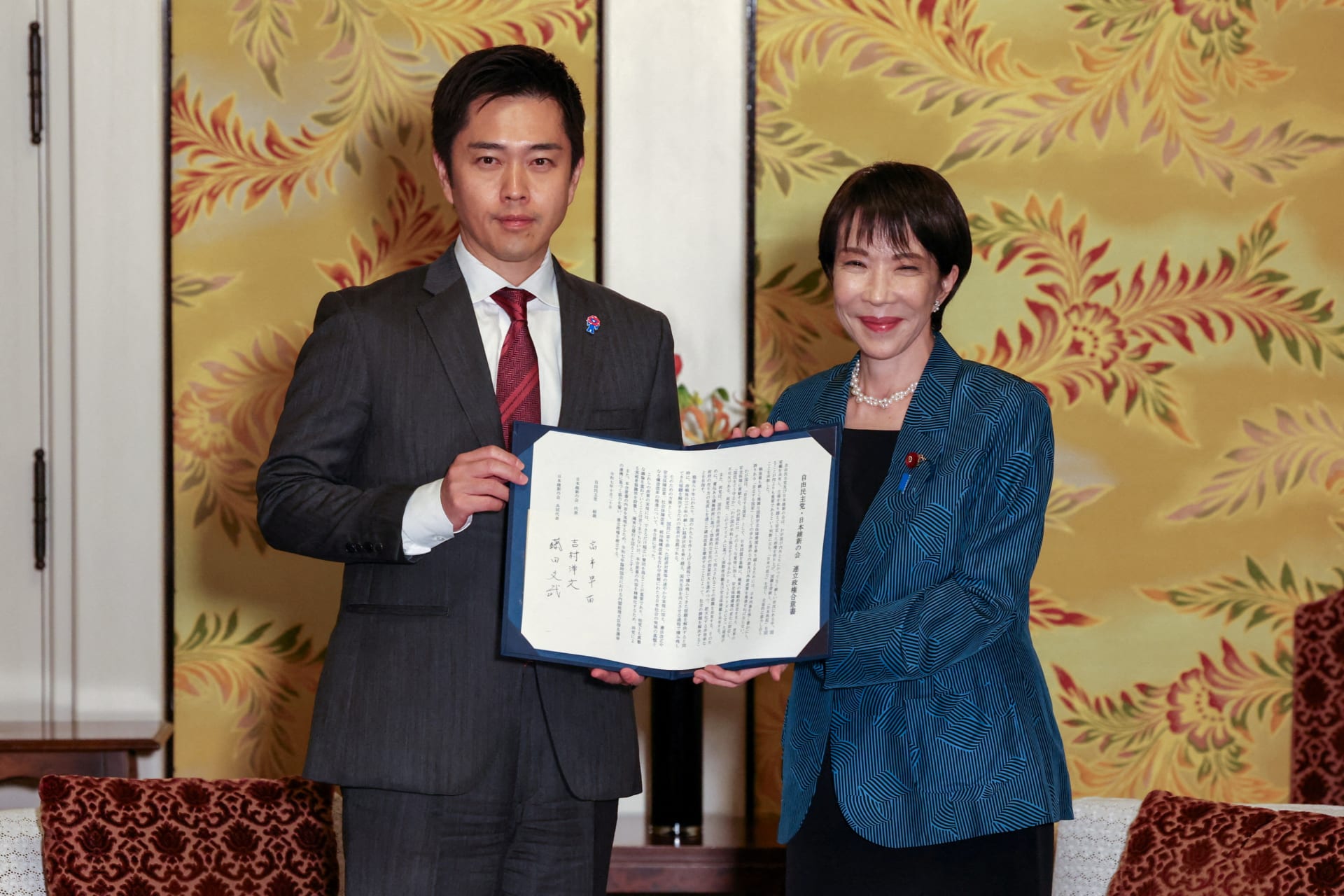
National defense policy features across all of Japan’s newer parties, but their priorities differ. Early on, Ishin no Kai gained a reputation for being hawkish, but its specific policy recommendations for defense were hard to decipher. In the 2025 coalition agreement with the LDP, Ishin agreed to establish a committee for the revision of Article 9. In November 2025, this committee began deliberations on constitutional amendments, including Article 9 and the clause dealing with decision-making during crises. This constitutional revision committee aims to submit a draft to the Diet by the end of March (Japan’s current fiscal year).
The Centrist Reform Alliance (CRA), formed from CDPJ and Komeitō, now recognizes the use of Japan’s SDF as constitutional in situations involving existential threats, as provided under the 2015 security legislation. This marks a shift from CDPJ’s earlier position calling for repeals of provisions from that legislation that they thought were unconstitutional. The CRA states that it will pursue responsible discussion on amending Japan’s constitution with an aim of upholding its fundamental principles.
Sanseitō’s 2026 manifesto includes explicit language on national defense. They call for revisions to Japan’s National Security Strategy, discussion of nuclear sharing, and a rebalancing of the U.S.-Japan alliance toward a more equal footing.
In contrast, the Democratic Party for the People’s (DPP) 2026 election manifesto mainly focuses on cost-of-living issues and only addresses economic security concerns, including the need to strengthen Japan’s supply chain so it does not rely on China. The only security-related issue they highlight is improving national intelligence gathering.
Takaichi, Taiwan and the U.S.-Japan Alliance
On November 6, 2025, Prime Minister Takaichi responded to opposition questioning in the Diet about how Japan should respond if China used force against Taiwan. According to the 2015 security legislation passed under Abe, Japan would consider using its SDF with other national militaries should Japan’s survival be threatened. Takaichi responded by saying that if China were to initiate the use of force, then Japan could see that as a situation that threatened its survival and would have to consider deploying the SDF with U.S. forces in response. Her statement drew immediate and intense criticism from China, beginning with an inflammatory tweet from the Chinese consul general in Osaka, who threatened to cut off the head of a snake that intruded into China’s domestic affairs.
Within days, Chinese sanctions against Japan emerged from more senior decision-makers in Beijing. Chinese tourists and students were cautioned not to travel to Japan due to risks to their safety. Imports of Japanese aquatic products, once curbed in an earlier moment of tension, were reimposed. And, on January 6, 2026, the Chinese Ministry of Commerce made an announcement that rare earths exports would be restricted.
Public opinion polling in the wake of this escalation in Chinese pressure revealed that around half of the respondents supported the prime minister. After Takaichi’s statement, Nikkei showed that 55 percent found her statement appropriate, Yomiuri Shimbun showed that 56 percent approved of her stance, and Asahi Shimbun showed that 56 percent found her statement appropriate. Most condemned China’s sanctions against Japan. Growing concern over Japan’s security environment seems to have eclipsed worry over Article 9 and instead increasingly seems supportive of enhancing Japan’s defense.
Nonetheless, political debate will continue over national security policy choices. How to fund increased spending on defense may be the next focal point. Deployment of new capabilities will undoubtedly raise concerns in communities that host both the SDF and U.S. military forces. And any future regional crisis that might require a Japanese prime minister to deploy the SDF or deepen military cooperation with the United States will also raise the possibility of political opposition.
But in 2026, national security policy seems surprisingly uncontroversial as an election issue regardless of the consequential policy shifts taking place in Japan. Few seem to be bothered by the idea that Japan is now motivated to move beyond its postwar subscription to self-restraint as it invests significantly more in its military. Indeed, it seems many in Japan think it is about time.