John F. Kennedy’s “Ich bin ein Berliner” Speech
In just four words, JFK bonded with the people of West Berlin and gave rise to an urban legend.
By experts and staff
- Published
 James M. LindsayCFR ExpertMary and David Boies Distinguished Senior Fellow in U.S. Foreign Policy
Being president is a tough job. Your every mistake is relentlessly dissected and replayed. Even when you get it right, people sometimes insist you got it wrong. Consider John F. Kennedy. On June 26, 1963, he gave a rousing speech to several hundred thousand cheering West Berliners. Yet that speech is misremembered by many people more than a half century later for a mistake he did not make.
JFK’s visit to West Berlin had immense symbolism. The city was the focal point of Cold War rivalry. On June 24, 1948, Joseph Stalin barred Western powers from accessing Berlin, which was deep in what was then the Soviet sector of Germany, by highway and railroad. President Harry S. Truman responded two days later with the Berlin Airlift. For thirteen months, U.S. and Allied airplanes landed at Tempelhof Airport virtually around the clock, bringing West Berliners food and fuel and sustaining their lifeline to the West. The Soviets finally ended the blockade on May 12, 1949.
Over the next dozen years, East Germans increasingly fled to West Berlin, using their feet to cast a vote against communist rule. The Soviet Union and its East German client state eventually had enough. On the night of August 13, 1961, they began building the Berlin Wall. Not willing to risk starting a war in Europe, Kennedy could only complain as first barbed wire and cinderblocks, and then concrete walls and guard towers, went up around the city.
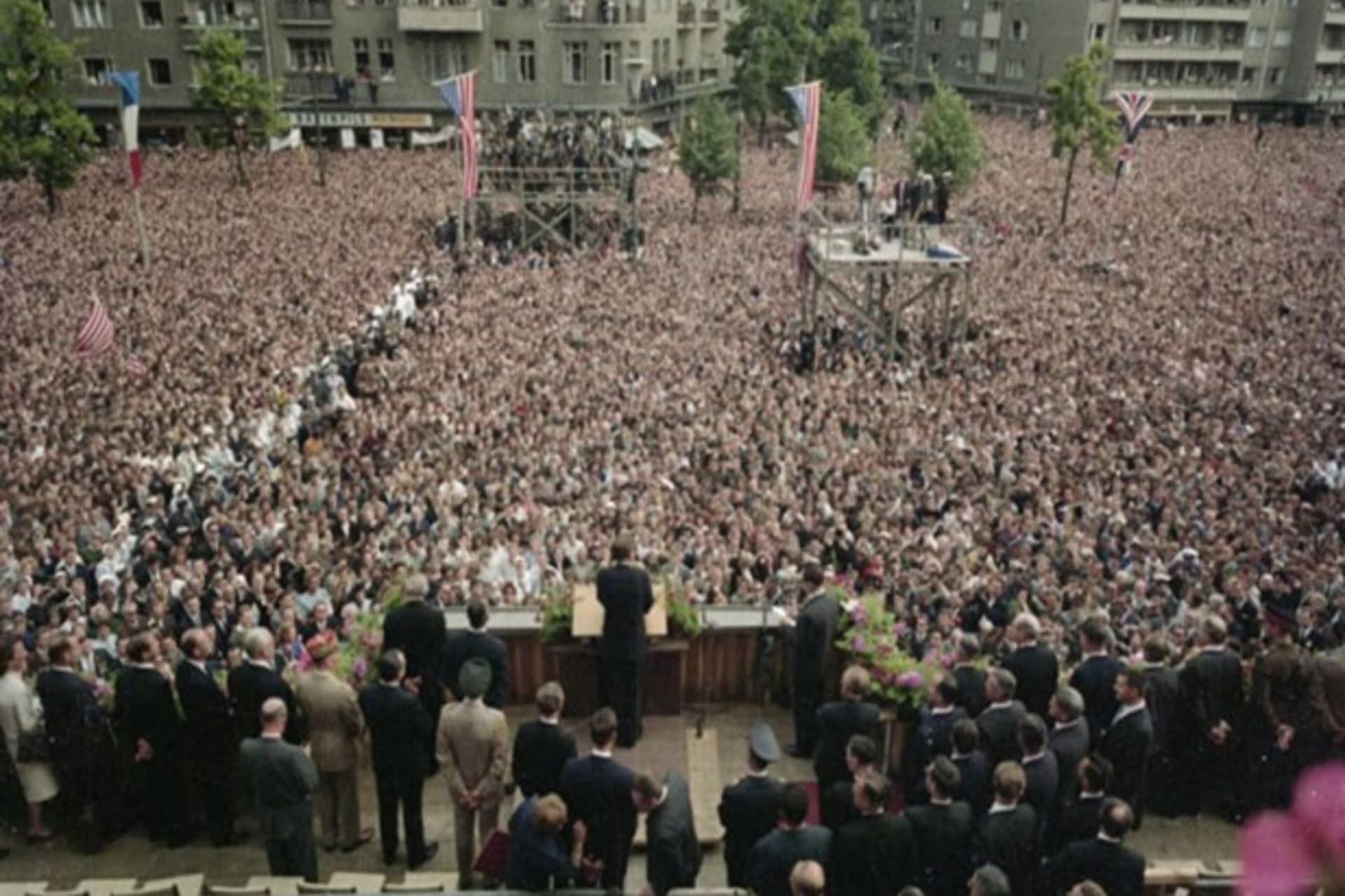
So, when JFK arrived in West Berlin in 1963 nearly two years after the construction of the wall and fifteen years after the start of the Berlin Airlift, a huge crowd awaited him. By some counts, six out of every ten residents turned out to see the young president—and leader of the Free World—speak.
Kennedy had a clear goal for his speech—to reassure West Berlin of U.S. support. He knew that many U.S. allies thought he had mishandled critical foreign policy challenges early in his presidency. He had authorized the Bay of Pigs debacle, held a disastrous first meeting with Soviet leader Nikita Khruschchev, and watched the Berlin Wall go up. Although he had adroitly managed the October 1962 showdown with Khrushchev over missiles in Cuba, fears that he could not be counted on in a pinch lingered. He stoked those fears with his commencement address two weeks earlier at American University calling for the United States and the Soviet Union to find a way to co-exist peacefully.
[Video: https://www.youtube.com/watch?v=qK1ol_IG77c]
Never one to shy away from a challenge, the young president met the moment. Just three paragraphs into his remarks, he delivered the line that bonded him to his audience and made clear that the United States would stand by West Berlin:
Two thousand years ago the proudest boast was “civis Romanus sum.” Today, in the world of freedom, the proudest boast is “I am a Berliner.“
Those words do not appear on the final typed notecards prepared for Kennedy. But the phrase was not improvised. Robert Lochner, Kennedy’s translator and a fluent German speaker, practiced the phrase with him until right before the speech.
What the cheering crowds did not realize that day was that JFK’s speech would generate a powerful urban legend: that in trying to declare his solidarity with the people of West Berlin, Kennedy had actually called himself a jelly doughnut. The legend has persisted despite being debunked time and again, perhaps because so many news sources, including the New York Times, have repeated the mistake.
Yes, a “Berliner,” or more precisely a “Berliner Pfannkuchen,” is a jelly doughnut. But context matters. Just as no American would think someone who says “I am a Bostonian” is saying “I am a shoe,” or that someone who says “I am a New Yorker” is saying “I am a magazine,” Berliners knew exactly what JFK was saying that day in Rudolph Wilde Platz. “Ich bin ein Berliner” is the great gaffe that never was.
The United States celebrates its 250th anniversary in 2026. To mark that milestone, I am resurfacing essays I have written over the years about major events in U.S. foreign policy. A version of this essay was published on June 26, 2013.
Jack Patton and Ishaan Thakker assisted in the preparation of this article.