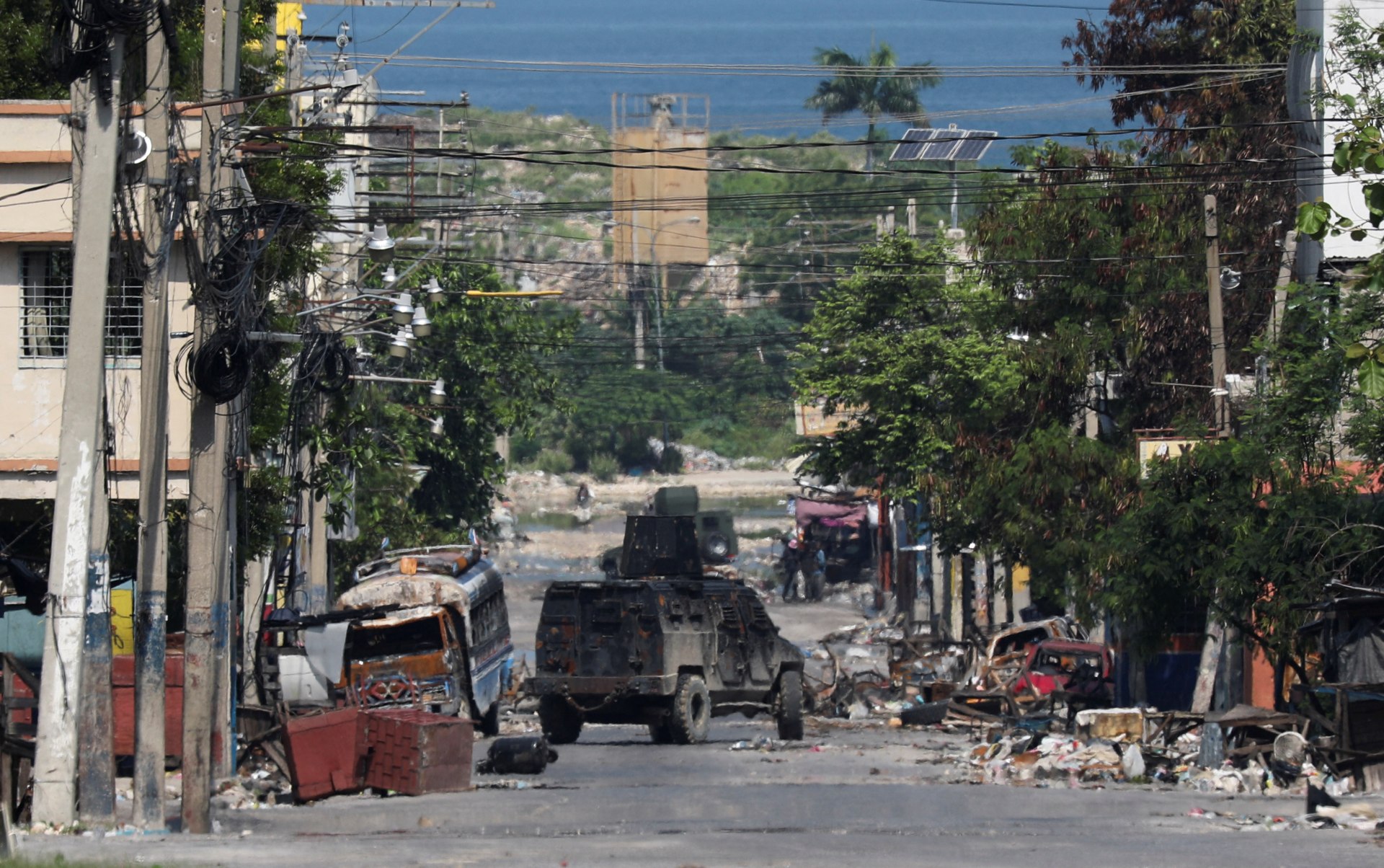
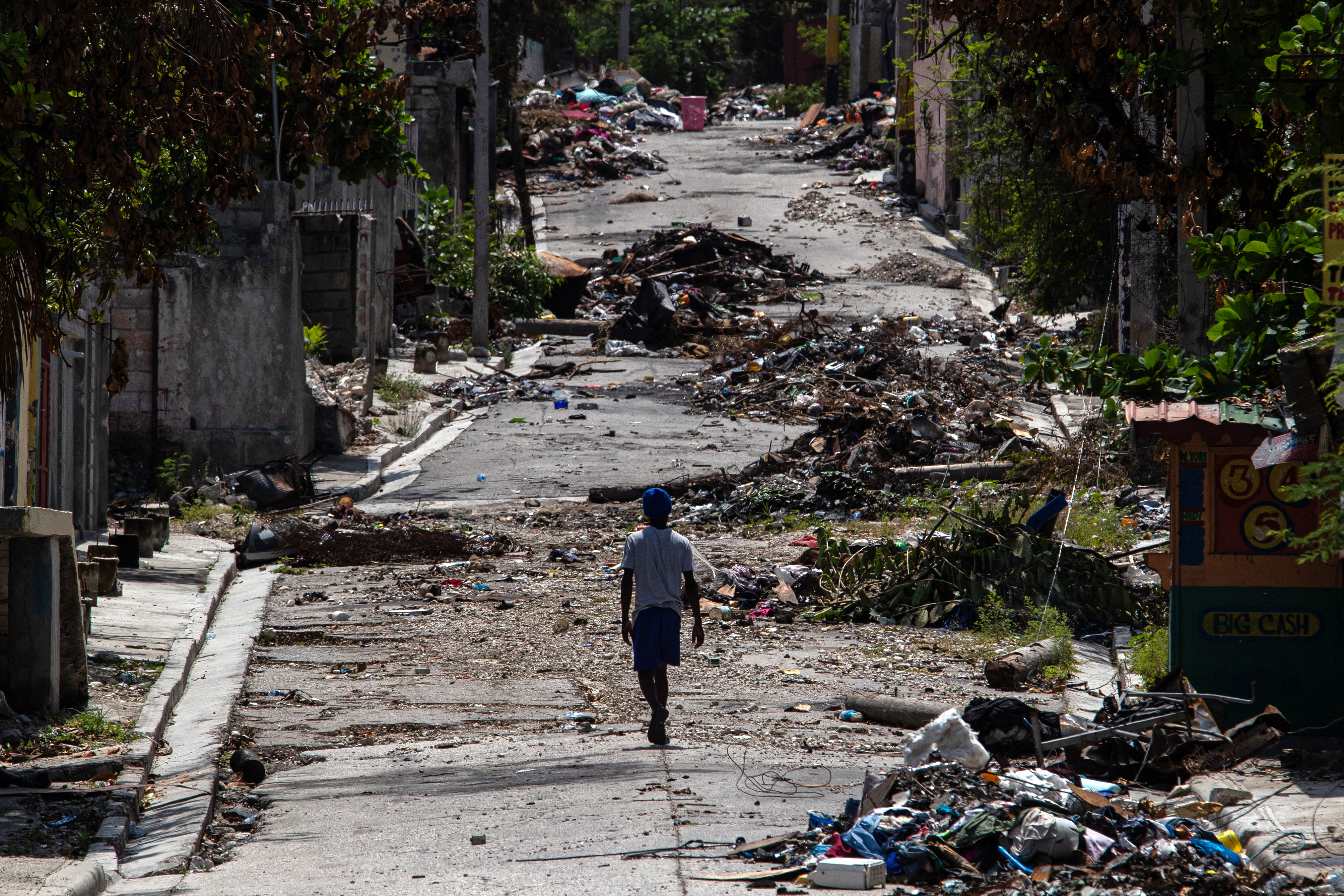
Driving through Port-au-Prince, Haiti’s capital, the city has the feeling of a war zone.
That is because it is one. In the past five years, gang-related violence has reached a new level.
Armed gangs have set fire to entire neighborhoods, destroying large sections of Port-au-Prince—including this area, a neighborhood scarred by collapsed buildings and missing roofs. The violence has displaced nearly 1.5 million people within the country.
The Trump administration is now sending up to 350,000 Haitian immigrants back to Haiti, after stating in June 2025 that conditions there have “improved enough that it is safe for Haitian citizens to return home.”
I visited Port-au-Prince to see the situation firsthand.
On the Ground in Haiti: The Growing War Zone Facing U.S. Deportees
On the Ground in Haiti: The Growing War Zone Facing U.S. Deportees
<p>Gang warfare, hunger, and a disintegrating health-care chain has hollowed out Haiti’s capital, Port-au-Prince. Seven hundred miles away, the U.S. government has revoked TPS, a humanitarian immigration status used by Haitians since the devastating earthquake in 2010. Up to 350,000 Haitian migrants could now be deported to a country beset by violence.</p>
Sam Vigersky ·
I returned to Port-au-Prince on a muggy morning in June, fourteen years after I was last in Haiti as a UN aid worker responding to the country’s 2010 earthquake. In the days that followed, I saw a city hollowed out by years of deliberate and indiscriminate armed conflict. Gangs had fortified neighborhoods that I had once freely driven through in my Toyota 4Runner. Mine-Resistant Ambush Protected police vehicles were posted at intersections in the few pockets where the government still had a presence. At a Doctors Without Borders (MSF) hospital in the Cité Soleil neighborhood, the cement was still drying on a seventy-foot protective wall that was built after a recent gang battle left the facility littered with stray bullets.
With gangs now controlling the large majority of Port-au-Prince—up to 90 percent by some estimates—even the senior security officials tasked with stopping them are not safe. Days before I arrived, gang members dressed in police uniforms kidnapped James Boyard, inspector general of the Haitian National Police, along with his wife and their six-year-old daughter, a U.S. citizen. The parents’ errand that morning was one most people wouldn’t think twice about: taking a sick child to the doctor after a restless night. In Haiti, it’s now a life-and-death gamble.
Henry Wooster, chargé d’affaires at the U.S. embassy in Haiti, called the situation “full-scale urban warfare” when testifying before the Senate Committee on Appropriations in February. That language matches the State Department’s own assessment: Haiti is under a Level Four “Do Not Travel” advisory given the risk of crime, terrorism, and kidnapping.
But in late June, the U.S. Supreme Court ruled in favor of the Department of Homeland Security and allowed the Trump administration to terminate Temporary Protected Status (TPS) for Haitians, a humanitarian program allowing migrants whose countries are considered unsafe to legally reside and work in the United States. Up to 350,000 Haitians, who have been protected under TPS since Haiti was designated for the program after the devastating 2010 earthquake, can now be deported back.
The Trump administration’s actions acknowledge that the removal of these humanitarian protections is at odds with the security situation on the ground. The U.S. government is pushing an aggressive counter-gang offensive within Haiti itself. Built around a 5,500-troop, UN-authorized Gang Suppression Force that effectively has a license to kill, the campaign has surged security personnel and resources into the country. The administration has also indicated it plans to collaborate with a lethal drone operation in Haiti run by former Blackwater CEO Erik Prince’s private military company, Vectus Global.
Missing from the strategy, however, is a humanitarian surge to match. I saw the consequences of this imbalance firsthand: a humanitarian response less than half funded, even as violence drove displacement to record highs. After the earthquake response fourteen years ago, I remember thinking Haiti could not get worse. But in 2026, it has.
[Interactive content — https://cfr-vallenato-media.s3.amazonaws.com/vallenato/wpvip/dw.html?group=93hDh&dark=true&maxWidth=1024px&margin=auto]
A country in freefall
The World Food Program (WFP) helicopter carrying me into Port-au-Prince touched down on an improvised dirt helipad carved into the downslope of a ravine, in the leafy suburb of Pétion-Ville—a lily pad of tenuous security and luxury comforts. After landing, the helicopter never cut its rotors. Passengers hustled off and on in under ten minutes while an armed guard kept watch.
Our landing zone was just a few hundred paces from the Karibe Hotel, home to the WFP Country Office and its permanent staff. The travel method was not one of convenience, but the result of a Federal Aviation Administration ban on U.S. flights below ten thousand feet over Haiti. The policy decision came after gangs opened fire on three commercial aircraft at Toussaint Louverture International Airport in November 2024, wounding a Spirit Airlines flight attendant.
At the start of my trip, I visited a WFP cash distribution site serving people recently displaced by gang violence in Cité Soleil, a densely packed urban slum that stretches along the western edge of Port-au-Prince. Its thirty-four neighborhoods have been balkanized by generations of gang control.
Under a high noon sun on the grounds of a fire department compound, I watched as hundreds of displaced people patiently rotated through a circuit of lines. Over the hum of conversation, a young woman in a neon-green staff polo used a bullhorn to corral people through registration sign-ins and benefit card checks. Eventually, envelopes of emergency cash—15,600 Haitian gourdes, or around $120—were pulled from boxes, counted by hand in front of each recipient, and handed over to those recently displaced from Cité Soleil.
Twenty-five-year-old Jean Wadline was one of them. The mother of a seven-year-old son, and expecting her second child later this year, Wadline fled Cité Soleil after days of armed clashes erupted in mid-May. Through an interpreter, she described how two gangs began fighting in her subsection of the neighborhood. Then, for no reason, one of them set fire to her block.
She ran. It happened so fast, Wadline left with nothing—not even her identification card. Thankfully, she said, her son was in school that day.
At first, she stayed with friends. But the arrangement eventually became untenable, and she was asked to leave. Now Wadline sleeps on the floor of a school classroom with fifty other displaced people, where hanging sheets divide the room into smaller pods for modest privacy. As she described the conditions in which she and her family were living, she began to cry.
Wadline explained how she has taken on debt to buy food. Most of the WFP cash assistance in her hand—made possible through the U.S. State Department’s humanitarian funding—would go toward paying back the money she owed. What’s left would buy uncooked spaghetti and rice.
Her story is devastatingly ordinary: nearly 17,500 other Cité Soleil residents were displaced during the single gang battle that took her home in May. Many other neighborhoods in the capital have suffered the same fate.
Satellite imagery shows the scale of the destruction. Here’s the neighborhood of Solino in Port-au-Prince in 2021 and 2025, with buildings collapsed or missing their roofs as a result of gang violence.
The same is true for this area in the lower Delmas neighborhood, where MSF sets up an urban violence clinic once per week.
We can also see new settlements of displaced people, such as this green space near Cité Soleil, now hosting tents and makeshift shelters.
Over the last four years, 1.5 million people have fled their homes due to gang violence, amounting to 12 percent of the population, according to the International Organization for Migration’s Displacement Tracking Matrix.
The forces driving that displacement accelerated after the July 2021 assassination of President Jovenel Moïse. In the wake of his death, twenty-six gangs tightened their grip on the country, and in early 2024, the largest of them united into a single coalition called Viv Ansanm (“Live Together” in Haitian Creole). The group is led by former police officer Jimmy “Barbecue” Chérizier. The United States is offering a $5 million bounty for information leading to his arrest.
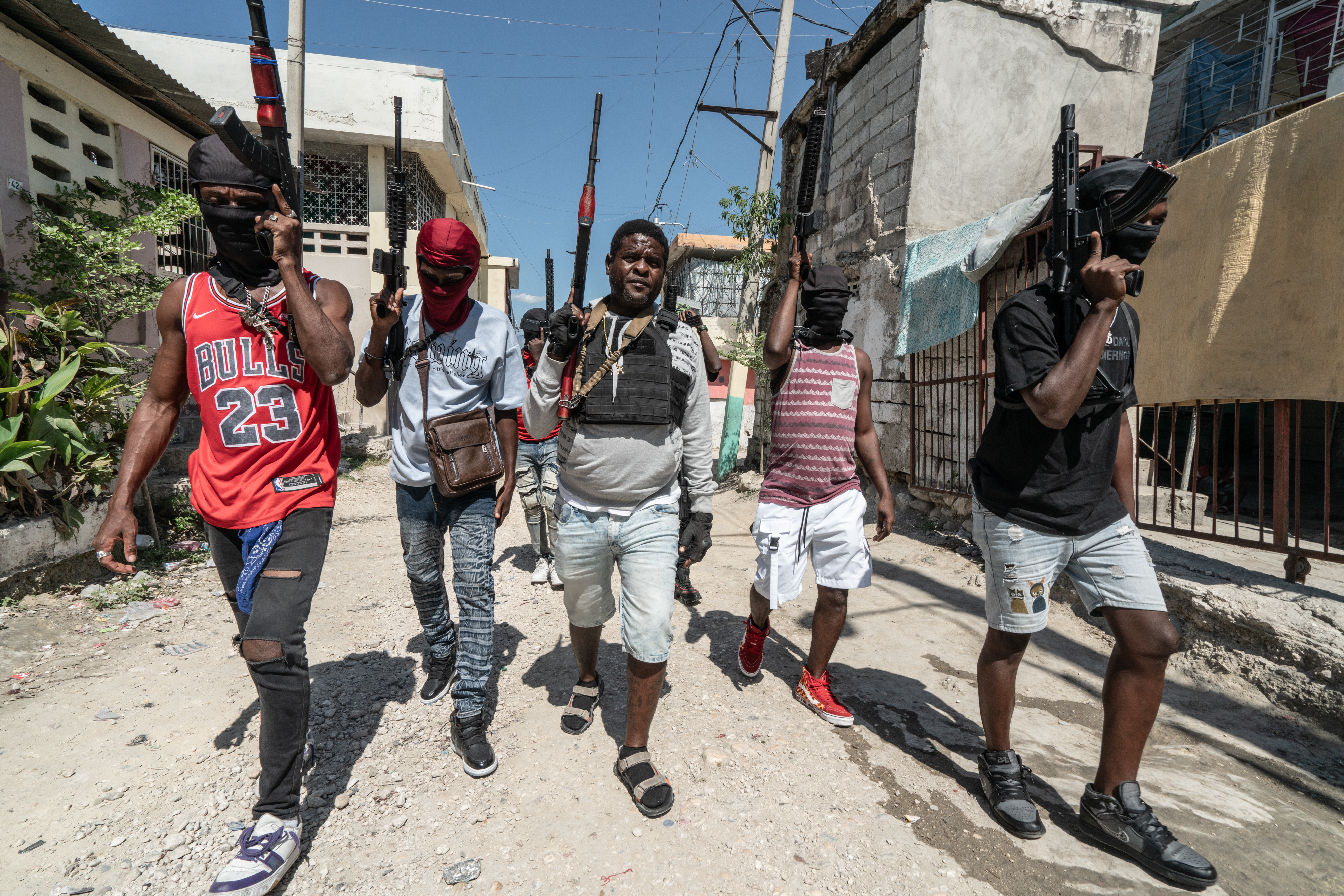
The UN Office on Drugs and Crime found that Viv Ansanm, like other gang coalitions in the country, sustains itself through transnational criminal networks, armed largely by a surge of high-caliber, military-style weapons trafficked from the United States. Gangs deploy violence strategically—to “extract rents, expand influence, contest authority”—and recruit liberally. Roughly half of Haiti’s gang members are now children, in what the United Nations considers one of the worst child protection crises in the world.
In a nation already plagued by hunger, the gangs have turned food into a weapon of war, cutting off farmers from their markets and populations from food stocks. For those who are hungry, gangs use food as a tool of recruitment. Erwan Rumen, deputy country director for WFP in Haiti, recounted how gang control in Cité Soleil had placed nearly twenty thousand people in famine conditions when he arrived in 2023. Urban famine in the capital of a country is extraordinarily rare; in Haiti, it reflected not an absence of food so much as an absence of access. Today, more than half the population faces acute food insecurity.
Nicholas Tessier, a forensic clinical psychologist who heads the MSF mission in Haiti, explained that destruction and hunger were only part of the playbook. Sexual violence directed at women, men, and children is also rampant.
“It’s [meant] to destroy you,” Tessier said as we maneuvered out of Cité Soleil in an MSF Land Cruiser, describing the epidemic of rapes deployed after gangs conquer new territory, or against men who refuse to fight for them. Admissions at MSF’s Pran Men’m clinic for sexual and gender-based violence have nearly tripled since 2022, with more than 2,300 people treated between January and September 2025 alone. Tessier said the situation is still worsening: cases have doubled since February 2026.
Mass casualty plans
One of Port-au-Prince’s few health facilities that is still standing, for now, is the privately run Fontaine Hospital Center in Cité Soleil, where staff and patients fled the same mid-May outbreak of violence as Wadline. Founded in 1991 by Jose Ulysse, Fontaine is a lifeline for three hundred thousand people living in what has become a near-total health-care desert.
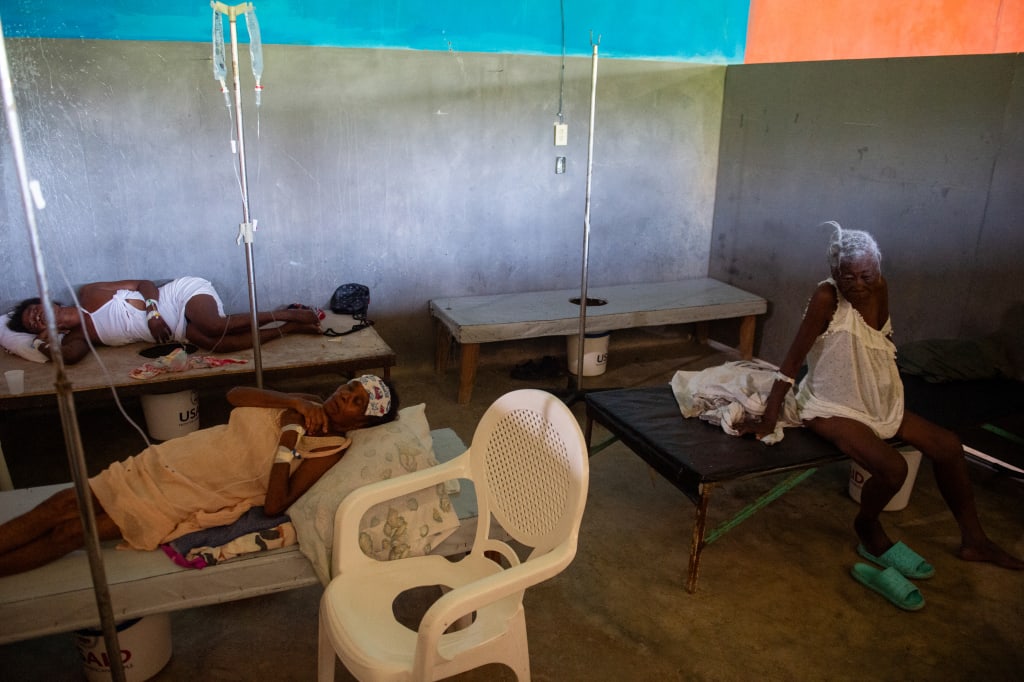
While walking through Fontaine’s courtyard, Ulysse recounted how the entire hospital scrambled to evacuate as gunshots grew louder and closer on May 10. It was the second time in two months they had been forced to do so. Eleven newborns in the intensive care unit were cradled out of the second-floor ward and into an improvised caravan of cars as caregivers tried to keep oxygen flowing. Eight of the hospital’s maternity patients were transferred to the MSF Cité Soleil hospital down the road; some gave birth that night. None would stay long.
That same morning, Max Kowalski, MSF’s acting field coordinator at its Cité Soleil hospital not far from Wadline’s torched home, woke up hearing the stuttering drumbeat of machine guns getting closer. The wildfire of violence was within two hundred meters (about 660 feet) of his facility.
“When the fight is close,” he said, “you’re expecting [trauma] patients.”
Sitting behind the desk in his prefabricated office, Kowalski described the violence like a farmer might explain crop cycles. The gangs fight hard for three or four days. Then they retrieve their dead and organize burial ceremonies. About a month later, once munitions have been restocked, the intense firefights start again. The World Health Organization reported that only thirty-seven of the capital’s one hundred inpatient health facilities remain functional two years after the gangs consolidated power.
The gang battle that sparked on May 10 was particularly intense, however. And so, by 9:00 a.m. that morning, Kowalski made a fateful decision: activate MSF’s Plan Blanc, a contingency operation that involves emptying out the hospital in anticipation of an imminent mass casualty event. The Plan Blanc ensures beds are available for a wave of trauma patients. The risk, Kowalski said, is that you clear the facility, bring additional staff in through armed conflict, and nothing happens. Depending on the outcome, he joked, you look clairvoyant or like an idiot.
But Kowalski is a fifteen-year MSF veteran with five postings in Haiti alone. He trusted his instincts and began making calls: more doctors and nurses, more crowd control, more watchmen.
Every person coming into the hospital, and every evacuee, would need security coordination to navigate the gun battle outside. It was a dangerous proposition: in March 2025, while staff evacuated MSF’s Turgeau Emergency Center in Port-au-Prince, four of MSF’s vehicles were intentionally fired upon despite prior coordination with Haitian authorities. Tessier told me that police often suspect ambulances of doubling as escape vehicles for gang members evading arrest.
And medical staff would need to plan for more than just gunshot wounds: dangerous conditions meant people would drive more recklessly, causing road traffic accidents; civilians hazardously evacuating on motorcycles might be hurled off after hitting a pothole too fast.
By 10:00 a.m., the first wave of gunshot victims flooded in; within hours, the number rose to ten. By that evening, there were more than forty gunshot wounds, all for a hospital with only five emergency room beds. Often, doctors didn’t know who they were treating; two rival gang members and a police officer could have been in the same room. Somehow, the team managed to stabilize patients and transfer those in critical condition to larger hospitals for more complex surgeries.
But then, in the waning hours of daylight, a wave of more than eight hundred terrified civilians from Cité Soleil appeared at the hospital compound’s perimeter entrance. Most were physically unharmed—they were simply desperate for shelter after hunkering down for the hours-long gun battle. At the first sign of a lull, they ran for their lives to find protection overnight from the gangs. One by one, each was checked for weapons before coming inside. By morning, Kowalski said, all were gone. Considering the violence of the prior twenty-four hours, there was no prospect of continuing services. MSF suspended operations the following day.
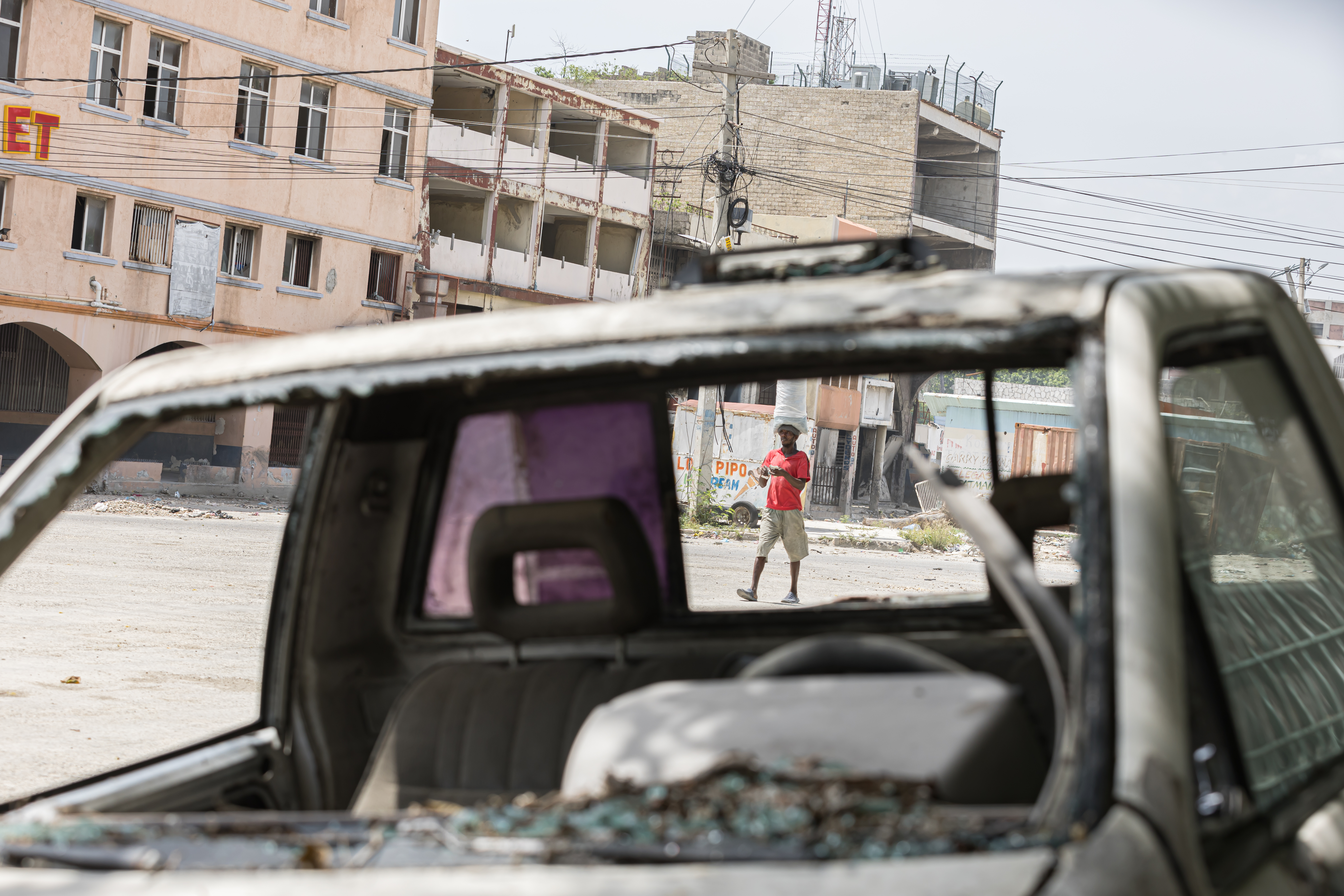
MSF’s outpatient department sees an average of 150 patients per day. Its third suspension of services in three years, however brief, only increased the demands on the few remaining facilities in Port-au-Prince—most of which are on the “verge of collapse,” according to the International Committee of the Red Cross. The head of the Red Cross’s mission in Haiti, Amélie Chbat, put a finer point on it last fall: “the entire health-care chain is disintegrating,” with open centers being flooded with gunshot wounds, victims of sexual violence, and severely malnourished displaced people with no access to essential services.
With two Cité Soleil hospitals suspended in an already crumbling health-care chain, patients must travel farther and across more gang territory to reach medical care, and they must wait longer to receive it as the network’s catchment zones swell. The risk is so great, many will forgo care altogether.
A city in critical condition
Every chair and free inch of wall of the Hôpital Universitaire de la Paix (HUP) emergency room was packed with patients when I visited in June. In a separate wing of the facility—the only state-run medical facility in Port-au-Prince—surgery recovery was a maze of beds, wedged into whatever space could hold them.
This advanced care facility is where many patients in critical condition from Fontaine and MSF ended up in May. Already filled to the brim with patients in dire conditions, its staff faces everything, including gunshot wounds, traffic injuries, and severe malnutrition. As clinics have closed across the country, HUP is now burdened with primary care work as well.
HUP’s medical director, Dr. Jean Philippe Lerbourg, said that patient loads have doubled in recent years: now two thousand emergency cases and between four and five thousand primary consultations. “There may be more patients,” Dr. Lerbourg said, “but we still have the same number of beds.”
And that increased load coincides with the suspension of U.S. aid and severe funding cuts. Now, with fewer dollars circulating, twenty-five staff have been terminated. Those who remain rarely receive their paychecks on time.
The Trump administration slashed U.S. aid to Haiti by 48 percent in its first year in office, according to the Center for Global Development. Asked whether the State Department had a plan to seek additional funding for humanitarian needs—food, medical care, clean water—Ambassador Michael Kozak, the State Department’s most senior official for Western Hemisphere affairs, told the House Foreign Affairs Committee in July that he was “not aware that there is a big gap” in funding, noting that he frequently signs off on grants for humanitarian assistance.
And yet, the United Nations’ 2026 humanitarian response plan for Haiti was only 47 percent funded as of early September.
This dearth of funding more than shrinks services; it corrodes the relationship between health workers and the communities they serve. Patients have begun to accuse hospital staff of taking the benefits that they used to receive. The loss of these services, combined with inflation and a crippled economy, has made the patient-provider relationship more hostile, Dr. Lerbourg said.
One way to rebuild that trust, and reach patients closer to home, is through mobile medical clinics. Once a week, MSF sets up an Urban Violence Clinic in the Delmas 1A neighborhood—a part of the city that can only be described as a war zone. MSF relied on a convoy of four Land Cruisers to carefully navigate there through Port-au-Prince’s red zone, the 90 percent of the city under gang control that is considered too dangerous for most aid workers.
Through the window of the Land Cruiser, I watched a theater of urban warfare pass by. Husks of burned cars, felled metal billboard poles, and mountains of debris had been hewn into crude barricades. Electric wires had been cut. Burned-out buildings and houses were everywhere. An old Ministry of Health hospital in the neighborhood had been abandoned after gangs intentionally ran cars through it and pillaged its supplies.
The grand, thousand-plus-seat church that MSF has converted for this weekly clinic had sandbags stacked at every window; the crackle of gunfire I heard minutes after we arrived made clear why. Patients waited in pews before being triaged through makeshift spaces for consultations. Battery-powered lanterns were used to illuminate the sanctuary.
Lethal drones and a gang suppression force
Haitian security forces pushed gangs out of several Port-au-Prince neighborhoods between late 2025 and February 2026. But many gangs regrouped in the Plaine du Cul-de-Sac, the corridor carrying commercial traffic to the capital’s container port and oil terminal, then turned on the gangs already there.
The offensive against the gangs changed the control of the city geographically, but it only increased the violence on the streets. The United Nations recorded 2,444 homicides [PDF] in Haiti between December 2025 and February 2026, a 23 percent increase over the previous three months. The waves of fighting that followed, from March through July, are the ones that burned Wadline’s block, emptied Kowalski’s hospital, and filled Dr. Lerbourg’s hospital beds. Cleared from one pocket of the city, the gangs hollowed out what livable space was left in another.
It is indisputable that a new international strategy toward Haiti is needed, but the Trump administration is effectively reimagining the approach to the country’s security through a set of tangled objectives: cutting aid to Haiti, deporting Haitians back to it, and pushing forward on a military intervention to stabilize it. These moves raise new fears that a period of fighting could pick up just as Haitians deported from the United States arrive in the country.
To support its plans for military intervention, the United States advanced a UN Security Council resolution in September 2025 that created a 5,500-member Gang Suppression Force (GSF) for Haiti, replacing a failed Kenya-led mission—the latest chapter in a cycle of foreign intervention and disengagement that has shaped Haiti’s instability for over a century. The GSF is not a traditional peacekeeping operation; rather, it is a counter-gang operation overseen by a Standing Group of Partners, chaired by the United States, and composed of voluntary troop commitments and funding contributions from member states.
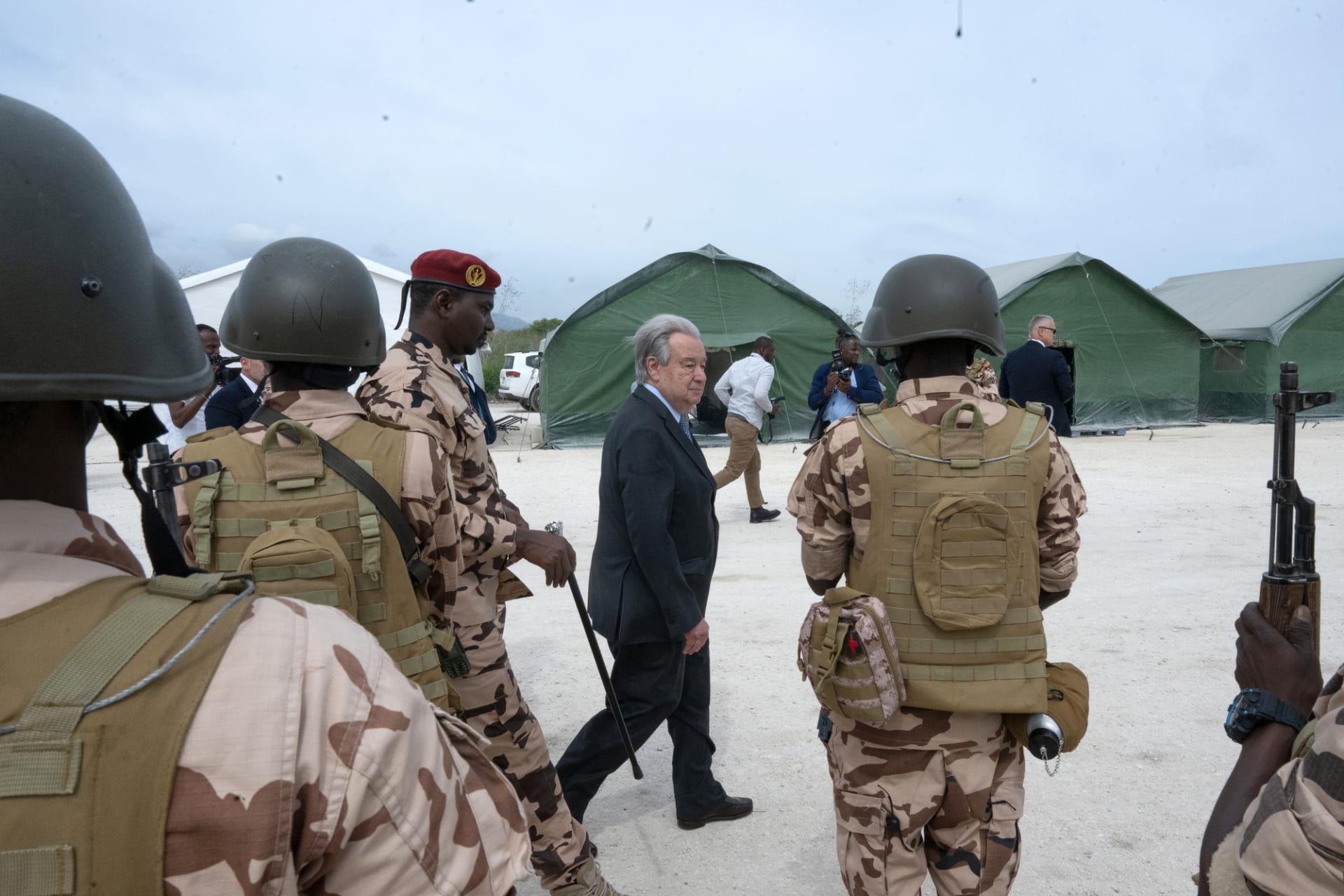
Colonel Justin Gorkowski, who co-leads the U.S. Department of Defense’s Haiti GSF Tiger Team, has described the new approach as a counterinsurgency operation: clear, hold, build. Ten countries will contribute troops to the GSF, including three key battalions dedicated to gang-controlled departments: Chad in West (metropolitan Port-au-Prince), Sri Lanka in Artibonite, and Ivory Coast in the Center.
The issue, of course, is the sheer scale required to bring this strategy to life.
In testimony before the House Foreign Affairs Committee, Gorkowski explained the simple math needed to stabilize the country. U.S. planners estimate needing 30,000 security personnel to secure a population of 11.9 million, using a standard formula for peacetime security of 2.8 law enforcement personnel for every 1,000 civilians. The situation in Haiti today is far from a peacetime scenario, however, and could be compared more closely to a counterinsurgency operation. During the Iraq War, the United States used a counterinsurgency formula of 20 law enforcement personnel for every 1,000 civilians.
But Haiti is a long way from thirty thousand security personnel. For 2026, the United States forecasts a combined force of ten thousand Haitian National Police and Armed Forces of Haiti. The number is projected to increase to nineteen thousand in 2028. By the following year, Col. Gorkowski told Congress that Haiti will have “some numbers” close to a peacetime ratio of security forces that will be needed.
This still leaves a gaping chasm between the ambitions of the U.S. strategy and the ability to execute it by securing territory where civilians can safely live. And security force numbers are only half the problem. During the winter offensive, Haitian security forces dismantled a criminal network that included five of their own—national police officers who had been supplying a gang with escorts, weapons, and ammunition as it ran kidnappings.
Meanwhile, the Trump administration has indicated that it intends to work more closely with Vectus Global, the U.S. private military company led by former Blackwater CEO Erik Prince, to address the country’s security challenges. Haiti originally turned to the group in March 2025, with Prince characterizing his work there as “the definition of mercenary, no question.”
During an August 2025 Wall Street Journal interview, Prince said he had a one-year security contract with the Haitian government, which includes Salvadoran mercenaries, to help the Haitian National Police deploy off-the-shelf drones loaded with explosives. Prince has set a straightforward benchmark for the group’s success: “when you can drive from Port-au-Prince to Cap-Haïtien in a thin-skinned vehicle and not be stopped by gangs.” That possibility seemed distant during my visit. National Route 1, the critical artery running north-south out of the city, remained under gang control.
It is unclear how this offensive is improving security in Port-au-Prince and Haiti overall, or achieving U.S. strategic goals. Between March 2025 and January 2026, drones piloted by Haitian security forces and private contractors have killed at least 1,243 people—including forty-three civilians and seventeen children—according to a Human Rights Watch report.
The gang leader Barbecue’s Port-au-Prince stronghold was bombed by drones in January to no effect. He remains at large, and no major gang leader has been captured or killed. The Haitian security official, James Boyard, and his daughter are still held by the gangs, despite the payment of several ransoms. His wife’s status has not been reported.
In the meantime, the gangs are taking new ground through mass violence. On August 23, 150 heavily armed gang members stormed Kenscoff, a rural community in the mountains above Port-au-Prince and Pétion-Ville that serves as a key transit route in and out of the country’s capital. Under the cover of night, gangs massacred forty-seven people, dozens of them who had taken refuge in a Protestant Church, with another fifty-two people kidnapped.
A puzzle of no-fail decisions
In a world with no shortage of humanitarian emergencies and record-breaking conflict, I asked MSF’s Tessier why Haiti’s crisis is so difficult. Armed conflict, government collapse, natural disasters, mass displacement, and famine are the metrics by which MSF calibrates its response posture all over the world, he said. But not only are these all present in Haiti, they are all present in Port-au-Prince, a city covering just about fourteen square miles. And, in the past year, the conflict has expanded to include rural regions of the country that were once considered safe.
“Gangs make alliances, then break them,” Tessier said. MSF and others are constantly recalibrating, triangulating information by the minute, attempting to keep pace in Haiti’s landscape of rival gangs, the GSF, the Haitian National Police, and Vectus mercenaries. The stakes are life-and-death, for patients and the aid workers themselves.
Sitting with aid workers in Port-au-Prince who had previously deployed to war zones in the Democratic Republic of Congo, Gaza, and Sudan, I asked how those environments compared to Haiti. They told me that their experience seven hundred miles off the coast of Florida was as harrowing and complicated as any they had faced. It was also as rewarding as any.
The intellectual challenge of deconflicting and navigating across the battlefield—a puzzle of no-fail decisions—can still, most days, be solved, they said. MSF’s skills are what allow its people to maneuver in a war zone with only white cloth vests and unarmored vehicles. It was one of the few glimmers of hope remaining in a country so decimated by violence and hunger, disease and displacement: workers extraordinarily courageous and agile, trusted and empowered to protect their patients and each other.
And yet, for all their heroics, the health system keeps deteriorating, displacement keeps climbing, gangs keep terrorizing the capital and pushing into the countryside, and donor money keeps drying up. Disease surveillance will soon go with it, according to the Pan American Health Organization.
As my WFP helicopter carried me out of Port-au-Prince, Tessier and MSF issued a press release: Maternité Isaïe Jeanty, an MSF-supported maternity hospital in the Chancerelles section of Cité Soleil, was forced to suspend operations following five days of fighting. The hospital was only down the road from the Delmas mobile clinic we had visited the day before. One more hospital offline, one more community stranded without help, one more wave of patients headed across conflict lines to the few health centers left standing.
A few days after I left, the Supreme Court ruled that Haitians formerly protected by TPS could now face deportation. When President Donald Trump’s deputy chief of staff, Stephen Miller, was asked whether the country they’d be returning to was safe, he didn’t hesitate to respond.
“For Haitians?” Miller said. “Absolutely.”
Sam Vigersky is an international affairs fellow at the Council on Foreign Relations.
This work represents the views solely of the author(s). The Council on Foreign Relations is an independent, nonpartisan membership organization, think tank, and publisher, and takes no institutional positions on matters of policy.
Colophon
Staff Writers
Data Visualization
Additional Contributors
Phil McCausland, Editorial Director, News
Lucky Benson, Associate Vice President and Creative Director
Austin Steinhart, Data Visuals Editor
Maya Fuentes-Stanard, Data Visualization Intern
Sabine Baumgartner, Senior Photo Editor
Diana Roy, Senior Writer/Editor
Grace Raver, Senior Video Producer
Megan Daley, Director, Audience Strategy and Growth
Aleissa Bleyl, Audience Editor
Asher Ross, Lead Content Strategist
Additional Photo and Video Credits
In the introduction, the videos of driving through Port-au-Prince are from the author, the photo of the armored truck in the street of Port-au-Prince is from Ralph Tedy Erol / Reuters, and the satellite photo of destroyed buildings is from Airbus via Google.