Prabowo Tightens His Grip as Indonesia’s Economy Collapses
Indonesia’s economy is in free fall and at a steep risk of causing economic turmoil throughout Southeast Asia following the resignation of Vice President Gibran Rakabuming Raka.
By experts and staff
- Published
 Joshua KurlantzickCFR ExpertSenior Fellow for Southeast Asia and South Asia
This story was originally published by World Politics Review.
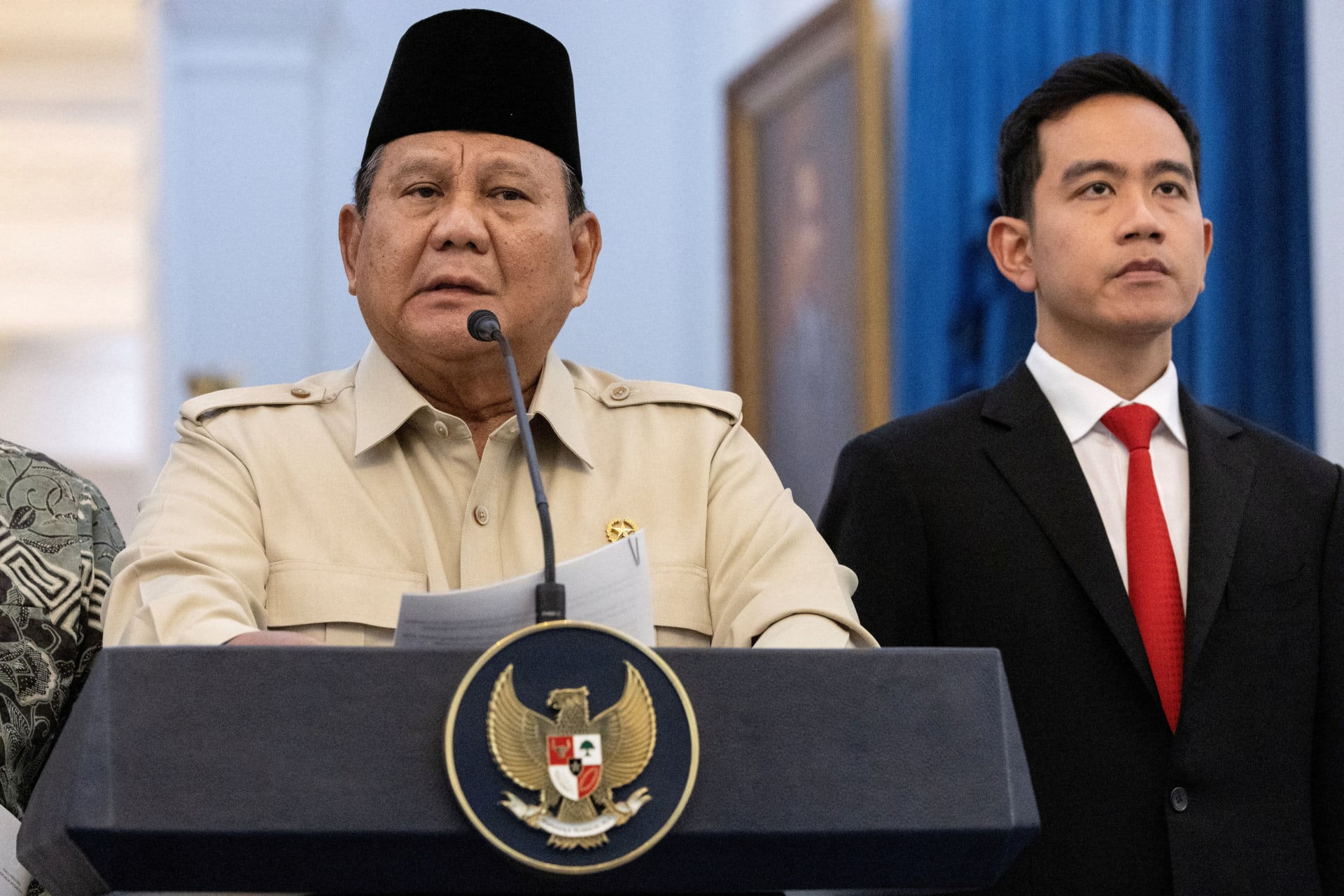
Indonesia’s vice president, Gibran Rakabuming Raka, resigned last week, adding a potential dynastic feud among political elites to the country’s wide range of crises. Technically, Gibran stepped down after a series of court rulings found he did not possess the educational qualifications required for the job, including a high school diploma. But his resignation signals a dangerous split between President Prabowo Subianto and his predecessor and onetime ally, former President Joko Widodo, popularly known as Jokowi.
The thirty-nine-year-old Gibran is Jokowi’s son, and his selection as Prabowo’s running mate in the 2024 presidential election was seen as the price the then-defense minister had to pay to secure the support of his outgoing boss. Gibran’s departure now further centralizes power in the hands of Prabowo, who appears to be taking near-total control of his Cabinet and political decision-making, even as the country continues to unravel in virtually every possible way.
The economy is in free fall, and the Indonesian people are suffering badly, with the potential for an outright economic implosion at its highest since the late-1990s Asian financial crisis. The country’s worst wildfires in a decade are raging, damaging people’s health across the archipelago and the region. Understandably, demonstrators are massing in every major city, despite facing brutal attacks and detentions from empowered security forces. Overall, the chaos on display across the country is probably the greatest seen since the massive riots that preceded the downfall of longtime dictator Suharto in 1998.
When Prabowo was elected in 2024, many Indonesians and outside experts worried that the former general’s autocratic, statist tendencies would badly damage one of the region’s economic and democratic success stories. Yet even to the most pessimistic of observers, Indonesia’s downward spiral has happened faster than expected.
Start with the country’s major economic problems. Although on the 2024 campaign trail Prabowo presented himself as a kindly grandfather, he has a long history as a gruff, controlling manager who also tolerates—and possibly benefits from—cronyism and conflicts of interest. When he served as Jokowi’s defense minister from 2019 to 2024, Prabowo’s decision to centralize Indonesia’s arms procurements in the hands of a company controlled by his own ministry was already flagged by the head of Indonesia Corruption Watch, an NGO, as a serious corruption risk.
Since becoming president, Prabowo has stayed true to form. He has fired two finance ministers (the first of whom was an internationally respected technocrat), eroded the independence of the central bank and established a massive sovereign investment fund that reports directly to him. Foreign investors have understandably recoiled. The Jakarta stock market is down nearly 40 percent this year, and the rupiah has reached a record low against the U.S. dollar. Moreover, two of the three major ratings agencies, Fitch and Moody’s, have cut their outlooks on Indonesia’s sovereign credit rating to negative.
Worse still, in the middle of October, MSCI—a New York-based firm that creates stock market indexes—began considering the possibility of downgrading Indonesia two whole rungs from Emerging Market to Standalone Market status, essentially the bottom category of markets, below Developed, Emerging and Frontier. If that were to happen, passive index funds tracking Emerging Markets, whose benchmarks are set by MSCI, would automatically sell shares in Indonesian firms on the Jakarta exchange. That could pull as much as $13 billion more from the Jakarta index, possibly triggering a massive economic crisis.
Combined with the impact of the Iran war on Indonesian energy prices, the lack of investment, the stock market collapse and the overall weak economic climate have hit average Indonesians hard. The economy has been further weakened by the wildfires, the result of a powerful El Niño in 2026 as well as years of widespread, often illegal burning of land to clear it for agricultural use. Haze has blanketed millions of people across Sumatra and Kalimantan, and one research group estimated the pollution contributed to more than 3,500 deaths in September alone.
For its part, the government claims that the economy is growing by over 5 percent, but it is hard to believe those numbers. And reported figures do not mean much to a population struggling with repeated fuel shortages, rising prices, stagnant wages and a lack of secure jobs. Not surprisingly, opinion surveys have found that Prabowo is the most unpopular president since Indonesia became a democracy in the late 1990s. The leading Indonesian pollster SMRC found that 53.4 percent of respondents now express dissatisfaction with Prabowo’s performance, compared to just 16 percent following his election in 2024.
This dissatisfaction is visible in more than just opinion polls. Protests over low wages, high prices, the fires and Prabowo placing the hated military back at the center of the economy and public life have spread through Yogyakarta, Surabaya, Jakarta and other cities. The government’s answer, as it was to protests last year, has been the use of force, essentially encouraged by Prabowo. This is hardly surprising given that Prabowo himself, during his long time as a top leader of the Indonesian military’s special forces, was accused of massive rights abuses.
In Yogyakarta, police used tear gas, water cannons and armored vehicles against demonstrators, detained over 150 people, and reportedly entered a university campus alongside plainclothes soldiers to hunt for students. Some of the people who have been detained while protesting still can’t be reached by their families. Nonetheless, the demonstrations seem to be growing.
Meanwhile, Prabowo appears unwilling to abandon his control of the economy or his massive spending on pet projects, often poorly managed by military officers, which has recklessly wasted government money and prompted budget cuts to many essential local services in parts of the country.
With Gibran’s resignation last week, the instability is now spreading into the top tiers of the government as well. Gibran’s place on Prabowo’s ticket in 2024 was the glue in the Prabowo-Jokowi alliance. Since Jokowi remained highly popular even at the end of his second term, his de facto endorsement carried Prabowo, who was never beloved by most Indonesians, over the top in the 2024 race.
Jokowi claims he still supports Prabowo’s government, but few Indonesian analysts I have spoken with believe that to be true. Prabowo had relegated Gibran to irrelevance over the past two years before essentially cutting him loose, amounting to an insult to Jokowi, who had hoped to establish a family dynasty after leaving the presidency. Importantly, Jokowi openly turning against Prabowo could precipitate a massive political crisis just as an economic one looms.
Prabowo must now nominate candidates to replace Gibran within two weeks. If he picks someone clearly loyal to him, with no ties to Jokowi, the former president may indeed publicly denounce him, leading to open warfare between the two men and the elite politicians allied with them.
In the meantime, Indonesia’s problems may not stay within its borders. If MSCI downgrades its market status and billions more dollars flow out of the country, fund managers may decide to cut their exposure to Southeast Asia as a whole instead of sorting out the sick market from the healthy ones. In addition, a deep Indonesian downturn would hurt other regional states that depend on selling goods and services to the largest consumer market in Southeast Asia.
A sharper fall in the rupiah would add to inflation and likely lead to even larger and more violent protests. Given Prabowo’s background and history of treating any dissent as a threat, if he faced a defection from Jokowi, bigger crowds in the streets and a sinking currency, he could easily try to declare martial law and use the army to enforce it—a move that would likely fail in what is still a fairly strong democracy.
In many ways, his position is indeed reminiscent of 1998. The Suharto regime imploded when economic collapse, elite defections and street protests all converged at the same time, and Suharto’s attempt to use force to stay in power failed. With Prabowo publicly adopting an image of defiance with regard to the protests and the overall crises driving them, a repeat of that combination could be just over the horizon.
This work represents the views solely of the author(s). The Council on Foreign Relations is an independent, nonpartisan membership organization, think tank, and publisher, and takes no institutional positions on matters of policy.